Analyzing: How woke Hollywood is remaking, and ruining, every film you've ever loved · 2026-11-27
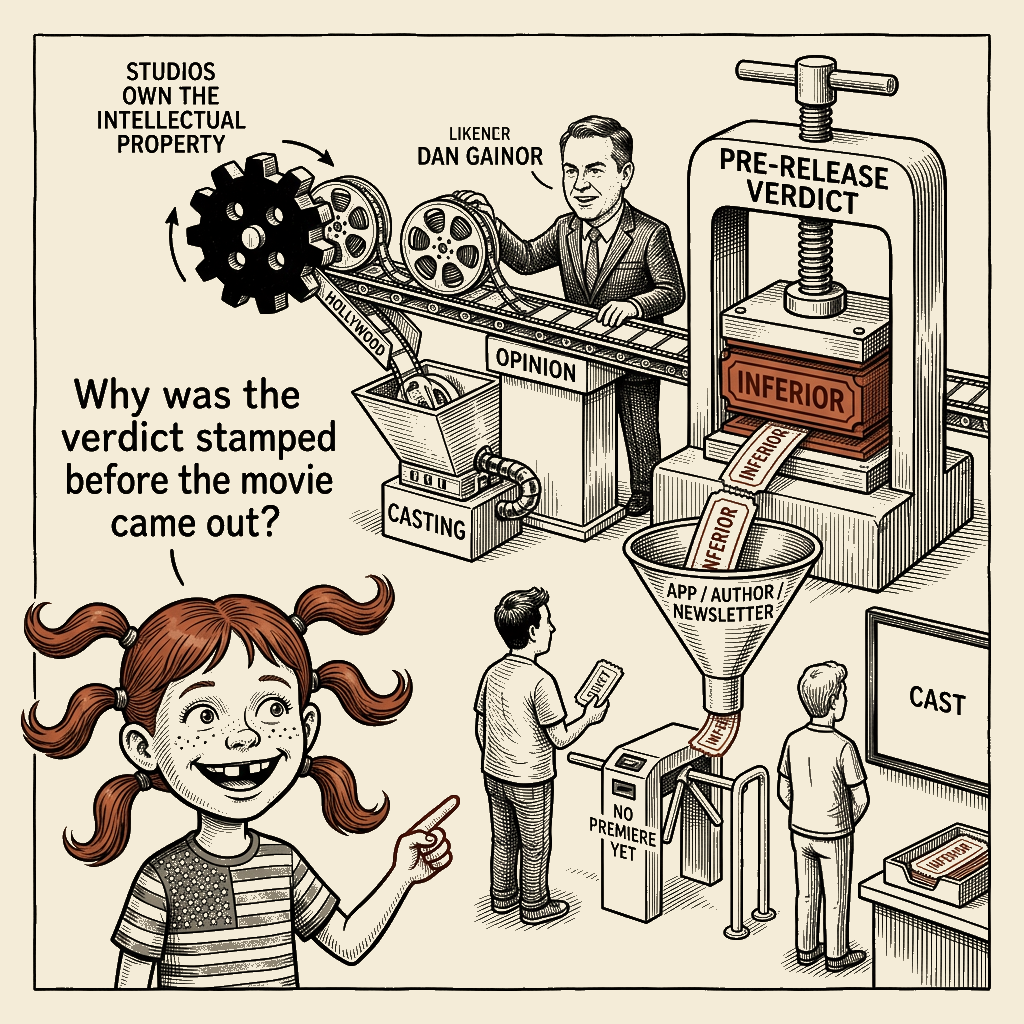
Why was the verdict stamped before the movie came out?
What the Editorial Argues
The column argues that Hollywood has entered a distinctive franchise-recycling cycle in which sequels, remakes and extensions of known intellectual property dominate output, and that an allegedly ideological apparatus of DEI-, race- and gender-conscious casting is making that recycling worse. It acknowledges that Hollywood has recycled stories since at least the silent era but contends that the current volume and its extension into television, merchandise and spin-offs constitute something different. It supports the economic claim with release announcements and an unsourced box-office count, and the ideological claim with casting controversies, the outlet’s own reaction headlines and Steven Spielberg’s warning about the danger of relying on “known, branded IP.” Its conclusion is both economic and moral: studios’ control of valuable characters drives repetition, while “woke” creators deliberately degrade beloved work, and the reader should identify and resist them.
Receipts
The move is grievance relocation: the column takes a real complaint about franchise economics, welds an identity villain onto it, and bills moral outrage as a remedy.
What the framing wants you to believe
- Hollywood’s decline has two named sources—greed and “woke” ideology—and identity-conscious casting is evidence of deliberate sabotage rather than one decision inside a larger financing system.
- Quality can be forecast before the work exists: it is “too early to tell” how the new Potter series will turn out, yet Narnia can already have “bad reviews,” an unnamed director can be “far inferior,” and a “far inferior cast” can be presumed.
- The reader’s proper response is moral recognition and resistance. Budgets, ownership, release dates, audience receipts and the actual films become secondary to deciding whose values are responsible.
What’s really going on
- The anchor is the column’s own sentence: “Greedy Hollywood will keep grinding out garbage because studios own the intellectual property.” It names the engine and then leaves it. Its historical paragraph likewise concedes that IP recycling long predates the casting controversy it wants to make the villain.
- The protected direct beneficiary is Fox News Digital. The opening broadcast clip, four capitalized internal headline cards, app links, the author-page promotion and the newsletter sign-up convert grievance into attention and subscriber acquisition. The published page supplies no traffic or revenue figure, so the pathway is visible while the magnitude remains unmeasured.
- The suppressed relation is the connection among greenlight decisions, ownership and audience spending. The normalized harm is that formulaic films and pre-release stigma are treated as entertainment while the economic and reputational consequences are pushed onto fans, performers and the studios that made the bets.
The Operation
Triage and classification. The source identification is high-confidence: the column runs on Fox News Opinion, the opening module is a Fox News broadcast segment, the body carries Fox-branded headline cards and the close contains Fox app and newsletter furniture. This is a signed Fox News Digital column by Dan Gainor, identified in the bio as a freelance opinion editor for the outlet. Its register is Fox’s direct second-person address—“every film you’ve ever loved,” “from your youth”—rather than the Wall Street Journal board’s collective “we” or National Review’s erudition. The topic is media-industry economics and the politics of casting. The archetype is the NR Editorial Technique Catalogue §4.4 cultural-decline ledger running on an unsourced count-as-evidence structure: a bare box-office count and selected announcements are made to bear a civilizational conclusion. The WSJ catalogue’s §4.5 “study shows” ledger requires an identified study as its spine; this column supplies a count with no study attached, which is the flimsier version of the same borrowed authority. The advocated position is mixed, leaning selfish at the institutional layer while carrying a genuine complaint about franchise fatigue. The argument is liberty-framed, and every technique criterion applied here is coalition-neutral: each would apply, unchanged, to a comparable greater-good framing.
Institutional authorship and placement. The first promotional element visible in the published presentation is Fox’s own Outnumbered broadcast segment. No think tank, donor network, trade group or message memo is traced to this column. The documented placement chain is: Fox broadcast video module → Fox Digital signed column → four Fox-branded headline cards embedded in the body → Fox app and author-page links → newsletter capture. That chain is the WSJ Editorial Technique Catalogue §4.22 intra-outlet citation loop: the column’s evidence repeatedly routes into the outlet’s coverage of the controversy it is reporting.
This is not enough to establish coordinated message discipline, the Bad-Faith Techniques Catalog’s coordinated pattern, because that would require a documented pattern across multiple speakers or venues, or a published directive behind the language. The evidence establishes an internal circulation loop. The incentive for that loop is visible without inventing a back-room committee.
Cui bono.
- Fox News Digital and Dan Gainor: the direct beneficiaries. The column supplies four additional click paths, cross-promotes the author’s fiction collection and presents the newsletter form at the close. Its pathway is audience attention and subscriber acquisition. The published page contains no verified traffic, click-through or revenue figure.
- Franchise owners and studios: a structural beneficiary, but a weaker finding than Fox. The column names ownership as the engine and proposes no change to it. Its attention remains on casting rather than greenlight finance, so the owners of Disney franchises, HBO series and other valuable characters retain the institutional power the column identifies. This is an inference from the incentive structure, not evidence that the column caused continued franchise spending.
- The anti-“woke” commentariat: it receives a ready-made grievance with fresh characters, a release calendar and a common vocabulary. The published page demonstrates circulation within Fox; it does not establish a larger donor-funded campaign.
- Cost-bearers: fans bear the risk of spending money and attention on films the column has already judged, or of being steered away from them before release; performers and crews absorb the reputational burden of being cast as the cause before a work can be seen. The column invokes its preferred “left” or “Hollywood” without showing how decisions about budgets, rights, release strategy and audience demand actually interact. No causal or financial magnitude for those harms is documented.
Alternative design. Reconstructed from the interests of fans and working creatives rather than from a preferred policy, an operation optimized for the column’s stated rationale—protect audiences from cynical recycling—would look different:
- Open with the greenlight: who financed the project, what rights the studio holds, what the risk model assumes and who bears the downside.
- Evaluate released work, with production budgets, grosses and reception in comparable form. The column’s “massive financial fallout” and “huge loss” language would require actual accounting rather than a second-weekend headline.
- Apply the IP critique consistently to the hit sequels and original films the same audience enjoys. Otherwise the criticism is selective by attachment.
- Judge casting by performance and the needs of the finished work, while recognizing that identity categories are neither evidence of quality nor irrelevant to who receives opportunity.
- Treat the performer pipeline as a labor and creative-institution question. A column truly concerned about good films cannot make the people selected for those films bear the blame for the financing model that selected them.
Fear, greed and laziness (FGL), applied across constituencies.
- The author and Fox’s editorial shop: fear of losing an already angry audience to competitors; greed for clicks, subscriptions and author-brand exposure; laziness in leaving the box-office accounting alone because the grievance package supplies its own proof.
- The apex structural beneficiary, the franchise owner: fear of scrutiny moving from casting to IP control and risk finance; greed in the continued option to monetize known characters, merchandise and spin-offs; laziness in not having to defend those economics because the public argument remains on identity.
- The rank-and-file reader, without contempt: fear of losing the cultural objects attached to childhood and youth; a mild greed for the satisfaction of moral clarity and group membership; laziness in accepting a one-villain explanation that saves the reader from an hour of financial and industrial homework. The attachment is real. The relief is also real. Neither makes the supplied explanation true.
Selflessness and selfishness. The classification is mixed. The selfless half deserves an honest concession: franchise fatigue is genuine, the recycling of familiar brands has real artistic limits, and the column’s printed Spielberg quotation supports the concern that an industry reproducing only “known, branded IP” will exhaust itself. The selfish half is the routing. Having identified the engine, the piece hands the reader a substitute that requires neither structural change nor expenditure.
Technique identification.
-
Pre-emptive legitimacy withdrawal. Cues: “It’s too early to tell how woke ‘Potter’ will be”; Narnia “has already gotten bad reviews” before release; “a far inferior director trying to outdo Hitchcock”; and the presumption of “a far inferior cast.” Cross-reference: Bad-Faith Techniques Catalog,
pre-emptive legitimacy-withdrawal; NR Editorial Technique Catalogue §4.4. The catalogue’s targets are institutions, processes or actors; here the withdrawal lands first on the cast and creative teams—identity-grounded rather than conduct-grounded—and is then extended to their productions before any specific output can be examined, a partial extension of the entry to the work level. Operationally, a flop becomes proof of the villain and a hit can be dismissed as noise or deviation from the frame. -
The suppressed-variable conversion. Cue: “Yes, this isn’t new… What we’re seeing now is different.” Cross-reference: The Suppressed Variable Diagnostic, §§1 and 6. The column concedes the true half—sequels, remakes and franchise extensions are a real and old industrial structure—then suppresses the variable most likely to explain its categorical conclusion: risk-averse franchise finance. Its motivated stop is visible: the argument reaches “studios own the intellectual property” and then turns to casting. “Woke Hollywood” is a Lippmann-style stereotype here, a whole greenlight apparatus compressed into one picture in the head.
-
Movement-label substitution. Cues: “woke casting,” “woke Hollywood” and the repeated conversion of race-, gender- and identity-related casting decisions into one doctrinal category; “greedy Hollywood” runs the same substitution in parallel, relabeling ownership economics as vice. Cross-reference: Bad-Faith Techniques Catalog,
frame-engineered relabeling; WSJ Editorial Technique Catalogue §§4.1 and 4.12; NR Editorial Technique Catalogue §4.12. The column proves repeated deployment of the label; it does not establish the catalogue entry’s deliberate-engineering criterion—no memo, no focus-group test, no message directive is in evidence, and I do not manufacture that missing evidence. What it does prove is the characteristic operation: heterogeneous creative, legal and financing decisions compressed into an identity attribute that carries the quality verdict inside the word—the cognitive cargo transfer that gives frame-engineered relabeling its force. This is the Luntz-Lakoff lineage in function even though the column’s own authorship chain is not documented. -
Begging the question. Cue: “every beloved movie, TV show or book from your youth will now be executed (that’s the appropriate word) by someone with far less talent, style or skill. And, of course, with a far inferior cast.” Cross-reference: Bad-Faith Techniques Catalog,
begging_the_question; WSJ Editorial Technique Catalogue §3.4 on “of course” markers. The disputed causal proposition—that the identity criterion selected worse artists—is treated as settled common knowledge rather than demonstrated through comparison. The “of course” staples the conclusion shut so the reader does not notice that the argument never arrived. -
Hasty generalization. Cue: “every film you’ve ever loved,” and the prospect of “three horrifying seasons” of Rings of Power applied to “every good movie and TV show you’ve ever loved.” Cross-reference: Bad-Faith Techniques Catalog,
hasty_generalization; NR Editorial Technique Catalogue §4.4. A selection of announcements, a few commercial failures and an unsourced count are extrapolated into a diagnosis of the medium. The evaluative adjective, “horrifying,” does the work the evidence does not. -
Hypothetical-as-evidence. Cue: “How long before they redo ‘Band of Brothers,’ with diverse casting, of course?” Cross-reference: adjacent to the Bad-Faith Techniques Catalog’s
slippery_slopeentry; the full label requires an asserted chain of intermediate consequences, which this single sentence does not supply, so the local operation is named directly rather than over-classified. The imagined future violation enters the evidence column as though it had already occurred. “Of course” then pretends the hypothetical needs no defense. Walton’s distinction is the test, and the column fails it: an argument from precedent supplies evidence for each link in the chain, and this one supplies none. Nothing connects a hypothetical remake of Band of Brothers to diverse casting to a collapse in quality except the sentence’s own rhythm. The terminal image is vivid, the links are missing, and the missing links are the charge. -
Intra-outlet citation loop. Cues include “REACTIONS POUR IN AFTER HBO DROPS NEW TRAILER…” and “ETHAN HAWKE BLASTS HOLLYWOOD’S ‘GREEDY BASTARDS’…,” presented as capitalized headline cards between the column’s paragraphs. Cross-reference: WSJ Editorial Technique Catalogue §4.22, Fox Opinion additions. The body repeatedly points back into Fox’s reporting, and those reports carry the evidentiary weight the prose does not. In the Chomsky-Herman lineage, the sourcing apparatus never has to leave the building: reaction is offered as evidence of reaction.
-
Credentialed-authority transfer. Cue: “famed director Steven Spielberg warned, ‘If all we make is known, branded IP, we’re going to run out of gas.’” Cross-reference: WSJ Editorial Technique Catalogue §3.7, the technocratic-credential ledger; Bernays’s lineage of credentialed authorities as campaign vectors. The quotation is accurate as printed and points toward branded-IP dependence—the very problem the column half-suppresses. The cargo swap is the operation: Spielberg’s borrowed seriousness then helps bank an identity indictment he did not make. A real authority is made to underwrite a conclusion it cannot bear.
Boundary check: not yet manufactured controversy. The piece alleges a “furor” and “months of ‘woke’ casting backlash,” but the Bad-Faith Techniques Catalog’s manufactured_controversy threshold requires evidence of coordinated doubt promotion around a settled factual claim, including funding or institutional infrastructure. The published column supplies internal circulation, not that trace. Naomi Oreskes and Erik Conway’s Merchants of Doubt is the canonical account of manufactured doubt as infrastructure; I attacked Oreskes reflexively during the cable years; I was wrong. The record her book compiles supports the reading. Here, the exact finding is narrower and stronger: Fox supplies its own coverage of the backlash as proof of the backlash.
Bandura cluster. The mechanisms the record supports operate in concert. Displacement and diffusion of responsibility are visible in “the left,” “Hollywood,” “they” and “Clearly, nobody in Hollywood is listening to him.” Distortion of consequences turns curated failures into a ruin of everything the reader has loved. Attribution of blame makes casting choices—not ownership, finance or release economics—the explanatory agents of the decline. Separately from Bandura’s eight, conscience displacement supplies the reader a costless moral action: condemning the makers without spending money or changing a decision.
Audience-management function. The primary function is grievance ratification, followed by identity confirmation, counter-frame and status display. Its most efficient product is a permission structure: the reader is licensed in advance to dismiss any production associated with the casting controversy as inferior, whatever the finished work turns out to be. Conscience displacement follows. The reader receives catharsis; the outlet receives an attention cycle; the financing system producing the recycling remains untouched.
The operator’s-eye-view. I drafted memos telling broadcast hosts which word to keep and which to retire, and I sat in debriefs where the winning phrase was whichever tested as common sense. No documentary source for those particular memos and debriefs is available; this is retained memory, not independently verifiable material. I do not use it to prove that anyone assigned this column. What the published page itself documents is the production line: broadcast clip, column, headline cards, newsletter. I know that shape because I built versions of it. The bitterness is real, but it is not the evidence. The evidence is the quote, the card, the hedge and the missing release date.
The Record
The evidentiary posture is asymmetric. The Fox News Digital column is a Tier 1 primary document for what Fox did and how it framed its subject. It is not a primary document for the truth of the future productions, casting rumors or box-office totals it asserts. Where public institutional records can settle narrow historical points, they are used below; everything else remains unconfirmed.
Anchor receipts.
- Tier 1 — the Fox News Digital column itself: the opening Outnumbered video module names the Bond casting warning and invokes the Dylan Mulvaney campaign; four capitalized Fox headline cards interrupt the body; Fox app, author and newsletter links close the placement loop. This is direct evidence of the internal circulation path.
- Tier 1 — institutional film records: the AFI Catalog identifies Thomas Dixon Jr.’s The Fall of a Nation (1916) as the sequel to The Birth of a Nation, supporting the column’s historical example. Marvel Studios’ release chronology places Avengers: Endgame twenty-second and Spider-Man: Far From Home twenty-third in the original MCU run, supporting the column’s “No. 22”/23 arithmetic.
- Tier 1 — AB InBev’s 2023 results: the company’s filings document a downturn in U.S. beer volumes and a severe brand downturn around Bud Light. They can anchor the direction of the business decline; they do not establish that one spokesperson campaign was its sole cause.
- Primary-text anchor for the central finding: the column’s own sentences—“Greedy Hollywood will keep grinding out garbage because studios own the intellectual property” and “What we’re seeing now is different”—establish the structural suppression more securely than any outside commentator could.
Supporting receipts.
- The historical examples involving The Birth of a Nation, The Godfather, Star Trek and Star Wars are consistent with the canonical film record.
- The official Eon-series chronology had six Bond actors through Daniel Craig—Sean Connery, George Lazenby, Roger Moore, Timothy Dalton, Pierce Brosnan and Daniel Craig—so the column’s arithmetic makes a seventh actor internally coherent if the casting claim itself is accepted.
- The eight-film Harry Potter run and the “15 years” interval are consistent with the column’s chronology. That does not verify the later premiere date.
- The printed Spielberg warning supports the legitimate half of the grievance—overreliance on known branded IP. It does not support the column’s identity indictment.
Unconfirmed claims.
- Unconfirmed: Hunter Schafer is “in the running” to play the next Bond woman; the column gives no underlying report, date or primary casting record.
- Unconfirmed: Robert Pattinson has been named the next Bond; the column supplies the claim, but the appointment is not independently anchored.
- Unconfirmed: HBO’s Christmas Day premiere date, the Snape casting and “months of ‘woke’ casting backlash.” The backlash is attributed only to “one outlet,” which is unnamed and undated.
- Unconfirmed: the Birds development report attributed to Deadline, because neither the article nor its date is supplied, and the “far inferior director” is not identified at all.
- Unconfirmed: the Narnia release date, production structure and Meryl Streep casting. More importantly, “bad reviews” for an unreleased film is a misdescription of casting commentary.
- Unconfirmed: “nine of the top 10” 2025 films and “more than half” in 2026. No source, market definition, title list or treatment of original franchises, reboots, adaptations and revivals is supplied.
- Unconfirmed: the Mandalorian and Grogu “huge loss,” the later Disney and MCU totals, and the causal claim that the Mulvaney campaign produced the commercial “fallout.”
Load-bearing omissions.
- Franchise finance and risk allocation: what each greenlight assumes about known brands, audience attachment and downside.
- The ownership relation the column names and then leaves behind: who controls the characters, the adaptation rights, the merchandise and the value captured from them.
- Budget, gross and profit figures sufficient to test “huge loss,” “massive financial fallout” and franchise failure.
- A defined universe for “sequel or remake,” without which the top-ten count can absorb or exclude whatever title helps the argument.
- Base rates for identity-conscious casting across comparable budgets and genres, rather than selected successes and failures.
- Actual reception after release. The column converts commentary before a premiere into “reviews” and then treats the verdict as already validated.
- The legal allocation of authorial rights, consent and compensation, which matters to the Rowling and Narnia examples but is never examined.
- The labor pipeline: who receives work, under what conditions and with what consequences when a casting decision becomes a public moral event.
- The outlet’s own interest in the grievance cycle. Fox is not merely reporting disappointment; it packages, links and solicits it.
Per-citation accuracy verdicts.
- “One outlet” on Snape backlash: inaccurate as a checkable citation. The underlying dispute may be real, but the source is unnamed and undated, and the duration of the “months” is not established.
- “According to Deadline” on Birds: the outlet is named but the article is not. The development claim remains column-supplied; the attached judgment that the unnamed director is “far inferior” has no cited basis.
- The four Fox headline cards: accurate as reports of what Fox chose to headline, not as independent evidence of industry-wide trends or financial loss. One supplies the desired conclusion, another supplies the financial spine, and the others supply the backlash.
- The Spielberg quotation: the wording stands as printed in the column; it gives no venue, date or full context, so the attribution is carried at article strength. Its substantive content is accurate as reproduced and points toward branded-IP dependence, not demographic casting.
- “Bad reviews” for Narnia: misdescribed. The column refers to criticism of a casting choice before the film exists. That is commentary, not a review of a finished work.
- The 2025 and 2026 top-ten claims: unverifiable at the stated precision. “In some way trading on existing IP” makes the category elastic enough to survive its own counterexamples.
- Bond as the “seventh movie star”: the Eon-series arithmetic is coherent after six actors through Craig; the casting itself remains column-supplied. The phrase also obscures non-Eon Bond portrayals, including David Niven, though the parenthetical attempts to handle the distinction.
- The historical examples: the silent-film sequel, The Godfather sequel and science-fiction franchise wave are accurate. The MCU 22/23 sequence also checks out, though the column’s later totals are not defined clearly enough to verify.
- Bud Light and Dylan Mulvaney: a broad downturn is documented; sole causation, exact magnitude and the clean label “massive financial fallout” are not. The teaser also compresses the campaign into “Budweiser” when the relevant brand was Bud Light.
- “The original cast’s rejection of all things Rowling”: overbroad. A public disagreement among several original cast members is not a rejection of everything associated with the author or her rights in the franchise.
Missing-information declaration. The following source records were not available for review: the box-office table and classification method, the unnamed Snape outlet, the linked Deadline report, casting-announcement records, premiere schedules, budgets, grosses and profit statements. The external anchors used here—the AFI Catalog, Marvel Studios’ release chronology, AB InBev’s 2023 results and the official Eon-series chronology—are named by institution and document class; the underlying pages could not be retrieved for re-checking, so each is carried at that attribution rather than as a checked quotation, and each supports only the narrow proposition stated. Where the column supplies its own wording—the Spielberg quotation, the four headline cards and the teaser—that wording is carried as printed and its external verification is unresolved. No leaked-memo evidence is used in this analysis. The account of my memos and debriefs comes from retained memory, is explicitly non-verifiable, and supports no conclusion on its own. The published column is treated as the primary record of its own wording and placement, not as self-authenticating evidence for its predictions. Where a future production’s reception is necessary, the claim remains unconfirmed rather than being completed from anticipation.
How to Recognize This
The pattern is the preemptive verdict machine: a legitimate grievance about creative recycling is welded to an identity villain, and the quality verdict is installed before the evidence-bearing event.
The mechanism is a confirmation loop that runs before the premiere. A flop becomes proof of the villain; a hit becomes noise, an exception or an ideological failure. Meanwhile the structural cause—ownership, financing, release strategy and audience demand—loses visibility. The reader’s genuine attachment to the culture of childhood is converted into a grievance with a named author and a free response.
Four textual signals will show it next time:
- The structural engine appears once and is never returned to. Here: “Greedy Hollywood will keep grinding out garbage because studios own the intellectual property.” Find the sentence where the piece names the mechanism that would matter to its own remedy. If the next paragraphs are about identity instead, the machinery is being relocated.
- The verdict predates the evidence. “It’s too early to tell how woke ‘Potter’ will be” is followed by a verdict anyway; the February Narnia already has “bad reviews.” Check the premiere date before crediting the judgment. The gap between judgment and release is the technique.
- The statistic is elastic and the denominator is missing. “Nine of the top 10… in some way trading on existing IP.” Remove “in some way” and ask what counts, which market is meant and which titles were excluded. When the hedge carries the precision, the number is doing advocacy rather than measurement.
- The reaction is sourced to the reactor. Capitalized interstitials route the claim back to the outlet’s own coverage of the backlash. When the argument’s evidence is the argument’s publicity, it is closed inside the building.
Why it works. The attachment is real, and the theft frame operates below argument: the reader feels the loss before the analysis begins. Naming a villain supplies moral clarity while removing the need for industrial accounting. The release calendar then restocks the genre weekly. The machine runs on the reader’s love and converts attachment into inventory.
What to do when you see it. Look up the premiere date before crediting any verdict. Strip the hedge and re-run the statistic against a named list. Pull the base rate: how do the productions actually perform after release, across comparable budgets and genres? Apply the IP critique to the sequels you cheered as well as the ones you condemned. Trace the statistic to its original table and, where there is a study rather than an asserted count, trace the study’s funding and methodology. Ask the suppressed question: what is the engine? Then ask the beneficiary question: who keeps that engine intact while the reader is busy with the cast? Look for the same vocabulary across outlets in the same week, but do not call coordination without a memo, a funding trace or a documented campaign. Finally, reduce the frame’s automatic activation: notice whether the anger arrived pre-formed, pre-aimed and pre-finished. A verdict that arrives finished is designed to feel like knowledge.
I built versions of this weld. The sequel complaint supplied the legitimacy; the identity label supplied the villain; the traffic apparatus supplied the repetition. That part comes from my retained memory and is not independently verifiable, but the published page shows the production line without me. I did not need to be fooled. I needed to be good at the work.
The reader who checks the premiere date, strips the hedge, follows the ownership and asks who profits is no longer available to the operation. I built versions of it. The reader is the part I could not finish.

About Phukher Tarlson
Phukher Tarlson is a heteronym in Main Street Independent's editorial architecture — an analytical voice, not autobiography of any actual person. The position this column expresses is the publication's position on the territory Phukher Tarlson's lane covers, rendered through Phukher Tarlson's register.