Potential output depends on stockpile depth and operative underground sites
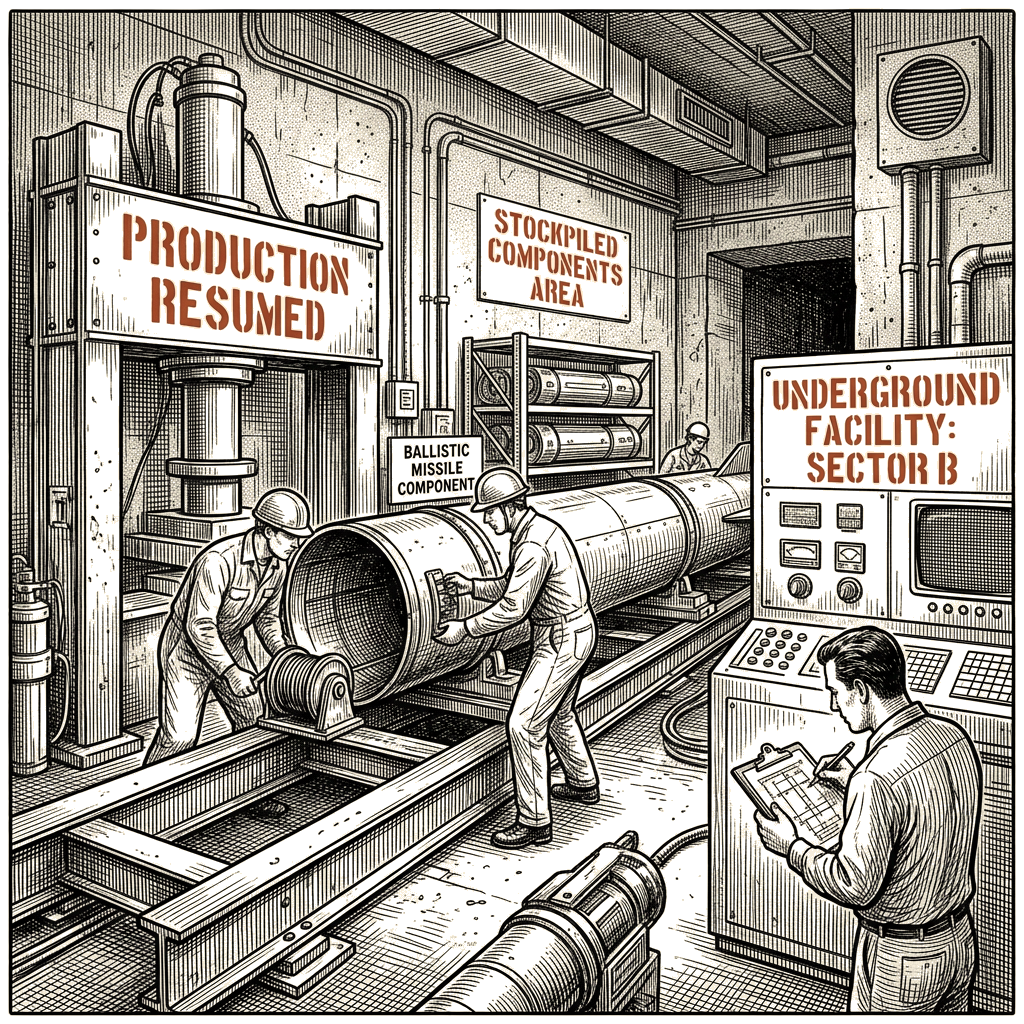
Iran has resumed assembling ballistic missiles in underground facilities using stockpiled components, U.S. and Middle East officials familiar with the matter said. The reported activity erodes what the U.S. and Israel have touted as a major achievement of the war.
Some officials said Iran is assembling liquid-propellant missiles, which have to be fueled just before launch, as well as solid-propellant missiles, which can be stored ready to fire. Intelligence points to activity at several underground sites, including the Khojir missile facility in southeastern Iran, those officials said. Iran is also attempting to build new underground assembly points to avoid being struck again, they said.
Satellite imagery shows Iran rebuilding bridges, roads and production sites at a pace Israeli officials described as worrying. Iran has restored access to missile-base tunnel entrances that U.S. and Israeli airstrikes had collapsed. Israeli military assessments said weapons stored inside those underground sites were likely to be well-preserved.
Iran is mainly assembling missiles from existing components in smaller quantities than before the war, U.S. and regional officials said. According to those officials, the U.S. and Israel damaged industrial facilities needed to produce missile components and complete missiles, and the naval blockade has complicated imports of parts and ingredients for solid fuel.
Arab officials said damage to chemical facilities needed to make liquid propellants and to industrial mixers used to produce solid fuel presents further challenges to restoring full-scale missile manufacturing.
A U.S. official said Iran probably resumed low-rate production after signing a preliminary deal with President Trump in mid-June to open the Strait of Hormuz and begin talks to wind down the war. The official said Tehran was believed capable of assembling at least a couple of hundred missiles from components it already had.
Before the war, Iran stockpiled finished warheads, airframes, and guidance and control systems, said Jim Lamson, a visiting research fellow at King’s College London and former CIA analyst who specialized in the Iranian military. Lamson pointed to older photos and videos released by Iran that showed many such components lined up against the walls of underground facilities.
“We could be talking about hundreds of missiles or possibly thousands of missiles,” Lamson said. He said the number Iran could produce depends on both the depth of its component stockpiles and how many underground facilities are operative.
Iran depleted its stockpiles of finished missiles during the war, leading it to reduce the volume of its attacks, but it retains substantial capacity. Tal Inbar, a senior analyst at the U.S.-based Missile Defense Advocacy Alliance, assessed that Iran still has thousands of ballistic missiles in its arsenal.
“When there are no bombings of the facilities, you can replace damaged infrastructure, and you can buy new components from other countries and store them in the facilities,” Inbar said. “You have to be extremely naive to think that Iran is not rebuilding its missile-production capabilities.”
The U.S. and Israel launched the war on Feb. 28. Early in the fighting, they carried out thousands of strikes aimed at Iran’s missile-production sites, storage facilities, missiles and launchers, severely diminishing the program. Officials said Iran used a period of calm this summer to rebuild its military capabilities because it believed the ceasefire was unlikely to hold.
The Wall Street Journal reported that the renewed production underscores the difficulty of fully dismantling Tehran’s missile program, a goal of the war the U.S. and Israel launched on Feb. 28. The resumption also extends Iran’s ability to hold on in the war of attrition that pits Iran’s supplies of the weapons against shrinking U.S. and Gulf stockpiles of missile interceptors, according to the paper.
A White House official did not directly address whether Tehran had resumed ballistic missile production. The official said Iran’s nuclear facilities had been obliterated and its military forces severely degraded.
“Iran is weaker now than ever before, and President Trump will never allow Iran to have a nuclear weapon,” the White House official said. The office of Israel’s prime minister did not reply to a request for comment.
Sean Parnell, the Pentagon’s chief spokesman, said the U.S. had “destroyed up to 90% of Iran’s drone, ballistic missile, and naval industrial base” and “significantly degraded” Iran’s ability to launch missiles and drones.
In April, Defense Secretary Pete Hegseth said Iran’s missile program had been “functionally destroyed” and that Iran lacked the means to make new missiles.
“You are digging out your remaining launchers and missiles with no ability to replace them,” Hegseth said. “You have no defense industry, no ability to replenish your offensive or defense capabilities.”
Iran continues to fire missiles at U.S. bases across the Middle East. Some missiles used in the attacks, including the Kheibar Shekan, are considered mobile, accurate and relatively inexpensive to produce. On Wednesday, Iran launched a heavy salvo at an air base in Jordan that houses U.S. troops. Videos showed projectiles with cluster warheads, a type Iran had frequently fired at Israel earlier in the war to challenge air-defense systems.
Arab and Israeli officials are preparing for continued fighting and the possibility that Iran will escalate as U.S. economic pressure tightens. In recent days, Iran has launched a series of attacks on U.S. warships that resulted in close calls, though none was hit.
Iran established its missile program during the war with Iraq in the 1980s. Lacking a modern air force, Iran has increasingly relied on missiles to deter its adversaries.
Tehran demonstrated its ability to rebuild its missile program after the 12-day war with Israel in June 2025. Though Israel targeted the missile program with its attacks, Iran rebuilt its stockpiles faster than expected, leading Israel to warn before the end of the year that more strikes on Iran might be needed.
“You can try to destroy facilities, you can try to destroy the missiles themselves, but it actually has quicker regenerative capacity than the nuclear program, and it’s pretty dispersed,” said Nicole Grajewski, an expert on Iranian strategy at Sciences Po in Paris. “The reason Iran created such elaborate missile infrastructure was because they were worried about this.”