Four Republicans break ranks on Iran war powers vote
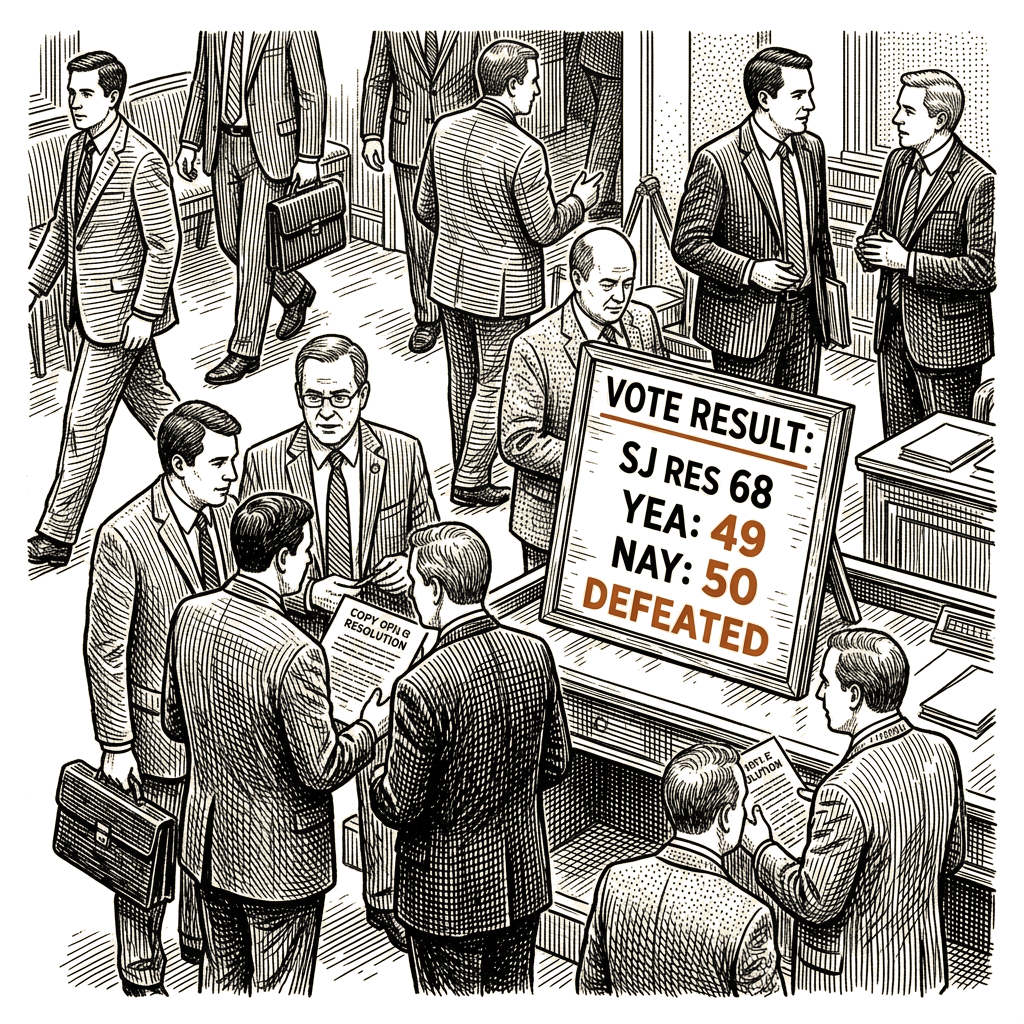
The Senate voted 50-49 on Thursday to defeat a resolution that would have directed President Trump to remove U.S. troops from hostilities against Iran. The vote was largely along party lines, with four Republicans breaking ranks to support the measure and one Democrat crossing over to oppose it.
Republican Sens. Thom Tillis of North Carolina, Susan Collins of Maine, Rand Paul of Kentucky, and Lisa Murkowski of Alaska voted with all other Democrats in favor of the resolution. Democrat Sen. John Fetterman of Pennsylvania voted with most Republicans against it. The measure would have directed the president to remove U.S. forces from hostilities against Iran.
The vote came weeks before midterm elections and offered GOP lawmakers a high-profile opportunity to signal disagreement with Trump over the war before heading home to campaign. Spiking gas and diesel prices linked to the conflict have become a major political vulnerability for Republicans, with polls consistently ranking the cost of living as a top issue for voters.
Diesel prices have vaulted to new records in the wake of missile strikes that have crippled fuel-making facilities in the Middle East and Russia. The national average for a gallon of diesel reached $6.51 on Thursday, up nearly a dollar over the past month, according to AAA.
Tillis, who had voted against previous Iran measures, said he might have voted no again if he had been properly briefed and convinced that the war was on the right track. He said he came close Wednesday, when senators received what he described as “a good brief” from U.S. Central Command’s commander Adm. Brad Cooper. But he added that it was “not enough and too late.”
Senate Majority Leader John Thune (R., S.D.) called war-powers measures “political votes” but said Republicans running in the midterms should be able to break with Trump, framing it as a pragmatic move that could help some candidates win. “I think they need to be their own person,” he said. “And I think that’s the best way to win.”
Other Republicans facing tight races echoed that pressure. Sen. Joni Ernst (R., Iowa), who is set to retire after this term, said farmers heading into harvest season want assurance that diesel prices will come down. “I would like the administration to come back with a very clear plan on how they bring this to an end,” Ernst said. “I do support the president, but this is really having an impact on everyday Americans.”
Democrats seized on the issue. “Our Wisconsin farmers are just getting hammered,” said Sen. Tammy Baldwin (D., Wis.). “Small-business owners are trying to stay afloat.” On the Senate floor this week, Minority Leader Chuck Schumer (D., N.Y.) criticized Trump, saying “Trump needs to reckon with the cost of his catastrophic blunder in Iran.”
Several House and Senate Republicans in competitive races also called this week for action on energy prices. Rep. Ashley Hinson (R., Iowa), who is running for the open Senate seat in her state, called on the Trump administration to pause diesel exports, arguing Iowans “shouldn’t have to foot the bill at the pump or the checkout line for the war in Iran.” Former Rep. Mike Rogers, the GOP Senate candidate in Michigan, also called for a pause in diesel exports and said the “war in Iran needs to end to bring costs down.” Rep. Tom Tiffany, the Republican candidate for governor in Wisconsin, said Tuesday, “I just believe we should be exiting Iran, that it’s time to move on.”
The resolution itself is largely symbolic. It previously passed the House 214-208 and would not have gone to the president’s desk for signature or veto. Legal scholars widely view such “concurrent resolutions” as nonbinding because of a Supreme Court decision in the 1980s that found similar measures to be unconstitutional legislative vetoes.
Thursday marked the 14th time the Senate has voted on an Iran war-powers resolution since the war started. In June, four Senate Republicans joined Democrats 50-48 to narrowly approve a concurrent resolution to limit Trump’s ability to conduct military operations against Iran without congressional authorization. The House had passed the same resolution on June 3, 215-208.