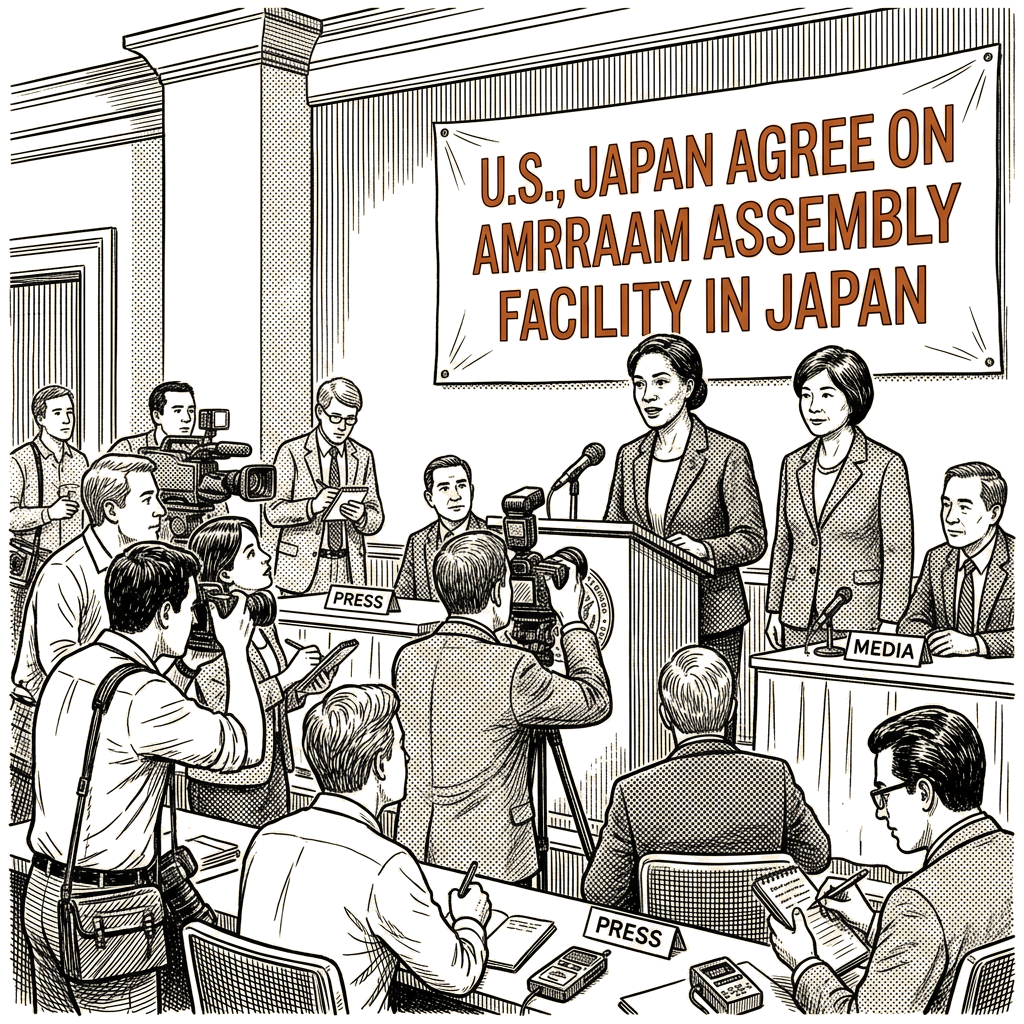
U.S., Japan share technical information to boost SM-3 production
The U.S. and Japan agreed Wednesday to establish a facility in Japan for the final assembly and inspection of Advanced Medium-Range Air-to-Air Missiles, or Amraam, a key armament for F-35 fighter jets. Japanese Defense Minister Shinjiro Koizumi and U.S. Defense Secretary Pete Hegseth reached the agreement at a meeting on the sidelines of a gathering of regional defense ministers in the Philippines, where the two nations also agreed to share technical information to help increase production of SM-3 missiles, which are typically fired by ships to destroy incoming ballistic missiles.
“This is a groundbreaking agreement that will not only ensure the acquisition of equipment needed by Japan and the United States, but will also strengthen Japan’s defense industry base,” Koizumi said. “We will elevate the Japan-U.S. alliance to even greater heights.”
The U.S. and its allies have used thousands of missiles in conflicts in Ukraine and the Middle East, and they have been seeking to rapidly scale up production of precision munitions. Some defense analysts have worried that dwindling stockpiles could hurt Washington’s ability to defend its interests and allies in Asia and elsewhere. China, meanwhile, has built up its own arsenal of advanced missiles it could use in a conflict in the contested South China Sea or over Taiwan, the self-governing island that Beijing claims.
Producing key munitions around the globe brings U.S. supply lines closer to potential flashpoints, making it easier to resupply troops. That benefit could be eroded, though, if factories remain dependent on U.S. suppliers for major components.
A similar effort is under way in Australia, which laid the groundwork for its own missile production lines during the Biden administration. Lockheed Martin is now assembling rounds used in truck-mounted missile launchers at a facility in Australia.
In a statement, the Defense Department said that “both leaders committed to continue close coordination on critical munitions production.” Neither nation provided specific numbers on how many missiles are planned to be assembled at the Japanese facility or a timeline for when production might begin.
The Amraam can shoot down drones and be fired from ground-based launchers. Ukraine has used the missiles to defend against Russian attacks. According to RTX, which makes the Amraam, it is the only radar-guided air-to-air missile cleared to fly on the F-35, and more than 40 nations have procured the weapon.
RTX in July said it is conducting feasibility studies to qualify additional suppliers in Europe for Amraam components. Last month, it won a $20.7 billion multiyear contract from the Pentagon to produce more of the missiles. The company said earlier in the year that it would increase annual production to at least 1,900, and that production already doubled in 2025 from 2024.
Setting up missile production from scratch can take years. Employees need to be trained, a complex set of U.S. export rules can take time to navigate, and crucial components for the weapons can be difficult to source.
The Trump administration has been pushing Japan and other allies to do more on defense, arguing that the U.S. has been unfairly shouldering much of the burden. Though Japan still has a pacifist constitution, it has loosened rules on lethal weapons exports and has increased training exercises with partners. In April, Japanese company Mitsubishi Electric said it was in talks with RTX to co-produce the Amraam, including by manufacturing electronic circuit boards and participating in the final assembly facility. On Thursday, it said it hadn’t been decided which Japanese company would help make the missiles.
Japan already produces Patriot interceptors, which can be used against drones and missiles, and in 2023 it said it would export some of the interceptors to the U.S. “The more this type of cooperation can be done, the better for the stockpiles of these common munitions,” said Jeffrey Hornung, a senior political scientist at the Rand think tank. “It also sets important precedent for more similar cooperation in other types of capabilities.”