October Pew survey found Trump approval fell among every religious group since his second term began
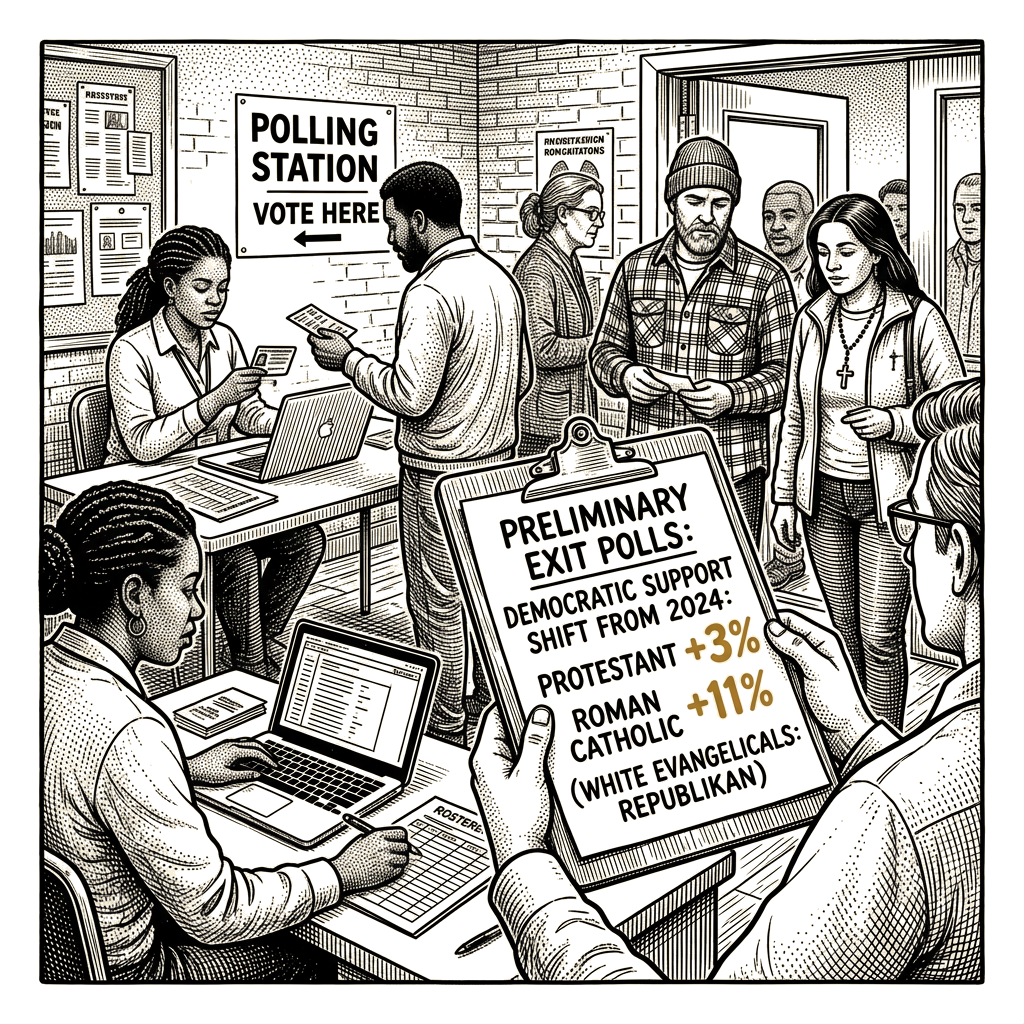
Preliminary exit polls showed Democrats gaining ground among Christian voters relative to 2024. Support among Protestant voters shifted 3 percentage points toward the party’s candidates, and support among Roman Catholics shifted 11 points. White evangelicals still overwhelmingly backed Republicans.
Nine Democrats who studied at a seminary or divinity school will serve in the 120th Congress. Many of them champion an alternative model for what faith could mean in the public sphere, emphasizing diversity and compassion for the vulnerable.
An October Pew Research Center survey found Trump’s approval ratings had fallen among every religious group since the start of his second term. Among white nonevangelical Protestant voters, 60% said they disapproved of his performance as president, according to the survey, as did 59% of white Catholic voters and 78% of Hispanic Catholics.
Mainline Protestant and Catholic voters had expressed growing dissatisfaction with the Trump administration, and appeals to faith likely resonated with those groups. Pope Leo XIV and U.S. bishops had spoken out against Trump’s immigration-enforcement tactics, some of which particularly affected Hispanic Catholics.
Talarico was not the only Democrat to campaign around Christian faith and court a segment of voters who had drifted toward Republicans. Across a number of closely watched races, Democratic clergy and a seminarian won Republican-held seats in the House and Senate and helped propel the party to its most sweeping victory in decades. Adam Hamilton, a United Methodist megachurch pastor who flashed his Bible at campaign events, won the Senate race in Kansas. Sarah Trone Garriott, a Lutheran minister, beat a Republican House incumbent in Iowa while continuing to preach at churches across the state. James Talarico, a Presbyterian seminarian who regularly quotes Scripture, won the U.S. Senate race in Texas and helped Democrats break through in the Republican stronghold.
James Talarico took the stage Tuesday night to celebrate his victory in the U.S. Senate race in Texas, concluding his long-shot campaign the way he began it: talking about Jesus. “That barefoot rabbi didn’t stay in his room and pray. He walked into the seat of power and he flipped over the tables of injustice,” Talarico said from behind a lectern emblazoned with “Love Thy Neighbor.” “Texas,” he told the crowd, “it’s time to start flipping tables.”
Democratic candidates who openly centered Christian faith won Republican-held House and Senate seats in closely watched races. The Wall Street Journal characterized the victories as a shift in the Democratic Party’s approach to religion and politics. In podcast interviews, stump speeches and campaign ads, the candidates articulated a vision of progressive or center-left politics rooted in theological principles. Some on the left hope their success will prompt the party to engage religious voters more directly and pave the way for other candidates who center their Christian faith to run as Democrats. “We might look back at these midterms and say this was the start of moving on from a politics where it was largely one party saying they were defenders of religion and another party being indifferent or antagonistic about it,” said Michael Wear, president of the nonprofit Center for Christianity and Public Life.
Among religious voters, Democrats have historically performed well with Black Protestants and Jewish Americans, as well as many Muslim voters, including those who backed Abdul El-Sayed, the first Muslim to be elected as a U.S. Senator. Catholic voters, long a political bellwether, were virtually split in their choice for president in 2020, according to AP VoteCast, then broke sharply for Donald Trump in 2024.
Over the past decade, Democrats largely ceded the white Christian vote to Republicans, and some candidates and party leaders shied away from embracing Christianity because of its association with conservative positions on social issues such as abortion. Some Democratic strategists argue that this began to shift more recently as the GOP’s fusion of evangelical Christianity and state power under President Trump helped spur a wave of religious Democrats to run for office. “They said, ‘My faith is being misrepresented and maligned by somebody at the top who claims he is Christian,’” said Faiz Shakir, an adviser to Vermont Sen. Bernie Sanders.
A White House spokesman said, “There has never been a greater president for Christian Americans than President Trump, and his strong record proves it.” He added that Trump “proudly defended and expanded our religious rights.”
Ahead of the election, Democrats held briefings for congressional candidates on outreach to faith voters and communities, according to the Democratic Congressional Campaign Committee’s national political director, Brooke Butler. Some candidates found success by tying Christian theology to voters’ economic worries, especially affordability. Talarico, for instance, argued that honoring God and following the Golden Rule meant expanding healthcare, lowering the cost of living and repealing billionaire tax cuts.
A person close to the national Republican Party leadership said religious voters who backed Democrats likely did so for economic reasons, not because they had changed their views of which party represents their values. Republicans, for instance, spent millions in Texas on ads featuring Talarico’s previous “woke” comments.
It is too early to say whether the election marks the start of a durable realignment among Christian voters. Policies espoused by some religious Democrats remain unpalatable to many social conservatives, particularly white evangelicals. Some conservative Catholics cautioned against reading the results as a rejection of their politics. Separately, Kelsey Reinhardt, chief executive of the conservative advocacy group CatholicVote, noted Republican voters still supported socially conservative causes and cited successful Colorado ballot measures her group backed that prohibit transgender athletes in girls’ sports and ban certain gender surgeries for minors.
On Wednesday, Sarah McCammon, a senior fellow at the centrist Democratic advocacy group Third Way, argued on X that Democrats were “learning how to speak effectively to religious voters and talk authentically about their own faith.” Authenticity, she added, “is the key; if it’s fake, people will know. It also has to be genuinely inclusive, and respectful of church/state separation.”
Democratic strategists say their party will likely look at the election as a case study in how candidates fluent in the language of faith can win over more voters. “Many Democrats are wondering: ‘How do we maintain that kind of relationship with those people?’” Shakir said. “And there is no doubt in my mind that faith is going to be one of the most discussed items.” The day after the election, theologian Anthony Bradley observed on X: “The religious left has a Jesus-speak secret sauce that works.”