Murray sees bipartisan compromise as possible but unlikely
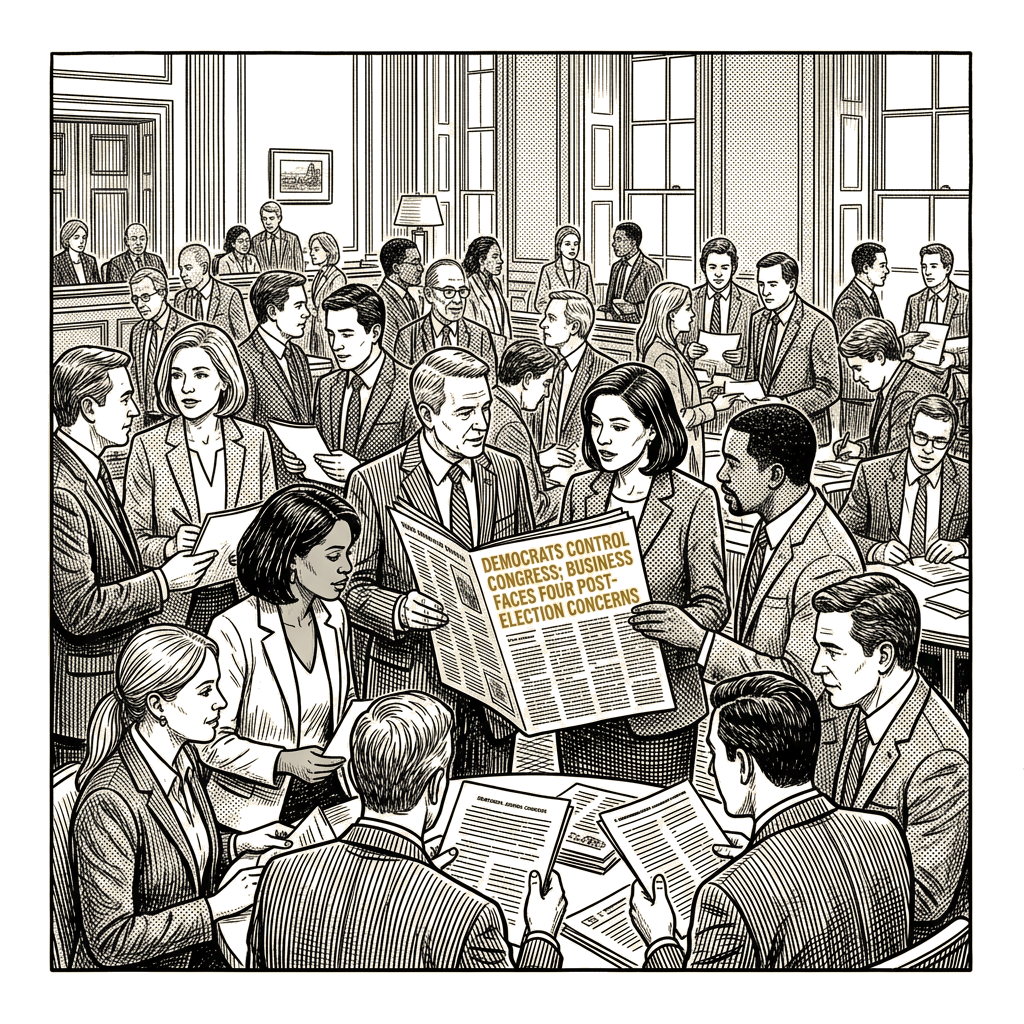
After last week’s election left Democrats controlling Congress, Alan Murray said the result should drive both parties toward the center, which he said would benefit business. He said bipartisan compromise on the budget deficit and global security remains possible but unlikely, and identified four developments for businesses to watch in the months ahead: congressional investigations, President Trump’s response to the results, public backlash against data centers and the unresolved 2028 presidential contest.
Power, oversight and presidential response
Murray’s first item concerned congressional investigations. He called it “The Democrats’ desire for vengeance” and wrote: “They control Congress’ investigative power, and are unlikely to be able to resist the temptation to use it not only against Trump but against his business supporters.”
His second item was “The president’s desire for attention.” Murray said the appointment of Stephen Miller as Trump’s new chief of staff “makes clear he won’t accept the results lying down” and wrote, “Look for him to take some bold actions to assert his relevance.”
What the election did and did not settle
Murray’s account of what the election showed was explicit: “President Trump and his Republicans saw a clear repudiation of their most extreme policies. Tariffs were trashed in the Midwest. Excessive immigration enforcement took a heavy toll in Texas. Attacks on civil rights lead to a backlash in Georgia. And higher prices fueled by war were rejected pretty much everywhere.”
The result also carried a warning for Democrats. “Yet Democrats should also have learned the country has little patience for their moves to the left,” Murray wrote. “Centrist candidates in red states outperformed Democratic socialists in swing states.” He said the party would need to pay close attention to figures such as James Talarico and Adam Hamilton to keep its new coalition intact. His overall lesson was that most Americans think politics, like golf, is best played near the center of the fairway.
Murray cautioned against becoming comfortable with that forecast. “The dynamics in the American political system that have pulled both parties toward the rough are still in place,” he wrote. He said, “An outbreak of bipartisan compromise to address things like the budget deficit or global security is possible—but unlikely.”
Business risks and the 2028 contest
Public backlash against data centers was Murray’s third item for businesses to watch. He said, “This could be the early expression of a kind of Gilded Age populist uprising that will have negative ramifications for business.”
His fourth item was “Leadership matters.” Murray warned against assuming the midterm elections had the next presidential contest settled: “Don’t make the mistake of thinking the midterm elections mean Democrats have the next presidential election tied up.” He cited “a long list of presidents—Eisenhower, Truman, Reagan, Clinton, Obama—who have demonstrated otherwise.” He added: “The story of 2028 is likely to be written by the candidates—and right now, we don’t know who they are.”
His underlying advice to executives was resilience. “In the meantime, elections are just one more data point reinforcing the overriding lesson of recent years: successful businesses need to be resilient. There is no predicting what comes next.”
A separate corporate-governance context
The same report included a separate corporate-governance item from Erle Norton. He wrote, “Internal investigations by boards are one of the most fraught duties directors face.” He added: “That’s even truer when the investigation involves one of the highest profile CEOs at the center of the AI economy.”
Nvidia’s board had announced the previous day that it was “initiating an independent investigation in light of recent reporting that founder and CEO Jensen Huang has been the target of a foreign intelligence effort.” A committee of independent directors with its own outside counsel will run the probe.
The board said it “has no reason to believe that either national security or Nvidia secrets were compromised,” while the board’s inquiry “will examine all available information.” Huang “fully supports the review and has committed to cooperating with it,” and the board “has confidence in Jensen and his leadership team.”
The Wall Street Journal reported that “the CEO had a romantic relationship with an executive suspected of working for Chinese intelligence” and that Huang had apologized to employees for being unfaithful to his wife.
Leadership calendar and editorial credits
The Wall Street Journal’s Leadership Institute will examine how boards can best handle new challenges at its WSJ Board of Directors Council Summit in Palm Beach, Fla., today and tomorrow, and CEO Brief will bring highlights from the sessions. Alan Murray will interview Huang at the WSJ CEO Council Summit on Dec. 7. The CEO Council Summit is in San Francisco on December 7–8.
CEO Brief is written and edited by a team from the WSJ Leadership Institute: Alan Murray, president; Erle Norton, C-Suite Content managing editor; and Lila MacLellan, CEO Brief editor.