Crop insurance gaps burden Navajo farmers after flooding
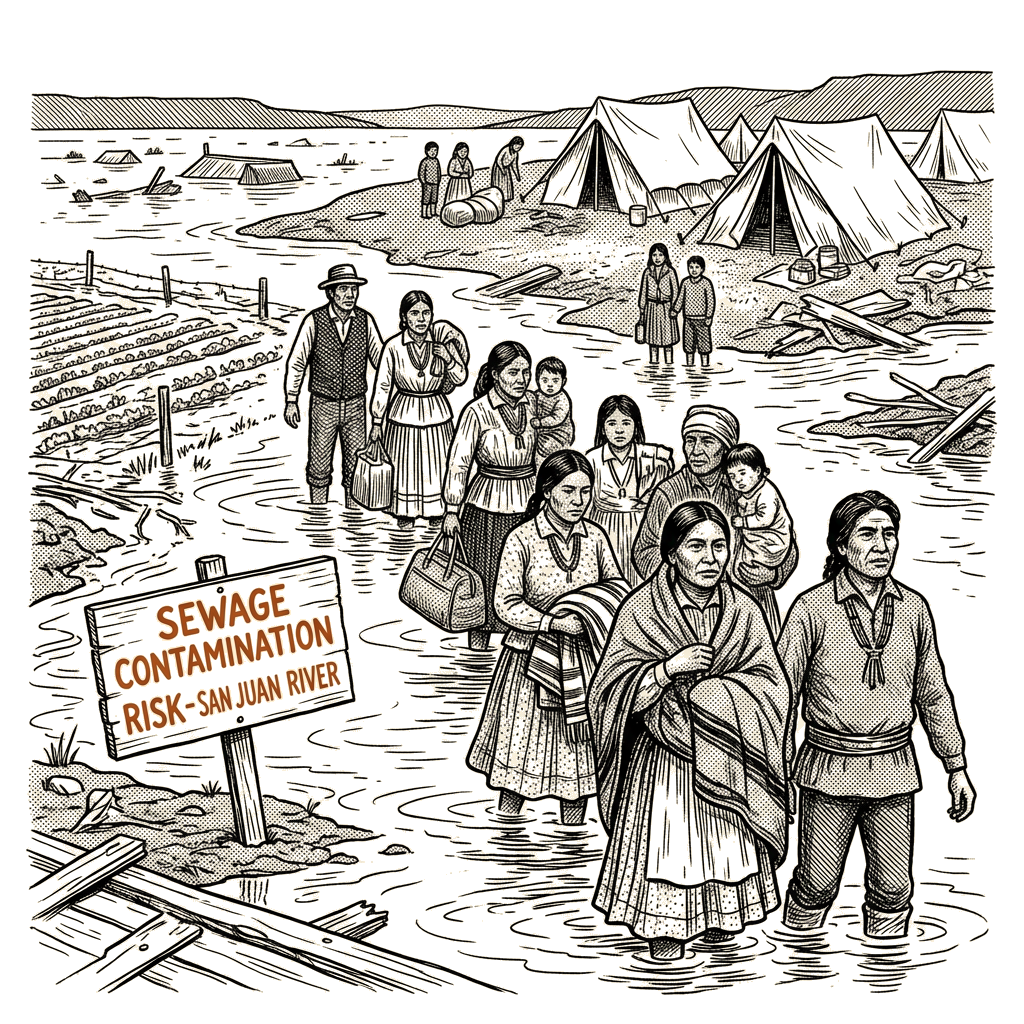
Severe flooding in late October and early November 2026, intensified by El Niño, left families across the Four Corners displaced and farms submerged while damage to wastewater systems sent sewage into the San Juan River. In Shiprock, New Mexico, the river crested at 21 feet near town — the highest reported level there since 1935 — and sewage entered it after facilities in New Mexico and Utah were damaged. By Nov. 19, residents and local groups were confronting contaminated land and water, crop and property losses, impassable roads and temporary housing uncertainty.
New Mexico had endured a dry year and recorded its hottest summer on record when heavy thunderstorms and rain intensified by that year’s El Niño hit the southwest. Two weekend storms in late October and early November produced once-in-a-generation flooding in the flash-flood-prone desert. The San Juan River reached levels not seen across much of the region since 1911, and communities in New Mexico, Arizona and Utah bore the effects.
Families were ordered to evacuate as floodwaters damaged several wastewater treatment facilities in New Mexico and Utah, causing sewage to flood into the river. “The San Juan River is a hazmat situation,” San Juan County spokesperson Devin Neeley said in late October. “Do not go in the water.” Near Bluff, Utah, residents were ordered to evacuate and remained hesitant to return weeks later as E coli levels in the river and surrounding soil measured 25 times the norm.
Communities across the Four Corners, where the 27,000-square-mile (70,000-square-kilometer) Navajo Nation reservation stretches across parts of New Mexico, Arizona and Utah, were affected by the rains and floods. In Dennehotso, Arizona, emergency personnel rescued elders as old as 102 by raft and helicopter. In Rock Point, Arizona, voters decided whether to navigate hazardous muddy roads to reach the polls on election day. Standing floodwater stood in Bloomfield, New Mexico, on Oct. 30, 2026, as volunteers filled sandbags and distributed them to local homeowners there.
On the night of Oct. 23, Jimmie Goodman, 67, a Navajo/Diné man, was trying to rest when his sister, who was recovering from back surgery and having trouble sleeping, woke him. Authorities in their hometown of Shiprock had warned that the nearby San Juan River was at risk of flooding. “That surge shot directly at us,” Goodman said, describing the river’s sharp 90-degree turn near the Navajo Housing Authority residential neighborhood where they lived. The water missed their house by about 50 feet.
Goodman helped his sister into their green Ford pickup, which they had loaded with essentials. He went back inside to turn off the house’s main power and save his Taylor Swift CDs before his sister called, “Let’s go!” As Goodman stepped outside, his foot sank into what he guessed was 6 to 8 inches of water. “It was like the Bellagio Casino,” he said.
The Shiprock area is one of the few portions of the Navajo Nation with river access and is home to many farms that fiber artist and shepherd Kevin Aspaas said grow produce for “all of the communities around the Navajo Nation who don’t have access to this river, who don’t have access to irrigation.” Some of those crops are “traditional to our communities, and are used in ceremonies,” he said.
Aspaas farms beans, melons, squash and corn about a mile from the river. He harvested his last beans early after seeing the river flood within a few hundred yards of his crops. Speaking during a break from shelling Hopi, Zuni gold and other beans in his uncle’s hogan, a traditional Navajo hut, Aspaas said he was focused on getting everything off the field. Nearby farmers mourned their flooded fields.
Some of Aspaas’s friends were less fortunate. One had an entire corn crop, which was drying after being steamed underground, soaked in floodwater. Another family, which had relocated some farm equipment to the field where Aspaas’s sheep graze, saw its entire farm and home submerged. With the sewage leakage, Aspaas said, “they can’t go back into their home.”
Aspaas called the conditions “a biohazard” and said residents feared not only the sewage but also “about what kind of chemicals they’re using to treat the human waste.” Zachariah Ben of Bidii Baby Foods, which operates one farm plot in Shiprock and another off the reservation, said in a text message that E coli and treatment chemicals “are leaching into the soil and will be causing significant problems for future growing seasons.”
Ben also said “Crop insurance doesn’t work the same on tribal trust land” and warned that it would “leave Navajo farmers with huge crop and infrastructure losses.” The absence of insurance coverage in the flooding’s wake extended beyond farmers to other residents, including rental and property owners. Ben and his family were looking at a $100,000 loss after floodwaters submerged their farm plot, greenhouse and yurt, along with possessions inside the structures.
After the first wave of flooding, Shiprock experienced large power outages. “People had no electricity. It was getting cold. They couldn’t cook their food,” said Virginia Kirk, who owns the Kirk Center in Shiprock. At that point, Denisa Livingston, who leads the Diné Community Advocacy Alliance, and Mackee Bancroft, a chef who is Ute Mountain Ute and Diné, began bringing hot meals to evacuees.
Livingston said, “We are not just people who stepped into the flood response; we are stewards of practicing our ancestral ways of organizing.” Her organizing included Covid relief and advocacy for the Navajo Nation’s first-in-the-nation junk food tax. She said the work followed the footsteps of her uncle Phil Harrison, who advocated federal compensation for families of uranium miners like her grandfather. She said Kirk, whose grandfather was one of the first chief justices of the Navajo Nation’s supreme court, fits into a similar legacy.
The Kirk Center, a leasing and rental company with a large event space called the MOD, quickly became the region’s central distribution and donation site. “We’re not any organization, we just have space,” Kirk said while directing community members dropping off clothing and picking up sanitary products. Donations included pet food, diapers and bottles of water, while volunteers distributed coal, hay and wood. With Turquoise Paws and Soul Dog Rescue, Kirk converted a nearby rental property into a temporary dog shelter. On Nov. 3, volunteers with the Kirk Center, Diné Community Advocacy Alliance and Red Cross distributed meals to evacuees including Goodman and his sister. Kirk said many displaced families remained confused about their next steps and were looking to one another for support.
Goodman and his sister found temporary housing in another Navajo Housing Authority neighborhood. The siblings were grateful for the housing but had to start from scratch, including finding a place to sleep. Their housing was guaranteed through Nov. 20, after which they would need to pay a deposit to remain for another 60 days. Floodwaters had begun to recede at their house, but the road remained unpassable, and Goodman had returned a few times on foot to feed his chickens.
Their nephew’s boss bought them air mattresses with built-in pumps. Goodman said the pumps mattered because metal remains in his elbow and hip from prior surgeries, while his sister’s neuropathy is a nervous-system condition not uncommon among children of uranium miners. Holding his miniature pinscher, Molly, Goodman said, “It’s hard to rebuild when you have to pay.” Goodman hoped the road to his home would soon be safe to drive on and that friends could help him and his sister begin the long work of rebuilding.