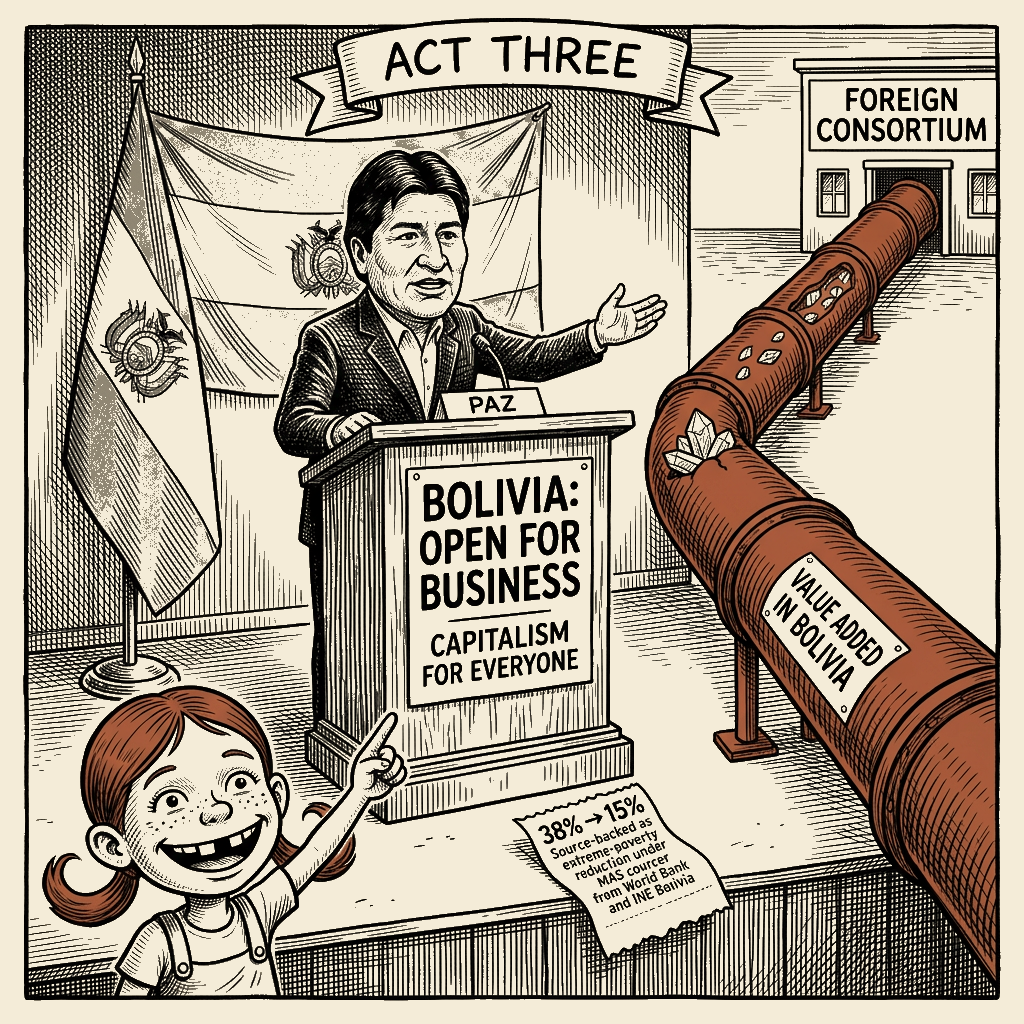
Responding to: PRESIDENT PAZ: Bolivia has rejected socialism and is open for business — President Paz · 2026-09-26
What the Piece Argues
Bolivian President Rodrigo Paz, writing in a Fox News opinion slot, frames his first year in office as a clean break from the Movement Toward Socialism governments of Evo Morales (2006–2019) and Luis Arce (2020–2025). He argues that Bolivia’s economic distress — characterized by his claim that central bank reserves had fallen to $51 million before being rebuilt to close to $1.2 billion — required abandoning socialist ideology in favor of “capitalism for everyone,” defined as opening the economy to private and foreign investment, building a new partnership with the Trump State Department under Marco Rubio, and securing “long-term partnerships” to develop Bolivia’s natural gas, lithium, copper, and tin. He presents this not as a sell-out but as the patriotic alternative: a century of exporting raw materials without adding value locally kept Bolivia poor, so the fix is foreign-capital partnership while protecting the Amazon, Indigenous communities, and ensuring that created wealth serves Bolivians. The piece targets a US conservative audience with the message that Bolivia under Paz is a reliable, business-friendly Western Hemisphere partner in contrast to the fractious MAS-aligned left.
Receipts
Paz’s op-ed is a sales document for foreign capital dressed as a populist break from “ideology.”
-
Anchor receipt: Extreme poverty in Bolivia fell from approximately 38% in 2006 to approximately 15% in 2019 (World Bank / INE Bolivia) — a reduction of more than 60% in thirteen years. This is the headline counter-evidence to the framing that MAS governance wrecked the economy.
-
Who benefits:
- Foreign mining and energy consortia with the capital and technology to operate Bolivian lithium, gas, and strategic-minerals extraction at industrial scale — a small number of firms headquartered in the United States, the European Union, and China.
- The Bolivian business elite that has long advocated for restoration of the pre-2006 extractive relationship with foreign capital.
- The Trump administration’s Western Hemisphere policy frame, which positions the Fox News Opinion placement as legitimization for critical-mineral access deals.
-
Mechanism:
- Paz’s pivot reverses the MAS-era nationalization of hydrocarbons (2006), which returned an estimated $6 billion to state coffers in its first decade and funded the social programs below.
- Paz reverses the national lithium strategy that had tried to keep value-added processing in Bolivia.
- “Open for business” reopens both sectors to foreign operation under terms that historically favor the operator over the host country.
-
Omitted fact:
- The November 2019 ouster of Evo Morales — the political event that created the conditions Paz is claiming to inherit from “socialism” — was later characterized as a coup by the Inter-American Commission on Human Rights’ Group of Independent Experts and by the Bolivian prosecutor general’s office.
- The MAS-created social programs — Renta Dignidad (universal old-age pension) and Juancito Pinto (child cash transfer for school attendance) — did not exist before 2006. The MAS government also expanded healthcare coverage through the 2019 Sistema Único de Salud (SUS).
- Paz’s $51 million central bank reserve figure reflects post-2019-coup economic deterioration, not steady-state MAS governance; Bolivia’s reserves were substantially higher in earlier MAS years.
The Response Ladder
Polite Reframe
When to use: A Bolivian-American friend or coworker who has heard Paz’s pitch and is genuinely unsure whether the MAS years delivered; needs the receipts on poverty and state coffers, without the heat.
Brenda is sixty-three years old. She lives in El Alto, on the altiplano above La Paz. She started collecting the Renta Dignidad — Bolivia’s universal old-age pension — in 2009, three years after Evo Morales took office. She uses the pension to buy cooking gas and to help with her grandchildren’s school supplies. She is the specific person Paz’s op-ed is about, even though Paz does not name her.
The op-ed says ideology doesn’t put food on the table. Let’s look at what the World Bank, the Bolivian national statistics institute, and the country’s own hydrocarbon revenue ledgers actually recorded during the period Paz calls the socialist catastrophe. Extreme poverty in Bolivia fell from approximately 38 percent in 2006 to approximately 15 percent in 2019, a reduction of more than sixty percent in thirteen years. Moderate poverty fell from approximately 60 percent to 37 percent over the same period. The Renta Dignidad pension, the Juancito Pinto cash transfer for poor children, and the expanded universal healthcare system that the 2019 Sistema Único de Salud formalized — none of those existed before the MAS government built them. They are paid for out of state hydrocarbon revenue that the MAS government recovered through the 2006 nationalization.
The op-ed says Bolivia’s central bank had only $51 million in reserves when Paz took office. That is true. What the op-ed does not say is why. Hydrocarbon revenues, the engine of those reserves, collapsed after the 2014 oil price crash and were further hammered by the political chaos that followed the November 2019 ouster of Evo Morales — an ouster that the Inter-American Commission on Human Rights’ Group of Independent Experts later characterized as a coup. Paz inherited the wreckage of a coup, not the wreckage of socialism. Those are different inheritances.
The op-ed says Bolivia is open for business. Here is what is actually on the table. Bolivia holds an estimated 9 percent of the world’s identified lithium resources, most of it beneath the Salar de Uyuni, which makes it the most strategically valuable mineral of the early twenty-first century because every electric vehicle on the road will eventually run on a lithium-ion battery. Paz’s “capitalism for everyone” pitch, written for Fox News Opinion and timed to Secretary of State Marco Rubio’s Western Hemisphere tour, is a sales document for foreign mining consortia. The MAS government’s national lithium strategy, slow and imperfect as it was, was built around the proposition that Bolivian lithium should be processed in Bolivia, that Bolivian workers should operate the plants, and that the value-added should stay in the country. Paz is reversing that proposition, and the Fox News placement is the legitimization layer.
The poverty-reduction numbers above were produced by an economic program that retained national control of the hydrocarbons. The lithium pivot Paz is offering will be operated by the same extractive-industry logic that has kept Bolivia’s neighbors in the resource-curse pattern for five centuries. There is nothing in Paz’s essay that promises Bolivians will share the upside from their own subsoil in any proportion comparable to the share the MAS years delivered.
So when your Bolivian-American coworker asks whether the socialist period worked, the honest answer is: parts of it did, for many of the people who needed it most, and the receipts are in the World Bank tables. The open-for-business alternative on the table today is a return to a structure that has historically delivered the resource value to foreign shareholders and the social cost to Bolivian communities. You can want reform in Bolivia without endorsing that. Those are different propositions.
Mockery and Ridicule
When to use: A social media exchange, a Substack thread, a reply section — anywhere the audience is mixed and the work is to perform for the bystander rather than persuade the repeater.
So. The President of Bolivia has written an op-ed in a United States outlet informing American readers that his country is “open for business,” that “capitalism is for everyone,” and that the previous government — the one that nationalized hydrocarbons and tried to keep the lithium in state hands and organized an Indigenous majority into actual political agency — was the wrong one. The President of Bolivia has been in office ten months. The country has strategic lithium reserves that make Tesla’s balance sheet tingle. The math, as they say, does not require a calculator.
Imagine the press conference. The President at the podium, the Bolivian flag behind him, the American mining consortium in the front row, the cameras. “Bolivia is open for business.” A pause for the translator. The consortium applauds. The Bolivian people who live above the lithium applaud less loudly. The piece in Fox News that follows is a faithful translation.
This is the third act of a play Bolivia has put on its own. Act One: the tin barons. Act Two: the hydrocarbon concessions. Act Three: the lithium consortium, with the President of Bolivia in the lead role explaining to the audience that this time is different because “ideology does not put food on the table.” The Bolivian audience has been through two acts. They know how the third act ends.
The piece says “long-term partnerships built around employment, training, technology, infrastructure, productivity and value added in Bolivia.” That sentence is the longest-running con in Bolivian economic history. The Bolivian state has been promised value-added partnerships since the tin era. With one partial exception under MAS, it has never received them. With one partial exception under MAS, it has always received the extraction.
You want a number? Bolivia holds the world’s largest identified lithium resources — the IEA and USGS document this. The market value of those resources at current lithium prices is in the hundreds of billions. The Bolivian people who sit above them have a per-capita income in the low four figures. The arithmetic has been the same arithmetic for a hundred years because the partnership structure has been the same partnership structure. The piece is announcing that the partnership structure will be, with refreshed strategic levers, the same partnership structure.
The man at the podium is not lying. He is performing a script. The script has been performed before, by predecessors whose names you have not been told because the script does not require you to know the names. The script requires you to know the words. The words are: “open for business.” The Bolivian people who have heard the words before are not applauding. The Bolivian people who have heard the words before will, when the moment comes, write a different script.
Nuclear Satire
When to use: The full cathartic piece — for a publication that runs sharper commentary, for the reader who has watched Bolivia’s lithium politics for fifteen years and wants the receipts in one place, for the conversation that is over the discussion of whether this is a clean ideological pivot or a lunatic-frankenstein extraction scheme.
The President of Bolivia stood at a podium and announced that Bolivia is “open for business.” The President of Bolivia has been in office for ten months. The President of Bolivia presides over the world’s largest identified lithium resources. The President of Bolivia’s stated policy is to invite foreign capital to extract those resources in partnership with the Bolivian state, on terms the President’s office has not published, while assuring American readers that this time the value will stay in Bolivia.
Let us take the President of Bolivia at his word. Let us take “capitalism for everyone” at its plain English meaning. Capitalism for everyone. Not capitalism for the consortium that signs the extraction contract. Not capitalism for the consulting firms that draft the contracts. Not capitalism for the financial intermediaries that finance the contracts. Capitalism for everyone. Capitalism for the salt-truck driver in Uyuni. Capitalism for the Indigenous farmer above the gas field. Capitalism for the Bolivian worker who assembles the value-added product the partnership promises. Capitalism for everyone.
The arithmetic of “capitalism for everyone” in an extractive economy is the arithmetic that produced the tin-baron era. The arithmetic is: extract the resource, pay the workers a wage, return the profit to the consortium, leave the country poorer in real terms than it was before extraction, and announce in the foreign press that the country has rejected socialism. The arithmetic has been the arithmetic for a hundred years because the partnership structure has been the partnership structure.
The President’s piece says: “We do not want to repeat the history of countries that exported their natural resources for decades while remaining poor.” The President of Bolivia is reading from the same script his predecessors read from. The script does not change. The script is “we will not repeat the history.” The history repeats. Every time.
The President’s piece says “Bolivia is open for business. But opening our economy does not mean selling our future.” That sentence is a hostage-negotiation opener. That sentence is the sentence a man says when he is about to sell the future and wants the audience to know he is aware that selling the future is what he is about to do. The President of Bolivia knows that selling the future is what he is about to do. The President of Bolivia is announcing it.
The President’s piece says “long-term partnerships built around employment, training, technology, infrastructure, productivity and value added in Bolivia.” The phrase “value added in Bolivia” is the phrase that mining consortia use when they want to extract a mineral from a country without building a refinery in the country. The phrase “value added in Bolivia” is the phrase that signals that the value will not, in fact, be added in Bolivia. The phrase is a tell. The phrase is the same tell the tin consortia used. The phrase is the same tell, refreshed, in 2026.
The piece is a sales document. The piece is not a policy document. The piece is the Bolivian economic elite’s sales document to the foreign-capital consortium that is being invited to extract Bolivia’s lithium, copper, tin, and gas. The piece is the cover note on the extraction contract. The piece is the brochure that goes to the consortium’s board. The piece is the Bolivian economic elite’s pitch to the foreign-capital consortium: trust us with your capital; we have the resource; we have the labor; we have the political cover; we have the rhetoric of “capitalism for everyone” to make the extraction look like development.
The Bolivian people who will absorb the cost of the extraction are not the audience of the piece. The Bolivian people who will absorb the cost of the extraction are the resource described by the piece. The Bolivian people are the lithium, in the piece’s operational grammar. The Bolivian people are the gas. The Bolivian people are the copper. The Bolivian people are the tin. The piece is not written to the Bolivian people. The piece is written over the Bolivian people.
The script does not change. The arithmetic does not change. The partnership structure does not change. The President of Bolivia is reading from the same script his predecessors read from. The Bolivian people will know what the script produces. The Bolivian people will know what the script has always produced. The Bolivian people have been through two acts. The Bolivian people are now being told that the third act is different. The Bolivian people will know, when the third act is performed, whether the third act is different.
The third act is not different. The third act is the same script, with refreshed strategic levers, in 2026.
Profane Scorched-Earth
When to use: For the reader who needs the full catharsis and the receipts; the cousin who sent the op-ed and won’t shut up about how Bolivia finally came to its senses; the night-shift break.
All right. Let’s talk about Rodrigo Paz Pereira’s fucking op-ed.
The Bolivian president wrote a column for Fox News Opinion explaining to the American right that his country has “rejected socialism” and is “open for business.” The framing is that the Movimiento al Socialismo era — twenty goddamn years of Evo Morales and Luis Arce — wrecked the place, and now the adults are back in charge, and the lithium is open for extraction, and the gas is open for extraction, and the Indigenous communities are open for the prior-consultation process that will be reinterpreted until it means whatever the foreign operator goddamn well needs it to mean. The op-ed wraps all of this in the language of dignity and mutual respect. The payload is subsoil wealth. Let’s unwrap the motherfucker.
The op-ed claims the MAS era wrecked the Bolivian economy. The receipts say the exact fucking opposite. Extreme poverty in Bolivia fell from approximately 38 percent in 2006 to approximately 15 percent in 2019 — that’s a sixty percent reduction in thirteen years, the largest poverty reduction in Bolivian recorded history. The MAS government created the Renta Dignidad universal old-age pension, the Juancito Pinto cash transfer for poor children, and the expanded universal healthcare system formalized through the 2019 Sistema Único de Salud. None of those motherfucking programs existed before 2006. They exist now. The MAS government nationalized the hydrocarbons in 2006 and pulled an estimated six billion dollars of revenue back into state coffers in the first decade. That money didn’t vanish into some socialist fantasy. It funded the social programs above. The MAS government nationalized the lithium policy to keep value-added processing in Bolivia. It was slow, it was imperfect, and it was a direct fucking rejection of the colonial-extractive pattern that has kept Bolivia’s neighbors in the resource-curse cycle since the fucking conquest.
Paz’s “open for business” is the original pattern, restored. Foreign mining consortia get the lithium. Foreign oil companies get the gas. Bolivian workers get the wage bill. Bolivian Indigenous communities get the prior-consultation process that the 2009 Bolivian constitution requires and Paz’s legal team will reinterpret until it means what the foreign operator goddamn well needs it to mean. The Fox News Opinion platform is the legitimization layer. The Inter-American Commission on Human Rights’ Group of Independent Experts, and the Bolivian prosecutor general’s office, all later characterized the November 2019 ouster of Evo Morales — the political event that created the conditions Paz is now claiming to inherit from “socialism” — as a coup. Paz didn’t inherit the wreckage of socialism. He inherited the wreckage of a fucking coup, and he is using the wreckage as the cover for the reversal.
And here is the goddamned thing the op-ed will not say out loud. The lithium beneath the Salar de Uyuni is the most strategically valuable mineral deposit of the early twenty-first century. The Trump administration’s Western Hemisphere policy is, by its own public framing, an effort to lock down critical-mineral supply chains against Chinese access. Paz’s “open for business” pitch arrives on the Trump-aligned platform at the moment Secretary Rubio is touring the region to secure exactly these fucking deals. This is not a coincidence. This is the deal.
King said it from a Birmingham jail cell in April 1963 — and the line is as true in La Paz in 2026 as it was in Birmingham sixty-three years ago — quoting his indictment of “the white moderate, who is more devoted to ‘order’ than to justice; who prefers a negative peace which is the absence of tension to a positive peace which is the presence of justice.” (“Letter from Birmingham Jail,” 16 April 1963.) The corporate-liberal op-ed reader who forwards Paz’s pitch and congratulates themselves on Bolivia finally coming to its senses is the fucking white moderate of this story. They prefer the negative peace of no headlines out of La Paz to the positive peace of a Bolivian pensioner keeping the income they have, a Bolivian child keeping the cash transfer, a Bolivian lithium worker keeping the value-added their government tried to keep at home. The order Paz is offering is the order of the resource curse. The justice is what the MAS government built.
Malcolm X said it in Detroit in February 1965, hours after his house was firebombed, and it is the operative line for every structural-political analysis of this kind: the analytical work continues regardless of personal cost, the audience receives the diagnosis not the catharsis. The diagnosis here is that Paz’s op-ed is a sales document for foreign capital dressed as a populist break from “ideology,” and the customers are the American readers the Fox News Opinion platform is designed to reach.
So when the cousin at Thanksgiving dinner forwards the op-ed and says Bolivia finally came to its senses, you can hand back the fucking receipts. The MAS era delivered the largest poverty reduction in Bolivian history and returned hydrocarbon revenue to state coffers. The coup it did not deliver was the 2019 one Paz is billing as the inheritance. The open-for-business deal is the original colonial-extractive pattern, restored under new management with American-aligned legitimization. The lithium is going somewhere. The question is whether the value-added stays in Bolivia or follows the precedent of every previous resource-extraction deal in Latin American fucking history. Paz’s op-ed doesn’t answer that question. Paz’s op-ed doesn’t ask it. The Bolivian people who will live with the consequences didn’t write the fucking op-ed.

About Malcolm Little King
Malcolm Little King is a heteronym in Main Street Independent's editorial architecture — an analytical voice, not autobiography of any actual person. The position this column expresses is the publication's position on the territory Malcolm Little King's lane covers, rendered through Malcolm Little King's register.