Responding to: Americans don’t have to choose between our AI future and ripping off copyright owners · 2026-11-25
Who gets paid when the biggest companies take the work?
What the Piece Argues
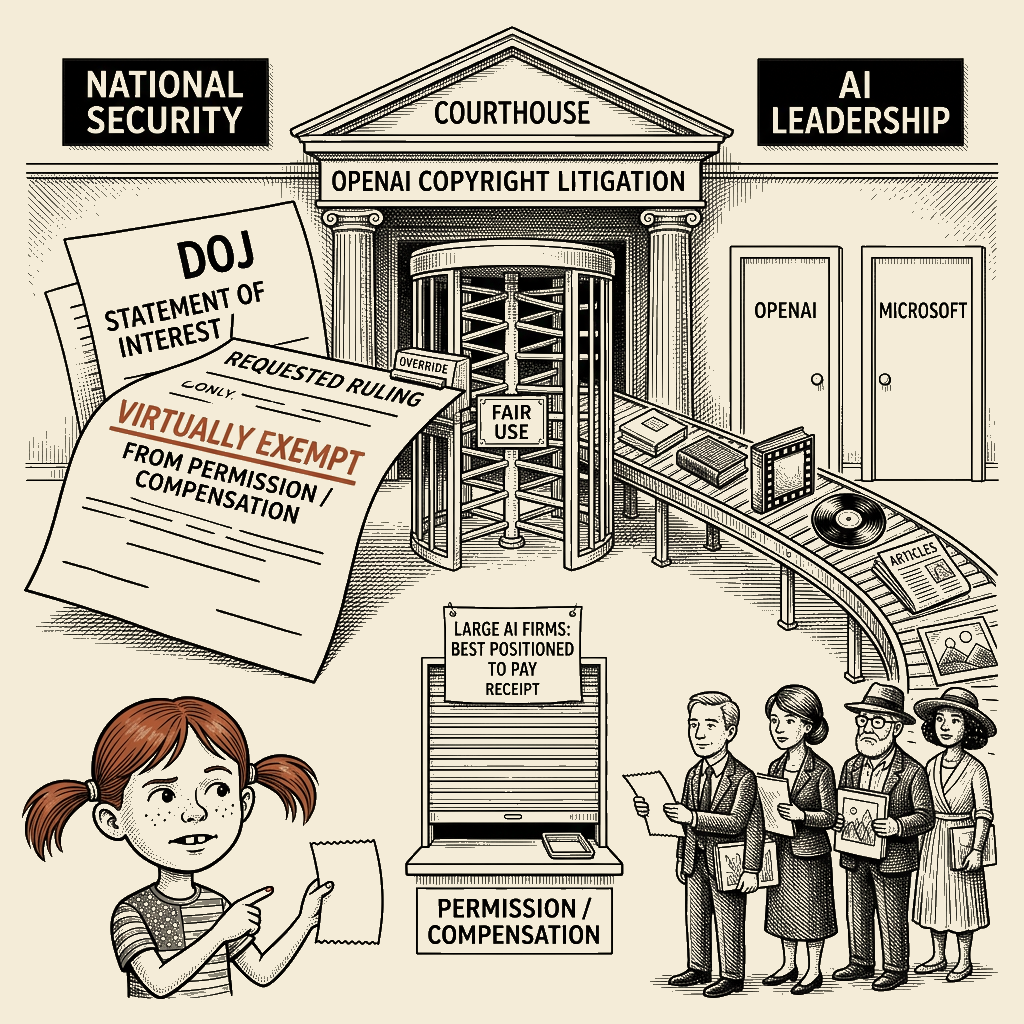
The opinion argues that the Department of Justice’s statement of interest in the OpenAI copyright litigation asks courts to treat commercial AI training as virtually exempt from permission or compensation under fair use. It concedes that licensing costs, legal uncertainty, competition among smaller firms, American AI leadership, and national security are real concerns, but argues that they do not justify a categorical rule. It therefore calls for withdrawing the DOJ filing, letting courts resolve AI copyright disputes case by case, and using the CLEAR Act’s training-data disclosure requirement to encourage lawful licensing without prejudging fair use.
Receipts
The framing turns a contested question about commercial AI training into a national-security argument for shifting copyright costs from the largest model builders to creators.
-
The framing wants you to believe
- The opinion attributes to the DOJ the position that requiring a copyright license for material used in AI training would impose high costs on AI developers, with those costs then threatening smaller competitors, American AI leadership, and national security.
- A broad interpretation of fair use should protect commercial AI systems almost categorically, leaving individual creators to absorb the resulting loss.
- Protecting copyright and advancing AI innovation are necessarily zero-sum: payment for creators is simply an obstacle to progress.
-
What’s really going on
- According to the supplied opinion, the institutional source of the power-protecting frame is the DOJ’s statement of interest in the OpenAI litigation. Its stated rationale is that licensing would be costly for developers and harmful to smaller firms, U.S. leadership, and security.
- The opinion reports that large AI firms are among the best positioned to pay; some startups say paying for material gives them more reliable access, reduces legal uncertainty, and improves models; and companies are already emerging to aggregate copyrights and make licensing easier. (Coke Morgan Stewart, “Americans Don’t Have to Choose Between Our AI Future and Ripping Off Copyright Owners,” Fox News, Nov. 25, 2026.)
- The source’s proposed alternative is targeted disclosure: the CLEAR Act would identify works used in new training datasets without automatically deciding fair use, leaving individual disputes to courts. The claimed national-security harm, quantified small-firm loss, and predicted decline in human creation remain unverified in the supplied record.
The Response Ladder
Polite Reframe
When to use: For persuadable readers who share the article’s concern for creators and innovation but need the distributional question asked before they accept a market solution.
Consider Marisol, a working magazine journalist whose reported sentences may become inputs to a commercial AI system. The article asks policymakers to create a market where developers can license copyrighted material efficiently while respecting creators’ rights. Efficiency tells us whether the transaction clears quickly. It does not tell us whether Marisol can reject a standard term, preserve control over her work, or receive a meaningful share of the value. The supplied article provides no receipt on those questions.
The article’s strongest reported facts are that large AI companies are among the best positioned to pay; several AI startups have argued that paid material provides more reliable access and reduces legal uncertainty; and rights aggregators can make licensing easier. Those facts show that licensing has commercial value. They do not establish that creators will gain bargaining power or compensation merely because the transaction is called efficient.
That omission changes the identity of the proposal. The opinion itself says large AI firms are among the best positioned to pay. If that existing capacity lets a few companies standardize terms and dictate the scale on which access is purchased, the market is not a meeting of free equals; it is a corporate procurement channel wearing the clothes of neutrality. And yes, that is awful: when the system that sets the price also sets the scale at which consent is purchased, efficiency becomes the name for concentrating bargaining power while calling creators suppliers.
The article already offers one measurable practice: training-data disclosure through the CLEAR Act, which it describes as giving creators information they can use to pursue compensation. We should add the missing pieces: let courts decide fair use case by case, give creators collective power to bargain instead of forcing each author to negotiate alone, and require payment where commercial training substitutes for licensed expression. We should not call a compulsory bargain “respect.” We should call creators rights holders, not line items.
Licensing can be a tool; it cannot referee its own market. The CLEAR Act’s training-data disclosure mechanism, as described in the opinion, gives courts and creators a factual record; it does not decide fair use for them. Let the doctrine remain where the Constitution put adjudication, make the data visible, and let creators organize enough power to bargain when the biggest firms ask for their work.
Mockery and Ridicule
When to use: For a public exchange where the repeatable claim has hardened into a slogan and the audience needs to see who is really being used as the cover story.
Picture a rented U-Haul pulling up to a public library with a banner reading: NATIONAL SECURITY. AI LEADERSHIP. NO RECEIPT REQUIRED. The driver parks beside a shelf labeled “FAIR USE,” unloads a warehouse of books, and leaves the librarian a card saying, “Your authors will thank you when the model becomes powerful.” The DOJ’s stated rationale is parked on the dashboard: licensing would cost developers too much.
Now put the largest AI firms in the driver’s seat. The reported facts say they are among the best positioned to pay. Startups say paying provides more reliable training material, reduces legal uncertainty, and improves models. Licensing aggregators are already emerging. The little-company mascot is therefore not even in the vehicle; it is holding an umbrella over the data center while the largest firms take the material for free.
Turn the “innovation” badge over and it reads “corporate free rider.” A free rider is not an innovator; it is a beneficiary wearing the innovator’s name. The party asking the court to make nonpayment the default by treating commercial AI training as categorically fair use is not defending experimentation. It is demanding compulsory access to other people’s work so its own balance sheet never has to negotiate for it.
We are the builders of the actual AI future: transparent training inventories, reliable lawful datasets, licensing markets small firms can enter, and payment where creators are willing to license. The CLEAR Act would disclose the works used without pretending that disclosure settles every legal question. That is not anti-innovation bureaucracy; it is what a real market requires when profit is built from somebody else’s labor.
Nuclear Satire
When to use: For a forum that tolerates sharper satire and where the absolutism of the “AI leadership” frame needs to be made visible.
Picture a cathedral of data rising over every city. At the altar lie millions of books, films, songs, articles, photographs, and research papers. A choir of servers sings in languages no human understands. Above the altar hangs a golden sentence: AI LEADERSHIP REQUIRES UNLIMITED INPUT. The DOJ filing described by the opinion stands as chief cathedral lawyer, asking the court to bless a royal exemption permitting commercial access without permission or compensation.
The source describes that position as giving the world’s most powerful industries virtually unfettered access to copyrighted material. That is the architecture of the ritual. The legal service is not chiefly for learning, innovation, or research. The service is for converting every archive into an unpriced input and every creator into an unpaid supplier. Put the ceremonial shovel beside the judicial filing: it is the same instrument with better branding.
Then the receipts enter the cathedral. According to the opinion, large AI firms are among the best positioned to pay. Startups say paying produces more reliable access, less legal uncertainty, and better models. Licensing aggregators are emerging to organize rights. The cardboard small-business saint in the procession is decorative; it exists to bless a rule that gives its largest competitors a categorical advantage over creators and smaller developers.
The source’s own distributional receipt is blunt: large AI firms are among the best positioned to pay, so the cardboard small-business saint does not need to ride in the vehicle. Turn the badge over and the full inversion appears. “Innovation” becomes corporate free-riding. “AI leadership” becomes a legal claim that the largest firms should not have to purchase the raw material of their competitors’ businesses. “National security” becomes the royal seal attached to a filing that the opinion says would protect access without payment. Those are not harmless labels. They are the mechanism by which private wealth is converted into a public entitlement.
We protect inventors, authors, and smaller developers. We protect the competition that lets a new entrant become more than a subordinate supplier to an established platform. The CLEAR Act disclosure model described in the opinion, lawful licensing markets, and case-by-case judicial review are not obstacles surrounding the cathedral. They are the foundations. We are the builders of systems that know what they consume and pay for what they take.
Profane Scorched-Earth
When to use: For the release valve—where the reader needs the receipts delivered with cathartic force and the corporate “small-friend” story blown apart.
Picture a colossal AI factory parked outside every writer’s house, hauling away their books while leaving a gift tag: FAIR USE—COME ON IN. The DOJ stands at the gate with a gold-plated doctrine and a bullhorn: AI LEADERSHIP. That is a hell of a corporate protection racket. Fair use is not a garage door that opens whenever a rich company comes rolling up with a model to train.
And don’t bullshit me about the little guys. The reported facts say large AI firms are among the best positioned to pay. Startups say licensing gives them more reliable material, reduces legal uncertainty, and improves their models. Licensing aggregators are already emerging. OpenAI and Microsoft do not need a cardboard startup standing behind them; they need the law to shift the bill to writers, artists, musicians, photographers, publishers, and the workers behind them. The “innovation-first” badge turns over and reads “corporate free rider.” Fuck the bumper sticker.
That national-security incantation is doing heavy lifting for a position whose receipt is a prediction rather than proof. The cited opinion supplies the DOJ’s stated reasons; it supplies no procurement case, no security study, and no quantified model showing that creators must surrender compensation to preserve American AI leadership. The claimed national-security harm, quantified small-firm loss, and predicted decline in human creation remain unverified in the supplied record. A shield is not an argument. A CEO is not a national-security theorist because the press-release font is metallic.
Amos 5:24 demands that justice run like a mighty stream rather than trickle through whatever paperwork the powerful control. The CLEAR Act offers a more useful instrument than incantation: require disclosure of the copyrighted works used in each new model’s dataset, let judges resolve individual cases, and let lawful licensing markets develop. Fuck the false binary. We can protect experimentation without turning every archive into an industrial reservoir.
George Carlin’s 2010 special, Copyright Is Dead, criticized a copyright regime he said had become corporate machinery rather than an instrument serving ordinary creators. Fuck that inversion. The reported record says the largest AI firms can pay; startups can organize lawful access; licensing markets can form. Real builders do not need theft to be called innovation.
So fuck the bumper sticker twice: protect inventors, protect authors, protect smaller firms, and make the companies that profit from human creation pay where markets exist or use lawful, disclosed inputs where fair use is actually established. The CLEAR Act’s disclosure requirement and case-by-case judicial review are the floor, not the enemy. We protect invention. We protect creation. We protect the people whose work makes the machine worth building. The future is not a copyright-free zone; it is a world where the people who built the archive finally have a chair at the table instead of a footnote under somebody else’s model.
About Malcolm Little King
Malcolm Little King is a heteronym in Main Street Independent's editorial architecture — an analytical voice, not autobiography of any actual person. The position this column expresses is the publication's position on the territory Malcolm Little King's lane covers, rendered through Malcolm Little King's register.