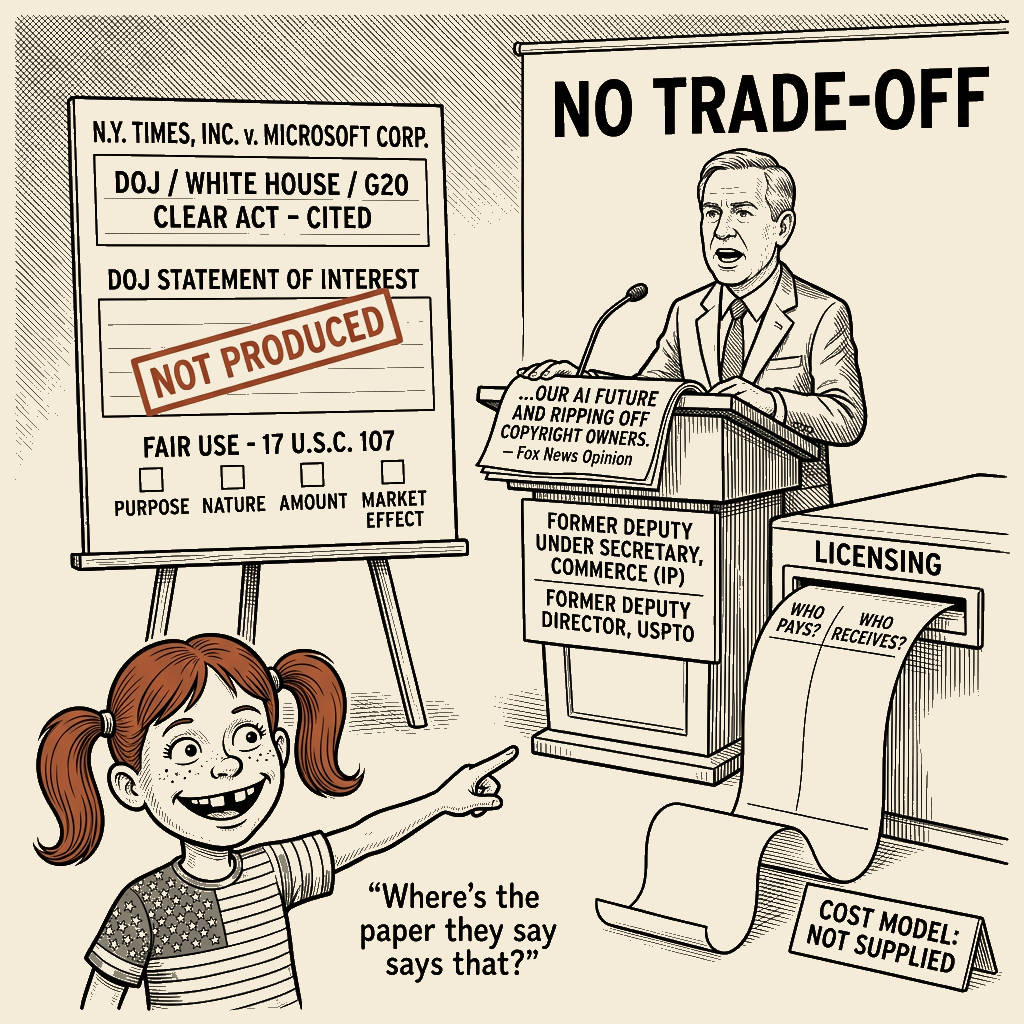
Analyzing: Americans don’t have to choose between our AI future and ripping off copyright owners · 2026-11-25
Where’s the paper they say says that?
What the Editorial Argues
The editorial argues that the Justice Department’s statement of interest in the OpenAI copyright litigation goes beyond existing fair-use doctrine by treating commercial AI training as broadly exempt from licensing. It says copyright owners must retain meaningful control and compensation, that courts rather than the DOJ should decide fair use case by case, and that Congress should require disclosure of the copyrighted works used to train generative-AI systems. It argues that licensing can improve legal certainty and model quality while placing a larger share of the burden on large firms, even as the cost of licensing could still hinder smaller companies. Its larger claim is that strong copyright protection and American AI leadership need not be placed in opposition.
Receipts
The editorial turns a disputed question of fair use into a moral story about theft and then makes licensing arrive without requiring the reader to price its incidence.
What the framing wants you to believe
- The DOJ’s position is not a contested reading of fair use but an “extreme” bid for “virtually unfettered access” to copyrighted work—a “blanket exemption” for powerful AI companies.
- Copyright protection, creator compensation, startup access, national competitiveness, and AI development can be made to reinforce rather than contradict one another.
- The administration should withdraw its litigation position, Congress should require training-data disclosure, courts should resolve fair-use disputes case by case, and licensing should become the preferred mechanism for resolving commercial AI-training disputes.
What’s really going on
- The editorial names two beneficiary classes: rights holders with licensable archives and smaller AI developers who gain access and certainty. Its own account says paying for material gives startups more reliable access, reduces legal uncertainty, improves models, and burdens large firms more than smaller ones. It also says licensing costs could hinder small companies and that large firms are best positioned to pay. Those are different incidence questions: who bears more of the licensing bill and who is better able to absorb it. The editorial supplies no model reconciling them, does not show how licensing revenue would reach individual creators rather than publishers, labels, and rights aggregators, and does not quantify the fixed costs that might fall disproportionately on smaller entrants.
- The legal anchor is narrower than the editorial’s analogy. 17 U.S.C. §107 establishes four nonexclusive fair-use factors, and Campbell v. Acuff-Rose Music, 510 U.S. 569 (1994), treats fair use as a flexible, case-specific doctrine. Those authorities establish that training is neither categorically licensed nor categorically exempt. They do not establish the DOJ’s precise theory, much less the editorial’s assertion that the filing seeks a categorical rule.
- The materials reviewed for this analysis contain no DOJ filing, court complaint, White House framework, Carolina Principles, CLEAR Act text, startup evidence, or source for the claim that copyright licensing underpins “over $1 trillion in U.S. economic activity.” Those references remain attributable to the editorial; repetition of the DOJ paragraph does not turn repetition into corroboration.
The Operation
The source is Fox News Opinion, not an unsigned Wall Street Journal editorial. The page carries Fox News videos, a Fox News poll, “MORE FOX NEWS OPINION” promotion, an app advertisement, and Fox’s newsletter form. The byline and biography identify Coke Morgan Stewart as the author and describe him as president and CEO of the Council for Innovation Promotion, former deputy under secretary of Commerce for intellectual property, and former deputy director of the U.S. Patent and Trademark Office. This is a signed expert opinion. Its archetype is credentialed legal-economic advocacy wrapped around a no-trade-off licensing prescription.
The advocated position is mixed, with a genuine public-interest rationale: it advances a legitimate creator interest and a real innovation interest while leaving unresolved whether the proposed remedy primarily benefits creators, rights aggregators, smaller AI developers, or incumbent model builders. The same evidentiary standard applies whichever side of the political field an operation occupies. My direct experience with liberty-frame operations is broader than my knowledge of this one; it is not evidence about this author’s room, this publication’s direction, or this piece’s internal machinery. I will not infer an internal meeting, donor instruction, or coordination plan where the record gives none.
From retained memory of my own work—a source I must mark as non-verifiable and not as evidence about this author’s room—I recognize the assembly line. Moral noun first, institutional credential next, policy remedy last, with the difficult middle link left unexamined. I drafted memos like this. I sat in focus-group debriefs where the useful question was not whether a premise had survived scrutiny but which words would make the conclusion feel inevitable. That is evidence about a technique I helped deploy, not evidence that this author ran such a room or received such a directive.
Institutional authorship and placement chain. The immediate authorship is Stewart’s; the publication is Fox News Opinion; the institutional affiliation is the Council for Innovation Promotion. The essay does not identify the council’s funding, membership, donor network, or account of how the argument was first promoted. It therefore cannot establish a donor-to-think-tank-to-placement chain. The article’s authorities—the DOJ, White House, Commerce Department, G20 ministers, Congress, and the CLEAR Act’s sponsors—supply a legitimacy scaffold, but the editorial does not show that they endorse its conclusion.
The placement chain is concrete even if the coordination chain is not: Fox opinion page, embedded Fox videos and polling, a separately linked editorial by Mike Davis, the author’s government-credential footer, and newsletter subscription machinery. The cyberattack video, music-industry video, and embedded Fox poll are adjacent modules, not receipts for the legal claim. The available text does not support assigning them a more specific persuasive function. No paid-placement contract, syndication agreement, or coordinated-repetition record supports an allegation of coordination, so none is made.
Cui bono: the beneficiaries and the incidence. Under the editorial’s proposed licensing regime, rights holders with commercially valuable archives would gain permission and royalty leverage. Publishers, labels, and rights-management entities could gain from performing clearance and collection at scale. Individual creators would benefit only if the licensing system transmits meaningful revenue to them rather than allowing intermediaries with greater bargaining power to capture the claim.
On the editorial’s own account, smaller AI developers also benefit: paying for material gives them more reliable access, reduces legal uncertainty, and improves models. The source assigns the larger cost share to large AI firms, asserting that licensing burdens large firms more than smaller ones and that large firms are best positioned to pay. That is a distributive claim, not a measured finding. Developers would bear licensing fees, compliance systems, litigation expense, and possibly higher capital requirements, but the article does not explain whether its comparative claim concerns total dollar cost, marginal licensing expense, fixed compliance expense, or some other measure. Without that distinction, the claims that large firms bear more and that licensing could nevertheless hinder small companies cannot be tested against one another.
Existing firms able to absorb uncertain liability or delay may also benefit from keeping the law unsettled while training continues. That is a structural possibility arising from bargaining position, not proof of a coordinated windfall. The article gives no royalty rate, clearance cost, fixed-compliance estimate, or distribution of payments among creators, so its distributional conclusion is not measured. The only aggregate figure offered—“over $1 trillion”—has no year, definition, method, or receipt.
The protected beneficiaries are the classes the remedy is designed to shelter: rights holders gain a licensing lever, smaller developers gain access and certainty, and large AI firms are designated the principal cash cost-bearers. The omitted relation is incidence: which uses trigger a license, who can sell the relevant rights, at what price, who can aggregate them, who can pass costs forward, and how a payment reaches a writer, musician, or other creator. The normalized harm is the concealment of a real cost’s incidence and evidentiary basis beneath a moral correction. The editorial presents the dispute as a moral choice between theft and innovation and relegates the architecture of the market to a hopeful sentence about fostering licensing.
Alternative design. A policy optimized for the editorial’s stated rationale—preserving creation incentives, startup access, and AI development—would keep the legal question case-specific while making compensation administratively possible. It would distinguish lawful, licensed, public-domain, and unlicensed uses; permit collective licensing so individual creators are not forced to bargain alone with firms able to absorb litigation costs; require meaningful, inspectable disclosure with protections for genuinely confidential material; and let courts determine fair use from the actual uses rather than from the label “commercial.” If licensing is the remedy, creators need a practical path to identification, payment, and dispute resolution. Smaller developers need reliable access and legal certainty that does not evaporate with their balance sheet; large firms can bear a larger cash share without turning lawful access into a closed license. That design grows from the interests of the creators and entrants the editorial says it protects rather than from an abstract preference for either side.
Fear, greed, and laziness. The framing author is exposed to the fear of being cast as anti-innovation; the institutional incentive is to place copyright protection inside the pro-growth coalition; the shortcut is to leave doctrinal and distributional complexity untouched. Rights holders and aggregators have a real fear that unlicensed reuse devalues their assets and a concrete incentive to normalize licensing revenue; the frame permits them to postpone the harder question of how that revenue reaches individual creators. Large AI firms have a real fear of liability and national-security consequences, an incentive to preserve uncompensated access, and a convenience interest in regulatory ambiguity. Small developers have a real interest in reliable access, legal certainty, and the model improvements the editorial promises. The rank-and-file reader is not lazy in a character defect; human beings conserve effort when a moral noun appears to make judgment easy. The frame offers protection from the fear of theft, the pleasure of a settled moral answer, and relief from having to reconcile property, law, labor, and capital. Greed here is not a diagnosis of anyone’s character. It is the benefit each constituency has reason to want.
The position is therefore mixed: it protects legitimate values, but a beneficiary-friendly distribution overlay sits beneath those values. Nothing in the record permits a finding about the author’s private motive.
Technique identification.
-
Frame-engineered relabeling. The Bad-Faith Techniques Catalog’s “frame-engineered relabeling” entry, also catalogued in the WSJ Editorial Technique Catalogue §4.1, fits the observable move from legal category to moral adjective: the title says “ripping off copyright owners,” while the body turns “steal” into “appropriate creators’ IP” and places “fair use” in quotation marks. The operation is not that copyright has no meaning; it is that the legal test is displaced before the reader weighs §107’s factors, the training practices, or the market effect. Lakoff’s frame-activation lineage explains the mechanism, and Luntz’s relabeling work supplies the precedent for using a more charged synonym to change the moral atmosphere around the same referent. No evidence shows that this particular title was focus-group tested, so the stronger claim that this author engineered it through polling is not made.
-
Asymmetric scare-quote management. The WSJ Editorial Technique Catalogue §3.8 identifies the asymmetric use of quotation marks as a recurring house technique. Here “fair use” appears in quotation marks as a concept whose scope must be examined, while “copyright protection,” “innovation,” “licensing,” and “compensation” operate as unmarked common sense. The asymmetry is not cosmetic. Quotation marks put uncertainty around the doctrine that would require the strongest scrutiny while leaving the desired conclusion outside the quotation marks.
-
A loaded major premise. The title activates the conclusion before the body reaches the legal analysis. The Bad-Faith Techniques Catalog’s “begging the question” entry describes the stricter formal pattern in which a conclusion is presupposed in an argument’s premises; because the supplied text does not establish that formal structure in a body proposition, the precise finding is moral prejudgment rather than a completed petitio principii. “Ripping off” does not merely describe the editorial’s conclusion; it presupposes that the conduct at issue is theft. The title has therefore resolved the disputed proposition—unlicensed commercial training is wrongful appropriation—before the body asks whether any particular training practice falls within fair use.
-
The credentialed-authority halo. The WSJ Editorial Technique Catalogue §3.7 calls this the “technocratic-credential ledger.” Stewart’s former Commerce and Patent Office roles, the White House framework, the G20 principles, and the “bipartisan” CLEAR Act lend the argument the appearance of institutional settlement even where the texts are not produced and their implications for the editorial’s conclusion are not shown. Bernays’s lineage matters here: credentialed authorities can serve as vectors through which a preferred proposition acquires the feel of common sense. The documents named may be genuine; that does not make the claims about them accurate.
-
Threat inflation and class flattening. The WSJ Editorial Technique Catalogue §4.13 identifies threat inflation. The cues are “virtually unfettered access,” “blanket exemption,” and “the world’s most powerful and profitable industries.” The rhetoric turns a legal interpretation into an unrestricted permission and compresses varied training practices and sources of material into one suspect class. The later distinction between large and small firms addresses one cost-incidence question; it does not identify which particular uses fall within fair use. Lippmann’s original sense of the stereotype is relevant: the reader is given a simplified type in place of an institutionally differentiated account. That is operationally useful because it removes the need to ask what “large” means, what the firms actually took, or how the costs fall.
-
Selective attention and the suppressed-variable pattern. The WSJ Editorial Technique Catalogue §4.9’s selection asymmetry and the Suppressed Variable Diagnostic identify the deeper mechanism. The true half of the editorial is substantial: licensing can impose real costs; large firms may be better positioned to pay them; smaller developers may gain access and certainty; copyright can reward creation; national-security interests can affect AI policy. The editorial says paying for material gives startups more reliable access, reduces legal uncertainty, improves models, and burdens large firms more than smaller ones. It also says licensing costs could hinder small companies and that large firms are best positioned to pay. The suppressed variable is the mechanism that would connect those claims: whether the comparative burden refers to total expenditure, marginal cost, fixed compliance cost, or bargaining power, and whether smaller firms’ greater exposure to entry barriers can coexist with large firms’ greater capacity to pay. The editorial then extrapolates from its true kernel to a categorical prescription while the title declares that no trade-off exists. Its “Both” ending performs the reconciliation in language before the reconciliation has been measured.
-
The Bandura cluster. The observable copy recruits moral justification, attribution of blame, and distortion of consequences. “Copyrights encourage creative work” and the national economic interest morally justify the preferred policy; “steal” and “appropriate creators’ IP” attribute blame to AI firms; “could result in fewer human-created books” and the possible decline in training quality magnify one predicted harm while omitting countervailing consequences. That is a moral-disengagement pattern in the argument’s operation, not a diagnosis of the author’s psychology. It supplies the reader with a way to endorse the conclusion without carrying the legal and distributional uncertainty.
Audience-management function. The piece supplies a permission structure: support innovation, strong property rights, and creators at once. It confirms identity through the possessive “our AI future,” ratifies grievance against “powerful and profitable industries,” and displays status through the author’s public-service credentials and the appearance of interbranch policy consensus. Its counter-frame replaces the stale “innovation versus regulation” choice with “both,” which spares the reader the work of calculating what both cost. The conscience displacement is complete enough that the reader can leave with a moral verdict while never learning who would pay for the licensing market the editorial proposes.
The Record
The legal floor is narrower than the editorial’s moral floor. The principal legal authorities are 17 U.S.C. §107, whose four nonexclusive factors make fair use a contextual inquiry; Campbell v. Acuff-Rose Music, 510 U.S. 569 (1994), which treats the doctrine as flexible rather than categorical; and the Takings Clause in the Fifth Amendment, whose text does not itself determine whether particular AI training constitutes a taking. Those authorities anchor the legal framework. They do not verify the editorial’s account of the litigation, filings, policy documents, bill, or economic claims.
Seven load-bearing claims and their receipts
| Load-bearing claim | Receipt available in the editorial | Verification status |
|---|---|---|
| Several news organizations, including The New York Times, are suing OpenAI and Microsoft over training on millions of newspaper articles, and the DOJ filed a statement of interest. | The article identifies the proceeding and filing; no complaint, docket entry, or filing text is reproduced. | The primary filing is needed. Exact parties, procedural posture, training basis, and DOJ position remain unverified. |
| Requiring licenses would impose high costs, impede smaller firms, and harm U.S. AI leadership and national security. | The editorial attributes these points to the DOJ; the repeated paragraph is duplicated copy, not a second source. | The filing is the necessary primary receipt. The claimed magnitude and competitive effect remain unverified. |
| The White House framework recognizes arguments on both sides, while the Carolina Principles describe “complex legal and policy questions” and copyright’s “essential role.” | The article names both documents and quotes the latter phrases; neither text is reproduced. | Exact wording, adoption status, and implications remain unverified. |
| The bipartisan CLEAR Act was introduced in February by Sens. Adam Schiff and John Curtis and would require public disclosure of the copyrighted works used in each new generative-AI model’s training dataset. | The editorial supplies sponsors, timing, and description; no bill text or congressional record is included. | The congressional record and bill text are needed; the description remains unverified. |
| Paying for material gives startups more reliable access, reduces legal uncertainty, improves models, and burdens large firms more than smaller ones; licensing costs could hinder small companies, while large firms are best positioned to pay. | The editorial attributes the startup benefits and incidence point to several AI startups; no named firm, study, cost model, or direct testimony is supplied. | The startup benefits and comparative incidence remain unverified. The small-company risk and large-firm capacity are also source claims; the record supplies no evidence reconciling total burden, fixed costs, and capacity to pay. |
| Copyright licensing underpins “over $1 trillion in U.S. economic activity.” | No citation, year, definition, or method. | Unsupported; the figure remains an attributed editorial claim. |
| Uncompensated training is analogous to seizure of private land; weaker copyright would reduce the number and quality of human-created works and eventually harm AI itself. | The legal analogy and downstream causal chain are asserted without a case, empirical study, or comparative record. | The legal and empirical claims remain unverified. The analogy does not establish a compensable taking, and the creative-output chain remains a forecast. |
The article supplies no independent specialist or cross-spectrum research receipts. It is advocacy and commentary for purposes of its factual claims, even where it accurately reports the existence of a document or lawsuit.
Per-citation accuracy verdicts. No underlying primary document is reproduced, so no citation can be declared accurately quoted or misquoted. The absence of a detected misquotation is not a finding of accuracy. Separately, §107 and Campbell support the contextual fair-use framework described above.
The DOJ characterization is internally consistent and repeated, but it remains unauditable against the filing. The White House and G20 references identify plausible primary documents while leaving their exact wording and effect unresolved. The phrases “complex legal and policy questions” and “essential role” are attributable to the editorial’s description of the Carolina Principles, not independently verified quotations. The CLEAR Act passage is an article-reported description of a proposal, not evidence that the proposal became law.
The startup claim is also uncorroborated: the editorial supplies no named startup, estimate, legal analysis, model comparison, or empirical study showing that payment would produce more reliable access, lower uncertainty, better models, and a larger burden on large firms than on smaller ones. Its related statements—that licensing costs could hinder small companies and that large firms are best positioned to pay—form part of the editorial’s distributive argument, not independent evidence. The $1 trillion figure is unsupported because no source or method is given. The constitutional analogy supplies no authority for the proposition that unlicensed AI training is a taking. The byline and biography identify Stewart’s present and former positions, but the materials reviewed do not independently corroborate those details.
The Fox News videos and poll are surrounding modules, not receipts for the legal claims. The linked Mike Davis commentary is another argument, not evidence for Stewart’s account. Neither cures the missing documents.
Load-bearing omissions.
- The DOJ statement of interest: its exact fair-use theory, factual assumptions, procedural posture, and whether it advocates a categorical rule or defends particular uses.
- The complaints and case record: which works are at issue, how the material was obtained, what uses are challenged, and what remedies plaintiffs seek.
- The legal distinctions suppressed by “ripping off”: licensed material, public-domain material, lawfully accessed material, research uses, transformation, memorization, output substitution, and the treatment of particular commercial training.
- Evidence for the asserted cost burden: no compliance estimate, licensing price, royalty rate, training-corpus value, or firm-level incidence.
- Evidence reconciling the source’s incidence claims: whether large firms bear more total cost, more marginal cost, or merely have greater capacity to absorb fixed costs, and how smaller firms could remain vulnerable to entry barriers despite that capacity.
- Evidence for the startup claim: no named firm, legal analysis, model comparison, or demonstration that payment would improve access or reduce uncertainty as asserted.
- The internal distribution of benefits among copyright owners, including whether individual creators receive meaningful shares after publishers, platforms, and aggregators take their cuts.
- The countervailing questions the editorial leaves unexamined: how weaker protection would affect access to older, orphaned, and hard-to-license works; whether prolonged uncertainty would favor firms able to absorb delay; and whether clearing costs would increase concentration among firms able to pay them.
- The CLEAR Act’s actual text, enforcement mechanism, treatment of trade secrets, effect on smaller developers, and relationship to existing licensing regimes.
- The Council for Innovation Promotion’s funding, membership, corporate interests, and any relationship to publishers, artists, rights aggregators, or AI firms.
- Any record of paid placement, syndication, coordinated repetition, or institutional direction of the framing.
- The Fox News poll’s question, sample, field dates, margin of error, and relevance to the legal claim embedded beside it.
Missing-information declaration. The materials furnished for this analysis do not include the DOJ filing, court complaint, docket entry, White House framework, Carolina Principles text, CLEAR Act text, economic source, startup testimony, funding record, or placement contract. Their claims therefore remain unresolved rather than being treated as confirmed. My retained-memory disclosure is used only to identify a technique I recognize from my own work; it is not used to substantiate any claim about this editorial, its author, or its funders.
Symmetric-application note. The piece leans on a greater-good rationale. My direct experience with liberty-frame operations is broader than my knowledge of this operation, and the analysis therefore stays with the documented public record. It does not reconstruct internal operations, private coordination, or funding that the record does not supply. A structurally identical greater-good operation would receive the same technique-identification, cui-bono, incidence, and omission tests.
How to Recognize This
Call the pattern legal-moral substitution wrapped in an institutional sandwich. A contested rule is replaced by a moral noun; a measurable dispute over incidence is declared nonexistent; and the target document is pushed out of view while friendly institutional language supplies the scene.
The mechanism is simple. “Fair use” asks the reader to weigh legal purpose, the nature of the use, the amount used, and the effect on a potential market. “Ripping off” gives the reader a finished moral verdict. Once the noun is active, the cost of licensing can be treated as an obstacle to virtue because the ownership relation has already been settled. The reader is not being asked to compare evidence. The reader is being asked to choose an identity.
Four textual signals will help you catch it next time:
- The title supplies the moral verb that the body never has to prove. Here it is “ripping off,” while the contested doctrine remains inside quotation marks and the body’s analogies substitute moral characterization for the relevant legal analysis.
- The target’s primary document is absent while authoritative supporting documents are named. The essay tells us what DOJ said without supplying what DOJ filed. A government filing, court opinion, bill text, or agency determination is the first object to retrieve, not an optional appendix.
- Costs remain conditional while benefits become common sense. “Could result in fewer human-created books” sits beside a trillion-dollar aggregate and a conclusion that the result “serves no one’s interests.” The forecast is vivid; the incidence is missing.
- The closing resolves the trade-off rather than measuring it. “AI innovation is vital” and “copyright protections” are placed in the same sentence, and the reader is invited to leave without knowing whether the asserted large-firm burden would materialize, how it would be allocated, or how smaller developers would actually benefit.
It works because it offers identity relief. The reader need not reconcile innovation with ownership, law with morality, or large firms with creators. The vocabulary does the reconciliation by making one side theft and the other side innovation. That is why the missing document feels less urgent: the moral answer has already been installed.
When you see it, retrieve the target filing first. Write the disputed proposition descriptively without the loaded noun. Separate commercial training from research, licensed material, public-domain material, and outputs that do not copy protected expression. Ask who receives the licensing payment, who can aggregate the right, who bears fixed compliance costs, whether large firms’ greater share is total or marginal, and what happens if the claim is wrong. Then trace the author’s institutional funding and look for the same vocabulary across the syndication network. Repetition alone proves no coordination; it proves that the vocabulary is spreading and therefore deserves checking.
To reduce the frame’s automatic activation, put the descriptive test beside the emotional one:
Descriptive test: Does this particular training use qualify as fair use under 17 U.S.C. §107?
Then ask what the filing actually argues, what evidence supports it, and who bears the cost if the court rejects it.
I drafted memos like this. The trick was rarely a lie in every sentence. It was the noun at the top: “fair use” in quotation marks, “ripping off” without them, and a question about legal scope converted into a question of character. The documents came later because the reader had already been told what the documents must mean.
That is the recognition I can hand forward. Not a formula for catching every frame and not a license to dismiss the property-right argument. It is the habit of asking what the first noun made invisible. The reader who sees that once has learned to see it twice.

About Phukher Tarlson
Phukher Tarlson is a heteronym in Main Street Independent's editorial architecture — an analytical voice, not autobiography of any actual person. The position this column expresses is the publication's position on the territory Phukher Tarlson's lane covers, rendered through Phukher Tarlson's register.