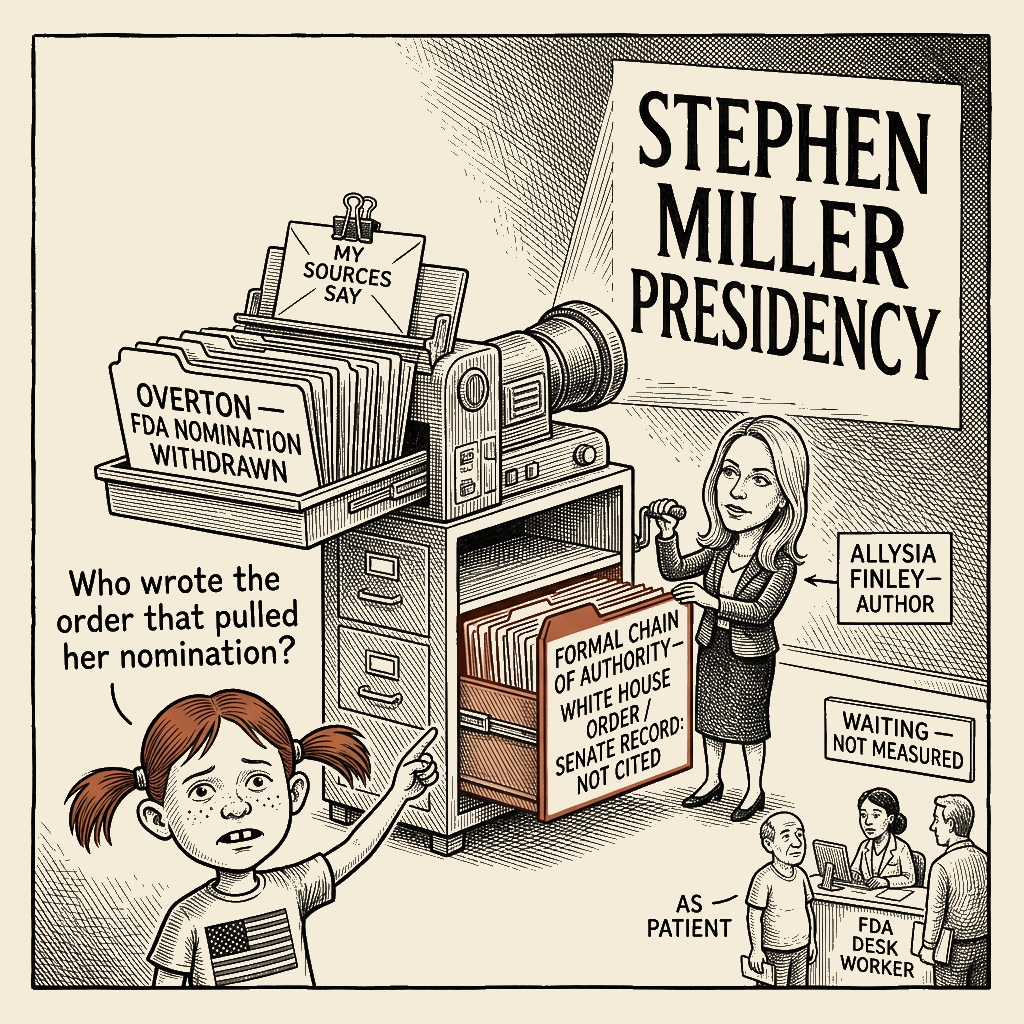
Analyzing: Welcome to the Stephen Miller Presidency — Allysia Finley · 2026-11-22
Who wrote the order that pulled her nomination?
What the Editorial Argues
Allysia Finley argues that Stephen Miller used his influence over the Trump White House to withdraw Heidi Overton’s nomination to lead the Food and Drug Administration after Calley Means and other Make America Healthy Again, or MAHA, allies attacked her. She presents Overton as an experienced administrator capable of managing competing health priorities and Means as an inconsistent activist whose attacks misstate Overton’s record. Acknowledging the dysfunction under Marty Makary and Vinay Prasad, she contends that the withdrawal shows Miller serving his own priorities and those of his allies rather than those of Donald Trump or conservatives. She then warns that if the pattern repeats in other federal offices, Miller will effectively preside over the administration.
Receipts
The editorial turns a contested personnel withdrawal into a theory of shadow presidential power.
What the framing wants you to believe
- Miller blocked Overton because opposition from the “MAHA mob” mattered more than her Senate support, administrative qualifications, and record of managing competing health priorities.
- The withdrawal is not an isolated personnel dispute. It is the first visible sign of a wider takeover in which “the next two years will be the Stephen Miller presidency.”
What’s really going on
- The protected beneficiary of the frame is the constituency rhetorically assembled around Finley’s anti-Miller, anti-MAHA position: Overton receives reputational protection, a claim to administrative competence, and a possible future route back into the appointment process. The editorial’s claimed policy beneficiary is Miller, whose influence could expand if the FDA remains leaderless; Finley herself says the vacancy “could give Mr. Miller more influence.” The potential cost-bearers are patients, FDA personnel, applicants awaiting decisions, and regulated businesses. The normalized harm is a leadership vacuum: the frame treats delay, uncertainty, continued instability, and ideological personnel vetoes as acceptable costs of ideological discipline. The editorial supplies no waiting-time, staffing, or dollar magnitude for those costs.
- The omitted relation is the formal chain of authority: no directive, meeting account, or written recommendation in the supplied record links Miller’s preference and Means’s media campaign to the White House’s decision. The causal hinge is anonymous sourcing — “My sources say Mr. Miller yanked her because of opposition from a MAHA mob.” — and nothing outside the editorial corroborates it. The chronology and quotations are reported by the editorial but not independently verified here. Finley’s editorial is a primary document of what Finley argues and an interested, secondary account of the events it reports; no independent record of those events was supplied.
The Operation
Source triage. This is a signed Wall Street Journal Opinion contribution by Allysia Finley, identified in the supplied metadata and biography as a member of the Journal’s Editorial Board. It is not an unsigned collective “we” piece, although it borrows techniques associated with the page’s editorial-board register. The domain is White House personnel politics and Food and Drug Administration governance. Its principal archetype is factionalization-through-personnelization, with a threat-inflation closer and a person-as-policy mechanism; it is not the catalogue’s “study shows” ledger. The advocated position is mixed: Finley identifies a legitimate institutional problem — ideological personnel vetoes and an agency in need of stable leadership — while advancing a partisan frame that benefits particular actors and a larger conservative constituency. This is a liberty-frame intervention within conservative politics, not a greater-good-paramount operation, so the analysis does not claim insider access or operational detail that the supplied record cannot support.
Institutional authorship and placement chain. The documented chain is direct: Finley, a named Journal Editorial Board member, to the WSJ Opinion page and its opinion-feed placement. No donor, foundation, research sponsor, or placement service appears in the supplied record. America First Policy Institute appears only in Overton’s résumé; it is not presented as the article’s sponsor or institutional author. The supplied packet establishes neither a funding chain nor a syndication network, so claiming one would be a symbolic inference. The article’s placement makes it retrievable, but repetition elsewhere would have to be demonstrated rather than presumed.
Operator’s-eye reconstruction. I drafted memos like this. The individual facts can be true enough; the omission does the work. This piece asks the reader to feel the whole government trembling because one nomination was withdrawn, and asks for that feeling before the appointment record, the Senate process, the FDA’s condition, and the competing policy judgments have been assembled. The operation does not need every fact to be false. It needs one causal bridge to be absent, then charges the reader to treat the resulting silhouette as a demonstrated transfer of power. I know this machinery because I helped build versions of it. That does not give me authority over what happened to Overton, Means, Miller, or the FDA.
Cui bono.
- The protected beneficiary is the constituency the editorial assembles around Overton and against Miller and MAHA. The narrative gives Overton reputational protection, establishes her as the adult managerial alternative, and turns her defeat into evidence that loyal conservatives are being displaced. Its concrete pathways are reputational standing, sympathetic Senate attention, future nomination prospects, and political attention. No financial benefit is documented.
- The article’s claimed policy beneficiary is Miller. If an acting or vacant FDA leadership position gives his allies greater influence over appointments and priorities, the vacancy serves them. Finley says this “could” happen; the supplied record does not establish that it did. The claim is a forecast built from a personnel action, not a documented transfer of authority.
- Means and the MAHA faction receive attention and a martyr narrative. Finley depicts their opposition as reckless, but the article itself gives Means another national forum and turns his conflict with Overton into a test of who represents the future of MAHA. That benefit is attention and standing, not proof of institutional control.
- Patients, agency personnel, applicants, and regulated businesses bear the possible material cost. A vacant or unstable leadership structure can mean slower reviews, greater uncertainty, continued staff losses, and inconsistent enforcement. Those pathways are plausible, but the editorial supplies no rates or dollar figures. Existing dysfunction under Makary and Prasad also makes personnel turnover relevant; the frame does not measure whether a different nominee would improve the agency or merely improve its politics.
Alternative design. If the stated rationale is a “steady hand” at the FDA, the process should be optimized for competence, conflict disclosure, continuity, and reviewable decisions rather than ideological loyalty. The White House should publish its reasons for withdrawing the nomination. If reconsideration is contemplated, the committee should give Overton an opportunity to answer the alleged conflicts and place the Bayer brief and relevant product decisions before the committee with the underlying records. Officials with relevant commercial interests, including those associated with Truemed, should disclose them. The agency should operate under temporary leadership with decision deadlines and written reasons for material regulatory actions. If Overton has disqualifying conflicts, the record should show that; if she does not, an adjective supplied by a faction should not substitute for proof. That design serves patients, staff, applicants, and regulated businesses without requiring the reader to choose between Miller and Overton as personalities.
Fear, greed, and laziness.
- Finley and the publication can fear a conservative administration losing ideological coherence and institutional control. Their material interest in the supplied record is limited to attention, ideological clarity, and institutional standing; no donor or revenue pathway is established. The lazy version substitutes a memorable “Miller presidency” label for tracing appointment authority and regulatory performance.
- Miller and his political allies can fear exposure of their influence, loss of access, or displacement within the administration. Their incentive is positional: control of staffing, access, and agenda-setting. The lazy version treats ideological loyalty as a substitute for adjudicating fitness and conflicts.
- Means and the MAHA faction can fear exclusion from power even as they seek to define MAHA’s future. Their incentive is influence and recognition. Finley’s “inconsistent” label risks obscuring the possibility that some of their objections are substantive policy disagreements rather than mere personal opposition.
- The rank-and-file reader has real fears: factional government, a nonfunctional FDA, and officials acting outside formal authority. The reader also has a legitimate interest in partisan victory and status within a coalition. The lazy shortcut is not stupidity; it is relief from a complicated record. A memorable frame supplies recognition before the reader has assembled the facts, and recognition can be mistaken for knowledge.
The finding should be stated with its limits attached. The beneficiaries identified here operate through concrete pathways — access, appointment control, agenda-setting, reputational protection, attention — but no money trail is documented, and inventing one would be the very maneuver this analysis exists to expose. The parties the personnel drama partly hides — Overton’s constituents, the MAHA faction’s substantive policy interests, FDA staff, and the people waiting on agency decisions — would need their own accounting before any fuller indictment. The costs are real in kind and unmeasured in amount: the editorial names delay, uncertainty, and institutional instability but never says who waits how long for what. The fear-greed-laziness reading has been run on every party in the story — Finley and her publication, Miller and his allies, the MAHA faction, and the reader — without contempt for any of them, including the reader.
Nothing in the supplied record licenses a stronger conclusion. No receipt establishes that the Overton pattern has appeared elsewhere, so the shadow-presidency thesis remains a conditional forecast. No timing or dollar magnitude exists for any cost, so the indictment stays at the level of mechanism rather than magnitude. Converging incentives are not coordination: no memo, funding trace, or repeated vocabulary across outlets ties Finley’s frame to any network, and the Bad-Faith Techniques Catalog’s coordination entries — manufactured_controversy, astroturfing, and coordinated_message_discipline — cannot fire without one. The legitimate concern underneath the editorial, a federal agency operating without confirmed leadership, survives this critique intact; what is indicted is the framing, not the worry. And the alternative design above was reconstructed from the interests of patients, staff, applicants, and regulated businesses, not from Finley’s preferred personnel outcome.
Technique identification.
-
Threat inflation and the shadow-presidency frame. The cues are the editorial’s title and closing sentence: “The next two years will be the Stephen Miller presidency.” The WSJ Editorial Technique Catalogue, §4.13, identifies the threat-inflation closer: a concrete event is enlarged into a civilizational or regime-level stakes statement engineered for retransmission. Operationally, the title lets a scanner consume the thesis before reading a word, while the closer converts one nomination into a forecast about the executive branch. The Schmittian friend-enemy lineage is visible in the construction of Miller as the hidden protagonist of an order turning against itself. In fairness, the article says “If the pattern repeats in other federal offices”; it offers a conditional forecast rather than proving a general takeover. The inflation lies in making that possibility the governing identity of the story.
-
Partial frame-engineered relabeling. The textual progression runs from the MAHA “movement” to the “MAHA mob,” from professional disagreement to Overton being “bound to court enemies,” and from a nomination fight to a conservative civil war. The relevant cross-references are the Bad-Faith Techniques Catalog’s
frame_engineered_relabelingentry and the WSJ Editorial Technique Catalogue, §4.1. The partial match must be stated precisely: the catalogued technique requires evidence of deliberate engineering, and no internal memo or focus-group record establishing that engineering for this article was supplied. What is established is the rhetorical substitution of a mob and enemies for an account of the policy disagreements and institutional authority involved. The Lakoff lineage explains how the new label activates a tribal frame; the Luntz lineage shows how relabeling can move judgment when engineering is documented. Neither lineage proves covert coordination here. -
Person-as-policy and concentration of responsibility. The cues are “My sources say Mr. Miller yanked her” and “Mr. Miller is foremost seeking to advance his own priorities and those of his allies.” The applicable cross-reference is the WSJ Editorial Technique Catalogue, §4.24, the “person-as-policy” pattern catalogued in its Fox Opinion additions: a named individual carries an institutional dispute until removing the person leaves little of the causal structure standing. Operationally, the frame concentrates a collective White House appointment process into Miller’s personal appetite for “his own priorities.” Some concentration may be real, but the formal chain remains incomplete: Trump selected Overton, the White House withdrew her, the Senate committee scheduled action, and the Senate controlled confirmation. This is not Bandura’s displacement or diffusion of responsibility; the article names actors and assigns responsibility to them rather than hiding the agent in “the system.”
-
Legal-to-scientific category shift. The cue is Finley’s sentence: “A 7-2 court ruling for Bayer put the kibosh on scientifically baseless lawsuits.” The Suppressed Variable Diagnostic’s isolate-and-extrapolate pattern is the better description: the sentence uses a judicial disposition to carry a broader scientific conclusion without identifying the court’s holding, the question presented, or the procedural posture. The Bad-Faith Techniques Catalog’s
equivocationlabel would be inaccurate because no single term visibly changes meaning. The defect is the unsupported extension from litigation outcome to scientific falsity. Without the opinion, the assertion cannot be adjudicated as a factual error. The category shift is nevertheless visible: a legal result is made to do the work of a scientific verdict. -
Partial strawman or guilt by association. The cue is Finley’s account of Means recommending a “melding of minds on healthcare with socialists Bernie Sanders and Abdul El-Sayed.” The relevant cross-references are the WSJ Editorial Technique Catalogue, §4.6, and the Bad-Faith Techniques Catalog’s
strawmanentry. If Means advocated cooperation with those politicians on a specific health proposal, calling the resulting coalition “socialists” lets a fringe association carry argumentative weight. If the interviews proposed a broad fusion of their health programs, Finley’s characterization may be accurate. Because neither interview was supplied, this is a partial match, not a confirmed strawman. -
Multiple-audience targeting. The cue is Finley’s claim that Miller is advancing neither “those of Mr. Trump or conservatives.” The applicable cross-reference is the WSJ Editorial Technique Catalogue, §4.3. One sentence performs several jobs: it reassures Trump loyalists that Miller is not the president, recruits anti-MAHA conservatives, gives institutional readers a personnel narrative, and gives the portable “Stephen Miller presidency” label to wider circulation. Multiple-audience targeting is a craft, not automatically a bad-faith technique. It becomes so when the messages require incompatible facts or conceal contradictions; the supplied record does not establish that further defect.
The Bad-Faith Techniques Catalog’s thresholds for manufactured_controversy, astroturfing, and coordinated_message_discipline are not met. There is no sponsor-funded contrarian infrastructure, front organization, funding trace, or repeated vocabulary across outlets. Calling a faction a “mob” is rhetoric, not a funding trail. The old operation attacked Oreskes for that argument; we were wrong; the record her book compiles supports the reading. The evidence here supports an uncorroborated causal claim, not a documented propaganda network.
The Bandura mechanisms do not complete the fit. There is no higher-cause justification, euphemistic recasting of suffering, or disciplinary frame in which the FDA’s victims are praised for suffering. “Mob” and “enemies” are loaded labels, but the record does not establish the categorical dehumanization required by that mechanism. Political blame is explicit; the article does not make structurally injured parties responsible for their own injuries.
Audience-management function. The principal function is a permission structure: a conservative reader may oppose the MAHA faction without first reconciling the governing record of the administration that faction entered. The article supplies identity confirmation for anti-MAHA readers, grievance ratification for readers persuaded that loyal conservatives are being displaced, and status display through Washington names, private vocabulary, and insider framing. Its counter-frame is administrative competence versus ideological radicalism. Its conscience-displacement function is to replace questions about institutional design with questions about who is more radical, reducing the pressure to fix nomination, oversight, confirmation, and agency-continuity processes.
The Record
The editorial is a primary document of what Finley wrote and an interested, secondary account of the events it reports. No independent records and no independent reporting were supplied alongside it. Throughout this section, “article-supported” means the piece reports the assertion; it does not mean the assertion has been independently corroborated. Seven different kinds of claim fail differently, so each row below carries its own verdict.
| Load-bearing claim | Receipt status |
|---|---|
| The Senate committee scheduled a vote, the White House withdrew the nomination late Tuesday, and Miller acted because of MAHA opposition | Chronology: reported by the editorial, not independently corroborated — no withdrawal notice or Senate record was supplied. Motive: rests solely on the anonymous “My sources say” attribution; no decision record was supplied. |
| Cassidy believed Overton had enough support for confirmation and was “befuddled” by the withdrawal | The editorial presents these as quotations. The interview, recording, and committee record were not supplied; their wording, context, and authenticity cannot be checked from this package. |
| Makary and Prasad created dysfunction, drove out agency veterans, and blocked medications | Article-reported without dates, denominators, personnel records, inspector-general material, or the cited medication decisions. Cannot be assessed from the supplied record. |
| Overton played little role in the Bayer brief, vaping decision, and Moderna decision, and Means falsely accused her | Article-reported characterization; the Bayer brief, FDA records, White House statements, and relevant interviews were not supplied. “Falsely” is Finley’s adjudicative conclusion, not established fact. |
| A 7-2 ruling for Bayer ended “scientifically baseless” glyphosate lawsuits | Cannot be assessed without the opinion. The editorial identifies no holding, question presented, or procedural posture; a judicial disposition cannot be adopted as a scientific verdict sight unseen. |
| Means founded Truemed, favored unregulated supplements and hallucinogenic drugs, recommended cooperation with Sanders and El-Sayed, and was thwarted on psychedelic access | Article-reported; corporate records, the cited interviews, and the Federal Register material for the ibogaine order were not supplied. |
| Means called Overton “demonic,” Kennedy privately said Miller was more radical than anyone else on MAHA, and Kennedy posted “It’s time to unleash the Kraken” | The podcast and social-media statements are checkable in principle against their sources, none of which was supplied. The dinner remark is second-hand, and no corroborating account was supplied. |
Per-citation accuracy verdicts. The editorial uses no formal footnotes, so its evidentiary structure has to be audited claim by claim.
- Cassidy’s quotations: Finley presents them as quotations, but the supplied record does not permit verification of their exact wording, context, or authenticity.
- Means’s “demonic” characterization: the article attributes it to a Joe Rogan podcast, which would be a primary audiovisual receipt if supplied. The editorial does not identify the episode or expose the surrounding exchange.
- Kennedy’s dinner remark: this is second-hand reporting of a private conversation. “Only one in the administration ‘who’s more radical than you are on MAHA’” cannot bear the weight placed on it without corroboration.
- “Unleash the Kraken”: the article presents this as a social-media statement and therefore makes it checkable against Kennedy’s post, but the post was not independently retrieved.
- The court sentence: “A 7-2 court ruling for Bayer” may be verifiable from the opinion. “Scientifically baseless lawsuits” is not attributed to the court and cannot be accepted as part of its holding without the opinion.
- “Mr. Means falsely accused Dr. Overton”: this is an adjudicative verdict rather than a citation. The reasons supplied may make the accusation implausible; they do not independently establish the full record.
- “My sources say”: this is transparent attribution to anonymous sources, not independent evidence. It is weaker than a named-source account and cannot establish motive.
- “Scores of agency veterans departed,” “nixed medications,” and “were pushed out”: these are article-reported assertions without rates, dates, personnel records, or primary testimony in the supplied material.
Load-bearing omissions.
- The formal nomination chain: any White House statement explaining the withdrawal, the legal status of the nomination, and whether the President, chief of staff, health staff, or other officials approved the decision.
- The substance of the MAHA objections. “Mob,” “enemies,” and “radical” substitute for the policy positions and evidence supporting or undermining them.
- Overton’s actual performance record in the White House and Domestic Policy Council. The article offers résumé-based praise but no performance measures.
- The court’s actual holding and the difference between disposing of litigation and resolving the scientific dispute over glyphosate.
- The FDA’s substantive condition: pending drug approvals, safety reviews, staffing vacancies, enforcement backlogs, and measurable effects on patients and legitimate businesses.
- The relevant conflict-disclosure record for Means, Truemed, Overton, and officials whose commercial or policy interests intersect with the nomination.
- The Senate’s role, including what the committee record shows about support, opposition, scheduling, and the consequences of another nominee facing confirmation.
- Evidence from other federal offices sufficient to support the forecast that the Overton pattern will repeat.
- The context of the podcast, dinner, social-media remarks, and “My sources say” account whose compressed language carries much of the causal case.
Missing-information declaration. The supplied packet contains no White House withdrawal notice, Congress.gov or Senate committee record, court opinion and docket, Bayer brief, FDA personnel or product-decision record, corporate disclosure, ibogaine executive order, or complete Rogan, Cassidy, and Kennedy source materials. No leaked-memo reference appears in the editorial. I have not used retained memory to establish any event in the Overton episode; my operator disclosure concerns my own class of work and is not evidence for what happened here. No assumption has been used to fill a documentary gap. Where independent verification is absent, a claim stands as reported by the editorial and unresolved outside it; where it bears the causal conclusion, it rests on attribution alone and is treated that way throughout this analysis.
How to Recognize This
The pattern is strongman-through-personnelization, more precisely a personnel-vignette-to-shadow-presidency operation. It takes a reported appointment dispute, removes the institutional chain, turns one official into the hidden protagonist, and presents the resulting vacancy as evidence of personal rule. Here, one nomination becomes a struggle over Trump, conservatism, MAHA, and the presidency. Policy questions and formal authority disappear behind “mob,” “enemies,” “radical,” and “presidency.”
The mechanism is compression. The reader receives one vivid personnel story in place of a causal process: nomination, review, internal objection, presidential decision, Senate process. “Influence” is easy to recognize and dramatic to describe; “authorization,” “recommendation,” “approval,” and “accountability” require documents and institutional knowledge. The operation trades that knowledge for psychological completion. In the Bernays-Lippmann lineage, consent and public opinion are made rather than merely found; in Lakoff’s, a compact label activates a whole interpretive frame. The reader gets the satisfaction of recognition before the reader has assembled the appointment record, the court’s holding, or the FDA’s actual condition. That satisfaction can be mistaken for understanding.
Four textual signals will help you catch it next time:
- A local institutional event acquires an epochal title. Watch for one nomination, hearing, resignation, or appointment becoming a “presidency,” “regime,” or “new era.”
- A policy faction is relabeled as a mob or enemy. The tell is not the insult itself; it is the moment disagreement stops being analyzed and becomes a character judgment.
- Anonymous or compressed insider evidence carries the causal claim while the formal process disappears. “My sources say” may be legitimate reporting, but it cannot substitute for the appointment record, committee record, directive, or official decision.
- A legal, scientific, or administrative result is made to carry a broader conclusion than its source permits. A court ruling is not automatically a scientific verdict; a nomination controversy is not automatically a theory of government.
The frame works because it is not simply fabricated. It draws on a reported nomination fight and the legitimate institutional concern Finley identifies: a federal agency without confirmed leadership and an administration splitting over personnel and policy. Then it compresses the record until the compression itself becomes the conclusion. The reader is given a moral position — competent public administration, loyal conservatism, opposition to radicalism — that can be held without doing the harder work of tracing authority and consequence. The omitted relation is the formal chain from preference to recommendation to authorization. The protected beneficiary is the faction whose standing the narrative repairs. The normalized harm is a leadership vacuum and delayed agency decisions treated as an acceptable price of ideological discipline.
When you see it, do five things.
- Trace the primary record. There is no “study shows” spine here, so do not hunt for a study. Pull the nomination notice, Senate record, court opinion, regulatory dockets, and executive order. Trace the ownership, funding, and conflict chain around Truemed, MAHA organizations, and every cited expert.
- List the omissions before judging the conclusion. Ask what formal authority, contrary evidence, policy consequence, and institutional repair are absent from the frame.
- Ask who benefits through a concrete pathway. Here the pathways are appointment control, access, agenda-setting, political attention, and reputational protection. “Ideology” is not itself a pathway, and “they” is not a beneficiary.
- Look for the same vocabulary across the syndication network. Search for the distinctive label in the same news cycle. Repetition can show independent convergence; identical wording, shared timing, and a common sponsor can show coordination. The editorial alone proves neither.
- Reduce the frame’s automatic activation. Before repeating the conclusion, write three columns: what the source directly establishes, what it infers, and what record would distinguish those things. Name the actor with formal authority. Separate what is known from what is alleged. Restore the omitted party and the concrete cost. Then decide.
I drafted copy that made a personnel quarrel feel like constitutional destiny. That gives me no standing to grade the people caught in the frame; it gives me an obligation to show the wiring. The next time this operation appears, ask for the order, the authority, the beneficiary, the omitted relation, and the cost. Without those five things, the story is not a demonstrated takeover. It is a dispute among powerful people dressed as destiny. Recognition is not redemption. It is the point at which the frame has to work in daylight.

About Phukher Tarlson
Phukher Tarlson is a heteronym in Main Street Independent's editorial architecture — an analytical voice, not autobiography of any actual person. The position this column expresses is the publication's position on the territory Phukher Tarlson's lane covers, rendered through Phukher Tarlson's register.