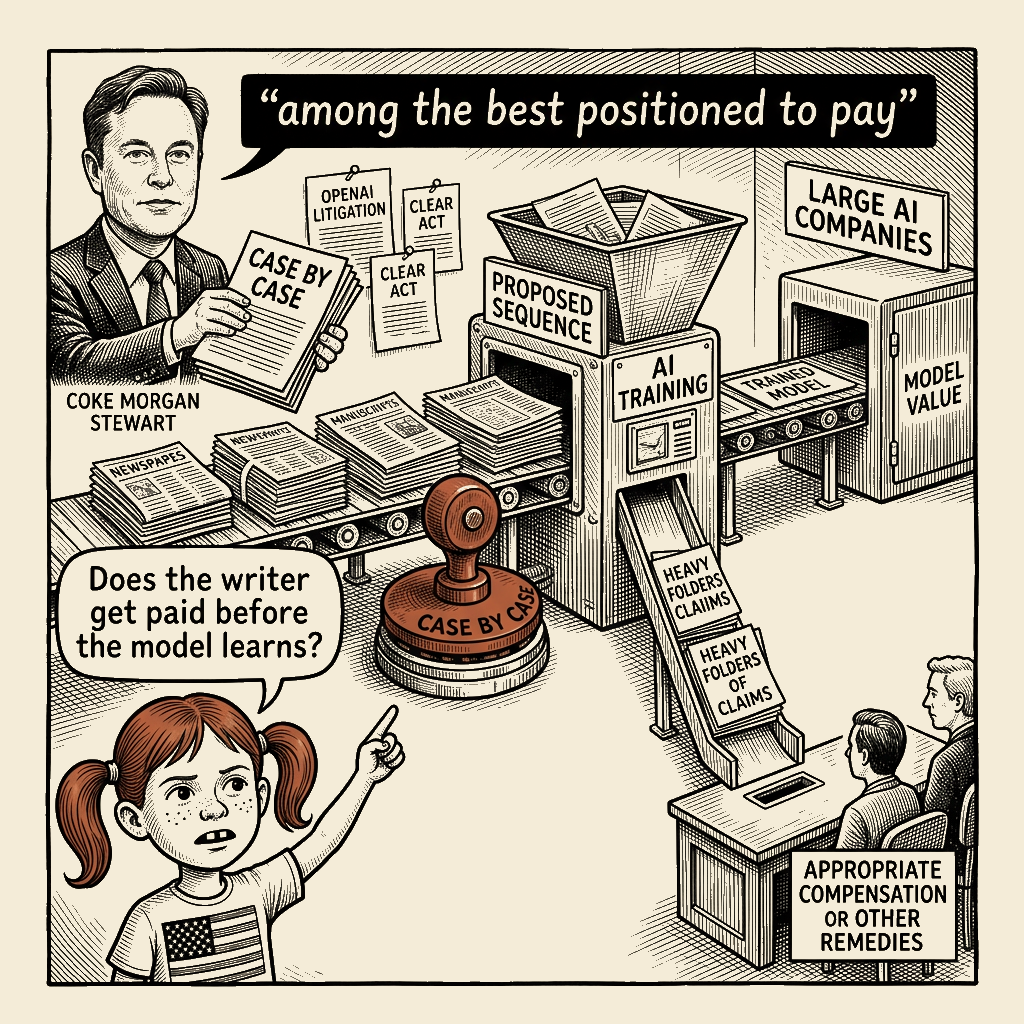
Responding to: Americans don’t have to choose between our AI future and ripping off copyright owners · 2026-11-25
Does the writer get paid before the model learns?
What the Piece Argues
According to Coke Morgan Stewart’s Nov. 25, 2026 Fox News Opinion essay, “Americans don’t have to choose between our AI future and ripping off copyright owners”, the Department of Justice should withdraw its statement of interest in the OpenAI litigation and leave fair-use disputes to judges, while also supporting the CLEAR Act’s training-data disclosure and Stewart’s call to “foster a market where AI developers can efficiently license copyrighted material while respecting creators’ rights.” Stewart accepts that innovation, competition, and national security matter, but rejects a blanket government position that would let commercial AI firms take copyrighted works without permission or compensation. His operative case-by-case recommendation is: “The Trump administration would be wise to follow its own AI framework and let the court system evaluate AI copyright disputes case by case, rather than arguing for unfettered fair use exceptions.”
Receipts
The move is to make litigation delay look like neutral procedure while the firms with the deepest pockets retain the economic value of models already trained on copyrighted works.
-
The framing wants you to believe
- Judges, rather than the Department of Justice, should determine whether particular commercial AI training qualifies as fair use.
- Case-by-case review protects innovation, smaller developers, national security, and the separation of powers without the government choosing a permanent winner in the copyright dispute.
- Disclosure, judicial review, and a market for licensing copyrighted material can advance innovation while still enabling creators to pursue compensation.
-
What’s really going on
- Stewart supplies his own distributional receipts: large AI companies are “among the best positioned to pay for those materials,” while startups report that paying provides more reliable access to training material, reduces legal uncertainty, and improves models. Coke Morgan Stewart, “Americans don’t have to choose between our AI future and ripping off copyright owners,” Fox News Opinion, Nov. 25, 2026
- The case-by-case recommendation supplies no payment mechanism for the ordinary commercial case. Disclosure can identify a claim; a court can decide it; only a license, collective agreement, or other payment arrangement creates the transaction before the use becomes the developer’s free input.
- Stewart says the CLEAR Act proposal would not settle fair use and would leave creators to pursue “appropriate compensation or other remedies.” He characterizes the DOJ’s position as expansive, but the filing itself is not available in the materials presented, so the exact scope of the government’s argument cannot be independently established from that record.
The Response Ladder
Polite Reframe
When to use: For a persuadable reader who values both innovation and copyright and needs the distributional question placed inside the case-by-case frame.
Picture Elena Ruiz, a freelance magazine writer in the scenario this policy creates: her article is among the copyrighted newspaper works used to train AI systems. The recommendation before us says courts should evaluate disputes “case by case,” while Stewart says the CLEAR Act would give creators notice so they can pursue “appropriate compensation or other remedies.” That is a real door, but Elena must find it, walk through it, and prove what happened.
The piece deserves credit for refusing a categorical rule. Fair use depends upon facts; innovation, competition, and national security are real. But its own receipts expose the distributional problem: large AI companies are “among the best positioned to pay,” while startups say paying provides more reliable training material, reduces legal uncertainty, and improves models. If payment improves the product, the queue in the courthouse is not the scarce input.
Case-by-case adjudication can decide whether a particular use is protected. It cannot, by itself, decide who bears the cost of identifying that use and pursuing compensation or another remedy. The sentence under reply does not specify any payment architecture for ordinary commercial training; it leaves the transaction, if one ever occurs, for a dispute that may arrive after the model already exists.
Stewart supplies the receipt for that design himself: large AI companies are “among the best positioned to pay,” and the essay calls for a market where AI developers can “efficiently license copyrighted material.” Put that principle in front of the transaction: preserve judicial review for genuinely narrow uses; require transparent dataset records; build paid access and collective licensing for ordinary commercial training; and keep the legal question where the law belongs. We defend creators by making the market pay them before the market profits from their work. We protect innovation by protecting the people whose work supplies its material.
Mockery and Ridicule
When to use: When the conversation has hardened around “case by case” and a sharp correction can expose the bargain without mocking the person who repeats it.
Welcome to America’s newest innovation accelerator: the courthouse delay. No venture capital, no server farm, no experimental jet fuel—just enough litigation latency to turn a writer’s article into a corporate input while the lawyer learns where to park. The prescription is to let courts decide fair use “case by case” and to foster a market where AI developers can “efficiently license copyrighted material.” Efficient for whom? That is the receipt hiding in plain sight.
The source’s own text names the apex: large AI companies are “among the best positioned to pay.” The badge under reply is “innovation,” and the conduct making the inversion applicable is plain: the buyer can finance the market but asks the seller to wait. That turns the large developer into a parasite of the rich. The model gets the corpus; the creator gets a scavenger hunt.
And the better data point comes from startups: paid access provides more reliable training material, reduces legal uncertainty, and improves models. The argument for uncertainty is that it protects small builders? The receipt says otherwise. Uncertainty is not the product. It is the toll.
The piece is right to reject the DOJ’s broad position and right to support a real licensing market. The sentence under reply leaves the operative sequence unsettled: judicial review first, compensation later, with no payment mechanism specified before ordinary commercial use. That is not coexistence; it is expropriation with a courthouse attached.
Stewart’s own concession supplies the rule: large AI firms are “among the best positioned to pay,” and startups report that paid access yields more reliable material and less uncertainty. Ordinary commercial training gets paid access; judges decide the exceptions. We are the builders. Builders lay the cost on the table before they eat from it.
Nuclear Satire
When to use: For a hostile or captive audience that needs the concentrated beneficiary named and the euphemism burned off the page.
Imagine the Department of Timely Permission: a marble hall with a brass scale labeled INNOVATION FIRST, a velvet rope labeled FAIR USE, and a vast basement where creators queue with magnifying glasses while trillion-parameter caterpillars chew through the archives. Above the door, Stewart’s recommendation: CASE BY CASE. Inside: no timer.
The piece calls this balance. The architecture says something else: Stewart describes litigation involving OpenAI and Microsoft and models trained with millions of newspaper articles; his opinion piece supports case-by-case judicial review; the CLEAR Act would disclose the works but “not settle” fair use; creators would then pursue compensation or other remedies. That is a clearance line with two windows: the commercial loading dock stays open while the courthouse door remains locked until the customer finishes eating.
The piece’s own sentence ruins the cosmic disguise. Large AI companies are “among the best positioned to pay.” Startups say paying provides more reliable material, reduces legal uncertainty, and improves models. In the Department of Timely Permission, the giants are not waiting for permission. They are manufacturing the argument that the basement queue belongs to the people whose books made the machine.
The opinion piece characterizes DOJ as siding with OpenAI on expansive fair use, but because the filing itself is not available, the exact scope of the government’s position cannot be independently established. We do not need to pretend the filing says more than the record proves. The target sentence is fully documented in the essay: the administration should let courts decide case by case. The distributional consequence is visible too—a giant litigates with an already-trained model; a creator litigates over work already used.
The inversion must be named. A company that can pay but asks the author to carry the market’s uncertainty and enforcement cost is a parasite of the rich. That identity is awful because it converts other people’s labor into a free input and then calls the resulting legal delay “balance.”
The receipt for this design is Stewart’s own admission: large AI companies are “among the best positioned to pay,” while the essay calls for a market where AI developers can “efficiently license copyrighted material.” We will not build delay. We will build paid access, collective licensing, public dataset records, and judicial review for narrow uses. We are the builders, and we build from the foundation: the person whose work is in the machine gets a real transaction, not a courtroom scavenger hunt.
Profane Scorched-Earth
When to use: When the reader needs the cathartic release valve and can handle the full force of the receipts without diplomatic varnish.
Holy shit, this is a hell of a fine innovation policy: the giants get the fucking library now, the writers get a fucking courthouse later, and everybody calls the delay “case by case.” The piece wants us to admire a market where AI developers can “efficiently license copyrighted material” while the biggest firms—“among the best positioned to pay,” its own sentence says—keep the model and send the bill upstairs.
Amos 5:24 says, “Let justice roll down like waters.” Justice does not roll down as a deferred-discovery motion. It rolls down when the company with the fucking data center buys the work, joins a collective license, or proves a narrow fair-use case before the market takes the work for free. Amos did not write a pamphlet about litigation latency. Justice moves now.
The badge is “innovation.” The inversion is “parasite of the rich.” That label fits the conduct the piece itself describes: large AI companies can afford the materials, startups report that paid access yields better training data and less legal uncertainty, and the recommended sequence leaves creators to pursue compensation after disclosure. You do not get to feed the machine with other people’s work and then complain that the invoice is inconvenient. That is corporate fucking feudalism with a content-management system.
National security does not turn theft into doctrine. The piece is right that the DOJ’s broad position should not govern automatically; that is legal discipline, not a blank check. But the sentence under reply supplies no payment mechanism for the ordinary commercial case; the larger answer is a market where AI developers can “efficiently license copyrighted material” and the CLEAR Act’s disclosure. Those are not the same as compensation before training. A market without a payment mechanism is a private tollbooth for the rich. The people least able to wait are the people whose work the machine already ate.
The receipt is Stewart’s own sentence: large AI companies are “among the best positioned to pay,” and paid access gives startups more reliable training material and less legal uncertainty. We defend creators, and that is how we defend innovation. Paid access before ordinary commercial training. Public records of what was used. Collective bargaining where one-by-one licensing is impossible. Judges for the narrow exceptions. We are the builders, and we do not build empires on the unpaid backs of people whose work we call “free.”
The machine can learn from us. It cannot feed us while pretending our work belongs to everyone except the people who made it. The piece’s own favored words—“strong copyright protections,” “respecting creators’ rights,” and “efficiently license copyrighted material”—mean something: somebody pays. Put the fucking money on the table, then turn the damn machine on.
About Malcolm Little King
Malcolm Little King is a heteronym in Main Street Independent's editorial architecture — an analytical voice, not autobiography of any actual person. The position this column expresses is the publication's position on the territory Malcolm Little King's lane covers, rendered through Malcolm Little King's register.