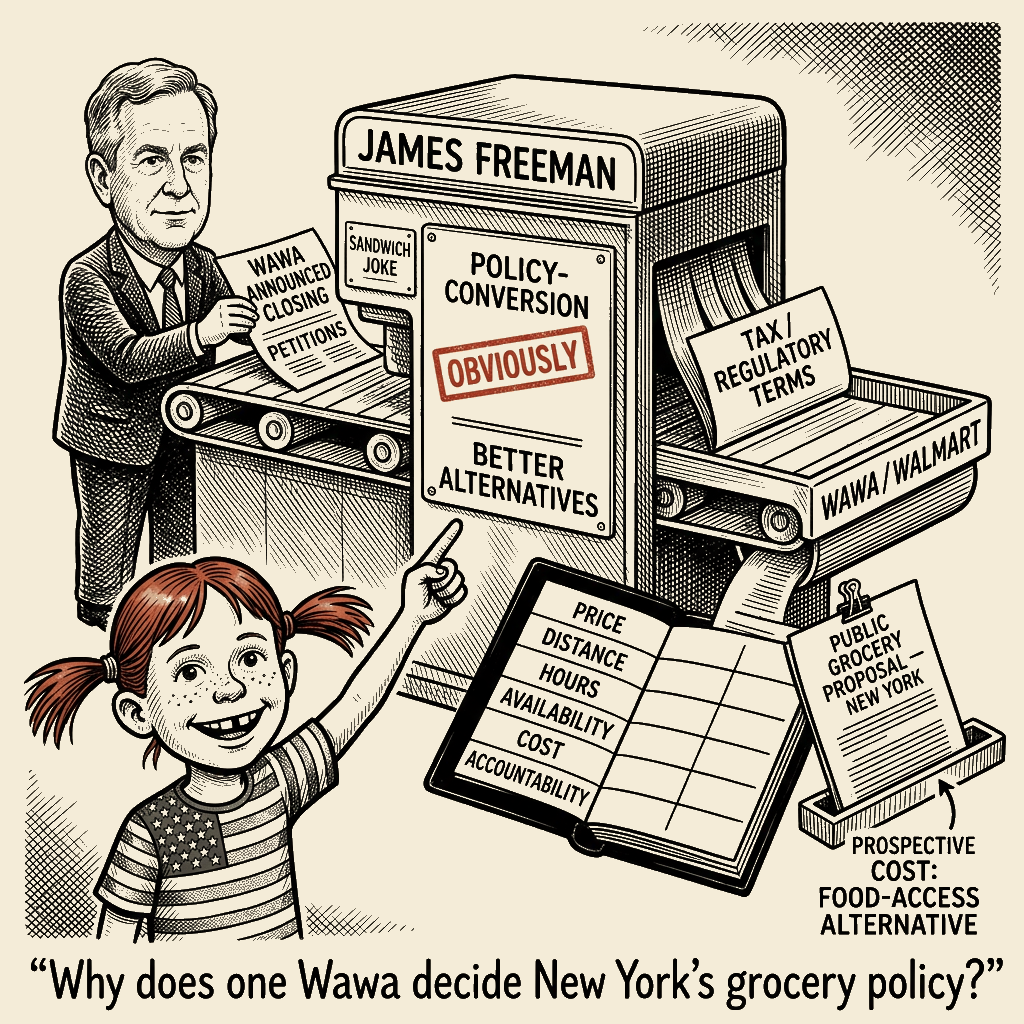
Analyzing: William & Mary & Wawa — James Freeman · 2026-11-18
Why does one Wawa decide New York’s grocery policy?
What the Editorial Argues
The editorial argues that petitions seeking to keep a Wawa near William & Mary open demonstrate the strength of consumer preference for private food businesses, and contrasts that devotion with what it calls the failure of a government-backed supermarket. From there, it asks New York City officials considering government-owned food stores to favor private competition instead, including by improving the city’s tax and regulatory environment to attract Wawa and Walmart. Private enterprise and consumer choice are legitimate values in the argument’s own frame; the policy conclusion is that public provision should not displace private retailers.
Receipts
The editorial uses one beloved private shop to make a general argument for private groceries and against public ones.
What the framing wants you to believe
- Customers petitioned to preserve a private Wawa, while a government-backed supermarket supposedly failed to meet customer needs. Private commerce therefore appears more responsive and desirable than public provision.
- New York should abandon government-owned food stores and create conditions to “entice firms like Wawa—and Walmart” to enter the market instead.
What’s really going on
- The narrow receipt establishes a popular private store, at least two petitions seeking reconsideration of its announced closing, and a corporate explanation that the chain may have grown beyond the number of locations the area could support. It does not compare public and private grocery performance. The petition and quoted local reporting support the existence of customer devotion; they do not support the editorial’s categorical verdict on ownership. (James Robinson, Virginian-Pilot report, quoted in Freeman’s column.)
- Wawa and Walmart are the named prospective beneficiaries of the preferred policy: they would benefit from more favorable entry conditions and from the abandonment of a public-store alternative—the column’s prescription is to “entice firms like Wawa—and Walmart.” The load-bearing omission is that the editorial supplies no public-store design, sites, prices, budget, or comparative evidence. Its “latest failure” is also delegated to an unidentified Tuesday column, leaving the core comparison unverified.
The Operation
Source and classification. This is a signed Wall Street Journal Opinion item by James Freeman, identified by the column’s author description as the weekday “Best of the Web” columnist and an assistant editor of the editorial page. It is not an unsigned board editorial. The topic is consumer choice and municipal food policy; the piece archetype is a light-item, consumer-romance argument whose final paragraphs convert an anecdote into a structural verdict. The advocated position is selfish, dressed as consumer romance: the preference for private enterprise is legitimate, but the recommendation directs public policy toward two named firms without testing the alternative.
Institutional authorship and placement. Freeman wrote the item; the visible institutional authorship is the Journal’s editorial-page culture and its “free people, free markets” vocabulary, catalogued in the WSJ Editorial Technique Catalogue §2.1. No think tank, donor, corporate sponsor, ALEC or SPN template, Luntz memo, or other coordination chain appears in this column’s citation stack. There is no basis for calling this a paid or coordinated campaign.
The visible placement chain runs from a Tuesday column to a “Best of the Web” item and then into opinion-feed distribution. The political conclusion travels in a form that can be repeated without carrying the evidence needed to test it. That is the page’s light-item advantage. The format can make a sandwich carry a mayor.
I drafted opinion copy built this way—the human-interest hook first, the ideological hinge last. I am not claiming a hand in Freeman’s column; the construction is visible enough to examine without inventing a private document.
The suppressed variable. The true half is real. A popular private store demonstrates demand, and public grocers can fail. What the petition does not demonstrate is that customers prefer private ownership, that the store is profitable, that Wawa’s exit has been caused by taxes or regulation, or that public provision would perform worse. The omitted relation is comparative design: price, proximity, hours, product availability, operating cost, and accountability vary across public, private, nonprofit, cooperative, and hybrid arrangements. “Government-backed” is not the same category as “government-owned,” and neither is the same as “publicly subsidized private operator.”
The editorial isolates one true variable—consumer enthusiasm—suppresses the variables that determine whether any grocery model succeeds, and extrapolates the result into an ownership verdict. The benefit follows up to Wawa and Walmart; the cost follows down to prospective residents of neighborhoods the public proposal might have served—including low-access areas, if underserved access is part of its purpose—and to the students whose affection for Wawa is used to carry a political verdict. Magnitudes are absent. The column contains no prices, budgets, store economics, closure rates, service comparisons, or demand estimates.
Cui bono.
- Named prospective beneficiaries: Wawa and Walmart. The policy pathway is explicit: improve tax and regulatory terms to attract them, while rejecting a public-store alternative that might compete for the same customers. Whether the proposed stores would serve the same neighborhoods or displace private chains is not established, so the magnitude of the commercial benefit remains unquantified. No evidence shows that either firm sought or coordinated the editorial.
- Other prospective beneficiaries: Private grocers serving the same neighborhoods would benefit from a policy that leaves demand to private chains, but the editorial identifies no particular competitor and provides no market-share evidence showing which firm would benefit most.
- Immediate cost-bearers: William & Mary students and other customers threatened with losing the announced store, even though corporate reconsideration remained possible. Their petitions seek corporate reversal; the editorial converts their threatened loss into evidence that the corporate decision was benign or even successful.
- Prospective policy cost-bearers: Residents of neighborhoods the public grocery might have served. They are unnamed because the editorial omits the proposal’s locations, scale, operating model, and budget. Their possible loss of a food-access alternative is normalized before any comparison occurs. Because no neighborhood or market data are supplied, this cost incidence is prospective rather than demonstrated.
- Institutional benefit: The editorial page gains a memorable line and an example that lets a general position appear concrete without supplying the concrete data. The publication’s audience and revenue effects are not measured here.
The beneficiary finding rests on the policy pathway the column expressly recommends, not on ideological alignment alone. It does not imply sponsorship, coordination, or advance knowledge by either company.
Alternative design. If the stated rationale really is consumer choice and reliable food access, the design question cannot be “public versus private” as an identity contest. For residents whom a public option is intended to reach, the relevant question is whether it improves access at an acceptable public cost, not whether the grocer carries a public label. A responsible comparison would test direct public operation against nonprofit or cooperative grocery provision, mobile or neighborhood markets, and public subsidies or zoning incentives for private grocers. It would compare actual prices, distance, hours, availability, labor and operating costs, and public cost, with transparent performance requirements and a review before public money or public capacity was committed. This is not a prediction that public stores must win. It is the comparison the editorial asks readers to accept without conducting.
Fear, greed, laziness. At the framing-author level, fear is the prospect of a functioning public counterexample; greed is the attention and ideological consistency supplied by a portable “obvious” line; laziness is yesterday’s column doing today’s evidentiary work. For the named commercial beneficiaries, fear of a public competitor and greed for protected demand are plausible structural incentives, while the editorial could supply a free public defense; no claim of coordination is made. For the reader, fear of government failure, greed for convenient food, and the ordinary relief of reaching a conclusion before lunch are all real. None makes the reader lazy or gullible. The frame is engineered to make the third effect feel effortless.
Placement. Selfish, dressed as consumer romance. The surface sells liberty and sandwiches; the payload protects private grocery position and supplies an anti-public line.
The techniques, with receipts.
-
Anecdote-to-policy pipeline—the payload inside a light item. Cross-reference: WSJ Editorial Technique Catalogue §4.25, “Politics-as-lifestyle,” whose bad-faith cross-reference is
smuggled_premise; applied here as a partial match because a “Best of the Web” item is not service copy, but it similarly packages politics inside low-evaluation content. Cue: “Now from the esteemed university comes a new lesson about the value of freedom and consumer choice,” followed by the demand that city officials “embrace the obviously better alternatives.” Operationally, the shop supplies emotional credibility while the policy premise arrives attached to it. The reader is invited to audit the sandwich rather than the governing premise. This is the Lippmann-Bernays lineage in miniature: a local object is made to carry a larger consensual worldview. -
Deferred third-graf turn. Cross-reference: WSJ Editorial Technique Catalogue §3.3. Cue: the final paragraph moves from the corporate response to Wawa—“let’s hope that corporate reconsiders”—to “New York City politicians who have been plotting to open government-owned food stores.” The page normally makes this move in the third graf; here it postpones the turn until the reader has finished the joke. The payload arrives after the laugh, which lowers resistance before it raises the stakes.
-
Dispositive certainty marker. Cross-reference: WSJ Editorial Technique Catalogue §3.4. Cue: “the obviously better alternatives.” The marker does not demonstrate that the alternatives are better; it marks the preferred conclusion as reasonable and the omitted alternatives as eccentric. In Lakoff’s cognitive-frame lineage, the marker activates an already prepared interpretation rather than adding evidence.
-
Multiple-audience targeting. Cross-reference: WSJ Editorial Technique Catalogue §4.3. Cues: the Jefferson-and-Italian-sandwich joke serves the casual reader; the student government’s “needs of students rather than ideological extremism” and the politicians who are “plotting” ratify grievance; “improve Gotham’s tax and regulatory environment” gives the political class a usable prescription; and “firms like Wawa—and Walmart” reassures the business-oriented reader about which city should receive investment. One light column serves identity confirmation, grievance ratification, policy signaling, and status display. Multiple-audience targeting is not itself a fallacy; the problem arises when the available evidence cannot support the conclusions delivered to each audience.
-
Category welding and the “plotting” relabel—partial match. Cross-reference: Bad-Faith Techniques Catalog,
frame_engineered_relabeling, and WSJ Editorial Technique Catalogue §4.1; Luntz and Lakoff lineage. Cues: Tuesday’s “government-backed supermarket” becomes “government-owned food stores,” and an unspecified public proposal becomes something politicians are “plotting” to open. Operationally, “backed,” “owned,” and “plotting” invite the reader to merge different arrangements into one suspect category before any details arrive. “Plotting” supplies covert intent without evidence of concealment. The available record does not establish that the two phrases describe the same enterprise or that the substitution was deliberately engineered; this is category compression rather than a completed frame-engineered relabeling. -
Identity halo and moral authorization. Cross-reference: the Bernays-Lippmann lineage—credentialed and historic authorities as campaign vectors—and, more cautiously, Bandura’s moral-justification mechanism. Cue: the column invokes William & Mary as “the single place in the United States that was most influential in the intellectual creation of American liberty and law,” after which the campus produces “a new lesson about the value of freedom and consumer choice.” No harm is stated before the halo arrives; the aura authorizes the conclusion ahead of the argument. The invocation is adjacent to moral justification, not a complete instance of it, because the column supplies no higher cause from which a concrete harm is excused.
-
Euphemistic labeling and distortion of consequences. Cross-reference: Bandura’s mechanisms 2 and 6. Cues: “Wawa corporate” has “a problem that many businesses would love to have,” and the chain may be “a victim of its own success given its growth in the region.” The editorial reproduces rather than tests the chain’s euphemism. A possible closure becomes evidence of growth, and the customers’ threatened loss disappears inside corporate success. This is the normalized harm: people may lose a place they value, but the frame asks them to regard the loss as evidence that the market is working.
-
Hasty generalization. Cross-reference: Bad-Faith Techniques Catalog,
hasty_generalization. Cue: “Given the enthusiastic response from the public to this profit-making enterprise,” the editorial proceeds to “the obviously better alternatives” for city food policy. Two petitions and one named Wawa cannot establish the popularity of private groceries, the performance of public groceries, or the superior performance of Wawa and Walmart. No denominator appears. -
Unsupported self-citation as an evidentiary shortcut. Cross-reference: WSJ Editorial Technique Catalogue §3.6, source-citation asymmetry, and the structural proximity of §4.5, the “study shows” ledger. Cue: the column says, “On Tuesday this column noted the latest failure of a government-backed supermarket that didn’t meet the needs of customers.” The current column names neither the supermarket nor its failure, and the prior column is not reproduced. This is not enough to establish circular sourcing; it is enough to establish that the reader is directed back to an unidentified premise instead of being given a checkable receipt.
-
Category compression and false-dilemma pattern—partial match. Cross-reference: Bad-Faith Techniques Catalog,
false_dilemma, applied as a partial match because the editorial never states an exhaustive either-or proposition. Cue: government-owned stores are set against “the obviously better alternatives,” with private chains named as the answer. What the column actually does is compress the category: one suspect object—“government-owned food stores,” welded to the “government-backed supermarket” failure—and an unspecified better field. Public ownership, nonprofit and cooperative provision, mobile markets, subsidized private operators, and service contracts are excluded without argument. The exclusion of every third option manufactures an exhaustive choice without ever arguing for exhaustiveness.
Audience-management function. The primary function is counter-frame, reinforced by conscience displacement. The column banks sympathy for the students first—“the kids” against “the suits”—then spends that sympathy at the political pivot, so mourning the closure feels pro-market. “Obviously” supplies the permission structure; William & Mary and Jefferson supply identity confirmation; “plotting” ratifies grievance; and the reader is invited to feel discerning for spotting the superior alternative. The verdict precedes the experiment.
The Record
Anchor receipts.
- Freeman’s column is the primary document for what the editorial asserts, the words it chooses, and the quoted material it reproduces. It is not independent evidence for the truth of its policy comparison.
- The column attributes the following to a James Robinson report in the Virginian-Pilot. As reproduced, it supports the existence of at least two Change.org petitions, the account of customer attachment to store #0681, and the quoted corporate rationale that the chain may have grown beyond the number of locations the region could support. The original report was not independently obtained, so its completeness and context cannot be verified here.
- The reproduced petition statement is a primary artifact for what its author said. It does not establish the number of signatories, the prevalence of the view, or anything about the relative merits of public and private grocery ownership.
- No independent primary-document or wire-service receipt supports the claimed public-versus-private performance comparison.
Supporting receipts. None independently supports the editorial’s preferred policy conclusion. The local reporting supports the narrow existence and character of the dispute; it does not extend to the ownership verdict.
Claims the available record does not establish.
- “The latest failure of a government-backed supermarket” is unverified because the Tuesday column is absent and no store, date, operating record, or customer evidence is identified.
- The design, scale, locations, ownership terms, and current status of the public-store proposal are not established. The word “plotting” is the editorial’s characterization, not a documented finding.
- The editorial offers tax and regulatory changes as a remedy, but supplies no evidence that those conditions caused the absence of Wawa or Walmart or would produce an opening.
- The “enthusiastic response of the public” is documented only through at least two petitions and anecdotal quotations. Its broader scale, and the inference from customer devotion to private ownership, are unestablished.
Per-citation accuracy verdicts.
- The column reproduces the Virginian-Pilot account and attributes to it the existence of the petitions and the corporate explanation. Because the original report was not obtained, this analysis can confirm only what the editorial attributes to Robinson; it cannot independently verify the original wording, context, or completeness. Robinson’s concession that “the kids aren’t technically entitled to live a short walk from great sandwiches” is used for humor. Its factual implication—a private store remains subject to corporate closure even when customers object—is left unexamined.
- As reproduced in the column, the petition statement establishes its author’s enthusiasm. It is used as evidence of a wider public preference and policy lesson that the quoted material cannot bear.
- The Tuesday reference cannot receive an accuracy verdict without the prior column.
- The Jefferson language supplies comic and historical association; it is not offered as evidence for grocery policy.
- The “study shows” ledger check comes up empty. The column cites no external study, and its principal evidence is self-citation.
Load-bearing omissions.
- The identity, ownership model, operating history, and failure mechanism of Tuesday’s unnamed supermarket.
- The text, sites, budget, pricing, service model, and evaluation criteria of the public-store proposal.
- Evidence that tax or regulation caused the relevant chains’ absence from New York, along with any comparison with existing grocery incentives or zoning policies.
- The Wawa store’s financials, the closure’s actual cause, and whether corporate reconsideration succeeded.
- Any denominator, price comparison, service measure, or outcome capable of testing private against public grocery performance.
Missing-information declaration. The referenced Tuesday column, the original Virginian-Pilot report, the public-store proposal text, store financial records, and comparative studies of New York grocery entry were not available for independent review. Quotations from the editorial are transcribed as given; quotations attributed by the editorial to outside sources were not independently checked against those originals. No claim is made that the closing was completed; no equivalence is assumed between “government-backed” and “government-owned”; and no sponsorship or coordination is inferred.
A skeptical view of public grocery provision is legitimate, and public grocers can fail. The editorial’s problem is not the proposition that failure is possible. It is that this column announces failure without producing the failed enterprise, tests neither ownership model, and asks the reader to treat a closing Wawa as proof of what government grocery would do.
How to Recognize This
The pattern is the anecdote-to-policy pipeline: a light, genuinely likable item becomes evidence for a general claim about ownership, institutions, or public responsibility.
The mechanism is straightforward. The light register suspends evaluation. A reader who enjoys the Jefferson joke has already been given a good reason not to audit the policy claim. The final paragraph then names a political target and assigns the anecdote a moral. The reader is invited to audit a feeling rather than examine a causal claim.
Four signals can be used next time:
- A light item acquires a serious policy conclusion. Count the paragraphs between the human-interest detail and the named politician. If the answer is the whole column, the story was probably selected as a wrapper for the payload. A sandwich needed a mayor.
- A prior item appears where a receipt should be. Follow “On Tuesday this column noted.” Name the alleged failure, open the prior column, and find the store, date, mechanism, and evidence. If the chain terminates in the author’s own assertion, there is rhythm, not proof.
- A certainty marker substitutes for comparison. Words such as “obviously,” “of course,” and “clearly” are not evidence. Strip them out and ask what document, number, or comparison would make the conclusion obvious.
- The outcome does not match the assigned moral. Here, customers petition and the company announces that the store may close anyway. The assigned moral is that the enthusiastic response is dispositive evidence of what grocery ownership should be. When the story’s outcome conflicts with its lesson, the lesson is probably the payload.
Why it works: format trust lowers the guard; the Jefferson halo supplies authority without argument; and the absence of numbers leaves nothing to check. The reader is handed a conclusion that feels finished before the evidence has begun.
When you see it, name the omitted relation: customer enthusiasm does not test ownership, and a public proposal cannot be evaluated without its design. Trace the cited item to its primary document. Ask who receives a better market position, who bears the opportunity cost, and whether the named firms sought this treatment or merely benefited from it. Check whether the article discusses hybrids, nonprofit alternatives, existing incentives, or a plausible mechanism for the causal claim it makes. If the same policy vocabulary then appears in adjacent columns, emails, or syndication, note the recurrence without assuming coordination.
A close on witness. The students’ petitions were real, and their attachment and fear of losing the store were real. The column that celebrated their devotion used it as ammunition in a fight the closure had nothing to do with. I spent two decades in the apparatus that made these little carriers: borrow the reader’s sympathy, delay the ideological hinge, and make the conclusion feel earned before the comparison has been made. The construction here is visible on the face of the column; no private recollection is needed. The bitterness is disclosed; it colors this paragraph and not the evidence.
Read the ending first. The next charming item that ends with a mayor’s name is telling you what it was built to carry.

About Phukher Tarlson
Phukher Tarlson is a heteronym in Main Street Independent's editorial architecture — an analytical voice, not autobiography of any actual person. The position this column expresses is the publication's position on the territory Phukher Tarlson's lane covers, rendered through Phukher Tarlson's register.