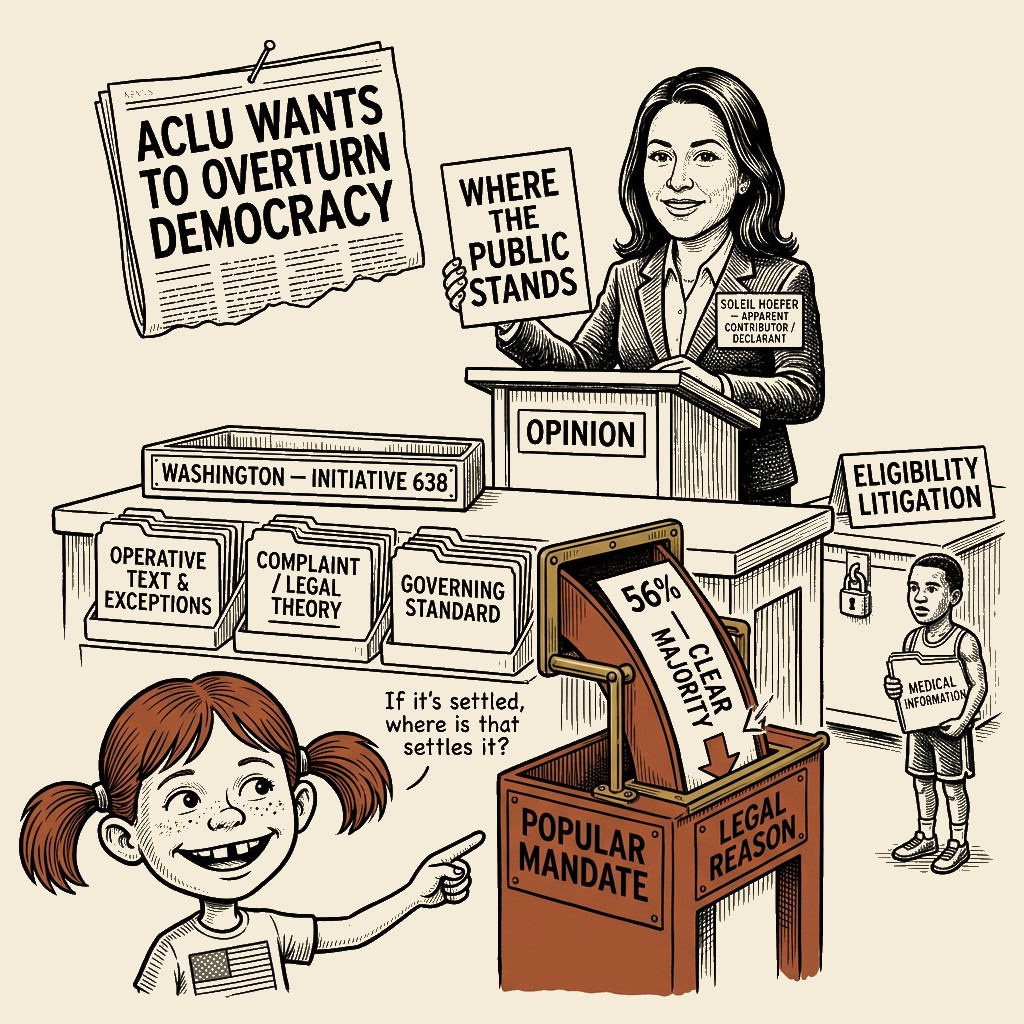
Analyzing: Washington voters protected women’s sports. ACLU wants to overturn democracy · 2026-11-19
If it’s settled, where is the law that settles it?
What the Editorial Argues
Soleil Hoefer argues that Washington voters adopted Initiative 638 to protect female athletes and that the ACLU lawsuit described in the column should be resisted because it overrides a bipartisan popular mandate. She supports that position through her track experience, an account of an injured wrestler, an unidentified United Nations report, and what she describes as Supreme Court action, arguing that allowing athletes she calls “males” or “men” to compete in girls’ categories defeats fair competition, safety, privacy, and the authority of voters. She asks Washington officials to defend the measure, closing with the declaration that “biology isn’t red or blue.”
Receipts
The editorial turns a legal challenge over Initiative 638 into an accusation that the ACLU is attacking democracy.
What the framing wants you to believe
- That the voters settled the matter, leaving judicial review of the measure as illegitimate interference with their decision.
- That participation by athletes the editorial calls “males” or “men” is not competition but an automatic transfer of roster spots, records, medals, safety, and privacy from other athletes.
- That the dispute is settled by “biology” and “common sense,” making the initiative’s definitions, exceptions, the complaint, and the medical and legal questions distractions rather than necessary evidence.
What’s really going on
- The protected beneficiary presented by the editorial is the class of athletes who remain eligible to compete in the initiative’s protected category, especially athletes seeking a stable categorical rule, together with the legal organizations defending it. The apparent cost-bearer is the class rendered ineligible or forced into eligibility litigation; the column omits Initiative 638’s operative text, so its exact reach cannot be established here.
- The column gives Alliance Defending Freedom, Female Athletes United, and the litigation a route to public visibility and potential doctrinal influence. That is a prospective institutional pathway, not proof of financial benefit, Hoefer’s organizational affiliation, or editorial direction. It also gives Hoefer a forum for her experience and grievance.
- The load-bearing omission is the paper: Initiative 638’s text and exceptions, the formal plaintiff, the ACLU’s legal theory, the complaint, and the documents behind the injury and statistical claims. The anchor for the rhetorical finding is the published column itself: Fox News Opinion, “Washington voters protected women’s sports. ACLU wants to overturn democracy”. It establishes what was published and how; it does not independently establish the underlying claims.
The Operation
The Fox News Opinion URL and page furniture identify Fox News Opinion as the host. No separate author byline appears in the reproduced text; the closing biographical line identifies Soleil Hoefer, and the repeated first-person language about her declaration supports treating this as an apparent signed contributor piece rather than an unsigned editorial-board voice. The operative archetype is a common-sense-versus-institutional frame built around a litigant’s personal column, a “study shows” ledger, and threat inflation.
Here is the sentence around which the operation turns, and it is not the lede: “Alliance Defending Freedom is representing Female Athletes United, a coalition of female athletes, in filing a motion to intervene in the ACLU’s lawsuit.” From my own earlier work, I remember organizations’ names often being placed in subordinate clauses rather than in the lede. That is an operator’s recollection, and it cannot verify this page’s internal process. What the page itself demonstrates is the placement: the moral work happens in the athlete’s first person; the institutional work happens in the grammar.
Institutional authorship and the placement chain. The visible chain is Fox News Opinion’s public frame, Hoefer’s first-person account and declaration, Alliance Defending Freedom’s role as the identified legal institution, Female Athletes United as the claimed constituency, and the ACLU—identified in Fox’s interstitial as ACLU of Washington—as the named antagonist. The headline supplies “democracy”; the opening grafs supply fear, fairness, and intimacy; the law firm’s name enters later; the all-caps outlet headlines interrupt the body with Fox’s own version of the dispute; and the conclusion returns the reader to the state’s obligation to defend the result.
That is a placement chain, not proof of a command center. The piece does not establish who first coined the headline frame, whether Alliance Defending Freedom or Female Athletes United supplied any language to Hoefer, who controls the copy, or who financed her participation. No relevant Alliance Defending Freedom filing was obtained. I will not turn a visible legal relationship into an unproved funding or editorial-control claim.
Cui bono and distributional impact. The direct policy beneficiary, as the editorial presents it, is the athlete class that remains eligible under the initiative’s protected category and the athletes who want that category preserved. The institutional interest made visible by the published frame is the allied legal project: the litigation places Alliance Defending Freedom and its client in the public record and creates a route to visibility and potential doctrinal influence. It gives Female Athletes United a litigation vehicle and public record; it gives the page an attention-rich conflict in which a constitutional contest becomes a morality play.
The costs travel elsewhere. Athletes rendered ineligible, or forced to litigate eligibility, would bear loss of competitive access, exposure of private medical information, and the expense and uncertainty of legal proceedings. The piece’s language about “men who have politicized their way” points toward transgender athletes as the apparent target, but without the initiative text the exact legal scope cannot be stated. Schools and athletic programs would absorb eligibility disputes and continuing compliance work; the Washington Attorney General’s office would bear the litigation burden of defending the measure. No dollar figure or independently verified magnitude appears in the record, so there will be no invented dollar estimate. The pathways themselves—exclusion, privacy exposure, administrative work, litigation expense, and precedent—are concrete.
Selflessness/selfishness placement: mixed. The public-interest half is genuine: fair competition, safety, privacy, and fidelity to voters are legitimate values that deserve substantive consideration. The selfish half is equally concrete: the measure protects a bounded class’s eligibility, while allied legal organizations gain visibility, a litigation vehicle, and doctrinal argument from the public frame. Nothing establishes payment, editorial control, or a common campaign plan, but the advocated position serves both defensible collective interests and identifiable institutional and competitive interests. The editorial presents that mixture as pure civic defense.
Alternative design. The editorial’s stated rationales are stable categories, fair competition, privacy, and safety. Optimized for those rationales rather than for a litigation headline, an alternative design would make the eligibility standard and its exceptions explicit in public guidance, apply them prospectively, give athletes advance notice and confidential review, require written reasons and an accessible appeal, protect medical privacy regardless of how an athlete is labeled, and maintain category-neutral safety and injury-prevention protocols. The affected constituency’s immediate interests are advance knowledge, equal procedural treatment, privacy, and a route to contest eligibility without public exposure. That is a design reconstruction from those interests and the editorial’s own rationales, not a claim that any organization has adopted this package.
Fear, greed, and laziness. The point of FGL here is not to moralize greed. It is to locate where each constituency’s incentives pull.
For Hoefer, fear is concrete: the loss of the category in which she competed, a roster place, records, safety, or privacy. The appetite for vindication and public standing is real; a writer who had experienced that loss has a legitimate claim to be heard. The laziness is the understandable wish not to untangle transition rules, exceptions, medical standards, and constitutional doctrine before reaching a conclusion.
For the institutional apex—Alliance Defending Freedom and the allied legal project—fear is losing the case or failing to place its theory in a durable doctrinal setting. Greed, in the institutional sense, is appetite for clients, visibility, doctrinal leverage, and influence in adjacent disputes. Laziness is the convenience of a narrative that can invoke “the voters” without publishing the instrument whose scope determines who is protected and who is excluded.
For the reader, fear of a daughter facing an unsafe or humiliating athletic environment is not propaganda’s creation; it is a real human fear. The appetite for a usable moral answer is real too. The laziness is the hope that someone will say “it’s common sense” so the reader can close the question for the night. The frame works because it supplies exactly what the reader came for: fear named as prudence, identity confirmed as expertise, a ballot count substituted for legal reasoning, and an institution cast as the antagonist.
The techniques, with their textual cues.
Judicial-review delegitimation through the voters’ mandate. Cue: “the ACLU—unable to make its case that men should be in women’s sports at the ballot box—is demanding that a state court go around us and overturn Initiative 638.” The Bad-Faith Techniques Catalog’s formal “pre-emptive legitimacy-withdrawal” classification does not fit: that entry requires legitimacy to be withdrawn on identity, composition, or categorical grounds, while this piece attacks judicial review by substituting the voters’ mandate for legal reasoning. The operation is to make the court appear to be an illegitimate detour around the electorate before the initiative, complaint, or legal theory can be examined. The movement toward a friend-enemy frame is visible; a claim about coordinated institutional direction is not.
Appeal to popularity. Cue: “a clear majority of its citizens have made law at the ballot box”; “Now we know where the public stands on this issue.” Cross-reference: Bad-Faith Techniques Catalog, “Appeal to nature, tradition, popularity,” after Walton’s treatment of popular appeals as defeasible argument schemes. The vote count is made to do legal work where an independent legal reason should appear. Popular approval may be relevant to democratic legitimacy; it does not, by itself, answer the constitutional, statutory, medical, or procedural questions the editorial has omitted.
Frame-engineered relabeling — partial match. Cue: the headline’s “ACLU wants to overturn democracy”; “When males enter girls’ sports, that’s not competition”; “men who have politicized their way into her locker room.” Cross-reference: Bad-Faith Techniques Catalog, “Frame-engineered relabeling,” and WSJ Editorial Technique Catalogue §4.1. A legal challenge becomes an assault on democracy; a category dispute becomes a test of biology. This is not Bandura’s euphemistic labeling—the terms are not softening harm—but a substitution that moves the argument away from the operative legal category. The match remains partial because no internal language memo proves that these terms were engineered for this campaign; the textual form is visible, deliberate coordination is not. The lineage runs through Luntz’s Words That Work and Lakoff’s frame theory, with institutional vocabulary reaching the reader through the athlete’s first person.
Insufficiently documented evidentiary stack. Cue: “my relay team ran against a male athlete who had previously competed in the high school boys’ category. He beat us, easily”; “just in West Virginia, one male defeated more than 470 girls over 1,400 times in a single sport.” Cross-reference: WSJ Editorial Technique Catalogue §4.5, the “study shows” ledger, and the Bad-Faith Techniques Catalog’s documentation threshold. The formal label “hasty generalization” is not established from the available text because the editorial also invokes a purported United Nations report, legal authority, and other factual material; the examples are not necessarily the editorial’s evidentiary sample. The documented failure is an unauditable stack: the relay anecdote supplies no rule or denominator, while the state aggregate supplies no method, source, definitions, or representative denominator. The unidentified report might provide broader evidence if retrieved, but it cannot cure what the examples themselves leave undocumented.
Identity as credential and ordinary ethos. Cue: “Other female athletes and I won’t take this without a fight, because we speak from experience”; “I was named Female Track & Field Athlete of the year three years in a row by my school’s coaching staff.” Cross-reference: WSJ Editorial Technique Catalogue §4.18, the “as a [identity]” credibility move. This is not an ad hominem, and Hoefer’s experience gives her legitimate standing. The finding is narrower: the credential carries part of the argumentative burden, and the award bearing the contested sex-class premise supplies identity confirmation where the rule text is absent. The problem is not that she is credible. The problem is that credibility is made to substitute for the missing policy record.
The “study shows” ledger. Cue: “A United Nations report documents more than 600 female athletes across 29 sports who’ve been displaced by men; the men collectively took more than 890 medals.” Cross-reference: WSJ Editorial Technique Catalogue §4.5. An unidentified report becomes the scale-spine of the argument without a title, date, issuing body, method, definitions, denominators, or funding disclosure. I attacked Oreskes and Conway’s argument for years and was wrong; their documentary work supports caution about citation carrying conclusions its source does not establish. But the Bad-Faith Techniques Catalog requires a funding and coordination trace before “manufactured controversy” can be applied, and none appears here. I am not making that charge. I am naming the ledger: the report does argumentative work the author does not show it doing.
The private declarant’s litigant column. Cue: “I’m filing a declaration as part of that lawsuit”; “Alliance Defending Freedom is representing Female Athletes United.” Cross-reference: WSJ Editorial Technique Catalogue §4.21, “Officeholder-as-columnist—the litigant’s column,” adapted here to a private declarant. The piece performs a declared role in the litigation while presenting itself as personal commentary. The role appears in the middle, after the grievance has been established; the closing bio restates the athlete’s identity rather than explaining the relationship among the declarant, coalition, and law firm. The piece does not establish that Hoefer is a named party, that the firm controls the text, or that she is paid.
Intra-outlet cross-promotion — partial match. Cue: the all-caps interstitials “ACLU OF WASHINGTON SAYS IT WILL SUE TO BLOCK BALLOT INITIATIVE TO PROTECT GIRLS’ SPORTS” and “WASHINGTON AG’S OFFICE INDICATES IT WILL DEFEND GIRLS’ SPORTS BALLOT MEASURE AFTER ACLU SUES TO BLOCK IT.” Cross-reference: WSJ Editorial Technique Catalogue §4.22, “Intra-outlet citation loop,” and Bad-Faith Techniques Catalog, “Circular sourcing.” Fox’s own headlines occupy the evidentiary space where the complaint, motion, and docket should appear. No destination is shown for those links, so circular sourcing is not established; the partial match is the outlet’s framing reaching the reader before the underlying legal records do. The page also contains an internal chronology mismatch: one interstitial says the ACLU “will sue,” while the body says it has sued.
The parasocial second-person register. Cue: “Would you want your daughter changing clothes and showering with men who have politicized their way into her locker room?” Cross-reference: the Fox Opinion register note in WSJ Editorial Technique Catalogue §3. The consequence-to-you construction converts a rulemaking dispute into a parental-consent frame. The reader receives a vivid domestic image and is not given the institutional vocabulary needed to examine the category rule.
Threat inflation. Cue: the headline, “Washington voters protected women’s sports. ACLU wants to overturn democracy.” Cross-reference: WSJ Editorial Technique Catalogue §4.13, “Threat inflation,” and §3.5, the quotable closing-line cadence. One lawsuit over one state measure is inflated into a contest over democracy itself. In Schmitt’s friend-enemy lineage, the adversary ceases to be a plaintiff or lawyer and becomes an existential enemy of the people’s decision. That recoding supplies urgency while displacing the legal question.
The Bandura mechanisms arrive as a cluster. Moral justification turns exclusion into service to fairness, safety, privacy, and Title IX. Attribution of blame appears in “politicized their way into”: athletes who become eligible under a rule are made to appear responsible for having intruded. Distortion of consequences appears in the asymmetry between the harm the frame invites readers to fear and the consequences it leaves below the evidentiary threshold: exclusion, privacy exposure, and litigation burden receive no serious treatment, while the threat to “democracy” is enlarged to civilizational scale. The underlying factual magnitudes remain unresolved; the rhetorical disproportion is visible. The law firm’s and coalition’s grammatical retreat is better described as de-emphasis than as Bandura’s displacement of responsibility: the litigation is assigned to the Attorney General while the allied organizations recede into a subordinate clause, but no agentless blame-shifting or denial of responsibility occurs. The terminology substitution is not euphemistic labeling; euphemism would soften the harm. Here it is definition displacement. The piece never needs to dehumanize its targets. The frame does the work more cheaply.
Audience management. Permission structure: support for the measure is presented not as prejudice but as common sense, fairness, and defense of women. Identity confirmation: the speaker is a woman who ran track and therefore knows the loss. Grievance ratification: “Voters had to do that; our legislators wouldn’t” confirms the reader’s sense that institutions failed. Status display: the award, the filing, the law-firm representation, and the national platform. Counter-frame: the ACLU’s court-as-protection frame is answered with court-as-illegitimate-interference. Conscience displacement: the reader need not read the initiative, only want the state to win. Multiple-audience targeting is also present: parents receive fear and privacy; athletes receive identity and vindication; lawyers receive a case narrative; legal organizations receive a public platform; and the political class receives “red and blue” and “biology isn’t red or blue” as the bipartisan license the movement needs.
The ACLU side receives no exemption. If it had published a testimonial with the same interested-party role, the same organization placement, the same outlet interstitials, and the same silence about the operative text, it would receive the same scrutiny. I will not soften the finding because the ACLU is defending a position I am not advancing. That is symmetry without counterfeit symmetry.
The Record
The published piece is a primary source for what the editorial says, how it says it, who it identifies, and where those names appear. It is not a primary source for the underlying vote, litigation, injury, or statistical claims. No independent primary receipt for those matters was obtained, so they remain unresolved rather than being silently upgraded into facts.
Tier 1 material obtained. The published piece: Fox News Opinion, “Washington voters protected women’s sports. ACLU wants to overturn democracy,” https://www.foxnews.com/opinion/washington-voters-protected-womens-sports-aclu-wants-overturn-democracy. It establishes the editorial’s exact wording, Hoefer’s stated declarant role, the placement of Alliance Defending Freedom, the all-caps interstitials, and the duplicated passages visible on the page. The duplication may reflect reproduction or syndication formatting; it does not by itself prove coordinated repetition.
Tier 1 primary documents not obtained. Initiative 638’s certified text; official Washington election results; the complaint, intervention motion, Attorney General filing, and state-court docket; the governing appellate opinion and Supreme Court disposition; Title IX and its implementing regulations; the United Nations report; records supporting the West Virginia count and the Keeler injury; and Alliance Defending Freedom’s relevant Form 990 filing. These are retrieval priorities, not receipts that can carry findings before retrieval.
Tier 2 receipts. None independently obtained.
Tier 3 context only. Alliance Defending Freedom advocacy material would be an interested party’s account of its own position. Advocacy trackers can provide context, but without verified methodology, funding, and specialist standing they do not anchor the numerical or legal claims here.
Load-bearing claims and their status.
- The measure’s passage, support, and legislative count. The editorial says Initiative 638 passed with 56 percent support, that voters in four states adopted comparable measures, and that 27 states have enacted protections. Official certification and an authoritative enumeration were not obtained, so these are article-supplied claims whose external verification remains unresolved.
- The ACLU litigation, intervention motion, and Attorney General’s position. The piece says the ACLU sued, Alliance Defending Freedom represents Female Athletes United in moving to intervene, and the Attorney General intends to defend the measure. No pleading or docket entry was obtained; the formal plaintiff is also ambiguous between the body’s “ACLU” and the interstitial’s “ACLU OF WASHINGTON.” The procedural claims remain article-supplied claims whose external verification is unresolved.
- The Supreme Court disposition and Title IX’s operative effect. The editorial attributes a ruling permitting state protections to the Supreme Court and invokes Title IX as its origin. The precise appellate and Supreme Court procedural history, the opinion’s actual holding, and the statute’s operative text were not obtained. These claims remain externally unresolved.
- The United Nations report’s figures. The report was not identified or obtained, so the 600 athletes, 29 sports, and 890 medals cannot be independently verified. The figures remain article-supplied claims.
- The West Virginia figures. No record was obtained for the claim that one male competitor defeated more than 470 girls over 1,400 contests. The aggregate remains an editorial claim whose external verification is unresolved.
- The Kallie Keeler injury and failure-to-notify allegation. The piece supplies the allegation but no contemporaneous medical, coaching, or official record. The allegation remains externally unresolved.
- The declarant, coalition, law-firm, and funding relationships. The piece establishes that Hoefer says she is filing a declaration and that Alliance Defending Freedom represents Female Athletes United. It does not establish Hoefer’s exact party status, who directs her participation, who bears her costs, or whether anyone paid her. Those relationships remain unverified.
Per-citation accuracy verdicts.
- The vote and chronology: externally unresolved, not established as inaccurate. The editorial presents 56 percent and describes a November election; official certification was not retrieved. That is insufficient to label the claim inaccurate, and it is equally insufficient to certify it.
- The ACLU litigation: rhetorically exact, legally unresolved. The piece accurately reports the editorial’s characterization of the ACLU as unable to prevail at the ballot box; the formal claim, plaintiff, and legal theory remain unverified.
- Title IX: broad invocation; narrower use unsupported. The statute may bear on the dispute, but the editorial provides no text or legislative history showing that it dictates the precise category rule it wants the reader to accept.
- The Supreme Court: externally unresolved. The piece’s attribution and procedural description cannot be tested against an opinion or docket in the present record, so no categorical accuracy verdict is warranted.
- The United Nations report: selective and unverifiable. It is the scale-spine of the argument, with no document, method, definitions, denominators, or funding disclosed.
- The West Virginia count: unverified. The number remains an editorial claim without a located primary source.
- The injury and notice allegation: unverified and medically consequential. It cannot bear the assigned evidentiary weight without the underlying records.
- The Fox interstitials: self-referential at the level of source use. They are evidence of Fox’s framing, not evidence of the complaint, motion, or Attorney General filing.
Load-bearing omissions. Initiative 638’s operative language and exceptions. The formal plaintiff and the ACLU’s legal theory. The definitions of “male,” “female,” “men,” “women,” and “sex” as legal categories. The complaint, intervention motion, Attorney General filing, and court docket. The title, date, author, method, definitions, funding, and denominators of the United Nations report. Authoritative records for the West Virginia count. The Kallie Keeler medical, coaching, and notice records. The decision path connecting the author, coalition, law firm, and publication. The source of litigation expenses and any financial relationships. The appellate and Supreme Court procedural history. The governing legal standards for pre-emption, equal protection, and the scope of state authority. And the relevant empirical and legal evidence on eligibility standards, privacy, sports science, and injury prevention.
The relay anecdote contains the omission that matters most. On the piece’s own account, the competitor had previously competed in the boys’ category and later won the women’s 400 meters twice. The editorial does not identify the governing rule, its exceptions, or the transition that produced that result. The anecdote is framed as a complaint about how an exception or transition operated, although the governing rule and transition are not identified. It therefore does not by itself prove that every sex-based category is impossible. The frame cannot state its own demand because stating it requires naming the operative category and its exceptions. Instead it says “biology isn’t red or blue.”
Missing information. Not obtained: the initiative text and election certification; the pleadings and docket; the appellate opinion and Supreme Court disposition; the UN report; the West Virginia records; the Keeler records; and the relevant nonprofit filing. No internal memorandum is cited or present in the published page. My recollection from earlier work about organization-name placement is an operator’s recollection, not documentary evidence about Fox, Hoefer, Alliance Defending Freedom, Female Athletes United, or this campaign. The assumptions filling the remaining gaps are narrow: the piece’s statements are treated as claims made by the editorial, not as independently established facts; the named documents are retrieval priorities, not receipts already obtained; and no hidden ACLU funding chain, internal strategy, or coordinated campaign is supplied.
How to Recognize This
The pattern is legal laundering through a civic moral noun. A specific dispute over a law is translated into a larger fight over democracy, fairness, safety, privacy, or biology. Once the larger noun is installed, the reader no longer has to examine the statute, the complaint, the evidence, or the exceptions. The label begins doing the work the record was supposed to do.
The mechanism is efficient because fear and identity arrive before analysis. The reader receives a threatened athlete, a suspect institution, a sympathetic witness, a statistic, and a declaration that the matter is beyond partisan dispute. The possibility that a person could support fair competition while criticizing the scope or procedure of a particular rule becomes psychologically expensive. The operation does not have to prove that the rule is optimal. It has to make opposition to the rule feel like opposition to fairness itself.
Four textual signals reveal the pattern.
- The instrument is missing. Every claim about the measure arrives second-hand—from an outlet headline, a report without a title, or an anecdote—while the initiative’s operative words never appear.
- A vote count is doing legal work. Watch for “56 percent,” “a clear majority,” and “we know where the public stands.” These phrases appear where the rule, pleading, or governing legal standard should appear.
- The interested voice and the institution arrive late. Here the declarant status appears in “I’m filing a declaration,” while Alliance Defending Freedom appears in a subordinate clause after the grievance is established. Read not only who is speaking but where the institution’s name sits in the grammar.
- The legal category is replaced by a political or civilizational label. “Male,” “men,” “politicized their way,” and “overturn democracy” do work that the initiative’s definitions, exceptions, and the complaint’s allegations would otherwise have to do.
It works because it converts a costly question into a cheap answer. Fear supplies urgency. Identity supplies belonging. The villain supplies focus. The statistic supplies apparent objectivity. The ballot box supplies legitimacy. The reader receives a complete moral drama without having to assemble a legal or evidentiary record.
When you see it, write down the literal question before reading another word: What does this measure do? What claim does the complaint make? What evidence supports each factual assertion? What does the controlling opinion actually hold? Then pull the statute, initiative, complaint, motion, docket, and actual order. Read the exceptions, because the exceptions are where these disputes live. Trace the cited study’s title, method, definitions, funding chain, and denominators. Ask who gains a concrete opportunity or institutional position and who loses access, privacy, money, or time. Look for the same vocabulary across litigation releases, coalition publications, and the syndication network—but check independent convergence before calling it coordinated message discipline. Reduce the frame’s automatic activation by putting the literal question in writing before the rhetoric can close it.
I built versions of this arrangement. The evidence I can defend from this page is narrow and useful: it puts identity first, institutional interest late, and the operative document nowhere. The next time an editorial says the question has already been settled, find the document. That habit is the recognition worth carrying forward.

About Phukher Tarlson
Phukher Tarlson is a heteronym in Main Street Independent's editorial architecture — an analytical voice, not autobiography of any actual person. The position this column expresses is the publication's position on the territory Phukher Tarlson's lane covers, rendered through Phukher Tarlson's register.