Responding to: The Threat of the ‘Solopreneurs’ — Matthew Lynn · 2026-10-22
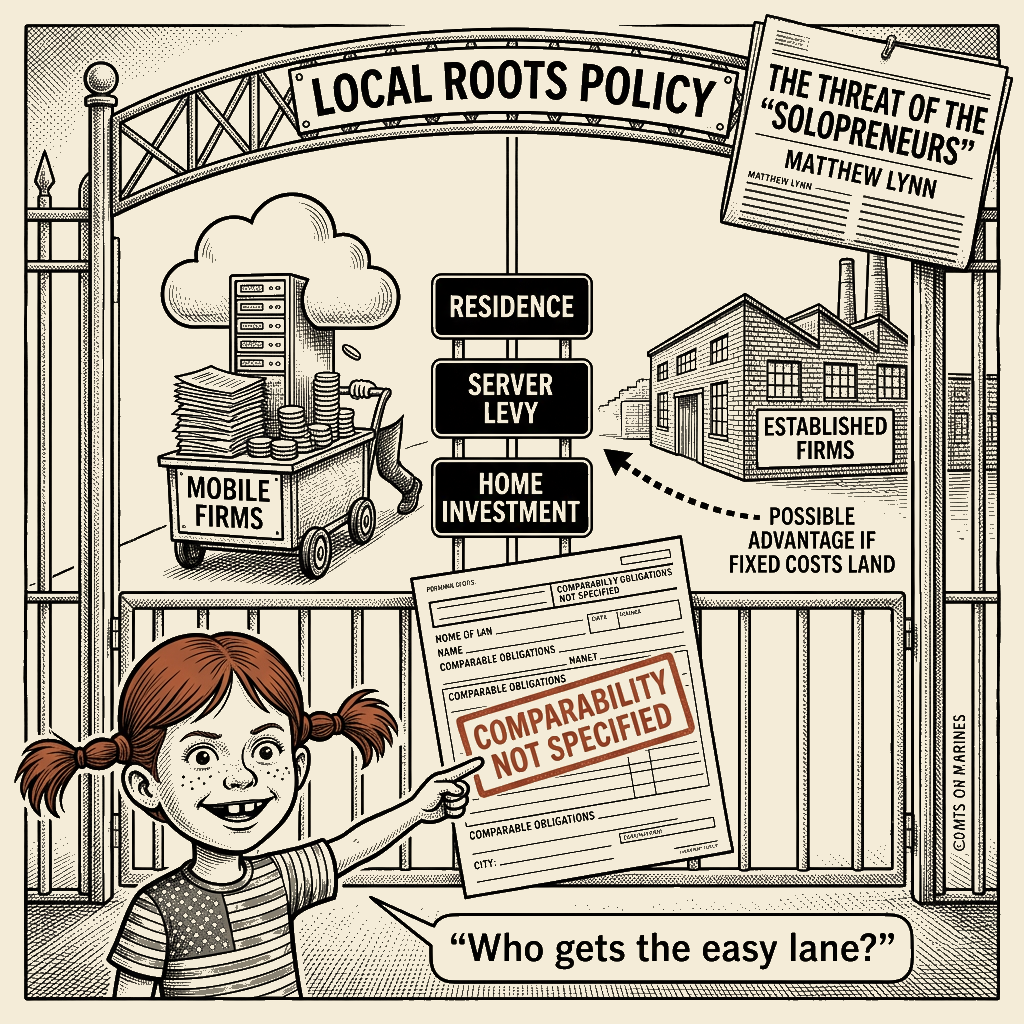
Who gets the easy lane?
What the Piece Argues
The single primary talking point is: “An economy built on a million disconnected fortunes, each one accountable to nothing but a laptop and a chatbot, is not the free market its defenders ever envisaged.” The piece argues that cloud tools and artificial intelligence let solo entrepreneurs scale businesses without the employees, facilities, and local ties that historically gave large firms obligations to particular communities. It concludes that free-market capitalism may need stronger residence rules, levies on web servers, home-investment incentives, and a broader civic culture tying businesses to the places they affect. It says server levies would “put money back into the communities it came from,” identifying communities as the intended beneficiaries in principle.
Receipts
The piece moves from a real change in business structure to a political claim about who deserves economic legitimacy.
- Framing: Staff and physical roots supposedly civilized wealthy entrepreneurs by creating obligations to workers and communities.
- Receipt: The historical examples of companies associated with particular cities demonstrate economic embeddedness, but they do not establish that staffing caused restraint or that locationless firms are less responsible.
- Framing: Cloud-based one-person businesses could become a superrich elite detached from society because they have neither employees nor an established community.
- Receipt — scale: Stripe, as reported in Matthew Lynn, “The Threat of the ‘Solopreneurs,’”, says the number of platform users earning more than $100,000 increased by one-third since 2022. That establishes growth among high-earning users on one platform; it does not measure conscience, community attachment, or political obligation.
- Mechanism: Residence rules, server levies, and home-investment incentives would attach economic obligations to a firm’s location and physical presence.
- Receipt: The article says server levies would “put money back into the communities it came from,” identifying communities as the intended beneficiaries in principle. It does not specify how proceeds would be allocated among the communities covered by the levy, how comparable obligations would apply to established businesses, how enforcement would work, or what the fiscal comparison would be.
- Who may benefit: If fixed compliance costs or relocation requirements hinder mobile entrants, incumbent local businesses and owners of established property or infrastructure could gain competitive protection. That is a possible consequence of the proposal, not an established result.
- Who else may benefit: The communities the article identifies as beneficiaries would benefit only if the money was collected and actually delivered; public services could benefit only to the extent that funds reached them.
- Omitted alternative: Obligations could instead be applied uniformly to cloud firms, factories, contractors, and other businesses according to their activity and public effects, without making founder residence a condition of economic legitimacy.
The Response Ladder
Polite Reframe
When to use: For a reader willing to take social connection seriously without treating a mobile founder as a moral suspect.
The strongest defensible version of this argument is a question about growing economic scale without an obvious social anchor. A business can operate from anywhere while still owing workers, customers, and communities fair treatment, transparent taxes, and accountable conduct. That is worth taking seriously.
The article, however, does not establish its central causal hinge. The piece’s Stripe receipt reports growth in users earning more than $100,000, but a rise in earnings does not show that employees produce conscience or that solo founders lack it. The piece’s own Medvi example reports $400 million in sales while acknowledging that the founder used his brother and freelance contractors, which demonstrates that even the boundary-setting example depends on outside labor. These are business facts, not moral evidence.
Residence rules and server levies cannot be evaluated until their incidence is public. Who pays, how proceeds would reach the communities from which the money came, which incumbents face the same obligations, and how the rules are enforced all matter. Apply comparable standards to every firm according to its activity and effects, publish the fiscal consequences, and enforce labor protections without regard to whether the employer is a cloud startup or a factory. The objective should be to make power accountable, not to make an entrepreneur purchase civic legitimacy by buying a house.
Mockery and Ridicule
When to use: For exposing a moral sermon attached to an incomplete policy mechanism.
Welcome to the Cloud Country Club. Membership requirements are simple: possess a local identity, purchase a residence, deepen your server roots, and exhibit enough disdain for contractors to satisfy the membership committee.
The article’s cleanest number is Stripe’s reported one-third increase since 2022 in platform users earning above $100,000. That means more people on one platform crossed a high earnings threshold. It does not mean their laptops developed conservative personalities or became eligible for a founders’ guilt spiral.
Then comes the remedy. The mobile firm must satisfy residence rules, pay a server levy, and demonstrate investment at home before receiving the full benefits of economic freedom. Meanwhile, established local businesses are not clearly placed under comparable obligations. If those rules create fixed costs that incumbents can spread across large payrolls and property holdings but mobile entrants cannot, the incumbents already inside the gate may enjoy protection without having to apply for it.
That is the missing receipt. No allocation rule, no fiscal note, no enforcement plan, no parity rule—just a stern voice telling the newest participants to show more community spirit. The article calls the cloud unaccountable, then proposes to account for it through a levy whose incidence it never discloses. Very efficient public policy: collect first, explain the distribution later, if at all.
Nuclear Satire
When to use: For turning the proposed cure into the bureaucratic machine it actually describes.
Imagine the Ministry of Rootedness issuing a laptop charter. Every independent business must surrender its server’s postal code, name a school district worthy of its charitable attention, and purchase a home before receiving permission to participate in capitalism. The application asks whether the founder has sufficiently divided their loyalty between a cloud data hub and a physical community.
The Ministry cites Stripe’s reported rise in high-earning platform users as proof of a social emergency. It also points to Medvi while quietly admitting that the celebrated solo operation involved a brother and freelance contractors. Apparently the definition of “nobody” remains flexible when nobody is available for bookkeeping.
Then comes the country’s new cohesion policy: tougher residence rules, home-investment incentives, and levies on web servers. Residence becomes a membership badge. Geography becomes a moral test. A server becomes taxable property because it has the impudence to be useful without owning a shopping mall.
The established local corporation now possesses a formidable advantage: it already satisfies the proposed definition of belonging. The mobile entrant bears the paperwork, relocation pressure, and levy exposure while the incumbent enjoys the protected side of the rule. If that happens, “connected to society” means connected wherever the existing power is already connected.
The Ministry should publish the missing form in large letters: WHO PAYS? HOW ARE THE PROCEEDS ALLOCATED? WHO IS EXEMPT? WHO ENFORCES? Without those answers, the program is not community policy. It is protectionism with a civic sermon stapled to the application.
Profane Scorched-Earth
When to use: For when the respectable version has run out of ways to disguise an unaccountable power grab.
Well, fuck the cloud’s magical moral decline. The article offers a Stripe statistic, a couple of anecdotes, and a foundationless leap from “works without employees” to “has no conscience,” then demands tougher residence rules and levies on web servers. That is not a demonstrated connection. That is a fucking leap of faith with a legislative footnote.
Stripe’s reported one-third increase in users earning above $100,000 proves that a lot of people earned a lot of money on one platform. It does not prove that every solo founder is a moral delinquent, that businesses without a payroll are detached from society, or that buying a house would improve the fucking public good. The Medvi example makes the problem worse by admitting that the supposedly one-person operation used a brother and freelance contractors. If the poster child has helpers, show the class picture.
Here is the burden, and it is damn naked: mobile firms are told to acquire local roots, satisfy residence rules, and pay levies, while established businesses are not clearly subjected to the same obligations. If those rules impose fixed costs that smaller or location-flexible firms cannot spread, incumbent local businesses and established property or infrastructure owners may receive protection they never had to earn. The article says the levies would “put money back into the communities it came from,” identifying communities as the intended beneficiaries in principle. What it does not explain is how that money would be distributed, who would collect and enforce the levy, or whether established businesses would bear comparable obligations.
That is bullshit disguised as community policy. “Who benefits?” is not an insulting question when the proposal creates burdens. It is the first question any honest legislation must answer.
Keep the cloud businesses. Keep the lean firms. Keep the freedom to invent without demanding permission from a country-club committee. Make labor rules apply to every employer, make taxes transparent, publish who pays and how the proceeds are distributed, and put incumbent factories and mobile startups under the same obligations. Mobility is not proof of depravity, and a server is not a moral delinquent just because it does not attend the PTA.
No goddamn cloud conscience is required. What is required is enforceable fairness, uniform rules, and receipts that survive inspection. If the proposal cannot explain the distribution among beneficiaries, disclose its incidence, or discipline its exemptions, then it is not defending the free market. It is handing established power a membership card and billing everyone outside for the privilege.

About Malcolm Little King
Malcolm Little King is a heteronym in Main Street Independent's editorial architecture — an analytical voice, not autobiography of any actual person. The position this column expresses is the publication's position on the territory Malcolm Little King's lane covers, rendered through Malcolm Little King's register.