Responding to: Trump's corporate stakes are a gift to the next Democratic president · 2026-10-23
Why does tomorrow get blamed for today’s stock?
What the Piece Argues
The piece argues that the Trump administration has announced or completed deals to take ownership stakes in 40 private companies, with four more proposed stakes added to the Cato tracker’s running count. Those holdings create conflicts because Washington is simultaneously shareholder, contractor, regulator, and national-security arbiter, while the article alleges present favoritism tied to Intel and dismisses claims that public equity is preferable to blank checks or necessary for supply-chain security. Its central recommendation is that Republicans divest the stakes now, before a future Democratic administration can use them to pressure gun, oil, or AI companies.
Receipts
The framing wants voters to see a present program of government equity chiefly as a future partisan weapon, while urging Republicans to dismantle it now.
- What the framing wants you to believe
- Primary talking point: “While Trump’s supporters may applaud that favoritism today, will they still applaud when a President Gavin Newsom or President Alexandria Ocasio-Cortez does it?” The question converts present ownership and alleged favoritism into a warning about future partisan weaponization. Tad DeHaven, “Trump’s corporate stakes are a gift to the next Democratic president,” Fox News opinion, Oct. 23, 2025
- If a Democratic administration had created this ownership program, the piece argues, a Republican-controlled Congress would have stopped it. Republican inaction is therefore presented as evidence of partisan inconsistency.
- The “passive shareholder” defense is supposed to collapse because the source alleges that the administration already favors Intel through contracts and regulatory authority.
- Future partisan abuse is an additional reason for Republicans to divest immediately—not an argument for waiting for another administration.
- What’s really going on
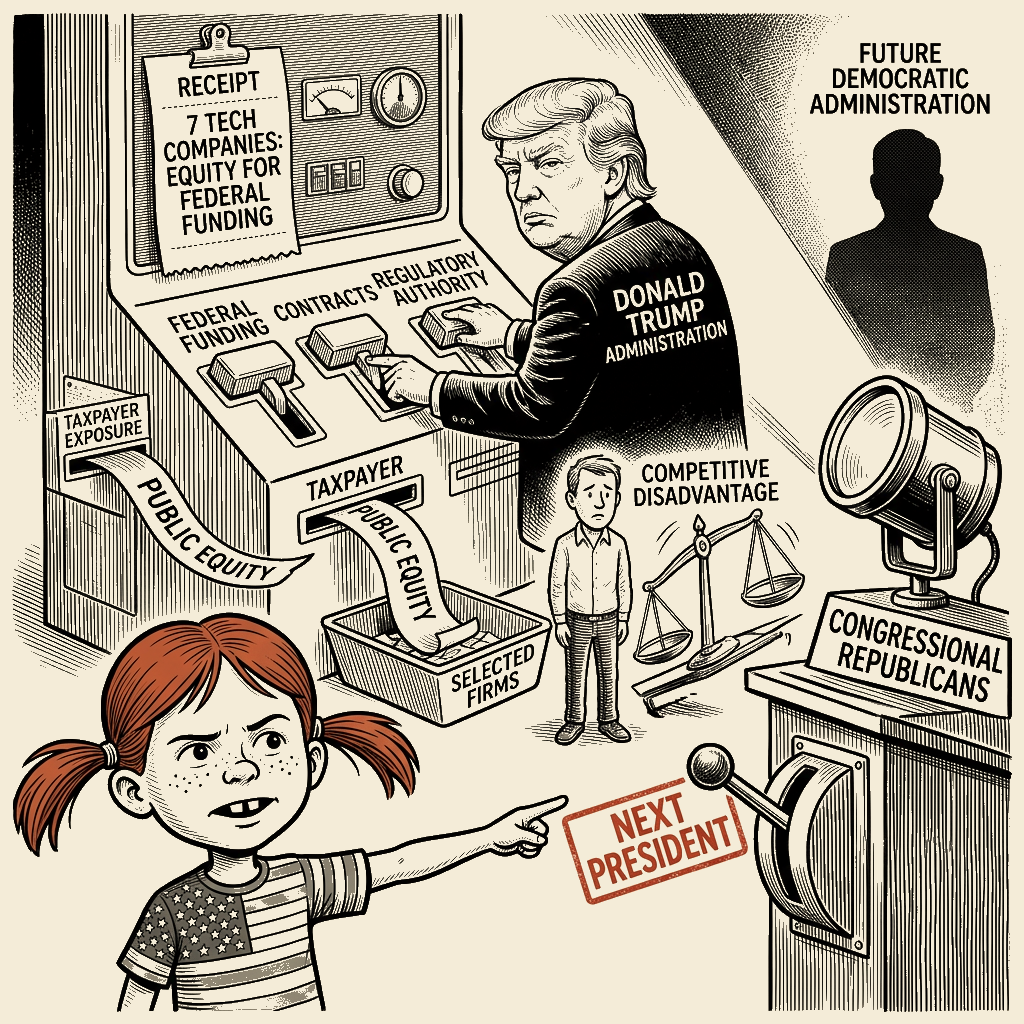
- The immediate beneficiaries are the selected private companies. They receive public equity, access to federal funding, and the possibility of favorable treatment in procurement and regulation; taxpayers carry the exposure, and startups bear the competitive disadvantage identified in the piece.
- The piece reports 40 announced or completed stakes and four additional proposed stakes. Its linked Commerce Department item says equity demands were extended to seven technology companies as a condition of federal funding.
- The source names Intel in its discussion of present favoritism tied to government ownership. That makes the conflict concrete and current; a future-Democrat warning cannot replace scrutiny of the present stake and the alleged preference it creates.
- The Semafor material establishes reported interest among former Biden officials, not an adopted future policy. It adds pressure to the divestment case; it does not substitute for evidence about the current portfolio.
- The piece’s own accounting undercuts the stakes as a deficit fix: it says an Intel sale would net roughly $28 billion, less than 1.5 percent of the $2 trillion deficit it reports.
- The omitted temporal fact is decisive. Republicans are told to act now. The future-president coda is partisan packaging and an additional argument—not a reason to postpone present divestment.
The Response Ladder
Polite Reframe
When to use: For a persuadable reader who rejects government overreach but refuses to let partisan ownership replace conflict-of-interest accountability.
Suppose a federal program tells a technology company it can keep the money only if it gives Washington equity. The company remains private, its executives remain in charge, and the public becomes a shareholder in a business whose customer, regulator, and financial beneficiary may all be the federal government. That is not simply the difference between a giveaway and an investment. It is the government placing its thumb on the scale while insisting its fingers are nowhere near the company.
The piece deserves one concession it does not need: the fiscal arithmetic does not make public ownership attractive. DeHaven reports that an immediate sale of the entire Intel position would yield roughly $28 billion, less than 1.5 percent of the $2 trillion deficit. The piece never claims that selling the stake would solve the deficit; the figures establish that the portfolio is not a fiscal rescue. Its real argument is the conflict created when government owns companies while funding, contracting with, and regulating them.
But the future-president warning remains a partisan escape hatch. Semafor, as cited by DeHaven, reports discussions among former Biden officials about possible uses of government ownership against gun, oil, and AI firms. Those are prospective political arguments. The Commerce Department account involving seven technology companies and the FAA exploration cited in the piece are present conflicts. The source’s Intel allegation is a present accusation that the ownership record and the contracts and regulatory decisions behind it must answer—not a future-Democrat fantasy. The Semafor account requires a Democratic imagination; these require only the existing record.
The administration has announced or completed deals involving 40 private companies, with four more proposed stakes added to the Cato tracker’s running count. That is what Republicans need to answer: not which party might misuse public equity tomorrow, but why the government should be permitted to combine ownership with contracting and regulatory power today. Divestiture can be defended on clean-government grounds. It cannot be sold as protection against Democrats while the present conflicts remain deliberately blurred. The future-president clause is not a firewall; it is a shield for the party currently holding the power.
Mockery and Ridicule
When to use: For a public forum where the repeater has stopped persuading and the bystander needs to see the machinery plainly.
Washington has become a conspicuous corporate shareholder with a compulsory membership policy: pay for the program, then surrender equity to the customer whose cash made the program possible. The administration has announced or completed ownership stakes in 40 private companies, with four more proposed stakes added to the Cato tracker’s running count. That is not a venture-capital portfolio. It is a government-run loyalty discount in which customers have to buy the referee.
Call the badge what the receipts make it: “free enterprise,” with a surveillance camera bolted to the boardroom. The article names Intel and alleges that the administration already uses contracts and regulatory authority to favor a company the government owns. It cites a Politico report saying the FAA explored taking a stake in the air-traffic-control software company it evaluates. So the government may fund the company, regulate the company, assess the company’s safety, and collect a slice of the company. Apparently what would make this un-American is changing the party that controls the stock ticker.
Then comes the future-president routine. Semafor, as cited by DeHaven, reports former Biden officials discussing possible use of government ownership against gun, oil, and AI companies. Wonderful: according to the article, the current administration can already favor Intel, its holding, through contracts and regulatory authority; only Democrats are supposed to have motives. The current owner gets to call it policy. The next owner gets to call it abuse. That is not a consistency test. That is a partisan permission slip.
The fiscal numbers are not supposed to rescue this arrangement. The piece knows that an immediate Intel sale would bring roughly $28 billion, less than 1.5 percent of the $2 trillion deficit. This is not fiscal conservatism; it is public ownership being preserved as private political ammunition. Republicans should not demand divestiture because Democrats might misuse the stakes. They should demand it because government cannot simultaneously own the company, bankroll the company, and judge the company without turning competition into patronage.
Nuclear Satire
When to use: For the apex of power and its willing helpers, when the existing conflict needs to be made impossible to misunderstand.
Imagine the Commerce Department as a medieval guild that taxes every merchant and, after collecting the silver, orders the merchant to surrender part of the shop. The piece’s linked Commerce Department account says seven technology companies were told to surrender equity as a condition of federal funding. The administration has announced or completed ownership stakes in 40 private companies, with four more proposed stakes added to the Cato tracker’s running count. Washington has not merely “bolstered supply chains.” It has become a bureaucratic investment bank whose customers are required to buy stock in the bank.
Next comes the judicial pantomime. The FAA may take equity in the company that develops the air-traffic-control software it evaluates. Imagine the referee owning the team, writing the rules, grading the officials, collecting a percentage of every victory, and then appointing itself commissioner. That is not a future-president problem. It is the present architecture described in the Politico report cited by the piece.
The deficit number is not the source’s fiscal escape hatch. DeHaven knows the scale: roughly $28 billion from an immediate sale of the entire Intel position, less than 1.5 percent of the $2 trillion deficit. That admission narrows the case precisely: the portfolio is not presented as a way to balance the budget. Its purpose is control. The fantasy is not that $28 billion will erase the deficit; it is that Democrats will someday use the ownership machinery for antitrust crusades, industrial policy, or partisan punishment.
So the prescribed firewall is “Republicans must not give Democrats this power.” The actual firewall is simpler: government agencies cannot own the companies they fund, contract with, and evaluate. If Republicans want to defend competition, they should not make the defense conditional on who occupies the White House. The free-enterprise champion does not protect free enterprise by deciding which party may hold the corporate gun.
Profane Scorched-Earth
When to use: For the reader who has watched this partisan machinery run long enough and needs the receipts dragged into the light with the gloves off.
Here’s the fucking setup: the piece says Republicans should act now—which is right—then puts a future-Democrat fog machine at the center of the argument. Forty announced or completed government stakes, four more proposed, and a linked Commerce Department item demanding equity from seven tech firms as the condition for federal money. That is the current program, right now, with real money attached.
Then the article names Intel and alleges that the administration is already using contracts and regulatory authority to favor the company it owns. That is a present conflict, and it is a motherfucking present conflict the government has to answer—not a future-Democrat fantasy. You do not get to slap “national security” on a portfolio and then deliver a future-president fairy tale instead of answering the power you already hold.
Passive shareholder? Passive like a landlord who owns the building, holds the deed, and serves as the tenant-rights ombudsman. If public capital, federal funding, procurement power, and regulatory authority all point toward favored companies, what the fuck is passive about that?
National security? Buy contracts. Stockpile critical materials. Ease permitting. Remove tariffs on production inputs. The article itself lists those alternatives. Government chooses equity because equity gives it power, and then calls the conflict passive. Convenient.
Former Biden officials reportedly discussing ways to pressure gun, oil, and AI companies is a warning. It is not policy. The portfolio is policy. The public capital is present. The equity condition is present. The source has already named Intel in its allegation of present government favoritism. So put the receipts on Intel. Democrats are speculation. Present power is the immediate issue.
The bullshit framing is that the next president must be made the center of the argument. The real answer is simpler: publish the ownership map, name the contracts, expose the regulatory ties, divest the stakes, and make this Congress answer.
No, Donald Trump, you do not get to build a federal ownership portfolio and turn the next party into your political excuse. No, congressional Republicans, you do not get to wrap a present power grab in a future-Democrat scare story.
Fuck the partisan fog machine. Demand the receipts. Divest now. The next president is irrelevant; the next vote is not.

About Malcolm Little King
Malcolm Little King is a heteronym in Main Street Independent's editorial architecture — an analytical voice, not autobiography of any actual person. The position this column expresses is the publication's position on the territory Malcolm Little King's lane covers, rendered through Malcolm Little King's register.