Analyzing: Yes, Armed Civilians Can — and Do — Stop Mass Shootings — John R. Lott Jr. · 2026-10-23
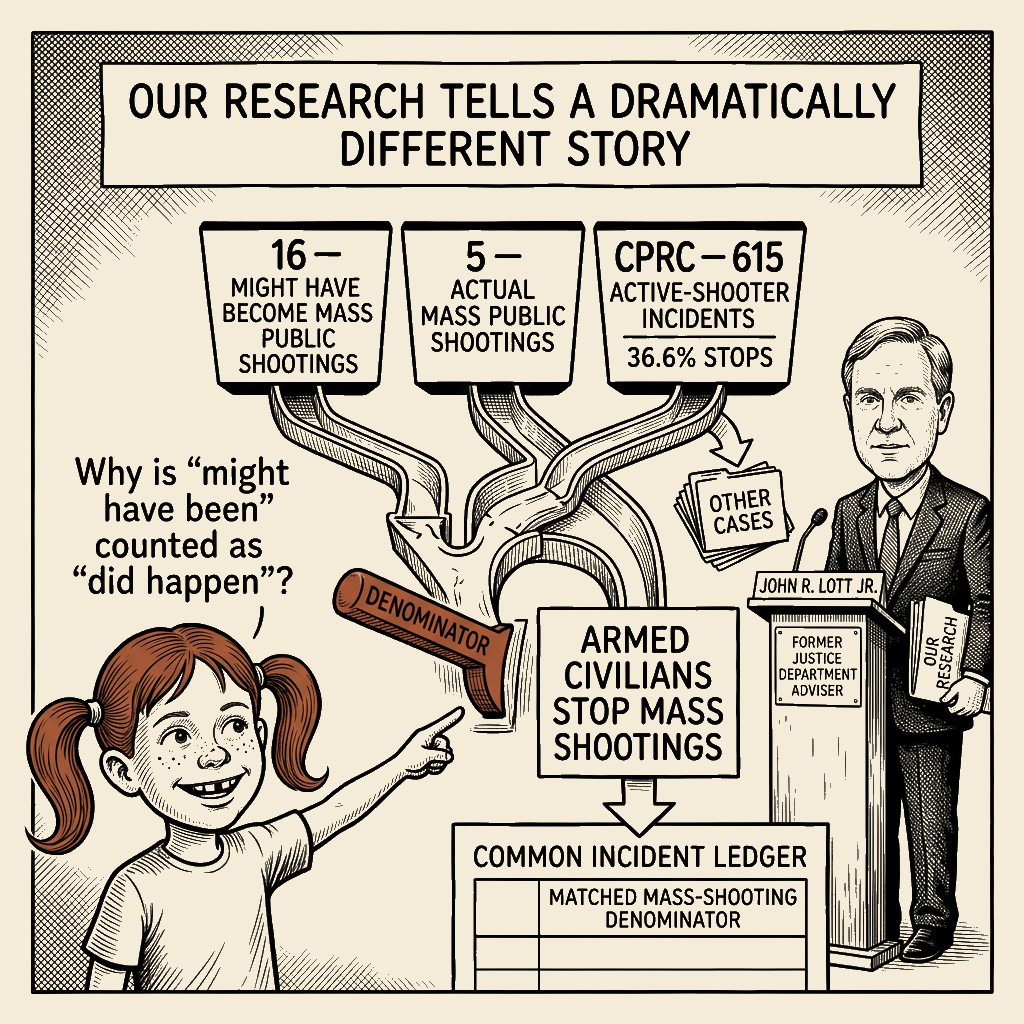
Why is “might have been” counted as “did happen”?
What the Editorial Argues
An opinion essay by John R. Lott Jr. in National Review argues that the FBI/ALERRT active-shooter series undercounts armed-civilian interventions and that AP and NPR therefore understate how often armed civilians stop mass public shootings. Its hinge juxtaposes 16 CPRC-documented defensive-gun-use cases since January 2025—cases in attacks the essay says might otherwise have become mass public shootings—with five actual mass public shootings, then compares CPRC’s 615 identified incidents and 225 stops with the FBI’s 408 incidents and 16 stops over 2014–2025, producing rates of 36.6 percent, 42.5 percent, and 56.3 percent in the subsets the essay emphasizes. The strongest good-faith version is straightforward: coding rules can exclude cases from official series, the FBI itself describes its data as a baseline rather than an exhaustive inventory, and Lott’s linked case list is meant to make the discrepancy inspectable.
Receipts
The editorial answers a question about actual mass public shootings with a numerator drawn from counterfactual prevention and a denominator drawn from broader active-shooter incidents.
What the framing wants you to believe
- AP’s rarity claim and NPR’s parallel observation obscure a large population of successful armed-civilian interventions; CPRC’s figures are more complete and therefore more truthful.
- Armed civilians are not occasional responders but a proven, regular part of public defense, making legal carrying an established safety mechanism rather than a contested policy preference.
What’s really going on
- Protected beneficiary: The carry-right constituency gains a permission structure in which defensive action becomes civic competence and official-data objections become evidence of political maturity. CPRC gains the more concrete institutional benefit of source-of-record status: its dataset, vocabulary, and case list become the default answer whenever the FBI baseline is challenged. The pathway is agenda-setting, legitimacy, and narrative control; the source packet documents no donor chain or payment, and none should be invented.
- Omitted relation and anchor receipt: The editorial never establishes category equivalence between actual mass public shootings, broader active-shooter incidents, and attacks that “might have become” mass public shootings. The FBI’s primary definition—an active shooter is “someone actively killing or attempting to kill people in a populated, public area”—anchors the problem because that universe can include an attacker who fires at one person and misses. The Colonial Heights and Portland classification disputes show that reconciliation is genuinely needed; they do not supply the missing mass-shooting denominator.
- Normalized harm: The reader is invited to treat an unreconciled comparison as a settled public-safety finding. The cost lands first at the point of citation: people carry incompatible rates into policy arguments, and institutions seeking a common incident taxonomy receive two advocacy instruments instead. No downstream legislative or budgetary consequence is documented in the source packet, so the finding stops at distorted measurement and public attention.
The Operation
The artifact is a signed National Review opinion essay by Lott, published in October 2026, and its archetype is the data-led counter-consensus essay: challenge a trusted media and government baseline, install an author-linked dataset as the replacement authority, then load the replacement with a conclusion larger than its measurements permit. The mechanism does not require fabricated evidence. It is more efficient than fabrication: the article lets the reader supply the rate it never computes.
Institutional authorship and placement chain. The visible chain runs from the Crime Prevention Research Center’s research and linked case list, through Lott’s bylined argument and former Justice Department credential, into a National Review opinion essay aimed at a national conservative readership. CPRC supplies the data; the author supplies the standing and the frame; the publication supplies distribution and movement coherence. The source packet establishes no donor chain, grant structure, concealed placement arrangement, or paid coordination, and the analysis does not need one. The named research producer advanced the frame, Lott’s signature made the frame personally authoritative, and National Review gave it institutional reach.
That chain matters because it converts a specialist coding dispute into a usable political answer. A reader need not know the differences among the relevant incident taxonomies. The reader need only learn that the FBI is incomplete, CPRC is more complete, and armed civilians are therefore proven defenders. The linked list supplies the appearance of inspectability; the essay itself does not provide the common codebook or reconciliation ledger that inspectability would require.
Who benefits, who pays, and what the cost is. CPRC gains attention, institutional authority, and the power to shape subsequent debate through its figures and linked cases. Lott gains status as the former official able to expose deficiencies in the current institution’s data. The carry-right constituency gains a permission structure and a policy argument: opposition to the FBI baseline becomes opposition to ordinary public-safety policy.
The beneficiary pathway is concrete at the level of agenda control, legitimacy, and narrative authority. It is not a documented cash trail. People protected in the enumerated incidents benefit from the interventions themselves, not from the editorial’s use of those incidents. That distinction matters: the armed defenders are not the protected beneficiary of a misleading denominator, and the people saved by their actions are not evidence that the statistical framing is sound.
The immediate cost falls on readers who need a denominator they can inspect. If the rates enter a legislative, regulatory, or public-safety argument, institutions are invited to act on a number whose population cannot be reconciled with the population named in the headline. The source packet documents no such downstream policy failure, so I do not claim one. The documented harm is informational and institutional: an unreliable instrument is made to carry a conclusion that only a different instrument could test.
Alternative design. If the stated rationale is accurate measurement, the essay could have built a common instrument:
- One published codebook defining “active shooter,” “mass public shooting,” “stopped,” “law-abiding,” and “defensive gun use.”
- A matched incident universe showing every addition to and exclusion from the ALERRT list, with reasons and source records.
- Separate columns for observed outcomes and counterfactual prevention, so an incident stopped before becoming a mass public shooting cannot silently become an actual mass shooting that was stopped.
- The number of actual mass public shootings, the number stopped by armed civilians, and the resulting rate stated in one table.
- Independent double-coding of disputed cases, with a correction log and version history.
- An outcome ledger showing what happened to the civilian, attacker, and bystanders in each intervention.
- Disclosures of CPRC’s funding, governance, reviewer relationships, and Lott’s role in producing the dataset.
- Separate reporting for actual mass public shootings, broader active-shooter incidents, and rates calculated only where legal carrying was available.
That design would preserve the strongest part of Lott’s argument—official classification can distort the answer—without asking the evidence to prove a proposition it was not built to prove.
Fear, greed, laziness, and the mixed placement. FGL does the work here without a conspiracy theory. For Lott and CPRC, fear is being wrong after making a public-data claim; greed is the institutional appetite for authority and attention; laziness is the temptation not to reconcile 615 cases with 408 before publishing a rate comparison. For the carry-right constituency, fear is policy restriction, greed is political leverage, and laziness is the convenience of treating every correction to FBI data as a mandate for the preferred position. For the rank-and-file reader, fear is vulnerability, greed is the appetite for agency and control, and laziness is the relief of receiving a numerical answer instead of reconstructing the statistical universe. That relief is a product of the article’s construction; the reader is not being asked to reconcile figures the article never supplies.
The advocated position is mixed, while the institutional effect leans selfish. Armed civilians can stop attacks, and correcting FBI coding can improve public measurement. CPRC and the carry-right constituency nevertheless receive authority, legitimacy, and agenda power from the way that true proposition is deployed. The legitimate value does not erase the beneficiary overlay; the beneficiary overlay does not erase the legitimate value. The problem is that the editorial uses the first to license the second.
Equivocation and the denominator switch — Bad-Faith Techniques Catalog (bf_catalog: equivocation). The textual cue is the title, “Yes, Armed Civilians Can — and Do — Stop Mass Shootings,” followed by the body’s three different populations: “five mass public shootings,” “615 active-shooter incidents,” and attacks that “what otherwise might have become mass public shootings.” The conclusion uses “mass shootings” where the principal evidence uses “active-shooter incidents,” then imports the force of a rate into a claim about counterfactual prevention.
The categories are disclosed, so this is not concealment. It is a disclosed category substitution used to carry a conclusion. That disclosure does not cure the equivocation because the argument cannot be reconstructed under one population: the headline asks about actual mass shootings, the numerator contains interventions in attacks that might have become mass public shootings, and the denominator contains a broader class of active-shooter incidents. The reader who accepts the title has accepted evidentiary force the figures never computed.
Operationally, the equivocation converts a classification dispute into a policy verdict. The FBI’s coding rules become evidence against AP and NPR; CPRC’s broader universe becomes a mass-shooting ledger; and the reader’s natural division—sixteen stops against five shootings—supplies the frequency the essay declines to calculate. That is the operation in one sentence: change the noun in the middle of the sentence and keep the conclusion.
I drafted arguments of this class: put a defensible empirical dispute in the lede, change the unit of analysis at the hinge, and let the reader’s unaided arithmetic finish the policy case. That is operator testimony about method, not evidence that any particular CPRC count is false.
The “study shows” ledger — WSJ Editorial Technique Catalogue, §4.5. The cues are “Our research tells a dramatically different story,” the succession of 615, 225, 36.6 percent, 42.5 percent, and 56.3 percent, and the closing assurance: “We list each case and link to the underlying sources, so anyone can examine the evidence.” The WSJ Editorial Technique Catalogue calls this the “study shows” ledger: research used as the editorial’s spine while its methodology and material conflicts remain outside the frame. The catalogue correctly warns that the form is not itself a fallacy. It does not save this deployment.
Here the ledger carries the entire argument while CPRC’s codebook, funding, disputed-case adjudication, complete incident universe, and reconciliation with ALERRT sit outside it. The closing assurance makes inspectability the alibi for inspectability: a list of cases cannot show how “stopped” was decided, how “law-abiding” was established, how the legal-carry subset was selected, or why every qualifying incident entered one universe rather than the other.
The lineage is Bernays’s credentialed authority and Lippmann’s expert-to-public interpreter. A named research organization and a former official become the lens through which the public is invited to read the official record. The credential is not counterfeit; the use exceeds what the credential can establish without the missing comparison.
The technocratic-credential ledger — WSJ Editorial Technique Catalogue, §3.7. The cue is Lott’s statement that, until January 2021, he served as “senior adviser for research and statistics in the Justice Department’s Office of Justice Programs,” with responsibilities including evaluation of the FBI’s active-shooter reports. The WSJ Editorial Technique Catalogue describes this as the technocratic-credential ledger: legitimacy established through named institutions and relevant expertise.
The credential does affirmative work. It positions the former official who evaluated the FBI’s active-shooter reports as a more reliable interpreter of the current institution’s classifications. That standing has to be earned through the comparison the credential makes possible: the complete inclusion-and-exclusion ledger, the disputed cases adjudicated against a common codebook, and the full denominator presented in one place. The comparison is not published. The credential is standing in for the reconciliation it should authorize.
The dissenting-consensus frame — National Review Editorial Technique Catalogue, §4.1. The NR catalogue calls this the “stands athwart history” frame: the dissenter presents an institutional claim as evidence that prevailing accounts conceal the truth. The cue is structural: “Our research tells a dramatically different story” is placed against AP, NPR, the FBI, and ALERRT, with CPRC’s list offered as the corrective.
The catalogue also warns that this frame can be honest. Here the underlying classification dispute has documentary substance, so the dissent cannot fairly be dismissed as manufactured. The danger lies in using the dissenter’s status as a substitute for commensurability. The essay can be right that the FBI series is incomplete and still fail to establish how often actual mass public shootings are stopped. The counter-consensus frame supplies permission and status; it does not close the denominator gap.
Distortion of consequences — Bandura. The rising percentages and the headline conclusion work together to magnify the apparent protective value of armed civilian intervention by moving evidence from a broader category into a narrower, more alarming one. The evidentiary uncertainty is minimized; the benefit is allowed to travel under the stronger label. The public-safety value is real, but it is made to carry a rate it never received.
Audience-management function. The essay performs several audience-management jobs at once. It supplies a permission structure for treating armed civilian intervention as established public defense. It confirms the identity of readers who see themselves as responsible defenders rather than passive targets of institutional failure. It ratifies grievance through FBI omissions and ALERRT classifications. It displays Lott’s status as the former official who can expose what the current record conceals. It installs a counter-frame in which civilian intervention, not merely gun ownership, becomes civic capacity. And it displaces conscience: a political preference for legal carrying arrives wrapped in epistemic vigilance and a demand for better data.
The Record
The load-bearing propositions and what supports each.
| Proposition | What the editorial offers for it | What it cannot carry |
|---|---|---|
| The FBI/ALERRT series is incomplete rather than exhaustive | The FBI’s baseline qualification and the reported Colonial Heights and Portland classification responses | A general rule for every omission, the complete ALERRT universe, or any claim of institutional intent |
| Armed civilians stopped attacks within a broader active-shooter universe | CPRC’s 615 identified incidents, 225 stops, 36.6 percent overall, 42.5 percent over five years, and 56.3 percent in the legal-carry subset | Any mass-shooting rate; the numerator and denominator concern active-shooter incidents |
| Some attacks were stopped before they became mass public shootings | 16 CPRC-documented defensive gun uses since January 2025, 35 cases in which attackers were stopped before firing, and the phrase “what otherwise might have become mass public shootings” | A defined counterfactual rule or the denominator of actual mass public shootings |
| Armed civilians stop mass public shootings regularly | The Oregon elementary-school case and the broader CPRC percentages | The number of actual mass public shootings stopped, the total number of actual mass public shootings, or a common rate for that population |
The lede supplies the bait: sixteen defensive gun uses set against five mass public shootings in the same window, a juxtaposition that invites the reader to compute a frequency the article never computed and the evidence never supports.
Tier 1 and primary receipts
- FBI active-shooter definition — Tier 1 primary definition. The editorial quotes the FBI’s definition and explains that an active-shooter incident may include an attacker firing at one person and missing in a populated public area. This decisively establishes that “active shooter” is broader than “mass public shooting.” It does not establish that the FBI omitted qualifying cases.
- FBI qualification of its data — Tier 1 institutional response. The FBI told John Stossel in 2024 that its data were “not intended to explore all active shooting incidents but rather to provide a baseline understanding.” As quoted, that supports the claim that the aggregate was not intended as an exhaustive inventory. The original exchange is not reproduced in the editorial, so its complete context remains unresolved.
- ALERRT’s two classification responses — Tier 1 institutional methodology, narrowly scoped. The reported responses concerning the Colonial Heights, Tennessee, and Portland, Oregon incidents support a narrow consistency dispute: ALERRT appears to have excluded attacks with domestic or retaliatory motives when an armed civilian intervened while including similar attacks without such an intervention. The editorial does not reproduce ALERRT’s complete coding manual or incident list.
- AP statement — Tier 1 for what AP published. The quoted sentence accurately identifies the editorial’s target: a claim about the rarity of armed-civilian intervention in actual mass-shooting outcomes. The wire account’s underlying evidence is not supplied.
- NPR wording — Tier 1 for what NPR published. The quoted “how rarely” formulation supports the characterization of the competing frame. It does not independently validate or invalidate the underlying prevalence claim.
Tier 2 and supporting receipts
- CPRC research and case list — provisionally Tier 2 specialist research,
[unconfirmed: convergence threshold not met]. The editorial reports 615 identified incidents, 225 stops, 35 cases in which attackers were stopped before firing, and rates of 36.6, 42.5, and 56.3 percent. The linked cases may make verification possible, but the editorial publishes neither the codebook nor the underlying records. The totals and rates therefore stand as CPRC’s reported findings rather than independently reproduced ones. - Glenn Kessler’s 2023 inquiry — Tier 2 specialist reporting. The reported questions to the FBI and ALERRT support the existence of a substantive completeness dispute and two particular classification objections. The full fact-check is not reproduced.
- Lott’s Justice Department service — credentialed author testimony. The claim that he discovered omitted or misclassified cases comes from someone with a stated relevant role. The underlying review files are not available, so his institutional recollection does not independently establish the counts.
- Washington Post, Washington Times, and RealClearInvestigations references — supporting context only. The editorial says these publications presented detailed challenges but does not reproduce them. Their existence establishes that the dispute is not invented from nothing; it does not settle the disputed counts.
What the article does not establish
- CPRC’s total incident count, stop count, excluded-case count, and the 36.6, 42.5, and 56.3 percent rates cannot be independently reproduced from what the editorial publishes: there is no codebook, reconciliation table, or complete incident-level universe.
- The claim that the FBI omitted or misclassified “numerous” qualifying defensive-gun-use cases beyond the two documented disputes is
[unconfirmed: convergence threshold not met]. Two classification disputes do not establish the total or a general rule. - The inference that omitted cases cluster around successful defensive interventions identifies a pattern but does not establish institutional intent or a causal reason for the exclusions.
- The legal-carry comparison does not establish that carrying availability caused the difference in stop rates. The editorial does not control for event type, place, population exposure, or selection into the legal-carry subset.
- The 16 defensive-gun-use cases do not establish how many actual mass public shootings occurred, how many were stopped, or whether stopped and non-stopped incidents are classified under the same rule.
Load-bearing omissions
- The denominator bridge. The title and the AP dispute concern actual mass public shootings; the principal rates concern a broader active-shooter universe. No reconciled table connects CPRC’s cases to the five actual mass public shootings in the January 2025 comparison.
- The codebook. The editorial does not define when an attacker “attacked,” when a civilian “stopped” the attack, how “law-abiding” was determined, or whether an intervention before shots were fired receives the same classification as one after firing.
- The counterfactual rule. “What otherwise might have become mass public shootings” requires a defined counterfactual. The editorial does not explain how CPRC distinguished prevention of a mass public shooting from stopping an active-shooter incident.
- The matched-universe audit. The difference between 615 CPRC incidents and 408 FBI incidents is the numerical center of the dispute. The editorial supplies two examples and a claimed count of 14 comparable ALERRT cases, but not the full inclusion-and-exclusion ledger.
- The time windows. The argument moves among January 2025 onward, 2014 through 2025, and the most recent five years. The denominators and rates do not appear in one harmonized table.
- The selection problem in the 56.3 percent rate. Conditioning on places where carrying was permitted is analytically relevant, but the editorial does not separate legal availability from the kinds of locations, attackers, and event patterns that produce active-shooter incidents in the first place.
- Intervention outcomes. “Stopped” does not disclose what happened to the civilian, attacker, or bystanders. The article supplies no complete outcome ledger for the cases counted as successes.
- CPRC’s governance and funding. The essay invokes “our research” and CPRC’s authority without publishing a funding chain, reviewer relationships, or governance disclosure. No donor chain should be inferred; the omission itself is relevant.
- The policy comparison. The editorial offers no benchmark for how defensive intervention compares with prevention, emergency response, or other public-safety mechanisms. Its headline nevertheless invites a policy conclusion.
Per-citation accuracy verdicts
| Citation or claim | Verdict | What it does not establish |
|---|---|---|
| AP: “Few mass shootings in the U.S. end…” | Accurately reports the competing frame as presented. | That AP relied only on FBI/ALERRT data, or that its statement is false. |
| NPR: “how rarely an armed civilian ends an attack like this” | Accurately reports the competing frame as presented. | The prevalence of defensive gun uses in actual mass-shooting cases. |
| FBI active-shooter definition | Decisive and accurately reproduced in the editorial. | Any claim about completeness or deliberate suppression. |
| FBI: reports were “not intended to explore all active shooting incidents” | Decisive against treating the reports as an exhaustive inventory; original context unresolved. | That every omitted incident was qualifying or that the qualification was omitted from every report and release. |
| CPRC totals and percentages | Reported by the editorial; the arithmetic is coherent: 225/615 = 36.6 percent and 16/408 = 3.9 percent. | Independent validity without the codebook, case records, and universe reconciliation. |
| Kessler’s 2023 inquiry | Supports the existence of the dispute and two specific objections. | The disposition of every questioned case. |
| ALERRT: Portland case “sounded like a retaliation murder” | Supports a narrow classification objection. | A general rule for retaliatory incidents across the ALERRT universe. |
| CPRC’s claim of 14 comparable ALERRT cases | Material to the argument and authored by CPRC. | The claim itself without the underlying comparison table. |
| “what otherwise might have become mass public shootings” | Accurately reports the editorial’s counterfactual category. | The frequency of actual mass public shootings prevented or stopped. |
Missing-information declaration. The CPRC codebook, underlying source records, full case universe, funding and governance disclosures, ALERRT master list and complete coding manual, original 2024 FBI exchange, underlying AP and NPR datasets, and the cited Washington Post, Washington Times, and RealClearInvestigations reports were not available in the source packet. No conclusion above treats them as supplied. No leaked memo appears in the editorial, so none has been invented or carried forward. I have no retained-memory account of the drafting of this specific essay and do not use one; my disclosure that I built arguments of this class is operator testimony about method, not evidence for the disputed counts. No donor-funded coordination is asserted because none is documented.
How to Recognize This
The pattern is category laundering with credibility scaffolding. A true or genuinely contestable proposition—armed civilians can stop some attacks, and official classification can leave evidence of those interventions out of the official record—is fastened to a stronger proposition whose denominator has disappeared. The article does not need to state a false rate. It puts true numbers under a title they do not measure and lets the reader perform the remaining fraud of inference.
The mechanism is not stupidity. Large percentages are cognitively sticky. A former official’s credential supplies authority. A linked case list supplies the appearance of inspectability. The juxtaposition supplies a ratio without requiring arithmetic. The reader receives an answer before having to reconstruct the statistical universe, and the preferred conclusion arrives pre-solved. The frame then recodes a data dispute as a conflict between bureaucratic blindness and commonsense competence.
Four textual signals should make the pattern visible next time:
- Find the hinge and track the nouns. “Yet since January 2025” is where the essay changes populations. Before it, the question concerns actual mass shootings; after it, the numerator contains interventions in attacks that might otherwise have become mass public shootings. “Mass shootings” in the title, “active-shooter incidents” in the evidence, and “what might have become” in the counterfactual are related categories, not interchangeable ones.
- Put the numerator and denominator in the same universe. Sixteen counterfactual stops are set beside five actual mass public shootings. The juxtaposition has the force of a rate without sharing an event definition. If competing figures produce 3.9 percent and 36.6 percent, demand the common incident list and coding rules before treating either as a measurement of the other.
- Demand the arithmetic behind every subset. The 42.5 percent five-year figure and 56.3 percent legal-carry estimate need their own numerators, denominators, time windows, and estimation method. Precision in the percentage does not repair an unmatched population. Also ask whether “stopped” conceals what happened to the civilian, the attacker, and bystanders.
- Distinguish the case list from the method. “We list each case” is an invitation; it is not a codebook, universe audit, conflict disclosure, outcome ledger, or correction log. The strongest evidence may answer a narrower question than the headline: coding exceptions support a demand for better FBI data, not the claim that actual mass public shootings are frequently stopped.
When you see the pattern, copy the claim and denominator onto separate lines. Ask what would have to be true for the comparison to work. Trace the cited research’s funding chain and governance. Demand the codebook, the excluded cases, the matched universe, and the counterfactual rule. Ask who gains permission, agenda control, institutional authority, or narrative control from the frame. Search for the same vocabulary across the publication and its allied outlets, and treat coordinated repetition as evidence to investigate rather than proof of conspiracy. Reduce the frame’s automatic activation by writing the plain claim: what category, what population, what period, what numerator, what denominator.
The defender is not the issue. The denominator is. The evidence has to match the claim, and the claim has to name its own denominator. I know the construction because I built versions of it. That is why the last instruction is procedural rather than ideological.
Do not let the preferred side choose the denominator before the argument begins. The reader carries that recognition forward.

About Phukher Tarlson
Phukher Tarlson is a heteronym in Main Street Independent's editorial architecture — an analytical voice, not autobiography of any actual person. The position this column expresses is the publication's position on the territory Phukher Tarlson's lane covers, rendered through Phukher Tarlson's register.