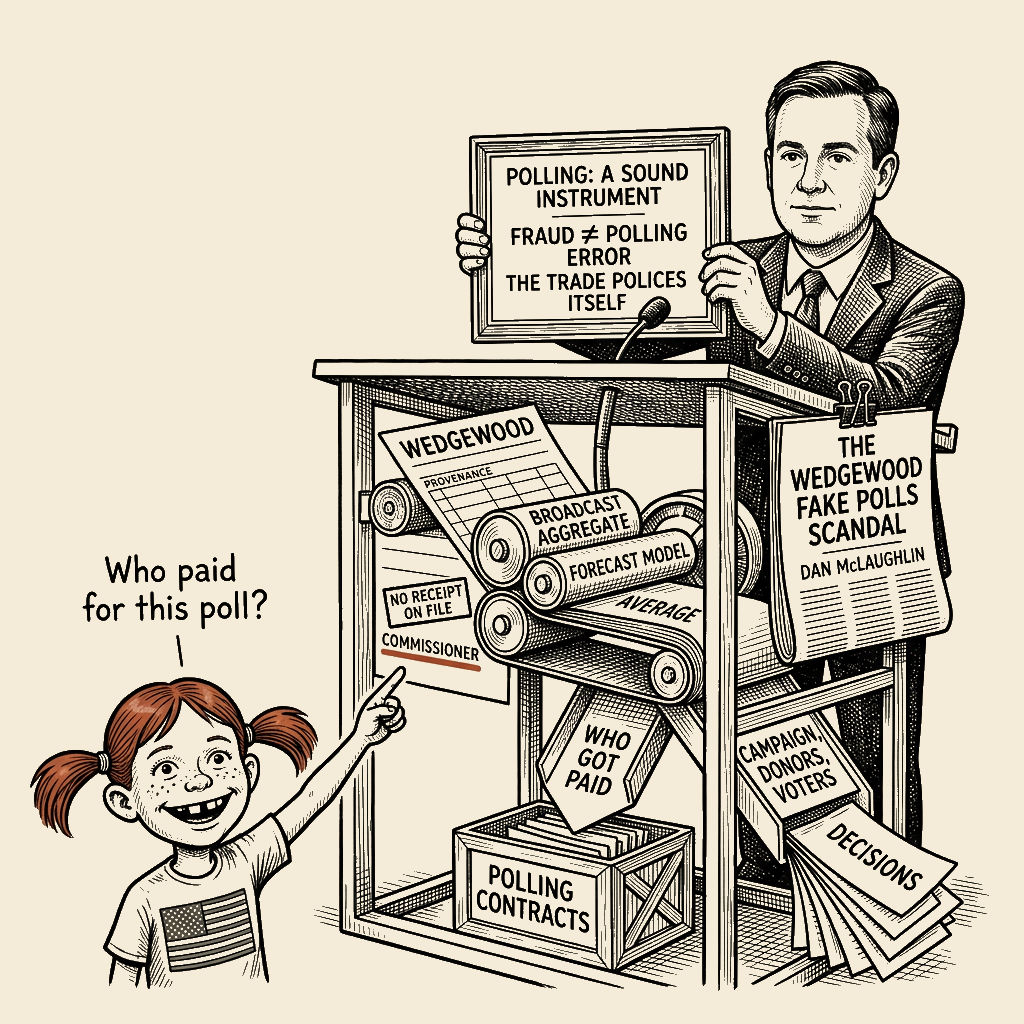
Analyzing: The Wedgewood Fake Polls Scandal — Dan McLaughlin · 2026-10-21
Caught the forgery. Never asked who paid for it.
What the Editorial Argues
In a signed National Review column, Dan McLaughlin argues that the fashionable suspicion of polling mostly confuses ordinary error with fraud, and that the handful of poll-fabrication cases the editorial reports from the current election cycle should be prosecuted as fraud rather than used to discredit polling as an instrument. He supports that case with real methodological distinctions: pollsters report ranges, averages can outperform single polls, and errors run in both directions across cycles. He then turns to political prediction markets, arguing that the efficient-markets analogy he draws from securities law does not transfer cleanly to them, before urging the polling and poll-analysis trades to police themselves before conspiracy theories harden into fact.
Receipts
The piece performs an inoculation: it uses the reported Wedgewood forgery to certify the polling instrument that the forgery indicts, while assigning the bill for the failure to readers’ skepticism rather than to the people and institutions that manufactured, amplified, aggregated, forecast, and acted on the data.
What the framing wants you to believe
Polling is a sound instrument, and its loudest critics are confusing noise with fraud. The Wedgewood and Median Strategies cases are individual crimes by individual perpetrators; the industry’s detection, removal, and model correction show self-policing working.
The firms that published fake data were crooks, not clients. That distinction deserves credit, and the editorial gives it: it names no one as having commissioned the polls.
Political prediction markets are a separate and more dangerous development because they lack the informational discipline and the trading rules that securities law built over a century.
What’s really going on
By the editorial’s own account, Wedgewood manufactured favorable numbers; one poll was said to be real, and fabricated or suspect material moved through television, aggregators, a forecast model, campaigns, donors, reporters, and volunteers before it was exposed. The named chain includes MS NOW, the New York Times, FiftyPlusOne, Decision Desk HQ, Vote Hub, an updated National Review post, and Nate Silver’s model; RealClearPolitics declined to include the Wedgewood polling. Every handoff converted a dubious number into a more authoritative-looking one.
The beneficiaries are concrete: pollsters and forecasters sell the product whose credibility is being restored; aggregators gain traffic and authority; campaigns and donors gain leverage from favorable viability numbers; the author gains standing. The cost-bearers are the candidates, donors, volunteers, reporters, primary voters, and readers who consumed the numbers as information rather than as a tradeable opinion. The editorial omits the relation that would connect these groups: who commissioned the polls, who paid, who checked, and who profited from circulation.
The prescription fails its own case. “Averages of multiple polls are more reliable than any one individual poll” depends on errors being sufficiently independent; shared-source errors can be propagated or overweighted when several aggregators ingest the same poll. Bates and Granger’s “The Combination of Forecasts,” Operational Research Quarterly (1969), is the anchor: one shared error entering several models is not independent confirmation, and it can travel through every average that ingests the same source. The editorial never states that condition, although its own circulation chain makes it indispensable.
The Operation
Triage and classification. The artifact is a signed National Review column by Dan McLaughlin, not an unsigned Wall Street Journal editorial-board piece. The byline and the editorial’s reference to “an NR post which has since been updated” support that attribution. Its domain is polling fraud, forecasting, and the evidentiary status of political prediction markets. Its dominant archetype is the inoculation: a real defect in an institution’s domain is used to certify the institution. Its subsidiary techniques include an inverted “study shows” ledger, frame-engineered relabeling, expert-deference, serial authority laundering, a partial hasty generalization, and threat inflation. The National Review catalogue is the primary register reference; the WSJ catalogue supplies the overlay.
The advocated position is mixed. The insistence that fabricated data are fraud rather than biased polling is legitimate and publicly useful. The larger operation—using that fraud to certify the polling and forecasting trades, while declining to name the commission chain that made the fraud consequential—is self-serving.
Institutional authorship. The editorial’s methodological frame is consonant with the American Association for Public Opinion Research’s task-force reports on the 2020 and 2024 election polls and with the polling trade’s disclosure and transparency standards. Those documents provide context; they do not establish that AAPOR, any pollster, or any foundation commissioned or directed the column.
The institutional interests are more concrete. Pollsters and political consultants sell polling products; aggregators sell reach, access, and the appearance of comprehensive evidence; forecasters sell authority and subscriptions, while also accumulating political influence; campaigns and donors buy judgment. The editorial presents the trade’s three methodological propositions—ranges, averaging, and errors running in both directions—without attaching citations to them, while attaching a fraud charge to a firm it never examines. Its solution gives those same trades the authority to police themselves.
That is the institutional authorship visible in the argument: not a hidden hand writing the column, but a field whose preferred remedy preserves its own standing and whose preferred vocabulary is being deployed as an exculpatory certificate.
Placement chain. The artifact is dated October 21, 2026, in the final stretch of the election cycle. It reaches an audience that has spent years being told that polls were crooked and may be looking for permission to trust them. The editorial itself supplies two placement facts: an NR post carried Wedgewood polling and was subsequently updated, while MS NOW broadcast the firm’s work. The same media system that carried the suspect data is then used as the case study proving that the instrument deserves trust.
No circulation data is available, so no claim can be made about how widely the piece traveled. Nor does the placement chain establish coordination between McLaughlin, MS NOW, the aggregators, or the political actors. The safe conclusion is narrower and sufficient: the piece was placed before readers already primed to distrust polling, and it supplied a truth that could be mistaken for a settlement.
Distributional impact.
Beneficiaries with a concrete pathway. Pollsters and forecasters can restore the credibility premium on which their contracts and public standing depend. Aggregators recover the authority to treat their own averages as verified products of many inputs. Campaigns, donors, and media actors can use polling to allocate money, volunteers, and attention. McLaughlin gains attention and professional authority by certifying the field he knows. The editorial reports political actors using Wedgewood numbers—Scott Colom touting a tied Senate poll and Abdul El-Sayed using Wedgewood polling in Michigan—but it does not establish that either man commissioned the polls or knew they were fabricated. They are documented users, not proven clients or knowing beneficiaries.
The umbrella beneficiary. The polling and forecasting trades as a category benefit if the public learns to treat two exposed frauds as the work of bad apples and returns to institutional confidence. The pathway is renewed contracts, restored authority, and a public willing to accept future polls without checking their provenance.
Cost-bearers. The editorial reports that a June poll showing Mallory McMorrow in single digits was followed by donations drying up, devastated volunteers, and reporters pressing her to withdraw. That account, if authenticated, places money, labor, and pressure on her campaign and personnel. Other cost-bearers include donors whose money moved on a false number, campaigns whose viability was distorted, outlets whose names laundered suspect data, primary voters confronted by manufactured momentum, and readers whose confidence in institutional verification was weakened.
The unresolved incidence. The super-PAC fundraiser’s “$80 million” statement is not a magnitude of harm from the poll. It is a competing explanation for the same funding decision—the campaign was being outspent—printed without comment. Outspent by whom, over what period, and how much of the withdrawal was caused by the poll remain unanswered. The editorial cannot assign primary causal responsibility without that answer.
Alternative design. A system optimized for the editorial’s stated purposes—fraud detection, market integrity, and public trust—would require receipts at every handoff rather than leave verification to the trade’s reputation.
Release-level provenance would begin the system. Every poll would carry the commissioner and funder, field dates, population universe, sample size and type, mode, questionnaire, weighting method, raw and weighted sample sizes, corrections, and a unique publication identifier.
Cross-aggregator duplicate detection would prevent apparent consensus from manufacturing itself. One poll entering four averages would remain visibly one source. The editorial’s own case demonstrates why independent averaging cannot do that work when the upstream source is shared.
Verification before amplification would place the receipt before the reputation. Television, aggregators, and forecasters would be required to obtain the original release rather than a logo attached to somebody else’s number. An anomalous result would trigger an independent audit before it entered a model or changed a campaign’s judgment.
Enforcement beyond private litigation would protect people who never saw the original document. The Daily Kos–Research 2000 precedent the editorial praises required one deceived publisher to break the story and then sue. Donors, campaign staffs, and voters cannot be left dependent on a private fraud action. An independent ombudsman or state-enforcement path would provide a claim where the public interest lies.
A correction trail, not deletion, would preserve the consequences. An outlet would state how long the false data remained visible, which model and decisions they touched, and what was corrected. Erasing the number does not erase the money, attention, or momentum it produced.
Auditability for prediction markets would prevent a price from masquerading as proof. A market price should not inherit evidentiary authority merely because it has a price. Information moving a contract should be traceable, and trades resting on later-disproven fabrications should be auditable. The editorial’s own securities analogy supplies that standard; it should not remain decorative.
Trade self-policing is not worthless. The editorial’s best reported evidence is FiftyPlusOne acting as a private gatekeeper. But that fact indicts the remedy’s incompleteness: the trade caught the fraud after it had already been broadcast, aggregated, forecast, and acted upon. The people consuming polls as power remain unprotected.
Fear, greed, laziness. The FGL analysis applies across three constituencies without treating any of them as stupid or contemptible.
The framing’s author. Fear is real: McLaughlin’s professional identity and standing depend on polling being a tool he can vouch for. Greed is present but small: the currency is attention, authority, and the market for his judgment. Laziness is located in the refusal to finish the causal analysis, because finishing means asking whether the gatekeepers he wants to exempt were among the institutions that failed.
The apex beneficiary, the polling and forecasting trades. Fear is the loss of the credibility premium on which their products depend. Greed is ordinary and specific: pollsters are paid by campaigns and outlets whose interests they then evaluate, while discovery imposes costs after publication. Laziness is the absence of an incentive to make disclosure a condition of aggregation when reputation can be repaired by blaming two firms.
The rank-and-file reader. Fear is being wrong about a race in a way that costs money or credibility. Greed is the desire to be on the winning side without doing the work. Laziness is the cheapest available position: “The polls are fake” and “The polls are fine” can both be held without reading a methodology. The editorial wants the reader off the second position. That is not stupidity. It is the rational result of years in which confident people made checking seem pointless.
Selflessness placement. The piece is candid about the fraud, and the candor is part of the instrument. It names the crime, distinguishes it from bad methodology, credits the detector, refuses to let one forgery become an indictment of all polling, and acknowledges that primary polling can mislead for legitimate reasons. Those concessions lend the closing certificate the appearance of being earned.
Its self-serving element is just as load-bearing. The credential paragraph supplies authority that the receipts do not, and the closing paragraph asks the failed institution to police itself. The editorial does not conceal its concern for polling; it uses that concern to narrow accountability.
Technique identification.
1. Frame-engineered relabeling: “experiment” for fabrication.
Textual cue: Wedgewood’s post-exposure statement called the operation a Sokal-style “experiment” designed to “test a simple hypothesis: How easy is it for an entirely fabricated polling firm to gain traction, be taken seriously, and expose how little scrutiny exists in media and public commentary?” The editorial also calls it “an elaborate prank.”
Catalogue cross-reference: Bad-Faith Techniques Catalog, bf_catalog: frame_engineered_relabeling; Bandura mechanisms: moral justification, euphemistic labeling, and displacement of responsibility.
Operational function: “Experiment” turns deliberate data fabrication into inquiry, false numbers into social evidence, and successful circulation into the finding. “Prank” softens the transaction without repairing it. The firm’s research-purpose language, as quoted by the editorial, also relocates responsibility from the producer to the media and public commentary. Whether “experiment” was the original plan or a face-saving story after exposure cannot be established from the supplied record; the wording performs the same work either way.
The editorial’s Sokal analogy is truncated. Sokal’s submission was gibberish offered to an academic journal without review by anyone qualified to test the physics. Wedgewood’s output, according to the editorial itself, was broadcast, aggregated, forecast, and acted upon by campaigns, donors, volunteers, and reporters. A fraud that reaches campaign decisions is not fraud in the Sokal sense. The catalog pattern is documented; the analogy that protects the firm is not.
2. Frame-engineered relabeling: empirical hypothesis into legal presumption.
Textual cue: “The law presumes that efficient markets for publicly traded securities are informationally efficient.”
Catalogue cross-reference: Bad-Faith Techniques Catalog, bf_catalog: frame_engineered_relabeling; WSJ Editorial Technique Catalogue, §4.1, frame-engineered relabeling.
Operational function: If the sentence is read as a freestanding legal presumption, the efficient-capital-markets hypothesis becomes a doctrine capable of carrying the next conclusion by institutional authority rather than empirical proof. Basic, Inc. v. Levinson, 485 U.S. 224 (1986), did use efficient-market reasoning in its fraud-on-the-market analysis, especially on materiality and the “total mix” of information. It did not make informational efficiency a freestanding presumption that displaced proof.
The editorial then does something correct with the analogy: it says the presumption does not apply if the market fails empirical tests ranging from liquidity to its response to news. That clause convicts the loose legal formulation. The problem is not skepticism about prediction markets; it is substituting an institutional label for the empirical test the editorial says matters.
3. Expert-deference and NR erudition-as-cudgel.
Textual cue: “Very little of what shows up in the economic literature on efficient capital markets, or in the legal regime governing them, is true of political prediction markets. I regard them as little better than witchcraft.”
Catalogue cross-reference: Bad-Faith Techniques Catalog, “Expert-consensus / expert-deference framings”; National Review Editorial Technique Catalogue, §4.2, “erudition-as-cudgel.”
Operational function: The passage invokes an economic literature and a legal regime, names the empirical tests, and then does not apply them to political prediction markets. The literature it declines to engage is not thin: work by Wolfers and Zitzewitz addresses prediction markets and the reading of market prices as probabilities; Snowberg and Wolfers address favorite-longshot bias and the effect of large trades on event-contract prices.
This is a partial match to erudition-as-cudgel, not a claim that technical language is inherently suspect. The defect is that expertise functions as a credential rather than a furnisher of answers. The editorial’s securities analogy also defeats its own proposed remedy: the regime he invokes depends on legal rules, enforcement, and remedies beyond trade self-policing. “Keep their own house in order” is not the inference drawn from the system he invokes.
The sharper allegation remains unproven: the editorial mentions—without supplying a trade record—that Wedgewood may have traded on prediction markets affected by its own fabricated data. The editorial correctly separates that allegation from the fraud charge. No trade record is supplied, so it remains unproven. But dismissing prediction markets categorically conveniently removes the need to ask whether the fraud and the market were parts of the same operation.
4. The “study shows” ledger, inverted.
Textual cues: “Its polling of the Louisiana Republican Senate primary was disastrously off”; “Median Strategies, which claimed that socialist Francesca Hong had a 23-point lead in the Democratic primary for governor of Wisconsin (she lost)”; “Nate Silver’s forecasts shifted slightly towards Republicans when he removed Wedgewood polling.”
Catalogue cross-reference: WSJ Editorial Technique Catalogue, §4.5, the “study shows” ledger.
Operational function: The WSJ ledger treats a supporting study’s methodology as outside the argument. This column reverses the structure while reproducing its omission: the decisive polls are presented as evidence without sample size, field dates, population universe, mode, questionnaire, weighting, likely-voter model, or complete pollster documentation. The fraud case therefore teaches the opposite of what the editorial says it teaches. A number without provenance is a rumor with a decimal point.
5. Serial authority laundering across institutions.
Textual pattern: Wedgewood output is carried by television, enters the aggregators the editorial names, appears in an NR post, and becomes an input to a forecast model. Campaigns, donors, volunteers, and reporters then convert the number into money, viability, pressure, and retreat.
Catalogue cross-reference: This is the cross-outlet analogue of the WSJ Editorial Technique Catalogue, §4.22, the intra-outlet citation loop: each institution treats another institution’s use of the number as evidence that someone has checked it. It is not bf_catalog: coordinated_message_discipline. No directing memo, common funder, or campaign of coordinated language is supplied. The finding is incentive-driven diffusion, not conspiracy.
The architecture is enough. The pollster produces the number; television confers apparent journalistic authority; aggregators turn it into a series; the forecast model turns the series into probabilities; campaigns and donors turn probabilities into decisions; deletion then removes the data while the decisions remain. RealClearPolitics’s refusal to include the polling, as the editorial reports it, is the counterexample: one node performed the check the system otherwise delegated to somebody else.
6. Hasty generalization, partial match.
Textual cue: “This is actually the second fake pollster exposed this cycle.”
Catalogue cross-reference: Bad-Faith Techniques Catalog, bf_catalog: hasty_generalization.
Operational function: The count of two detected firms is treated as evidence about an ecosystem without a denominator: how many pollsters participated, how many were examined, how many forgeries were undetected, or how detection rates changed across cycles. The match is incomplete because the editorial is not arguing from one anecdote to a population; it is making a broader market claim from two detected cases. Its own reported evidence partly cuts the other way: the two named cases were detected within weeks, one by FiftyPlusOne, and corrected.
7. Threat-inflation closer and compressed slippery slope.
Textual cue: “If you don’t, the conspiracy theories don’t just get believed — they come true.”
Catalogue cross-reference: WSJ Editorial Technique Catalogue, §4.13, the threat-inflation closer; Bad-Faith Techniques Catalog, bf_catalog: slippery_slope.
Operational function: The sentence compresses weak trade hygiene, generalized distrust, and conspiratorial belief into a self-fulfilling future without establishing the links. It is the least supported sentence in the editorial and the most quotable. Schwartz and Cook’s “The Base Rate of Denunciations and the Illusory Correlation of Terrorist and Immigration” (Journal of Personality and Social Psychology, 2002) supplies the relevant warning about low-base-rate phenomena being promoted into dominant risks; it does not prove the editorial’s precise prediction. The editorial’s reported receipts point the other way: two firms were exposed, one by an aggregator, and the outlets and forecaster corrected the record.
8. The “common sense”/elite pivot, reversed.
Textual cues: The piece makes a special point of polls “especially when polls are delivering bad news for MAGA Republicans,” while quoting the observation that “a lot of smart people fell for the op.”
Catalogue cross-reference: WSJ Editorial Technique Catalogue, §4.10, the “common sense”/elite rhetorical pivot.
Operational function: The pivot identifies the serious conservative reader as the person who can distinguish a real scandal from a manufactured grievance. It disciplines the populist anti-poll flank of the coalition without pretending the reader’s distrust is irrational. The credentialed author and credentialed audience occupy the same epistemic camp: the problem is not elite expertise in the abstract, but elite expertise offered as a substitute for checking.
Checks run and not applied. bf_catalog: motte_and_bailey is not applied: the “witchcraft” characterization is abandoned rather than resumed. bf_catalog: strawman is not applied: the editorial grants legitimate critiques of particular polls and the special problems of selectively released internal polls. bf_catalog: no_true_scotsman is not applied because real concessions are made. bf_catalog: coordinated_message_discipline is not applied because the record shows sequential institutional failures, not documented direction. The same criteria are being applied regardless of the author’s political alignment.
Lineage and the Oreskes disclosure. The lineage is Bernays and Lippmann more than Schmitt. Bernays described consent as something that could be engineered through authoritative intermediaries; Lippmann described the public’s dependence on institutional shortcuts and stereotypes. This editorial builds the shortcut out of numbers: if the pollster, television network, aggregator, and forecaster all repeat a figure, the reader experiences institutional verification that may never have occurred.
The central distinction—documented fraud masquerading as manufactured doubt—belongs to Naomi Oreskes and Erik Conway’s Merchants of Doubt (2010). McLaughlin’s operation is the mirror image: instead of manufacturing doubt around a settled body of evidence, he uses a real fraud to manufacture confidence around a compromised instrument.
The disclosure required here is mine: in my former work I attacked Oreskes for that argument; I was wrong. That part is a retained-memory account and is not independently verifiable here. The documentary point does not depend on my recollection: the record her book compiles supports the reading.
Audience-management function. The primary function is a permission structure. The reader is granted permission to trust polling and to treat personal doubts as confusion. The second is identity confirmation: the serious conservative can distinguish a real scandal from the manufactured grievance of allies. The third is status display through McLaughlin’s securities-law credential. The fourth is a counter-frame against generalized distrust. The editorial does not deploy conscience displacement against the reader; it flatters the reader’s epistemic position instead. That is the more effective version of the operation because the reader relaxes instead of feeling manipulated.
The operator’s-eye view. My retained memory—non-verifiable from outside—says I drafted memos of exactly this shape. Not the fraud part. The inoculation part. When a client institution’s credibility was under attack, the internal-response memo named the defect in the first paragraph, conceded it fully, and closed the larger question by pointing to the industry’s own code and to the fact that the defect had been caught and corrected. Every one of those moves is in this column. The column improves on the memos I wrote in one respect: it names the candidates around whom the fake polls were used. It stops one step short of naming who commissioned the polls. I did not build the Wedgewood operation; I am describing the inoculation template. The mechanism was ordinary, and the mechanism is the point.
The four questions, answered.
Who benefits through a concrete pathway? Pollsters and forecasters through restored credibility and contracts; aggregators through traffic and authority; campaigns, donors, and media actors through leverage over money, attention, and viability; McLaughlin through standing and attention. Political actors who used the reported polls are not established as knowing beneficiaries.
Who is invisible from the editorial’s frame? The funders and commissioners; the outlets that carried the data without assigning verification duty; the campaign staffs and donors who treated a suspect number as a verdict; the primary voters whose choices were made under manufactured momentum; and the readers, who are told the instrument is sound and are given no procedure for checking it.
Are the costs borne by the parties named? Not demonstrably. The editorial names candidates and campaigns, while the money, labor, pressure, and electoral consequences land across donors, volunteers, reporters, primary voters, and readers. The McMorrow account and the competing “$80 million” explanation make incidence more complicated than the editorial admits.
Has FGL been applied symmetrically? Yes: author, trade, and reader each receive fear, greed, and laziness without contempt. The symmetry check on myself is simple: this apparatus would land identically on a left-coded column using forged data and borrowed institutional authority. The readers would be wrong to assume otherwise.
The suppressed variable, named.
The techniques are frame-engineered relabeling, serial authority laundering, and threat inflation deployed around a genuine fraud. The omitted relation is the commission-and-publication chain—who bought the polls, who sold them, who checked them, and who paid when nobody did. The protected beneficiary is the polling and forecasting trades and their credibility premium; more narrowly, McLaughlin’s standing and the political actors able to convert favorable polling into leverage without establishing that they commissioned the fraud. The normalized harm is candidate viability, donor money, volunteer morale, reporter behavior, voter choice, and the public’s capacity to test a number before acting on it—all made to appear like the ordinary turbulence of politics rather than consequences of a documented failure to verify.
The Record
Most of the editorial’s election-cycle facts reach us through the editorial itself. That makes the artifact a Tier 3 source for its own 2026 allegations, not a Tier 1 anchor. The record supports the column’s methodological warnings and legal distinctions; it does not independently authenticate the Wedgewood chain.
Anchor receipts — Tier 1 and primary documents.
AAPOR task-force reports on the 2020 and 2024 election polls are primary institutional reports and the strongest documentary context for the distinction between ordinary polling error and fraud. They do not verify anything about Wedgewood and do not establish that AAPOR or any other institution authored the framing.
Bates and Granger, “The Combination of Forecasts,” Operational Research Quarterly (1969), supports the independence condition on combining forecasts and the danger of shared errors. It is the principal external anchor for the averaging point the editorial leaves conditional and silent.
Eugene Fama, “Efficient Capital Markets: A Review of Theory and Empirical Work,” Journal of Finance (1970), anchors the empirical family of efficient-market hypotheses relevant to the prediction-market analogy.
Wolfers and Zitzewitz on prediction-market accuracy and the interpretation of prices as probabilities, and Snowberg and Wolfers on favorite-longshot bias and large-trader effects, provide peer-reviewed counterweights to the editorial’s categorical dismissal. They support scrutiny of prediction markets; they do not vindicate any particular trading allegation involving Wedgewood.
Basic, Inc. v. Levinson, 485 U.S. 224 (1986), is the controlling source for fraud-on-the-market materiality and the “total mix” analysis. It also shows the legal correction to the editorial’s loose formulation of informational efficiency as a freestanding presumption.
Schwartz and Cook, “The Base Rate of Denunciations and the Illusory Correlation of Terrorist and Immigration,” Journal of Personality and Social Psychology (2002), anchors the low-base-rate warning relevant to the closing threat inflation, though not the editorial’s precise prediction.
Supporting receipts — Tier 2.
The polling trade’s disclosure and transparency standards provide context for what documentation a legitimate poll release should contain.
FiveThirtyEight’s documented pollster-weighting practices and Nate Silver’s The Signal and the Noise (2010) support the proposition that poll errors can be correlated and therefore cannot always be treated as independent votes.
The historical 2010 Research 2000 affair, in which Daily Kos published fabricated polling and its founder, Markos Moulitsas, publicly renounced the firm and sued, supports the legal distinction between biased or poor polling and fraud. The supplied record does not include the original posts or court docket, so this is contextual rather than an anchor for the current allegations.
Primary material quoted but not obtained. The editorial quotes Wedgewood’s post-exposure statement and reproduces portions of McMorrow’s account, a super-PAC fundraiser’s statement, and Neera Tanden’s characterization. The Wedgewood statement is the strongest candidate for an admission against interest, but its date, document, venue, and full text are not supplied. The statements cannot be independently authenticated here.
Editorial-reported claims without independent documentation.
Unconfirmed: convergence threshold not met. Wedgewood’s statement that nearly all its output was fabricated, that only one Nebraska poll was real, and that the operation was a Sokal-style “experiment.” The statement itself has not been obtained; its date, venue, and full text are unknown.
Unconfirmed: convergence threshold not met. The claim that the Nebraska poll was broadcast by MS NOW, carried by the New York Times, FiftyPlusOne, Decision Desk HQ, Vote Hub, and an NR post; that RealClearPolitics declined it; and that Silver’s forecasts shifted slightly toward Republicans after its removal. No archived page, timestamp, or model note has been examined.
Unconfirmed: convergence threshold not met. The claims that Wedgewood polling helped Abdul El-Sayed persuade Michigan Democrats, that Scott Colom touted a tied poll, and that Wedgewood’s Louisiana Republican Senate polling was “disastrously off.” The underlying releases are not in the record.
Unconfirmed: convergence threshold not met. McMorrow’s quoted account of donations drying up, volunteers being devastated, and reporters hounding her to withdraw; the super-PAC fundraiser’s “$80 million” statement; and Tanden’s “a lot of smart people fell for the op” quotation. The editorial supplies no venue for any of the three.
Unconfirmed: convergence threshold not met. Median Strategies’ claimed 23-point Wisconsin lead, its Los Angeles mayoral polling, and its August shutdown.
Unconfirmed: convergence threshold not met. The allegation that Wedgewood or others traded on prediction markets affected by the fabricated data. No trade record has been supplied.
Per-citation accuracy verdicts.
Research 2000 and Daily Kos: Accurate as reported, and the editorial is fair to Moulitsas. The legal distinction between poor or biased polling and fraud is sound.
Wedgewood’s statement: Accurate as attribution to the editorial, but the underlying statement has not been obtained. The editorial’s paired gloss—“an elaborate prank”—does not cure the exculpatory frame embedded in “experiment.” The Sokal comparison truncates the difference between an academic hoax and a fraud said to have reached campaigns and donors.
The Nebraska poll and aggregation chain: Accurately attributed to the editorial, but not independently authenticated. The claim that the poll carried by the listed outlets and aggregators was the Nebraska poll the firm says was real is not independently documented here. The editorial does not itself identify that carried poll as fabricated. The omission is the failure to verify, not a finding that every Wedgewood number was false.
The updated NR post: Accurate as reported. The editorial devotes a sentence to its own outlet’s failure and then asks the trade to improve.
McMorrow’s quotations: No venue is given, so no independent receipt exists. The “$80 million” statement is also a competing causal explanation for the funding decision, not evidence of the poll’s harm.
Tanden’s quotation: No venue is given. “Made up or highly partisan” is an unfalsifiable category, and “a lot of smart people fell for the op” is a partisan taunt where analysis is required.
The methodological propositions: Consistent with the forecasting literature but presented without attached citations, including the averaging proposition that the editorial’s own case makes conditional.
The efficient-market legal claim: Substantially imprecise. Basic used efficient-market reasoning; it did not create the freestanding presumption the quoted formulation suggests.
The closing general proposition: Unsupported by the body and weakened by it. Two forgeries were detected and corrected; the editorial offers no receipt for the claim that absent self-policing will make conspiracy theories “come true.”
“General election polls taken during an acrimonious primary”: Genuinely ambiguous about what was polled and when. One more precision failure in a column about precision.
Load-bearing omissions.
The identities of Wedgewood’s owners, principals, clients, and funders remain unprovided, along with which polls were commissioned, by whom, and for what price.
There is no information on whether real pollsters’ names were attached to fabricated data, or the original releases, field records, questionnaires, sample files, weighting instructions, and raw results.
No archived copies of what each outlet and aggregator displayed, with timestamps, are supplied, nor are the model notes explaining the exact forecast effect.
The identity and provenance of the June poll that allegedly showed McMorrow in single digits are absent, as are campaign books showing how much money the Michigan polling moved.
The mechanism by which donors, volunteers, and reporters converted the number into withdrawal pressure is missing.
The editorial supplies no denominator for the 2026 cycle: how many pollsters participated, how many were scrutinized, how many forgeries went undetected.
No verification duty for outlets and aggregators is established, and no audit of the editorial’s own outlet records how long the NR post remained live, who saw it, and what else it touched.
The prediction-market trading allegation lacks documentation, as does the operative event-contract legal regime as of this cycle, including whether any prohibition reaches a firm trading on a market its own data moves.
The omissions do not make the editorial’s account a neutral controversy. They map the institutional failure. The pollster could expect no one to demand a receipt. Media and aggregators could expect other institutions to have checked. Forecasters could expect a clean input pipeline. Campaigns could expect favorable numbers to survive contact with scrutiny. Each layer delegated responsibility to the next, and the fabricated poll traveled because no handoff required verification.
Missing information. The Wedgewood statement itself, original releases, archived pages, poll inventories, model notes, campaign books, venues for the quoted statements, June-poll provenance, principals and funders, and prediction-market trade records were not available. Circulation data were also unavailable, so the placement chain is limited to the editorial’s own references. Two assumptions fill the remaining gaps: the artifact is treated as a signed NR column because the byline and internal reference support that attribution; and the author’s operator recollection about internal-response memos is retained memory, not an independently verifiable document. No leaked-memo claim is made here.
The bottom line is narrow: the methodological criticism is substantially supportable, the legal correction is necessary, and the editorial’s own reported chain exposes a verification failure. But its central 2026 factual claims remain editorial-reported rather than independently authenticated, and its causal account of candidate withdrawal remains incomplete.
How to Recognize This
The pattern has two names. On the editorial side, it is the inoculation, assembled from the Bad-Faith Techniques Catalog techniques bf_catalog: frame_engineered_relabeling, bf_catalog: hasty_generalization, and bf_catalog: slippery_slope. On the data side, it is the fake-data prestige cascade: an unverified data product enters public circulation through respected intermediaries, and their names supply the authority the data never earned.
The mechanism. A documented defect in an institution’s own domain is used to certify the institution, and the certification is purchased with the reader’s skepticism. This is not the same operation as manufacturing doubt. It is the mirror, and the mirror is harder to catch because it is telling the truth about a real scandal.
The reader arrives with a genuine grievance. The 2016 and 2024 polling errors were real, and the industry’s handling of the “shy Trump” story was bad. The piece pays that grievance in full—“We hear a lot these days about how the polls are fake”—and then turns to the harder work of separating fraud from noise. The relief is real, which is what makes the bill invisible. The reader has just spent a quantity of vigilance on the wrong target, and the closing sentence moves the threat to an unspecified elsewhere, “the conspiracy theories,” that the reader is not told how to identify and therefore cannot check.
The data itself moves through six handoffs:
Manufacture. A pollster creates a favorable number.
Amplify. Television cites it without the underlying release.
Aggregate. One source enters an average beside genuine polling and appears to have become many.
Translate. A forecast model converts the polluted input into probabilities.
Convert. Campaigns, donors, volunteers, and reporters turn the number into money, momentum, pressure, and retreat.
Delete. Once the fraud becomes embarrassing, the data disappear more neatly than the decisions they caused.
The inoculation then reverses the causal emphasis. Because the editorial reports that the fraud was caught and corrected, the trade earns a certificate. Because the editorial has separated fraud from noise, the reader is told their distrust was imprecise. Because the column names a detector, it appears to have completed the causal investigation. It has instead removed the commissioner from the story and left the reader with the industry’s preferred remedy.
Four signals to carry.
The exculpatory frame reaches the narrator’s voice. Look for the unmarked gloss: a quoted phrase followed by an apposition in the writer’s own words—a Sokal-style “experiment”—“an elaborate prank.” If the narrator supplies or preserves the softer noun, the piece is carrying the defense. Ask what the label makes the actor appear to have been doing rather than what the record shows was done.
The remedy has no incidence. “Keep their own house in order” assigns detection to the trade. Ask who is left unprotected: the people who act on polls as power—donors, campaign staffs, primary voters, a candidate deciding whether to quit—rather than the people who act on polls as information. The piece’s own best reported evidence was a private gatekeeper catching the forgery. The reader was never given one.
The closer outruns the body. Take the last sentence and ask which receipt supports it. Here: the editorial reports two forgeries detected within weeks, corrected by outlets and by a forecaster—and a closing line about conspiracy theories coming true. If the closer is the only sentence with no receipt behind it, you are looking at an inoculation.
A technical analogy proposes a test and never runs it. “Tests of the depth of liquidity in the market to investigation of how it actually responds to news”—followed by “I regard them as little better than witchcraft.” When a passage sets an empirical standard and then terminates in a dismissal, the standard was decorative. Run the test the writer just supplied.
Why it works. Because it is largely honest. The fraud was fraud; the piece says so. The candidates around whom fake polls were used were named; the piece says so. The detector was credited; the piece says so. A reader who has spent years being condescended to by people insisting the polls were rigged recognizes good faith when it shows up and relaxes. That relaxation is the purchase.
Recognition is also expensive. Finding the sponsor, checking the sample, reading the questionnaire, reconstructing an aggregator’s inclusion decision, and tracing every syndication takes time. Repeating a number takes seconds. The logo does the verification for you.
What to do when you see it.
Require the original release. Find the sponsor, population universe, sample, field dates, mode, questionnaire, weighting, completed interviews, and corrections. If those cannot be produced, the number is not evidence.
Trace the release trail. Who commissioned it, who paid, who released it, who saw it first, and where did each intermediary obtain it?
Follow the correction trail. Deletion is not correction. Find what the number touched before it disappeared: models, donations, volunteer calls, candidate withdrawals, editorial copy.
Ask who benefits. Separate the user of favorable data from the proven commissioner. Search the same vocabulary across the syndication network; “range of probabilities,” “keep their own house in order,” and “how little scrutiny exists” can travel because they are designed to.
Run the analogy’s own test. If a writer says evidence must be independently verifiable, liquid, responsive to news, and protected against insiders, apply those criteria to the alternative he prefers.
Reduce the frame’s automatic activation. Refuse both cheap positions: “The polls are fake” and “The polls are fine.” Neither checks anything. Prediction markets are not a rescue. A market price can carry a forgery as efficiently as an aggregator can.
A fake poll is not an argument about polling. It is a forged credential attached to a number. Find the credential’s issuer. If there is no receipt, it is not evidence.
I do not want you to win this by learning to distrust every number; that is the other cheap position, and I have sold it too. I want you to learn to ask the one question the apparatus never asks: who commissioned this, who paid for it, and who was supposed to check it before it reached me. I did not learn to ask it in 1996. I am asking it here because the only credential I still have is the right to be doubted.
I am bitter about this class of operation. The bitterness is residue; the receipts are the argument, and you do not have to credit the bitterness to credit the receipts. You are not stupid. You were reading something built by people who were better paid and better educated than I was, and who had more practice at the work than I did. That is the part I cannot undo, and it is the reason I can show you the wiring.
Take the wiring with you. Next time you meet a number with no name attached to it, ask who commissioned it, and keep walking until somebody answers.

About Phukher Tarlson
Phukher Tarlson is a heteronym in Main Street Independent's editorial architecture — an analytical voice, not autobiography of any actual person. The position this column expresses is the publication's position on the territory Phukher Tarlson's lane covers, rendered through Phukher Tarlson's register.