Responding to: Misdiagnosing the Economy, from Left and Right — Julia R. Cartwright · 2026-10-22
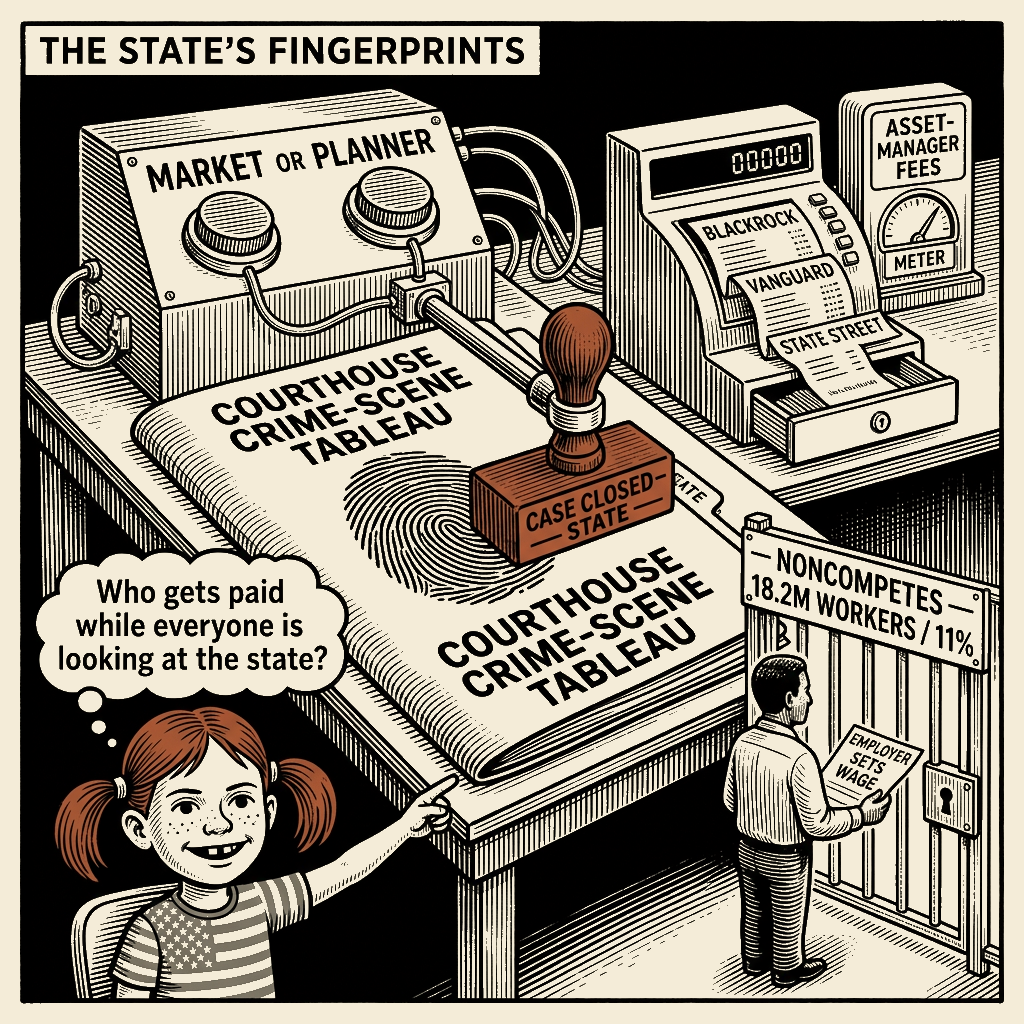
Who gets paid while everyone is looking at the state?
What the Piece Argues
The piece argues that both the right’s renewed embrace of tariffs and industrial policy and the left’s renewed call for public steering mistake economic disorder for the failure of unregulated capitalism. Its single primary talking point is this: “The state’s fingerprints are all over the scene of the crime, which features all kinds of interventions, from bailouts and occupational licensing to a tax code written by lobbyists for the companies that are lobbying the state.” Drawing on Arrow, public-choice theory, Hayek, Mises, and Friedman, it argues that collective steering invites capture and that Mazzucato’s “common good” framework therefore expands the disease. It nevertheless allows that Mazzucato’s discussions of taxation and transparency merit argument while insisting that public power needs institutional constraints.
Receipts
The framing makes the state the only defendant in the room, so once the state is convicted nobody has to ask who runs the money—and the answer is concentrated private capital collecting fees, employer monopsony, and pricing power.
The framing wants you to believe
- The central problem is discretionary state power, so the cure is either a more informed planner or a cleaner market untouched by intervention; public power must answer for economic concentration while private power need not.
- Profit is evidence of value created, employment contracts make workers genuinely free agents, and stock ownership is a democratic instrument rather than a form of concentrated financial control.
What’s really going on
- The state is captured, and that is no secret. The Federal Reserve’s 2023 Financial Stability Report counted 38 banks with more than $700 billion in assets and treated concentration among the largest banks as a financial-stability vulnerability. Capturing the state does not exhaust the inquiry; it merely supplies the defendant who is already available for prosecution.
- Labor-market mobility is not secured merely by the existence of an employment contract. The FTC’s January 2024 Noncompete Clause Report estimated that 18.2 million workers—about 11% of the workforce—were bound by noncompete clauses that limit where they may work. A contract enforced by the state against an economically constrained worker does not become voluntary because the worker signed it.
- Direct stock ownership remains a minority arrangement. The Federal Reserve’s 2022 SHED report found that 13% of families held stock directly. Retirement accounts and pooled funds broaden exposure, but they also place investment decisions in the hands of concentrated managers rather than workers voting over the assets they nominally own.
- Ownership is more unequal than the source’s “Stock ownership, the genuinely democratic option” suggests. Using the Federal Reserve’s 2023 Q2 Distributional Financial Accounts, the Economic Innovation Group found that the bottom 50% of households held roughly 1% of directly and indirectly held corporate equities while the top 10% held roughly 88%.
- The market can be concentrated without being a planner. SEC 13F filings identify BlackRock, Vanguard, and State Street as recurring top institutional holders across hundreds of large American companies. Those filings are snapshots rather than complete beneficial-ownership records, but they show where the retirement-saving register is held.
- Concentration is not merely an abstract possibility. The FTC and DOJ’s 2023 Merger Guidelines argue that mergers can lessen competition, reduce investment, and raise prices. The piece opens with BlackRock landlords and a financial sector that “exists mainly for itself,” then never asks whether those are private concentrations that the state’s capture does not explain away.
The Response Ladder
Polite Reframe
When to use: For a friend or relative who repeated the frame in good faith — a kitchen-table answer that keeps the conversation standing and costs you no ground.
Take a worker I will call Rosa Delgado—a composite of the records below, not a case file. She has spent eleven years on the same line in a distribution center outside a Sunbelt city. She owns a small slice of the company through the plan her employer offers with the job. She clocks in. She works hard. She prices her labor by living with the consequence if she refuses to accept the terms. She owns a piece of the company because the owner offered it.
The review calls this freedom. Rosa calls it Tuesday.
Here is what the review leaves out. The employer sets the wage. A noncompete may prevent that wage from competing for her labor elsewhere—the FTC’s January 2024 report estimated that 18.2 million workers, about 11% of the workforce, were bound by clauses limiting where they may work. The employer sets the dividend. The asset manager sets the terms and fees of Rosa’s savings without Rosa ever meeting it. The SHED receipt shows that direct stock ownership remains a minority arrangement; the DFA receipt shows how steeply ownership is stratified above it. Rosa is described as a free individual inside a system in which the price of her labor is set by somebody who does not have to ask her and the return on her savings is set by a fee.
Now grant the review its strongest point, because it is strong and deserves to be said plainly: the state is captured. Buchanan and Tullock were right in 1962. The people who run public institutions answer to incentives, and those incentives are shaped by the people who lobby. Bailouts, occupational licensing, a tax code written by lobbyists for the companies doing the lobbying—the review is right that these are state fingerprints. The Federal Reserve’s 2023 financial-stability report counted 38 banks with more than $700 billion in assets and treated their concentration as a vulnerability. That is the state, and the state is in the room.
But that is where the review stops, and where it stops is the entire story. The review tells us that a financial sector exists mainly for itself and never asks who runs it. SEC 13F filings identify BlackRock, Vanguard, and State Street as recurring top institutional holders across hundreds of large American companies. They did not need a state planner to become the custodians of the country’s retirement savings. They needed employer plans, pooled investment, and a fee.
The choice the review offers is a market or a planner. That is not a choice; it is a technique for ending the inquiry. There is a third thing, and the review names it in passing without running it: rules. The market was not discovered on a hillside. It is the Sherman Act, the Clayton Act, the National Labor Relations Act, the Securities Exchange Act, and generations of enforcement. Laws make markets. The market is not the absence of government; it is government constrained enough to make private power answer for itself.
So let us take the badge and hold it properly. We are for competition, which means enforced, not celebrated. We are for the contract, which means a contract a worker can leave; a noncompete the state enforces against a worker is not freedom of contract, it is the state drafting the employment agreement on the owner’s behalf. We are for the share and the pension, but we should not pretend that owning a sliver of a company through a fund dominated by somebody else means personally directing capital.
Rosa does not need a planner. Rosa needs a rule her employer cannot buy, a bargaining power she can exercise without risking the next paycheck, and an enforcement office that answers to her. Everything else is bookkeeping.
Mockery and Ridicule
When to use: For the room where the frame is already circulating as a punch line — for bystanders, when you want the repeater to feel used rather than mocked.
The review offers a diagnostic. There was a crime; the state’s fingerprints are on the scene; therefore the state did it. Somewhere in the review’s readership, one person is standing at an insurance counter arguing about a drug with one manufacturer, another is reading a noncompete he cannot afford to walk away from, and a third is staring at a 401(k) statement wondering what the fee was for.
All three are being told, by people who have read Hayek, that the problem is the paperwork.
That is the free-market individual: a person who cannot set the price of his labor, cannot leave his job without a signature from his employer’s lawyer, and does not personally control the investment made with his wages. The SHED receipt punctures the review’s claim—“Stock ownership, the genuinely democratic option”—because direct stock ownership is a minority arrangement dressed in superlatives. The noncompete receipt makes the “freely negotiated employment contract” a road with locked gates. And the 13F receipt makes the passive-fund sermon strangely quiet: the biggest asset managers appear again and again atop the institutional registers of the country’s largest companies.
Meanwhile the corporate serf—and I mean the position, not the person—whose mobility may be restricted by a noncompete, whose pay has lagged productivity in many periods, and whose savings are administered by a small group of global institutions that never had to lobby Congress for every dollar in the retirement account.
That is what the frame calls a free agent. The serf is awful, yes. The serf is exactly what you get when wages are set by somebody who does not have to ask and movement requires a signature.
And then there is the state, which really is guilty and should be. The state wrote the tax code for the companies doing the lobbying. The state let banking assets concentrate to the point identified by the Federal Reserve. The state licenses professions into scarcity and calls the scarcity “safety.” The state is guilty, and the guilty should be convicted, and the review is right on that.
But here is the trick, and it is a good one, and it is why this review will be repeated by people who believe they are defending freedom: the trick is to catch the state at the scene of the crime and then walk away. If the state is the criminal, the market is the neighborhood where the other criminals live, and nobody has to go there. Nobody has to ask how the largest asset managers ended up atop the registers holding the retirement savings of millions of workers. Nobody has to ask why one manufacturer can set the price of a medicine with no substitute. Nobody has to ask who sets the wage.
The maneuver does not need a conspiracy. It needs only a good phrase, a familiar villain, and readers eager to feel cleared. Concentrated private power benefits every time the inquiry ends with the state.
So read Mazzucato to see what is coming. Then read Hayek. Then read the quarterly statement, because that is the one with your money in it, and nobody in the review is going to read it for you.
Nuclear Satire
When to use: For the audience that has stopped asking questions — a newsletter, a wide thread — where the frame has hardened into doctrine and the mechanism has to be named before it can be survived.
Imagine the market as a cathedral, because that is more or less how its economists describe it: soaring, dim, full of colored light from a high window, and without a door. People go in and come out with jobs. People go in and come out with houses. Nobody asks where the money came from, because the cathedral does not take questions and does not issue receipts.
It has a subscription fee. It has a board of stewards. And the stewards are the market—which is to say the market has never once been audited. BlackRock, Vanguard, and State Street sit atop the register of America’s retirement savings. SEC 13F filings make them recurring top institutional holders across hundreds of large companies. These filings are snapshots, not a complete map of beneficial ownership; even a partial map is enough to make the “nobody knows anything except the planner” routine look ridiculous.
The review protects this building by relocating the fingerprints. The fingerprints are supposed to be the state’s. Fine. The state is guilty; the state is always guilty; the state has a tax code written by lobbyists for the companies that are lobbying the state, and a financial-stability regulator that sees enormous banking concentration. Guilt is not innocence, and the guilty are not the only defendants. But the review uses the guilt to close the file. The state’s fingerprints are on the crime scene, so the file closes, and nobody has to walk three blocks to the tower where the money is actually being counted.
Because it is being counted. In January 2020, BlackRock chairman Larry Fink told corporate executives to think beyond the shareholder-value framework and consider what he called the “corporate ecosystem.” That is not a conspiracy. Conspiracies require people to meet secretly. This requires only an employer plan, a pooled investment vehicle, and a fee—and the fee is why the arrangement keeps working.
The word the review needs is not “cronyism.” It is not “regulation.” It is concentration, and it is written on the receipts the review itself holds: the DFA ownership split, the SHED finding that direct stock ownership remains a minority arrangement, the FTC’s 18.2-million-worker noncompete estimate, and the 2023 Merger Guidelines’ treatment of concentration as a threat to competition, investment, and prices. Read those together and the frame’s panic becomes visible. A democracy that owns little directly, cannot leave, and cannot bargain is not a market correcting itself. It is a market organized—deliberately, lawfully, on paper—by the people who own it.
The inversion, then, and it is the honest one: the individual economic agent is not the free agent of this frame. The individual economic agent is the compliant endpoint of a chain of decisions made by somebody else. The employer who set the wage. The noncompete that nailed the door. The asset manager who set the fee. The index that made the holding automatic. The review calls this freedom because the word is free. The person inside it is not free; the person inside it is administered.
And the remedy the review offers is not a remedy. It is a reading list. Read Hayek. Read the market. Let the invisible hand do what invisible hands do. Meanwhile the visible hands—the ones writing the tax code, licensing the trades, consolidating the banks, and drafting the rules that make private concentration durable—get to stay visible, keep their names on the doors, and get to have the review’s admirers explain that they are the villains. The invisible hand works only if the other hands are bound. The review wants the binding removed and calls the result freedom.
The state has been captured for generations. Congress put a federal corporate income tax on the statute book in 1901 and retained it in the Revenue Act of 1909. The argument over how to constrain that capture is real and worth pressing. But the state is not the apex of this food chain. It is an instrument, often captured by the same private interests that the frame has trained us to ignore.
So: fire the frame. Keep the receipts. The arc does not bend because somebody read a book in the right order. It bends when Rosa Delgado’s employer can no longer buy a rule, when the antitrust office has a budget and a case and the nerve to bring it, when workers at that distribution center win a bargaining unit and a clause, and when the retired teacher’s pension stops being merely a fee the market takes and becomes a share she can actually direct.
The receipts for that are already filed: the FTC’s noncompete report, the Federal Reserve’s financial-stability report, the merger guidelines, and the ownership accounts. What is missing is not the diagnosis. It is enforcement.
Profane Scorched-Earth
When to use: For the reader who has watched the receipts fail for the third time and needs the register that actually says what is true.
Let’s say it plainly, because the review says it plainly: the state’s fingerprints are all over the scene of the crime. Bullshit—well, not exactly bullshit. The state is guilty. The state wrote the tax code for the companies that were lobbying to write the tax code. The state allowed banking assets to concentrate to the scale identified by the Federal Reserve. The state licenses professions into scarcity and calls the scarcity “safety.” The state is guilty, and the guilty should be convicted, and the review is right on that.
And here is where I put the receipt down and pick up the crowbar. The state’s guilt is the alibi. You catch the state at the scene of the crime, you point at the fingerprints, and then everybody goes home because the frame has told you the market is the neighborhood where the other criminals live. Nobody has to go there. Nobody has to ask why the largest asset managers appear atop the registers holding millions of workers’ retirement savings. Nobody has to ask why one manufacturer can set the price of a medicine with no substitute. Nobody has to ask who sets the wage.
The “freely negotiated employment contract” is doing the heaviest lifting in the entire review, because a freely negotiated contract is one you can refuse. The FTC estimated in January 2024 that 18.2 million workers—about 11% of the workforce—are bound by noncompetes that follow them from job to job and are enforced by state courts. Eighteen million people signed a contract that says you may work here and you may not work somewhere else, and the state does the enforcing, and then the review calls the resulting wage voluntary. That is not voluntariness. That is a toll road with a uniform in it.
And the money that is not a wage is not a mystery. Over the long run, labor’s share of national income has declined, and productivity gains have repeatedly outpaced average hourly earnings growth, as the BLS productivity and costs series records. That is the distributional record of the “free” market the review defends, and the review does not mention it because the moment you mention it, the “it’s the state’s fingerprints” trick evaporates.
The SHED receipt punctures the review’s claim—“Stock ownership, the genuinely democratic option”—by showing that direct stock ownership is a minority arrangement; the DFA receipt shows how ownership and control are stacked toward the top. That is what the phrase means in practice: democracy for the minority that can choose the security, a pooled vehicle for everybody else, and one more fee extracted from both.
So let’s hear the trick. The frame splits the common exploiter in two. Half is “the state,” which is where you can point at politicians and regulators. Half is “the market,” which is where the money goes and where nobody has to look. One exploiter, two costumes, so that neither one is caught. That is not economics. That is bullshit with footnotes, and the footnotes are what make it work.
The state is not the apex. It is the collection agent. The creditor is whoever sets the fee, whoever sets the wage, and whoever sets the price when there is no substitute. The review prosecutes the collection agent and calls it the fight. That is the whole goddamn frame, and it took a book review with footnotes to say it.
No goddamn reading list is going to make a worker’s noncompete disappear. No bullshit label for shareholder primacy is going to make an asset manager’s fee smaller. No Hayek quotation is going to make the employer bidding for that worker’s labor suddenly bid against somebody else.
So screw the reading list. The arc does not bend because we picked a book. The arc bends the way it has always bent: when the receipts are put in front of people with the authority to act on them, and enough of those people are made to be named. FTC report, on the record. Federal Reserve financial-stability report, on the record. Merger Guidelines, on the record. Then a complaint, a hearing, a rule, a vote, a picket, a union election, a contract, a wage. By any means necessary—and the means that have ever worked are the ones with receipts. Not a memo. Not a frame. A fucking filing with your name on it.

About Malcolm Little King
Malcolm Little King is a heteronym in Main Street Independent's editorial architecture — an analytical voice, not autobiography of any actual person. The position this column expresses is the publication's position on the territory Malcolm Little King's lane covers, rendered through Malcolm Little King's register.