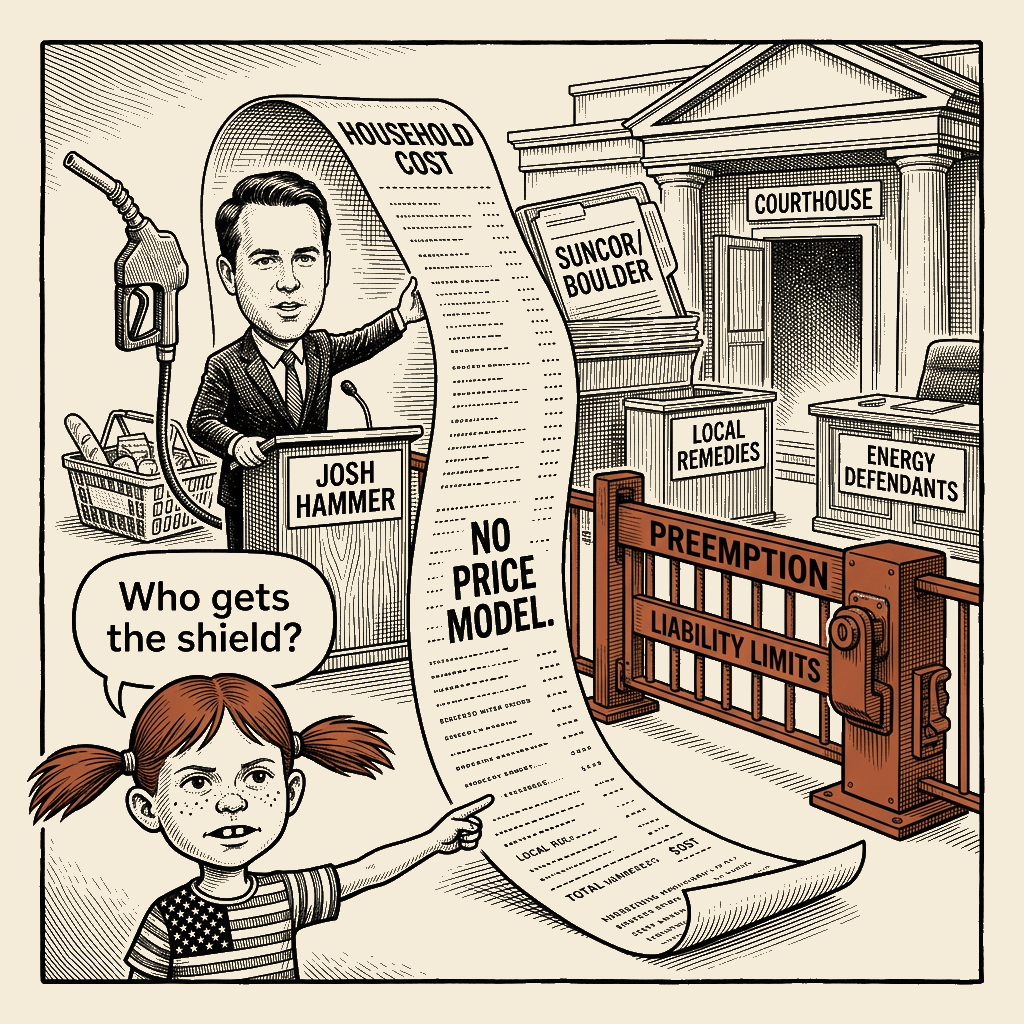
Responding to: Climate lawfare's back-channel campaign, and how you'll pay the bill · 2026-10-23
Who gets the shield?
What the Piece Argues
In Josh Hammer’s column, the argument is that a small, well-funded network of climate activists, having lost at the ballot box and lost the Supreme Court in 2011, moved climate policy into state courts and is now reaching for the bench itself. Its receipts are the Climate Judiciary Project’s climate “education” seminars — which the column reports have put at least 140 federal judges through their doors — and the behind-the-scenes editing of the judiciary’s climate science chapter by Michael Burger, of counsel at Sher Edling, a firm representing many of the municipalities suing oil companies. The column argues that these plaintiffs cannot solve causation honestly, since greenhouse gases mix globally and, it reports, about 90 percent of emissions occur outside the United States, and that lower courts have responded by declaring that a plaintiff need not tie specific injuries to a defendant’s actions. It concludes that the Supreme Court should shut the courthouse door for good, warning that if Boulder prevails some 90,000 municipalities could make national energy policy through jury awards and that every family will pay the bill at the pump and the grocery store.
Receipts
The piece advances one talking point — when the front door of democracy is closed, try the courthouse back door — and the receipts show what that frame is built to hide: a documented campaign to steer the bench, whose concentrated beneficiary is the oil-and-energy firm, not the household.
What the framing wants you to believe
- That the stake is your gasoline and your groceries: one case in Boulder, and suddenly the whole republic’s fuel bill is on the docket, with a jury box setting the price of everything.
- That the documents prove a corruption scandal — judges bought off with seminars, science dictated by counsel — rather than a documented plan to select and re-educate the bench.
- That the choice is between your wallet and the rule of law, as if there were no third option in which six people in one county write the nation’s energy policy.
What’s really going on
- The documents show something more concrete than corruption: Paul Hanle’s May 2022 email says the Climate Judiciary Project’s seminars should target “key judges” and “make a great difference in the final outcome of cases.”
- The conflicted authorship is on the record: the National Academies invited Michael Burger, who runs Columbia’s Sabin Center for Climate Change Law and was of counsel at Sher Edling, a firm representing many of the municipalities suing oil companies, to write the judiciary’s climate chapter; he offered to contribute “behind the scenes”; “Mike’s edits” circulated; the Federal Judicial Center balked at his litigation work, the chapter was withdrawn after publication, and the National Academies followed suit in August.
- The engine is a lowered standard, not a seminar: Boulder’s trial court has already declared that “in a multiple contributor tort case, there is no need to tie specific injuries to the actions of defendants.”
- The scale argument is the frame’s strongest receipt, and it comes from the defense: the companies’ lawyer warned that if Boulder prevails, some 90,000 municipalities could make national energy policy through jury awards, and Boulder’s lawyer conceded that “nothing in our theory” prevents suing retailers too.
- Who benefits: the concentrated beneficiary is the corporate defendant seeking preemption — preemption and limits on liability protect the oil and energy firms’ assets from litigation-driven costs. The household is the frame’s sales pitch; the firms are the party.
- What is omitted: no document in the record shows a judge’s vote bought, and no model supports a price increase. Those are the frame’s weak points, not the story.
Anchor: House Judiciary Committee documents released September 30, including Paul Hanle’s May 2022 email on the Climate Judiciary Project’s strategy, as reported in the column.
The Response Ladder
Polite Reframe
When to use: With a persuadable reader who wants the rule of law defended with precision instead of panic — an editor, a business reader, a moderate Republican who thinks courts are the right forum for corporate accountability.
Start with the paper trail, because the paper trail is better than the panic. Paul Hanle wrote in May 2022 that the Climate Judiciary Project’s seminars should target “key judges” and “make a great difference in the final outcome of cases”; the column reports the project has put at least 140 federal judges through its climate “education” seminars. The National Academies asked Michael Burger — of counsel at Sher Edling, a firm representing many of the municipalities suing oil companies — to write the climate chapter of the judiciary’s reference manual; Burger offered to contribute “behind the scenes”; “Mike’s edits” circulated through the draft; the Federal Judicial Center balked at his litigation work, the chapter was withdrawn after publication, and the National Academies followed suit in August. A judge who cannot name the sponsors of his own education cannot be expected to see a conflict. That is not a scandal of proof. It is a scandal of concealment, and concealment is a choice.
Then take the mechanism that the seminar slide is designed to hide. Boulder’s trial court has already declared that “in a multiple contributor tort case, there is no need to tie specific injuries to the actions of defendants.” The moment a plaintiff need not tie an injury to a defendant, tort stops measuring fault and starts manufacturing verdicts, and a six-person jury in one county becomes the legislature of the United States. That is what “regulation by litigation” looks like when it is working.
Then handle the money the way the receipts require, not the way the frame requires. The frame wants your grocery receipt to carry the weight of a constitutional crisis. The stake is a liability shield. The concentrated beneficiary of a ruling for the companies is the oil and energy firm that preemption and limits on liability protect from litigation-driven costs, and the household is scenery in the frame’s sales pitch. If the courthouse door shuts on policy-by-litigation, it shuts with a shield in the firms’ hands — say that out loud, and say it before the Supreme Court rules.
So the position is plain. Disclose who funds judicial education; require recusal for the judges the sponsors are shopping for; let the Supreme Court decide Suncor on preemption and the record; and let that decision be the last word, with no remand and no second bite. We defend democracy by making power visible and keeping national energy policy out of a jury box in Boulder County.
Mockery and Ridicule
When to use: With a reader who has heard “but it’s just a nuisance case” once too often and needs the seminar schedule, the manual edits, and the lowered standard in one place — a letter to the editor, a social reply, a talking-points sheet.
First, the seminar schedule. The brochure says “education.” The May 2022 email says target “key judges” and “make a great difference in the final outcome of cases.” The guest list says at least 140 federal judges. Somewhere in this arrangement the word “education” has to be entered on a list of endangered species. Bring your own conflict disclosure, apparently it was the elective.
Then the science manual. The National Academies invite Michael Burger, of counsel at Sher Edling, a firm representing many of the municipalities suing oil companies, to write the climate chapter for the federal judiciary. Burger offers to help “behind the scenes.” “Mike’s edits” circulate. The Federal Judicial Center balks at the litigation conflict, then the chapter is withdrawn after publication, and the National Academies follows suit in August. Somewhere in this arrangement, a plaintiff-side firm edits the instruction book the bench reads, and the institution’s response was to remove the chapter quietly rather than explain itself out loud. Take notes; that is the whole operation in three moves.
Third, the causation trick. Greenhouse gases mix globally and, the column reports, about 90 percent of emissions occur outside the United States — so the clean solution is to announce that proof is now optional. The Boulder trial court delivered: “in a multiple contributor tort case, there is no need to tie specific injuries to the actions of defendants.” When your proof standard no longer requires proof, the case stops being about what a defendant did and starts being about which jury gets to write national policy. Strictly more convenient, and the defendant does not even have to show up.
And the curtain speech: every family pays the bill at the pump and the grocery store. The concentrated beneficiary of the ruling the frame demands is the oil-and-energy firm shielded by preemption and liability limits; the household is the stage prop, and the grocery receipt is the prop department’s idea of evidence. Meanwhile the scale argument does the real work: the companies’ lawyer warned that if Boulder prevails, some 90,000 municipalities could make national energy policy through jury awards, and Boulder’s lawyer conceded “nothing in our theory” prevents suing retailers too. One county’s jury box, national fuel prices. The frame’s own lawyer supplies a better slogan than the frame does.
Take the receipts to the Supreme Court: Hanle’s email, Burger’s edits, the withdrawals, the lowered standard, and the warning about 90,000 municipalities. Shutting the courthouse door against policy-by-litigation is the vote. We defend democracy, and we will not be sold a grocery receipt as the substitute for a legal argument.
Nuclear Satire
When to use: For a hard-edged movement space where the full legal and institutional machinery must be named without pretending the evidence is softer than it is.
Picture the courthouse back door as a legislative vending machine with a jury of six: insert a county seal, select “nuisance,” dispense a national energy order, and collect the damages at the pump. Six jurors beneath a chandelier made from recycled zoning appeals. A bailiff checking carbon emissions with a weather app. A clerk stamping GLOBAL ENERGY POLICY on every filing. This is not jurisprudence; it is municipal democracy with a jury speed bump.
The operator’s manual is Hanle’s May 2022 email. When legislative or executive action is unavailable, “real government action might still be derived from court decisions.” The seminars will target “key judges” and make “a great difference” in the final outcome. The article says the Climate Judiciary Project has already put at least 140 federal judges through this seminar machine. The brochures have names in the “key judges” slot, and the orientation is aimed directly at outcomes.
Burger’s climate chapter is the machine’s blessed instruction booklet: litigation-linked, edited behind the scenes with “Mike’s edits,” yanked by the Federal Judicial Center, and then followed by the National Academies. Every turn of the conspiracy comes with a paper trail. Emails, drafts, withdrawals—shame that the secret plot has such impeccable clerical hygiene.
Source attribution becomes the jury’s spreadsheet: nearly two-thirds of all carbon dioxide emitted since the 1750s assigned to 90 fossil-fuel and cement producers; industrial agriculture not yet named as defendants; and the module’s ominous little “yet” standing there like a countdown timer. Soon the six-person chamber will add fuel, food, building materials, and retail to the menu. The machine cannot even wait for the intermediate litigation. It simply stamps “yet” and moves down the list.
Then the legal ghost enters the room: AEP. The cited opinion held that federal common-law nuisance claims were precluded or displaced by the Clean Air Act, held that the state-law claims before it were not preempted, and held that political subdivisions could sue. Roberts’s question, Kagan’s causation remark, and Kavanaugh’s precedent wall are not verdicts from the vending machine; they are the mechanism’s inspection ports. The source’s account shows the Supreme Court testing whether the machine is legally connected—or just screaming smoke.
The beneficiaries are named enough: Suncor and the other energy defendants; the 90 fossil-fuel and cement producers in the curriculum; and any agriculture, fuel, retail, food, or building-material company shielded from comparable liability. This is the corruption-preserver’s law: preserve the incumbent playbook by declaring every local remedy a national conspiracy. We defend democracy by naming the shield and the companies it protects. Let the Court rule on the case before it. Do not build a ban and call it adjudication.
Profane Scorched-Earth
When to use: With a reader who needs the evidence named plainly and the betrayal labeled without diplomatic embalming — a private message, a heated comment, a rally-stage line for people who are done with the seminar circuit.
Here is the fucking magic trick, and I want the receipts on the table before the trick starts. Paul Hanle’s May 2022 email says the Climate Judiciary Project should target “key judges” and “make a great difference in the final outcome of cases.” The project calls it climate “education” for at least 140 federal judges. Michael Burger, of counsel at Sher Edling, a firm representing many of the municipalities suing oil companies, was asked to write the climate chapter for the federal judiciary’s science manual; he offered to help “behind the scenes”; “Mike’s edits” circulated; the Federal Judicial Center balked, the chapter was pulled after publication, and the National Academies followed suit in August. Read the fucking receipts before you swallow the bullshit conclusion.
Because the conclusion these receipts support is not “some judges got bribed.” It is that a small minority lost the vote and went shopping for the people who count the votes for the entire country. That is not education. That is a campaign, and they had the decency to write it down: the target list (“key judges”), the promise (“a great difference in the final outcome of cases”), the pipeline (“education”), and a science manual that traveled with their fingerprints on it. Congratulations. You did not attend a conference. You attended a campaign meeting and they gave you a credential for it.
Then comes the other bullshit, the grocery-store apocalypse, where every family supposedly pays at the pump and the grocery store because of a case with no model, no dollar figure, and no merits decision behind it. There is no price. There is a beneficiary. The concentrated beneficiary is the oil-and-energy defendant: preemption and limits on liability protect their assets from litigation-driven costs, and when the door shuts on policy-by-litigation the shield lands in their lap. The household is not the party. The household is the pitch. Read the receipts on scale: the companies’ lawyer warned that if Boulder prevails, some 90,000 municipalities could make national energy policy through jury awards, and Boulder’s lawyer conceded “nothing in our theory” prevents suing retailers too. That is not a market scare. That is a map of what the jury box is being built to do.
And the standard that makes it work? Boulder’s trial court said it out loud: “in a multiple contributor tort case, there is no need to tie specific injuries to the actions of defendants.” Can’t prove the defendant caused the harm? Remove the requirement and the courthouse becomes the legislature. The Climate Judiciary Project’s own curriculum says it plainly: nearly two-thirds of all carbon dioxide emitted since the 1750s traced to 90 fossil-fuel and cement producers, and the heavily concentrated animal agriculture industry “not yet” named as defendants. Read that “yet” one more time, because it is the whole future in one fucking word.
Now the badge. They wear “climate defender,” “scientist,” “legal reformer.” Their method is to go around the vote and go around the bench. That makes them the enemies of the process they claim to serve, and I am not going to dress this up as procedure. We defend democracy. We defend it by demanding the emails, the money, the manual, and the record; by telling the Supreme Court to decide Suncor on preemption and the record and be done with it; and by refusing to buy the panic with our own grocery money.
So: publish the Hanle email. Disclose the seminar money. Audit the manual. Demand the record. Let the Court rule. Shut the courthouse door on policy-by-litigation, and shut the hell out of the bullshit that says this is a neutral case about judges, and the bullshit that says the stake is the price of gas. The frame wants you to choose between your wallet and the rule of law. Fuck that. There is no wallet on one side and law on the other. There is a back-channel legislature on one side and a public that pays for it on the other. We are not the back door. We defend democracy — loud, documented, and done with the bullshit.
About Malcolm Little King
Malcolm Little King is a heteronym in Main Street Independent's editorial architecture — an analytical voice, not autobiography of any actual person. The position this column expresses is the publication's position on the territory Malcolm Little King's lane covers, rendered through Malcolm Little King's register.