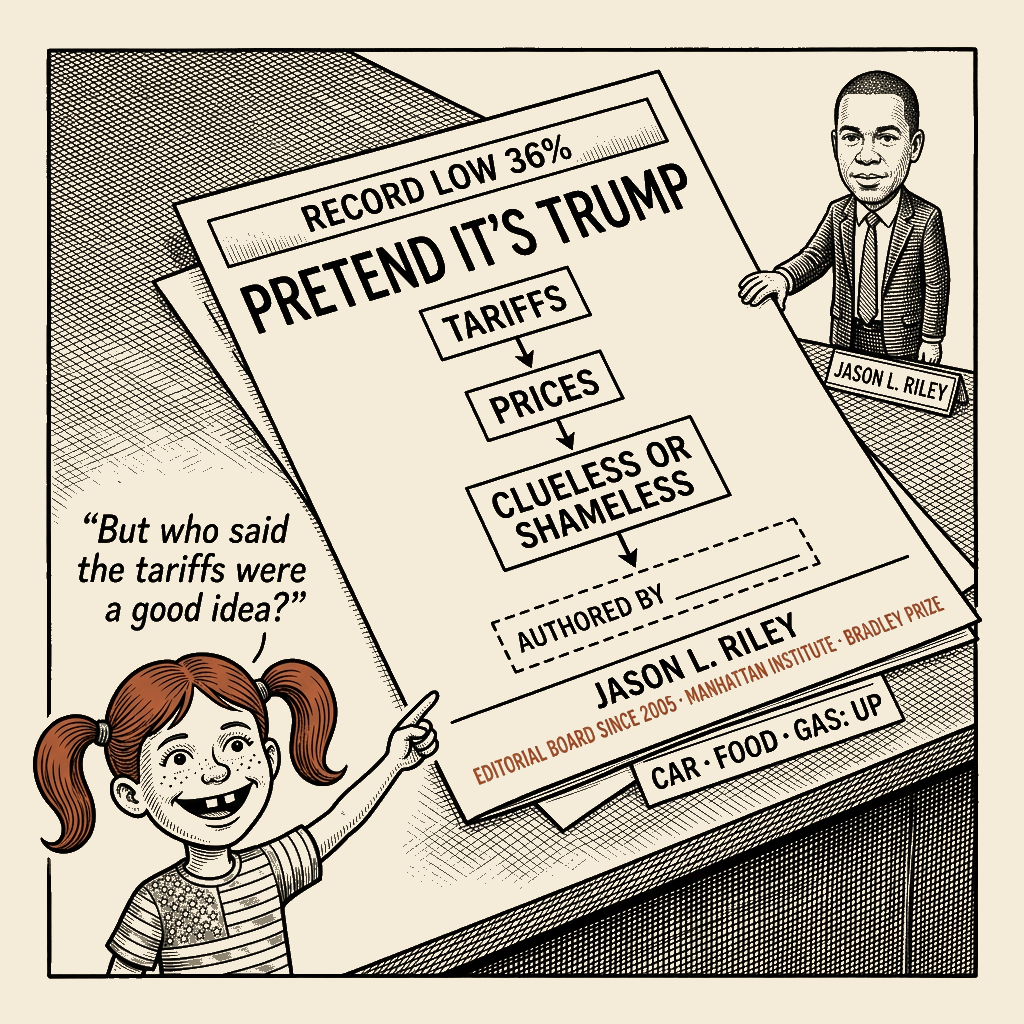
Analyzing: Trump Says: ‘Pretend I’m on the Ballot.’ Democrats Comply — Jason L. Riley · 2026-10-20
But who said the tariffs were a good idea?
What the Editorial Argues
In good faith: Jason L. Riley — a Wall Street Journal opinion columnist, an editorial-board member since 2005, a Manhattan Institute senior fellow — warns his own coalition that President Trump’s record-low approval, his self-absorption, and the cost-of-living squeeze are putting the midterms at risk. He credits the base with understanding what the president does not, concedes that the polls have been wrong about Trump before, and closes on the president’s own plea that voters “pretend that I’m on the ballot”: this election will be a verdict on the man, and his side should not pretend otherwise. The steelman is real — a loyal conservative saying an uncomfortable thing about his own side’s standard-bearer, in public, at some cost to his standing with that side.
Receipts
The editorial performs a scapegoat transfer: it converts the midterm into a referendum on one man’s vanity so the coalition’s agenda never appears on the ballot — and it launders that verdict through a byline that cannot be accused of disloyalty.
What the framing wants you to believe
- The election is a judgment on President Trump’s behavior, and loyal conservatives should say so out loud: “even MAGA die-hards and GOP allies in Congress have grown weary of his erratic behavior.”
- Voters’ pain is real, and the column is the rare conservative voice that tells the president what his voters actually feel: “What seems lost on the president surely isn’t lost on his voters… who can connect the dots.”
- The remedy is on the ballot — stay home and lose: “his objective was to rally the MAGA faithful because the White House fears they’ll stay home.”
What’s really going on
- The personality frame is the protective device. The technique is displacement of responsibility run as person-as-policy (WSJ Technique Catalogue §4.24): blame terminates at one agent — “the war in Iran, which he started”; “Has he noticed…”; “lost on the president” — so the causal story stops exactly where the coalition’s own policy authorship begins. The column names the tariff regime (“buying a car is more expensive thanks to tariffs on imported vehicles, auto parts, steel and aluminum”) and then, shortly after, blames the man. The omitted relation is the policy program and its authors; the protected beneficiary is the agenda and the institutions that wrote and cheered it; the normalized harm is a hurting base voter told the remedy is to turn out for the coalition that governed him.
- The numbers are quoted as weather, never as a ledger. Fox’s toplines — 77% disapproval on inflation, 70% on the economy, 69% on tariffs — are presented as conditions the president “noticed,” not as outcomes traceable to decisions: who designed the tariffs, who defended them, who started the war the column mentions in passing. That causal accountability is the load-bearing omission the framing depends on.
- The piece is a turnout instrument wearing a truth-teller’s coat, and it works four audiences at once (WSJ Technique Catalogue §4.3): Republican strategists and donors get the warning, the base gets its grievance ratified and a turnout order, swing readers get to watch conservative internals admit collapse, and the opposition gets a citation-ready indictment attributed to a Journal columnist and Bradley laureate rather than to a party committee. The closer — “Democrats are already doing that. Be careful what you wish for” — converts all of it into Republican self-reproach: pain acknowledged, direction unchanged.
- The evidence spine is one partisan poll that the column simultaneously leans on and disavows — “record low 36%” is the ledger, “pollsters haven’t helped themselves” is the alibi. That motte-and-bailey (bf_catalog:
motte_and_bailey) is load-bearing.
The Operation
Start with the triage, because the instrument matters. This is the signed-column lane, not the unsigned board’s collective “we” — but the author writes from that board’s own lineage: editorial-board member since 2005, personal byline, institutional voice, addressing the house position from the house building. The archetype is the loyal-warning column — straight talk from inside the tent — and the WSJ Editorial Technique Catalogue is the right instrument for it, in the register the catalogue logs at §3.7, the technocratic-credential ledger.
Cui bono.
Institutional authorship. Jason L. Riley — Wall Street Journal opinion columnist (“Upward Mobility,” running since 2016), at the Journal since 1994, editorial-board member since 2005, Manhattan Institute senior fellow since 2015, 2018 Bradley Prize recipient, author of Please Stop Helping Us, False Black Power?, and the Sowell biography. The Manhattan Institute is a named node in the counter-establishment pipeline Sidney Blumenthal documents in The Rise of the Counter-Establishment; the Bradley Prize is administered by the Lynde and Harry Bradley Foundation, a major funder of the conservative intellectual infrastructure in Jane Mayer’s Dark Money. This is the credentialed supply chain — and it sits on the page whose founding credo, William Henry Grimes’s 1951 “A Newspaper’s Philosophy,” makes “no pretense of walking down the middle of the road.” The placement chain is the circuit I used to call the donor→think-tank→publication pipeline: a signed column in the flagship business daily, anchored on a Fox survey, sourced to anonymous “Republican strategists,” syndicated through the opinion network to donors, operatives, and the faithful. The credential stack is also what makes the column portable: a Democratic operative cannot be accused of writing it, and a Journal reader’s guard is down precisely because the source is theirs.
Distributional impact. Named beneficiaries: the post-Trump faction of the conservative elite, which keeps its “serious conservative” brand and its entire policy program intact whether the GOP wins or loses; the policy architects who would prefer the tariffs read as golf-course-grade caprice — personal pathology, therefore fireable by election — rather than as a coherent program with authors, defenders, and institutional sponsors; the strategist class, which gets its turnout problem named and its base frightened back into the fold; the institutional complex itself, whose decades of advocacy for the economic agenda are absent from the causal story. Named cost-bearers: the base voter, told their pain is real but that the answer is the same ballot as before, and the public’s accountability mechanism, quietly amputated — when the party’s own diagnostician pins the election on the president’s personality, the agenda that governed is immunized against the returns. Unnamed cost-bearers, per the column’s own receipts: buyers of imported cars, first-time homebuyers, households paying food and gas prices — named only as evidence of Trump’s failure, never as constituencies whose costs were designed by identifiable decision-makers with identifiable lobbies behind them. The concrete pathway is agenda-survival: the man takes the verdict, the architecture lives to legislate again. The beneficiaries invisible from the frame are the syndication-and-donor network, Riley’s own institutional supply chain, and the page itself. The incidence is correctly placed for once — the column does name who is hurting — and then misdirected at the cause. No conspiracy claim is needed; the structure does this work without a meeting.
Alternative design. Reconstructed from the hurting base voter’s actual interests, not from my policy preference: a column that took its own stated rationale seriously would follow the causal chain past the man to the policies — the tariffs it names and drops, the tax structure, the trade and energy posture — and name who in the coalition authored them. It would ask what the Journal’s opinion page and the Manhattan Institute said about each policy at the time it was advanced. It would address voters as citizens deciding whether the governing record earned another term, not as a turnout machine to be frightened, and it would give the reader a question to ask candidates rather than a panic about staying home. The fact that the column stops precisely at the man’s ankles is the motivated stop the suppressed-variable diagnostic predicts: the next link implicates the coalition and the institutions that speak for it — including the writer’s own desk.
FGL, applied symmetrically. The author and his institution: fear (a wipeout that delegitimizes the party his page is attached to), greed (institutional relevance, donor networks, the brand — the column performs candor at no cost, indicting the president while preserving every fellowship and perch in the arrangement), laziness (the personality explanation is the cheapest one available; it requires no reckoning with the page’s own record). The apex beneficiary, the post-Trump elite faction and its intellectual supply chain: fear (a demoralized base), greed (program survival — if Trump loses, tariff orthodoxy and its defenders survive to be blamed on one man’s “erratic behavior”), laziness (one man can absorb all blame). The rank-and-file reader: fear is real and human — the squeeze on car payments, mortgages, groceries, and the fear that staying home hands the country to the other side. His laziness is the same human economy the column exploits: it asks him to do one easy thing (vote against Trump) instead of the expensive thing (re-litigate the sources he has trusted, including the ones I wrote for) — a personnel decision rather than a program review. Riley’s byline makes the expensive thing unnecessary, which is precisely the operation’s function. The reader here is not the mark; the reader is the payload-delivery system, and the paymaster is the agenda. No contempt is owed the reader; the contempt belongs to the design.
Selflessness/selfishness placement: mixed at the surface — a warning against self-deception is genuinely selfless as far as it goes, and Mr. Riley did say an uncomfortable thing about his own side, which costs him something and I will not pretend otherwise. Structurally selfish in the categorical sense: the candor is selectively aimed at the president’s person so that the program, and the credentialed class that supplied it, exits the piece unexamined. It costs the man; it does not cost the program.
I wrote this column’s ancestor. In the years I ghosted for the unsigned page I drafted the loyal-warning piece at least half a dozen times — the one that tells the truth about the man so it never has to tell the truth about the architecture. I drafted memos of exactly this shape in the Journal building: isolate the popular policy conclusion, pathologize its author, and never let the reader’s eye travel to the class that designed, scored, and defended the policy. I know the brief, because it was my brief: keep the base afraid, keep the donors calm, keep the agenda out of the paragraph.
Technique identification.
1. Structural omission — the motivated stop. Cue: “Has he noticed that buying a car is more expensive thanks to tariffs… higher mortgage interest rates… prices for food, gas… outpace earnings?” The causal chain runs from policy to price and halts before it reaches the policy’s authors or their institutional defenders — the Suppressed Variable diagnostic’s §1 almost word for word: “the argument follows a real chain and halts precisely at the link where continuing would implicate the beneficiary instead of the chosen target.” Operationally: convert a policy ledger into a personality defect so the fix reads as electoral rather than intellectual.
2. Frame-engineered relabeling — the scare-quote adoption. Cue: the headline, and “Oddly, Mr. Trump keeps asking people to ‘pretend that I’m on the ballot.’ Democrats are already doing that.” The column mocks the president’s frame while quietly adopting it as the organizing lens: the midterm is a verdict on the man, and every race in the piece is read through him. Bad-Faith Techniques Catalog, bf_catalog: frame_engineered_relabeling, in the Luntz lineage — substitution that shifts the frame before argument begins — with the twist that the relabeling is performed inside scare quotes, which lets the columnist claim he is only quoting while he is actually installing. Lakoff’s rule holds: a frame survives being negated; it thrives when the other side repeats it. The column then spends its entire length repeating it.
3. Euphemistic labeling at the level of the diagnosis — the forced choice. Cue: “Whether Mr. Trump is clueless or shameless is something psychoanalysts can debate.” Stupid or dishonest: the two-option frame forecloses the third option the column’s own receipts point toward — specific decisions, made under specific advice, by identifiable people. bf_catalog: false_dichotomy, running as Bandura’s second mechanism, euphemistic labeling, at the thesis level: the vocabulary of personality is substituted for the vocabulary of governance precisely because personality is fireable and governance is contagious. Either way, nothing about the agenda is on trial.
4. Displacement of responsibility, run as person-as-policy. Cue: “Elevated energy costs are directly related to Russian aggression in Ukraine… and to the war in Iran, which he started”; “Has he noticed…”; “lost on the president.” The tariff regime, the energy posture, the tax environment — none of these has authors in this column; the sole author is “he.” This is Bandura’s fourth mechanism in the person-as-policy mode the WSJ catalogue logs as 4.24: a policy dispute fully displaced onto one named individual, so the argument can only be engaged by defending or attacking that person. The institutional authorship — the coalition that wrote, ratified, and funded the program — dissolves into a single dramatized agent, and with it the question of what the institutions that speak for that coalition were doing while the program ran. In the trade, this is called giving the client an out: one man’s forehead takes the bullet the whole architecture earned.
5. The polling motte-and-bailey. Cue: the spine — “A Fox News survey… put Mr. Trump’s job approval at a ‘record low 36%’” — versus the retreat — “pollsters haven’t helped themselves… predictions that in some cases have been wildly off base” — versus the reassertion — “his approval rating is lower than Joe Biden’s in 2022 or Barack Obama’s in 2010.” Strong claim, retreat to the motte under challenge, resumption of the strong claim: Shackel’s motte-and-bailey, bf_catalog: motte_and_bailey. The reader keeps the headline (he’s sunk); the column keeps the alibi (polls lie — about him). Note the asymmetry: the same survey impeached as unreliable is the piece’s only quantitative anchor for the current picture, and the pollster impeached is Fox — the house pollster of the house audience. The column gets to doubt its own evidence and use it at the same time.
6. The sophisticated-middle strawman. Cue: “Mr. Trump and his supporters dismiss negative polls as fake or unreliable, and pollsters haven’t helped themselves… Whether the problem is driven by partisan leanings or an inability to get Trump voters to respond to surveys continues to be debated. But simply ignoring unfavorable results outright would be ill-advised.” Notice what the column does before it swings: it concedes pollster error and concedes the methodological question is genuinely open, so it is not inventing an opponent — it is selecting one. It stakes out both extremes it has just described, demolishes only the blanket version (the one no serious poll operation defends), and lets its own toplines inherit the sophisticated center without ever defending them on their merits. That is the selectional form of bf_catalog: strawman (Talisse and Aikin’s “Two Forms of the Straw Man,” in the Bad-Faith Techniques Catalog). I wrote this move on-air for years: concede enough, refute the dummy version, inherit the audience.
7. Moral justification via base-loyalty. Cue: “re-elected him primarily to address cost-of-living concerns that worsened under Biden.” Bandura’s first mechanism: the 2024 mandate is recoded so that holding Trump to it reads as fidelity to Trump’s own promise rather than as opposition. This is what licenses the rest of the piece inside conservative registers — the critic claims the movement’s stated values as his weapon.
8. Anxiety-engineering — the turnout payload. Cue: “midterm elections are all about turning out your fiercest supporters… the White House fears they’ll stay home,” and the engineered closer, “be careful what you wish for.” The column is a mobilization instrument. Its logic: voters are hurting; hurting voters are tempted to stay home; the remedy is fear of the alternative. Pain is acknowledged so that it can be transmuted into a floor for the faithful. This is Bernays’s engineering of consent in its purest form — the manufactured consensus that the only sane response to grievance is the ballot, delivered by a credentialed authority to the demographic whose interests the agenda most fails. The closer is the WSJ signature the catalogue logs as 4.13, the threat-inflation closer built for retransmission: “be careful what you wish for” is designed to be quoted back at donors, on panels, at the door — and it converts the entire column into a Republican self-own, which is the placement mechanism that makes content quotable by the very side it indicts.
9. The common-sense/elite pivot, mirrored. Cue: the opening — “As an avid golfer… As a voter, however, I wondered if the president had lost his cotton-picking mind” — and the flattery: “What seems lost on the president surely isn’t lost on his voters, particularly those in farm country and rural areas who can connect the dots.” A Manhattan Institute senior fellow addressing one of the most elite readerships on earth performs the voice of plain-spoken common sense and instructs the rural base that it is the clear-eyed party. WSJ catalogue §4.10 in its mirror form: instead of elite positions sold as common sense, elite-positioned criticism sold as base loyalty. The idiom is doing real work — the folksy register is the credential that vouches for the structural conclusion the column never draws.
10. The credential stack as evidence. Cue: the bio block itself — column since 2016, Bradley Prize, Manhattan Institute, editorial-board tenure — presented as background, functioning as argument. WSJ §3.7’s technocratic-credential ledger with a distinct twist: the credentials mobilized are the critic’s own, not a cited expert’s, and the bio tells the reader the indictment is insider information rather than attack material. Lineage: Bernays’s credentialed authority as campaign vector — the authority’s position inside the audience’s own institutional world is the vector, not his evidence.
11. Manufactured grievance — the embattled posture. Cue: “Mr. Trump’s victory in 2016 and comeback eight years later defied the expectations of many people in the media who follow politics for a living.” The NR Editorial Technique Catalogue logs the “stands athwart history” posture as 4.1: a movement holding formidable institutional power presenting itself as the perpetual dissenting conscience. Here the friend/enemy line (Schmitt) is drawn against the media rather than the Democrats — precisely how a coalition protects itself from the judgment of any institution, including the pollster it happens to be quoting. The same column that calls the survey “record low 36%” then runs the media as the unreliable enemy. Both cannot be true; the column needs both.
Audience-management function. Run the four layers the WSJ catalogue logs as 4.3 — one column, four audiences, four messages, one function. The wealthy reader receives confirmation that the house voice is still sane and institutional — the page is the adult in the room, whatever the president is. The political class receives a strategic memo: “a financial advantage and a favorable political map,” with turnout the problem and distance from the man safe as long as you keep the program. The populist base receives grievance ratification and a turnout order — “the White House fears they’ll stay home.” The technocratic class receives numbers it can cite — “record low 36%,” 63 seats, 40 seats. And one layer further out, the Democratic opposition receives a citation-ready indictment with a Journal byline on it. The service to the conservative reader is permission structure plus identity confirmation, grievance ratification, status display (the reader who shares this is the sophisticated one who can take bad news), and conscience displacement: the reader gets to feel honest (I admitted the pain) and loyal (I voted) at the same time, and never has to feel complicit.
Critical Questions run. CQ1 — the pathway is concrete: the frame’s beneficiaries are credentialed policy architects whose program survives Trump’s person being the sole target, and their institutional positions (magazine perches, think-tank fellowships, prize circuits) are documented in the column’s own bio. Not symbolic. CQ2 — the invisible beneficiary is Riley’s own institutional network: the piece’s structure ensures the reader never asks what the Manhattan Institute, the Bradley circuit, or the Journal’s editorial board said about tariffs and the Iran war when they were being advanced; flagging that as the missing party is not frame-bounded, it is the point the column’s own grievance list implies. CQ3 — incidence: the column correctly identifies who bears the price costs (car buyers, homebuyers, households) and correctly does not pretend the costs are fictional; the incidence error is causal, not distributive — the decisions that produced them are attributed to a single erratic agent. CQ4 — FGL applied above across three constituencies.
Failure modes checked: symbolic-inference — no, pathways stated. frame-bounded-blindness — the column’s own frame is the blind spot being named, and the scan runs outside it to the credentialed supply chain. cost-incidence-error — costs are real and correctly located; attribution is the defect, named as such. conspiracy-trap — structural-incentive language only; no claim of a coordinated memo, just documented institutional positioning. cynicism-trap — the column’s legitimate content (the polls are real, the prices are real, the criticism of Trump’s conduct is not fabricated) is conceded explicitly rather than collapsed into the placement overlay. mirror-trap — the alternative design above is reconstructed from the conservative reader’s actual interest (being told who told him the tariffs were a good idea), not from my policy preferences. asymmetric-fgl — run across all three.
Symmetric-application note. This analysis would apply identically to a left-coded column that pathologized a Democratic president’s personality while leaving the policy architects who supplied the underlying program unexamined. My operational detail reaches further on the liberty-frame apparatus because that is what I worked in, and I say so plainly: I do not have inside knowledge of how Democratic-aligned shops build their permission-structure columns, and this analysis of Riley’s piece is built entirely from the text, the catalogues, and the documented credential trail in the column’s own bio.
I am bitter about this genre. I am also right about it. Every quoted line above this one is on the public record — check it, then check who printed the warning. The bitterness is where the recognition lives, not where the argument comes from.
The Record
Anchor receipts, as the column supplies them, tiered.
- Fox News survey cited in-column, dated four days before the golf-course post: approval at “record low 36%”; disapproval at 77% on inflation, 70% on the economy, 69% on tariffs, 64% on foreign policy; three-fourths rating the economy negatively; more than half expecting it to worsen; two-thirds saying the country is on the wrong track. Tier: a named pollster’s published survey, quoted here secondhand within the column; I have not independently inspected the release, and the column’s quotes are internally consistent. Single partisan instrument, no cross-source confirmation in the piece:
[unconfirmed: convergence threshold not met — single-source, quoted secondhand]. - Historical midterm comparisons: “lower than Joe Biden’s in 2022 or Barack Obama’s in 2010, when Democrats lost 63 seats,” and Mr. Trump’s rating in 2018, “when his party dropped 40 seats.” Obama 2010 — Democrats lost 63 House seats: Tier 1, well-documented historical record. Trump 2018 — Republicans lost 40 House seats: Tier 1, documented. The 2022 clause is an approval-level comparison, not a seat-outcome claim; the column asserts no 2022 seat result, and neither do I.
- Riley’s credential stack — Journal since 1994, opinion columnist since 2016, Manhattan Institute senior fellow since 2015, 2018 Bradley Prize, editorial-board member since 2005 — as printed in the column’s own bio block: primary document, the piece itself. The bio records no board departure and the piece claims none.
- Bradley Foundation as Bradley Prize administrator: Mayer, Dark Money, and the foundation’s own public record — Tier 2, cross-spectrum documented. Manhattan Institute in the counter-establishment pipeline: Blumenthal, The Rise of the Counter-Establishment — Tier 2.
- Tariff pass-through to consumer prices on imported vehicles, auto parts, steel, and aluminum: the column’s own assertion, and it aligns with the widely documented mechanism of tariff pass-through reported across wire services and trade press — Tier 2 by my read, and I treat it as fact because it is also the mechanism the column itself invokes. The column adds no price magnitudes, so none are claimed here.
- War-in-Iran and Ukraine-war energy-cost linkage: stated in-column as causation (“directly related to Russian aggression”; a war “he started”). I have not independently verified the underlying transmission beyond what the column asserts:
[unconfirmed: convergence threshold not met]. - The anonymous source — “Republican strategists tell me” — is unverifiable and untraceable
[unconfirmed], the standard strategic-intelligence gesture: uncatchable precisely because it is uncheckable, and the column rests its turnout claim on it.
Supporting receipts (the analytical apparatus). WSJ Editorial Technique Catalogue §§3.7, 4.3, 4.10, 4.13, 4.24; NR Editorial Technique Catalogue §4.1; Bad-Faith Techniques Catalog: frame_engineered_relabeling, false_dichotomy, motte_and_bailey, strawman; Bandura’s mechanisms of moral disengagement, #1 moral justification, #2 euphemistic labeling, #4 displacement of responsibility; Bernays, Propaganda (1928), credentialed authority as campaign vector; Schmitt’s friend/enemy distinction; Lakoff on frame negation; the Suppressed Variable diagnostic §1 on the motivated stop.
Load-bearing omissions in the column.
- The authorship of the policy program: who in the coalition wrote, passed, and defended the tariff regime the column names and then blames on one man.
- The institutions’ own record: what the Journal’s opinion lane, the Manhattan Institute, and the Bradley circuit argued for on tariffs, trade, and intervention during the relevant period — the writer’s biography makes those affiliations the column’s implicit credential and then never calls them as witnesses.
- The alternative causal story: that the cost-of-living squeeze is the product of a governing record and a structural position, not a personality.
- The distributional shape of the program: who bore the tariff costs, who collected the benefits — the exact question the suppressed-variable diagnostic exists to restore.
- The historical analogy’s own content: the 2010 and 2018 seat losses are invoked for their figures without noting that those losses were driven substantially by the same economic-discontent dynamics the column is describing.
- Any remedy at all. The column proposes no policy, names no fix, and asks no question of any candidate; its only instruction is the closing warning, which runs directly from grievance to turnout. An opinion column with no policy content and a turnout payload is not analysis; it is a mobilization memo with a byline.
Per-citation accuracy verdicts. The Fox poll is cited with source attribution and specific figures — accurate as a citation of Fox’s survey, decisive as an anchor only if one trusts a single partisan instrument to carry an argument, which is the motte-and-bailey documented above; the underlying release, topline wording, and margin of error were not inspected here. The 2010 and 2018 comparisons are accurate to the public historical record; the 2022 clause is read only as an approval comparison. The biography, Bradley Prize, Manhattan Institute fellowship, and 2005 board appointment are accurate to the column’s own printed bio block and externally consistent with the public record. Book titles are consistent with the bibliographic record. The column does not misquote a study, because there is no study; there is a poll, an anonymous strategist, and a set of behavior claims. The piece’s own citations do the work they are given; their weakness is the load they are asked to bear.
Missing-information declaration. I could not independently verify the Fox News release date, exact topline wording, or margin of error; the price-series data behind “outpace earnings”; the war-in-Iran causal chain to energy prices; or the column’s behavioral and campaign claims — the golf-course redesign, the ballroom, the triumphal arch, the AI video, the rest of the conduct list. All are carried as the column asserts them and flagged as unverified; nothing here is fabricated by me. No leaked memos were needed for this one — the operation is visible in the text — and no internal strategy documents bearing on why this column ran when it ran were available to me; I have invented none. Where the documentary check for what the Journal and the Manhattan Institute publicly argued on tariffs in the relevant window failed to return a source, the Alternative design above stands as a structural claim rather than a sourced one; that assumption filled a gap and is disclosed as such. The operator’s-eye reconstructions — drafting memos of this shape, the Journal building, the loyal-warning brief — are my own retained-memory descriptions of trade practice, flagged here as non-verifiable by any external source: the reader is on notice these are recollections, not citations. The Grimes credo quotation is carried from the WSJ catalogue’s own record of the page’s founding philosophy. None of the unverified material is load-bearing: the structure the column performs would be the same operation if every dubious number were true, which is precisely the point. The receipts are not the argument; the motivated stop is.
How to Recognize This
The pattern. The warning-to-your-own-side column that converts structural trouble into a personality problem. Everything at the surface is true — the man is erratic, the voters are hurting, the polls are bad — and the analysis stops exactly where it must stop to save the architecture. Personality is fireable; programs are contagious.
The mechanism. It gives the reader the rare, flattering feeling of clear-sightedness — look, he admitted the polls are bad, he criticized the president, he said the base is smart — and then channels that clear-sightedness away from the structure. Your own pain is used as proof of the columnist’s honesty, and then routed into the same ballot lane you were already in. If the problem is the leader’s vanity, the fix is an election and your worldview survives intact; if the problem is the program — designed, defended, and intellectualized by people with magazine perches and foundation prizes — you have to audit your own sources, which is expensive and identity-threatening. The column resolves that cost for you in exchange for your trust, and the credential block under the byline is what makes the trade feel safe. The feeling of candor is the delivery system.
Textual signals to watch for.
- The scare-quoted adoption. A phrase belonging to the leader is quoted, mocked — “pretend that I’m on the ballot” — and then used as the column’s spine. The ridicule and the installation happen in the same sentence.
- Causal sentences that terminate at one person, or at nobody. “he started”; “has he noticed”; “thanks to tariffs” (whose tariffs?); “prices remain steep” (nobody decided they should). Watch for agentless causation and for a real policy-to-price chain that stops one link short of the policy’s authors.
- The forced-choice diagnosis of the leader. “Clueless or shameless” — two unflattering psychological options where the third would name specific decisions by identifiable people. Any time a column offers exactly two psychological explanations for a policy outcome, check what the third option would name.
- The evidence that is simultaneously the ledger and the alibi. The same poll is “record low” and “wildly off base,” whichever the sentence needs — and the survey impeached as unreliable is the piece’s only quantitative anchor.
Why it works. Because the kernel is true. The man is a disaster; the victims are real; a columnist who says so against his own side’s applause lines has bought credibility with the very audience he is managing — and reading it feels like receiving hard truths from your own side, which is exactly the condition under which the source-checking reflex is lowest. The motivated stop is invisible because you are looking at the man, not at the distance between the paragraph that names the tariff and the paragraph that blames the personality.
What to do when you see it.
- Ask first who is absent from the causal story — name the institutions, not just the man. Then check the omission directly: does the piece name a single advisor, lobby, think tank, or editorial position that supported the policy being criticized? Zero absences is not neutrality; the absence is the operation.
- Trace the cited grievance back to its author, and trace the author’s institutional home and its decades of advocacy — the page that explains a crisis you live with has usually helped build it, and its own record is never in the paragraph. Ask the letterhead test: would this indictment carry the same weight printed on a party committee’s letterhead? If not, the credentials are load-bearing, not decorative.
- Ask what the piece instructs you to do. If it ends in “turn out,” “don’t stay home,” or “be careful what you wish for,” the beam has been aimed back at you.
- Look for the same vocabulary across the syndication network — “erratic,” “clueless or shameless,” the vanity-project phrasing — appearing in aligned outlets in the same news cycle, which is the message-discipline signature rather than independent analysis. A coordinated frame is a campaign, not a coincidence.
- Reduce the frame’s automatic pull with the operator’s question, and read the credential line last, after you have already decided what the argument’s structure is doing: cui bono? Who keeps their agenda untouched by a Republican defeat? If the answer is the people who printed the warning, you have found the operation.
I know that stop; I wrote it. I have no standing to hand anyone absolution, and I am not offering any — the credibility here is only that I built versions of this and can therefore show you the joints. The recognition is what I have to give the reader: not redemption, which is not mine to claim or yours to grant, but the one thing the operator can leave behind — the map. The next time someone tells you the problem is just the man, the question that breaks the frame is not whether the man is clueless or shameless. It is who pays if you believe it, and who profits if you don’t.

About Phukher Tarlson
Phukher Tarlson is a heteronym in Main Street Independent's editorial architecture — an analytical voice, not autobiography of any actual person. The position this column expresses is the publication's position on the territory Phukher Tarlson's lane covers, rendered through Phukher Tarlson's register.