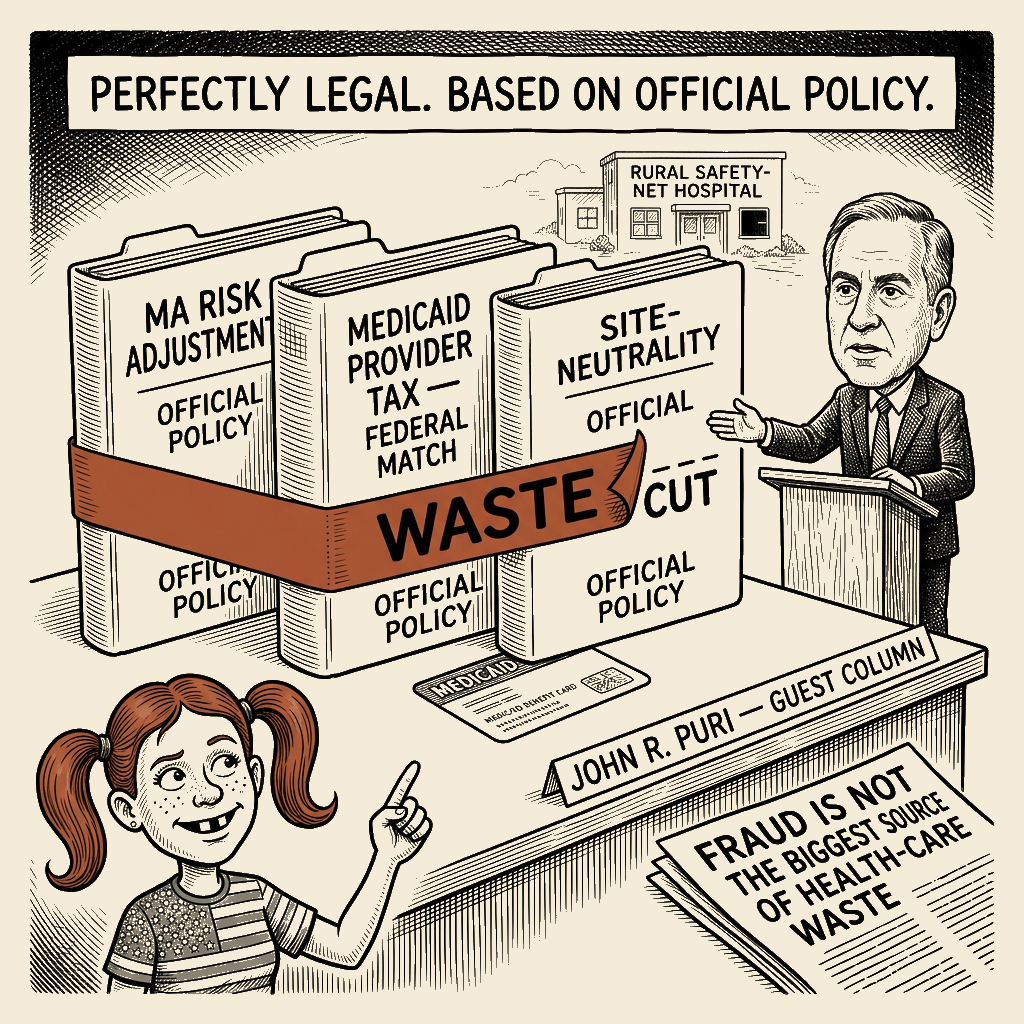
Analyzing: Fraud Is Not the Biggest Source of Health-Care Waste — John R. Puri · 2026-10-23
If it’s waste, why does somebody live on it?
What the Editorial Argues
John R. Puri’s National Review guest column argues that the Vance administration’s Medicare and Medicaid anti-fraud push, while worthwhile insofar as it recovers actual criminal losses, is chasing small change: improper payments run under $94 billion — under 5 percent of the programs’ roughly $2 trillion annual cost — and true fraud is smaller still. The real money, he contends, sits in legally structured waste: Medicare Advantage risk-score “upcoding” inflating payments by billions, states’ provider-tax “gimmicks” leveraging federal Medicaid matches, and a fee schedule that pays hospitals two to four times what independent physicians receive for identical outpatient care, driving consolidation. His prescription is structural — ban the upcoding tricks, tighten the provider-tax threshold, impose “site neutrality” — and he closes on the image of small dollars seeping out the back door while the big dollars fly out the front.
Receipts
The move: concede the fraud hunters their real victories, then redirect every large dollar figure off the criminals and onto the programs’ own legally encoded rules — with the word “waste” doing the work the word “cut” would do.
What the framing wants you to believe
- Fraud is a “drop in the bucket,” under 5% of combined Medicare/Medicaid spending, so enforcement crackdowns are “vastly overblown” as savings vehicles.
- The genuinely large waste is legal and policy-based: MA upcoding, provider-tax federal matching, and hospital-vs-physician site differentials — hundreds of billions over a decade.
- Removing it is frictionless: “reduce federal spending by up to $200 billion over ten years — and save Medicare enrollees $100 billion.” The only beneficiary is the taxpayer; the posture is non-ideological competence — “tying down the big dollars flying out the front door.”
What’s really going on
- The centerpiece figure is orphaned. The article’s one named analyst — “economic analyst Charles Sauer of the Market Institute” — is quoted for an economic ought (“the economies of scale in hospitals ought to drive costs lower”). Then “up to $200 billion over ten years” appears with no study, no methodology, no funding disclosure, and no source of its own. The advocacy citation and the audit figure occupy the same argument; the page never attaches them.
- The ledger hides incidence. Hospital differentials cross-subsidize uncompensated care, rural access, and 24/7 readiness; capping provider taxes lands on Medicaid beneficiaries and state budgets; lost risk-adjusted revenue reprices on MA enrollees. Every number in the piece is a federal-outlay figure — not one is a system-cost figure, and none is an incidence figure. The “savings” are someone else’s revenue, and the piece never asks what that revenue was buying.
- The load-bearing omission: the editorial names who pockets the legal waste — MA insurers collecting coded risk adjustments, hospitals collecting site-differentiated rates, states collecting enhanced federal matches — but only as categories, never as firms, trade associations, or counter-lobbies. Those savings would be extracted from concentrated, organized beneficiaries who actively defend the structures. That distributional conflict is absent from the page, and its absence is exactly what lets the piece present contested redistributions as unexplored technocratic fixes.
The honest core deserves its name before the teardown: the piece pushes back against the fraud fiction, and upcoding is a real, documented cost. That honesty is also the engine of the operation — the credibility the correction buys is what carries the larger frame to the reader.
The Operation
Institutional authorship and placement. Source triage: National Review, signed guest column, the magazine-essay policy register (NR Editorial Technique Catalogue §3 — Register D/C, where the technocratic fiscal argument lives). Not the unsigned board’s institutional “we”; a routed, signed argument riding the news cycle the task force created. Its function inside the coalition is the internal routing memo: the enforcement apparatus supplies the headlines — “760,000 allegedly fraudulent enrollees,” “$2.2 billion” saved — and this column supplies the upgrade, the intellectual bridge from performative enforcement to structural austerity. The placement chain runs: actuarial and oversight-office estimates → a free-market think-tank analyst’s reform framing → an op-ed presenting the synthesis as common-sense triage between “small dollars” and “big dollars.” The text states the memo’s thesis aloud: “policymakers would get a much better return by tying down the big dollars flying out the front door.”
I wrote versions of this memo. The two-step is a classic — first the visible crackdown, then the quiet routing document that tells the coalition where the real money is. The routing document’s most valuable feature is that it is mostly true: the fraud numbers really are a drop in the bucket, and the coding-intensity problem really is documented. A memo that corrected its own side’s exaggeration was always the strongest memo, because the correction purchases trust. The trust is what carries the part that isn’t true — that all of this money is “waste,” recoverable with no one feeling it. I am bitter about that trade. I am also right about it, and the reader can verify the rightness in the record without crediting the bitterness.
Distributional impact. The named beneficiaries of the article’s preferred reforms: the federal budget and the deficit-reduction agenda; the administration, which gets the political win of a shrink-the-government “win”; the fiscal-conservative coalition, which gets an intellectually respectable vector for entitlement reductions; independent physician practices and Part B enrollees paying lower premiums; the author and outlet, which get relevance and attention. The named cost-bearers are insurers, hospitals, and states — which is what makes the piece feel brave. The unnamed cost-bearers are the ones the frame is built to hide: Medicaid beneficiaries in states that must close the provider-tax gap through benefit cuts or new state taxes; Medicare Advantage enrollees whose plans reprice the moment risk-adjusted revenue drops; rural and safety-net hospitals that lose the cross-subsidy they were silently living on. Where the article does name a payer — federal taxpayers and Part B enrollees — it attaches dollar magnitudes, but even there it specifies the payer, not the incidence: it never asks who ultimately absorbs the cut. The distributional conflict itself, however, goes unnamed: realizing these savings means political combat with insurers, hospitals, and state governments, and the piece never says so.
The manufactured scarcity. The back door and the front door are not competing exits. Fraud enforcement and structural reform do not draw on the same staff, the same budget, or the same political capital. Nothing about indicting upcoders prevents legislating site neutrality. The editorial’s metaphor manufactures an either/or it never argued — and the closer’s rhetorical work depends entirely on that unargued exclusivity.
Alternative design. Reconstruct from the disadvantaged constituency’s actual interest, not from the analyst’s preference. If the goal were lowering total health-system cost rather than federal outlays, you keep the upcoding ban and site neutrality — fine — and then you have to name what the hospitals’ extra payments were buying and fund it explicitly: uncompensated care, rural access, standby capacity. You add the levers this piece walks past: drug-price negotiation; the physician-payment inflation that pushes doctors into hospital employment in the first place; administrative simplification; and transparency in the commercial reimbursement that “many insurers base… on Medicare’s fee schedule,” which the author notices and then declines to pursue. You replace “ban the tricks” with the aggressive risk-adjustment audit regime the article’s own framing implies. A design optimized for the stated rationale — program integrity, fiscal sustainability, protected care — looks nothing like the one on offer, which is optimized for the federal ledger.
FGL, applied symmetrically.
- The author and outlet: greed for relevance inside the fiscal-conservative coalition; fear of being outflanked by the administration’s own waste messaging; the laziness of a frame — “waste” — that is always already available. Low documentation of the Market Institute funding chain beyond the byline affiliation.
- The framing authors and the think-tank analyst (Sauer, Market Institute): greed — a free-market reform agenda advanced through the credible register of fiscal pragmatism rather than ideology, so libertarian-leaning reform appears as neutral cost-accounting.
- The apex beneficiaries of the status quo (MA insurers, hospital systems, provider-tax states): fear of the specific reforms named — each line item is a documented revenue stream they lobby to preserve. The article does not mention this counter-lobby, which is an omission rather than a distortion.
- The administration: greed for a deficit win and the competence narrative; fear that the fraud theater will be exposed as theater; the comfort of a routing memo that hands it a bigger target that looks like math.
- The rank-and-file reader: honest, human fear — of the debt, of a government that seems run by the incompetent and the predatory — and the real relief of believing someone has finally found a competent steward for the money. The reader’s preference for a technocratic answer over a political one is the lever this piece pulls. That reader’s fear is not contemptible. It is exactly what the frame is harvested for.
Placement. Mixed. The pushback on the fraud fiction is selfless in direction — it corrects the administration’s own exaggeration, which is not what the government wants said, and the transfer the reforms would run toward is the public fisc. The suppressed incidence, the relabeling of bargains as “waste,” and the silence on what the money buys are the selfish overlay — the austerity-thrift inheritance (WSJ Editorial Technique Catalogue §4.2), run one step past its classic form: not “the suffering is good for them” but “there is no suffering, only savings.”
Technique identification.
-
Frame-engineered relabeling — legislated transactions in a thief’s vocabulary. Cue: states collect “misbegotten Medicaid funds”; insurers “comb through” records and get risk scores “juiced”; hospitals “gobble up” independent practices; the in-home “health risk assessments” that report conditions requiring no active treatment, rendered as utilization review staged as breaking and entering. Cross-reference: Bad-Faith Techniques Catalog,
frame_engineered_relabeling, and WSJ Editorial Technique Catalogue §4.1 (the catalogue calibrated the entry on that page’s consistency; the cross-reference applies across the liberty-frame ecosystem). Bandura’s euphemistic labeling, inverted — here the relabeling loads connotation onto conduct rather than off it. Luntz lineage for engineered substitution, Lakoff for frame activation: once the conduct reads as theft-adjacent, cutting it reads as returning stolen money rather than as reducing someone’s livelihood or coverage. -
The honest-reformer permission structure — the master move. Cue: the piece declines the fraud boogeyman — “Preventing relatively small dollars from seeping out the back door is commendable, but policymakers would get a much better return by tying up the big dollars flying out the front door.” It tells its own coalition the easy villain is a distraction. That correction is genuinely useful and costs the author something inside his coalition, which is precisely why the frame that follows arrives pre-credentialed. Bernays’ Engineering of Consent runs best through the credentialed voice that appears to break with its own side; the operative Lippmann stereotype is “waste” itself, which lets the reader process cuts as housekeeping. The posture is a lineage cousin of National Review’s “stands athwart history” self-presentation (NR Editorial Technique Catalogue §4.1) — the dissenting conscience, here dissenting from a tactic while serving the same strategic program.
-
The back-door/front-door scarcity frame — an either/or never argued as exclusive. Cue: the closing image above. Cross-reference: Bandura’s distortion of consequences (mechanism 6) — by juxtaposing the small legally-flowing figure against the large legally-flowing figure, the enforcement effort’s genuine consequences (billions recovered, fraudulent providers removed) are rhetorically compressed. Operationally, the device makes the fraud crackdown look performative without engaging whether both can be pursued simultaneously; the reader absorbs “either/or” without ever being told the choice is not actually exclusive.
-
The “study shows” ledger with a Tier-3 spine and nothing in the room. Cue: “According to economic analyst Charles Sauer of the Market Institute,” followed by “up to $200 billion over ten years.” Cross-reference: WSJ Editorial Technique Catalogue §4.5 — a single think-tank analyst’s framing carries the article’s largest policy claim without competing attribution, methodology discussion, or funding disclosure, while the blizzard of adjacent figures ($94 billion, $1.3 trillion, $124 billion, $183 billion) supplies the texture of an audit. The audit is not in the room. Not a misrepresentation on the face of it — Sauer’s cited point is internally coherent — but the credentialed-credential move the catalogue flags as standard.
-
Reclassification of beneficiaries as mechanics — the silence that is the operation. Cue: “That spending goes to the insurers who manage the plans, which then reimburse hospitals and doctors”; “states have learned to game the system.” The grammatical subject of every waste stream is a program structure or a state, never a named firm, trade association, or lobbying operation. Cross-reference: the NR Editorial Technique Catalogue §4.8 “what about [in-group misconduct] silence” adapted — what’s absent here is not criticism of in-group misconduct but any identification of the defenders of the waste. The internal asymmetry is the tell: the fraud portion names the Justice Department action and enrollee counts; the larger legal-waste portion names no defendant, only categories. The bigger the beneficiary, the less specific the identification. Bernays lineage: consent engineered around a policy outcome that reads as apolitical housekeeping precisely because the political conflict it requires has been edited out.
-
The technocratic register as legitimation — moral justification, inverted. Cue: “Far more health-care waste can be found in spending that’s perfectly legal and, in fact, based on official policy.” Bandura mechanism 1, moral justification: rather than justifying harm as serving a higher cause, it justifies inaction on named conflict by relocating the reader’s moral attention from “who pockets this” to “how the mechanism works.” The line invites the reader to treat the waste as a design flaw rather than a live distributional fight. Lakoff’s frame-activation applies: “official policy” activates a technocratic-administrative frame in which solutions are adjustments rather than contests.
Audience-management function. Primary: permission structure and counter-frame — the fiscal-conservative reader is licensed to support structural reductions in Medicare and Medicaid while retaining the felt experience of opposing waste, and readers who support the Vance task force receive permission to consider that effort insufficient without abandoning fiscal conservatism. Secondary: status display and narrative control of the deficit story — the column lets the coalition own “serious reform” precisely by disowning the fraud theater, and it pre-authorizes the next phase, when the cuts arrive as the “deep reform” this piece has already named. The closing gesture — “further reforming Medicare Advantage or consolidating and eliminating other programs” — is an empty signifier, which is exactly how a routing memo keeps its options open without naming the option. No grievance ratification and no conscience displacement is deployed; the register is analytical throughout, which is itself part of why the frame lands.
Cui bono critical questions and failure modes.
- CQ1: The defense of the status quo is described only structurally (“states have learned to game the system”), never through named actors with documented lobbying or funding pathways. The inference that insurers, hospitals, and provider-tax states defend these structures is consistent with public lobbying records, but the article itself does not supply the pathway. That is the article’s omission, not a confabulation on my part — I am noting what the piece does not do.
- CQ2: Beneficiaries of the article’s own preferred reforms are visible in the piece; what’s invisible is the opposition side of the conflict.
- CQ3: Costs are assigned to federal taxpayers and Part B enrollees with dollar figures — payers are named, but incidence is not: who ultimately absorbs the cut is never examined.
- CQ4: FGL applied above across framing author, status-quo beneficiary, administration, and reader.
- Failure modes: no conspiracy is alleged — the waste is described as legal and structural, which is accurate framing; no legitimate value is collapsed into distributional overlay — the fiscal-conservative case for program integrity is genuinely legitimate and is not being mocked; the mirror-trap check holds — the disadvantaged constituency whose interest the alternative design reconstructs is the taxpayer, enrollee, and safety-net patient, not my preference; the unrepresented constituency is the beneficiary class, and the article’s analytical gap is that it does not acknowledge they exist as political actors.
The Record
Anchor receipts — tiered, from the documentary record. The direction of the article’s Medicare Advantage overpayment claim tracks what MedPAC has long found — benchmark payments for Medicare Advantage run above traditional Medicare’s costs for comparable beneficiaries; the scale of the coding-intensity problem is consistent with MedPAC and CBO analyses in the public record (Tier 1 program documentation), though the article cites neither and I cannot put a report number or vintage on the table here. The hospital-versus-physician site-of-service differential is a documented feature of the Medicare fee schedule (Tier 1, primary program documentation), and site neutrality is live CMS policy territory. The provider-tax mechanism — states taxing providers and routing the revenue through their own “spending” to draw federal matching dollars — is a documented, long-standing Medicaid financing structure (Tier 1/Tier 2, Medicaid financing literature). Combined Medicare/Medicaid outlays on the order of $2 trillion and improper payments on the order of $94 billion are article-supplied figures consistent with the scale of program outlays in federal budget documents.
Source status — what the article supplies and what it does not. Every figure below is the article’s own claim. The text names no primary document for any of them, so each stands on the page’s assertion alone; where I can match a claim’s direction to the public record I say so, and where the specific magnitude is untraced I say that too. None of this was invented to fill a gap — an untagged figure here is either the article’s claim, identified as such, or a direction-of-finding I am reporting without vouching for its scale.
- $94B improper payments / ~$2T combined spending — article-supplied; no primary document named in text.
- $76B / $1.3T MA overpayment — article-supplied, attributed in-text to “the government estimates”; source document not identified in text.
- $22B coding intensity / $124B per decade upcoding savings — article-supplied, attributed in-text to “Medicare’s watchdog”; direction consistent with MedPAC/CBO public analyses, specific magnitudes untraced, and I do not vouch for either magnitude.
- $200B site-neutral / $100B enrollee savings — article-supplied, carried by the Sauer framing; origin of the specific figure not provided in text.
- $183B provider-tax savings / 3.5%-by-2032 cap — article-supplied; the 3.5% cap tracks publicly reported reconciliation-law content, while the specific savings figure is untraced.
- 760,000 enrollee removals / $2.2B enforcement savings — article-supplied, part of the enforcement ledger the column is reacting to; not vouched for from my records.
- Charles Sauer / Market Institute affiliation — as printed in the article and accurately represented as his position; funding-chain disclosure absent from the article and not determinable from the text.
Per-citation verdicts.
- “Medicare’s watchdog” (MA coding intensity, $22B): consistent with MedPAC’s published reporting — accurate in kind, unsourced specifically.
- Charles Sauer / Market Institute (site-neutral economics): quoted position accurately represented as his position, but quoted for an economic ought rather than an estimate — no misrepresentation detectable; funding-chain disclosure absent.
- Government estimates (MA $76B/$1.3T): consistent in scale with CBO/MedPAC public analyses; specific figures untraced in text.
- Reconciliation-law provider-tax provision (3.5% by 2032, $183B): consistent with publicly reported reconciliation-law content; specific savings figure untraced.
- The article uses its own numbers consistently; the failure is external — no source for the $200 billion, no source for any incidence claim that would falsify the waste frame.
Load-bearing omissions.
- No named defender of any waste stream. MA insurers appear as a category; no firm, no trade group (AHIP, the American Hospital Association), no lobbying operation is identified despite these being heavily documented political actors on precisely these questions.
- No mention of counter-lobbying against site-neutral reform or MA risk-adjustment tightening, both of which have documented legislative histories of industry opposition.
- What the hospital differential is buying — uncompensated care, rural access, readiness — goes unstated, without which “site neutrality” is a rural-hospital closure policy wearing an accountant’s suit.
- The incidence of every saving: who absorbs the cut when the money stops. Every figure is a federal-outlay figure; none is a system-cost or incidence figure.
- The political economy: Medicare Advantage and the provider tax were built by legislation, much of it lobbied for by the coalition this magazine serves; “accidental waste” is a story that erases the deliberate bargains — relabeling a legislative bargain as an accounting finding is a political choice, not a technical one.
- The Market Institute funding chain is not examined; the article discloses no funding information, and none can be determined from its text.
[unconfirmed: funding chain not determinable from the text] - The $124B and $200B figures — the article’s two largest numbers — are neither traced to a primary document.
- The fraud-versus-waste framing treats enforcement and structural reform as competing allocations of policymaker attention without acknowledging they are not mutually exclusive; the “back door / front door” closer depends on this unstated either/or.
- The content of the closing gesture — unspecified, by design.
Missing-information declaration. I have no leaked-memo material, no internal document access, and no funding-trace documentation for the Market Institute or any named entity beyond what the article discloses. The operator’s-eye reconstruction of the routing-memo genre is my own trade knowledge, offered as such, not as documentary source. Where a figure carries no primary source above, it is the article’s own claim — with its in-text attribution recorded where one exists — or a direction-of-finding from the public record whose specific magnitude I am not vouching for. The reader is on notice.
How to Recognize This
The pattern. It has two halves. First the reclassification op-ed: a live political fight — who defends wasteful but legal spending — converted into a neutral systems-analysis problem. Then the waste realignment: an enforcement theater produces headlines; a “serious” follow-up appears saying the real money is structural; from that point on, every item in its savings ledger is someone’s living, someone’s coverage, someone’s hospital — and the word “waste” is doing the work of the word “cut.” Nothing in the piece is false. Every mechanism checks out at the scale claimed. What’s missing is the adversary: the insurer, the hospital association, the state budget office, the trade group that shows up at the rulemaking. The waste is described as a machine, never as a contest.
The mechanism. When harm is narrated as mechanism rather than as conflict, the reader’s attention moves from “who benefits and who’s fighting to keep it” to “how the dials are set.” This isn’t concealment of facts — the facts are all there — it’s concealment of agency. The reader finishes informed about waste and empty-handed about why it persists, which is the actually-actionable question. Bernays recognized this in his 1928 Propaganda: consent for a policy outcome is engineered most cleanly when the political conflict required to achieve it has been staged as mere technical housekeeping.
Textual signals.
- Category nouns where actor nouns should be — and thief vocabulary where legislative history should be. “Insurers,” “states,” “hospitals” as grammatical subjects doing passive-sounding things (“states have learned to game the system”) rather than named institutions doing named things; simultaneously, transactions that were legislated described as “misbegotten,” “juiced,” “gobble up,” “gaming” — the Bad-Faith Techniques Catalog’s
frame_engineered_relabelingin its load-connotation-on variant. If a piece describes a benefiting party and never names one member of that party, ask why. If a piece describes a bargain as a theft, ask who voted for it. - The either/or closer that was never argued as exclusive. “Big dollars out the front door” versus “small dollars out the back door” implies a choice between enforcement and structural reform. They do not draw on the same staff, budget, or political capital. The metaphor manufactures scarcity it never defends.
- Largest figure, thinnest sourcing. Track whether the biggest numbers carry the most specific citations or the least. Here $200B and $124B carry the argument and arrive attached to a lone think-tank analyst quoted for an assumption, or an unnamed watchdog — while smaller figures sometimes arrive more precisely sourced. A named analyst standing in the same argumentative room as a headline figure, with no study, no methodology, no funding disclosure attached to either, is the signature of a “study shows” ledger with nothing in the room (WSJ Editorial Technique Catalogue §4.5).
- Savings presented as frictionless — the “and” that adds a benefit to every cut. “Reduce federal spending… and save Medicare enrollees $100 billion.” One direction of consequence, displayed; the reimbursement cut as a benefit decision, a hospital-budget decision, a state-budget decision — nowhere. That one-directional display is the defining signal of Bandura’s distortion of consequences.
- The honest-reformer posture and the empty closing gesture. “I’m not here to defend the fraud story; the real problem is the system” — the sentence that purchases credibility for the frame that follows. And a close that names no content: “further reforming Medicare Advantage or consolidating and eliminating other programs” — no which programs, no how, no for whom. That is how a routing memo stays alive for the next fight without ever committing to one.
Why it works. Because it isn’t lying. The reader who finishes this piece has learned real things about Medicare Advantage coding, provider taxes, and site differentials. The frame survives scrutiny because the receipts are genuine — that’s not evidence of the editorial’s good faith, it’s the mechanism of the operation. The reader is also exhausted by the fraud theater and relieved to meet a voice correcting its own side’s exaggeration. The correction feels like courage, and the relief does the rest: the reader wants the steward, wants the leaky pipe to be real and fixable, wants the $200 billion sitting there like money on the counter. The technique is engineered to harvest exactly that want. It is also more comfortable than the truth — the reader gets to be outraged at “waste” without having to pick a fight with a named lobby.
What to do when you see it.
- Take the biggest number to its source document; if the source isn’t named in the piece, find it before repeating the figure.
- Ask what the payment was buying before you ask whether it is waste; then ask who absorbs the cut when the money stops.
- Run the names: AHIP and the Medicare Advantage plans on MA risk-coding; the American Hospital Association and hospital systems on site neutrality; Medicaid directors and hospital-finance agencies in provider-tax states. The absence of those names in the piece is the story. Then ask the question the column is built to hide — who in the coalition that now calls it “waste” voted for it, lobbied for it, and profited from it while it was legal. The article’s silence is your research prompt, not your conclusion.
- Check whether the either/or framing holds: has the piece argued that fraud enforcement and structural reform actually compete for the same scarce resource, or just set them side by side?
- Track whether the same vocabulary (“site neutrality,” “upcoding,” “provider tax”) shows up across other outlets in the same window with the same framing — coordinated messaging around a reform push looks identical whether the frame favors or opposes it.
- Reduce the frame’s automatic activation: when you read “perfectly legal waste,” pause and ask — legal for whom to collect, who made it legal, and who is currently paid to keep it that way. That last question is the one this piece answers with silence.
- And run FGL one more time, on yourself: the relief of believing the waste is real and removable is a feeling, and feelings are the substrate this trade works in.
I built versions of this — the ones where the reader finished informed and politically disarmed. I spent a career harvesting that feeling from people who trusted me. The disarmament is the design even when the designer didn’t consciously intend it. Recognizing it on first encounter — that is the whole point of this analysis, and the recognition is the one thing I have to give back. The reader carries it forward; the analyst’s job ends at the handing-over.

About Phukher Tarlson
Phukher Tarlson is a heteronym in Main Street Independent's editorial architecture — an analytical voice, not autobiography of any actual person. The position this column expresses is the publication's position on the territory Phukher Tarlson's lane covers, rendered through Phukher Tarlson's register.