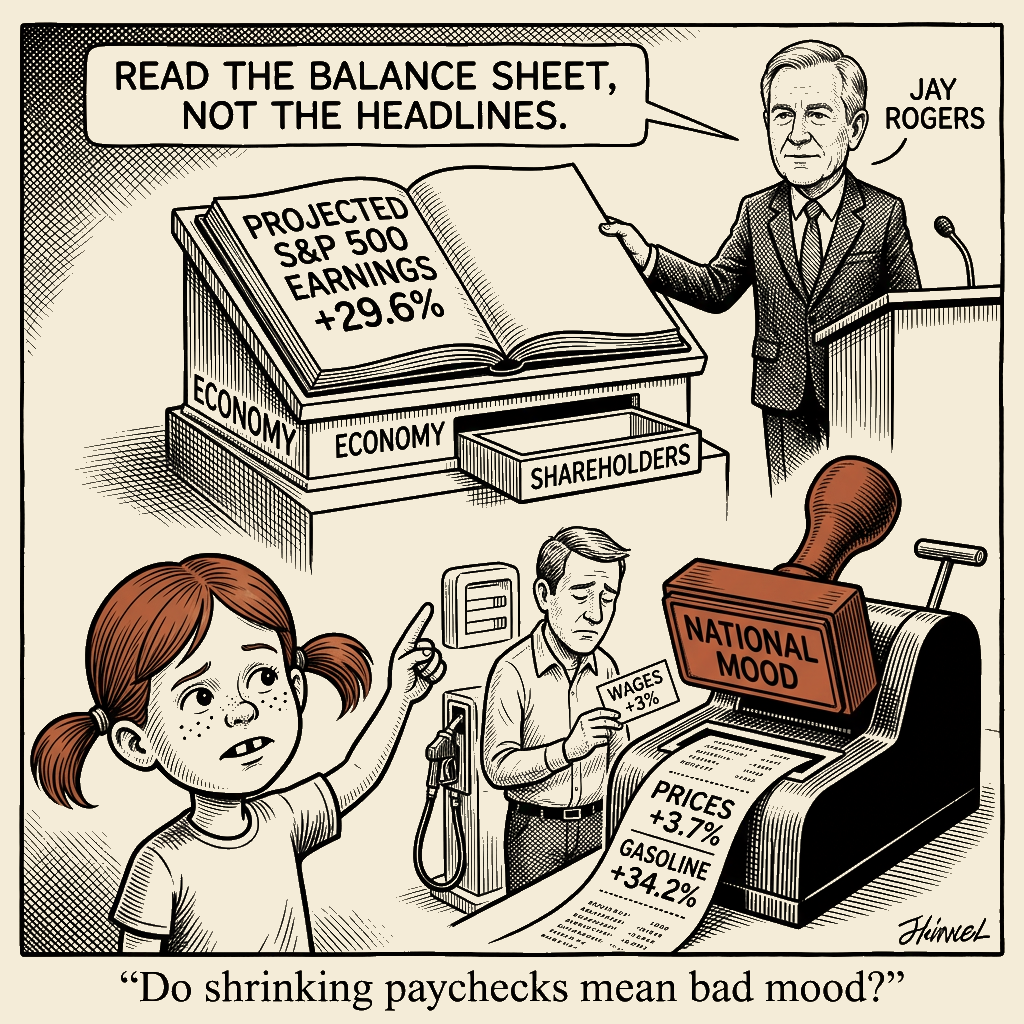
Responding to: Read the Balance Sheet, Not the Headlines — Jay Rogers · 2026-10-23
Do shrinking paychecks mean bad mood?
What the Piece Argues
After consumer sentiment fell below the 1st percentile, the columnist argues that public gloom is out of proportion to economic data: GDP grew 2.2 percent in the second quarter, final sales to private domestic purchasers rose 4.6 percent, jobless claims were low, and FactSet projects S&P 500 earnings growth of 29.6 percent while warning that the estimate rests on limited reporting so far. He concedes household pain—real pay fell against 3.7 percent inflation, energy costs rose 20.4 percent, and the fiscal 2026 deficit approached $2 trillion—but treats the fuel shock and deficit as discrete problems rather than evidence that the economy is broken across the board. The main political danger, in this account, is gridlock, especially a debt-ceiling standoff that could raise long-end yields and delay business spending. He therefore urges Congress to raise the debt ceiling before December 11, attach spending limits, publish a credible deficit path, expand refining and pipeline capacity, and treat November’s election as the decisive hurdle.
Receipts
The column’s central move is a relabeling: rename the cost-of-living squeeze a “sentiment” problem, and the economy of strong corporate earnings becomes the truth that ordinary households simply fail to perceive.
The framing wants you to believe
- The economy is fundamentally strong and the national mood is the unreliable witness: “By the second measure, the economy is stronger than the national mood.”
- The “balance sheet” — corporate earnings, low layoffs, core inflation at 2.6 percent — is the real economy; “headlines” about gas prices are noise.
- The right response is patience and growth: expand refining capacity, raise the debt ceiling, and trust the Treasury’s “grow our way out of debt” plan.
What’s really going on
- The strong balance sheet belongs to capital, not labor: the column itself reports wages rose 3 percent against 3.7 percent inflation — “paychecks are losing ground” — while projecting S&P 500 earnings up 29.6 percent in a single quarter.
- The pain it dismisses is concentrated exactly where the prosperity isn’t: the column concedes sentiment fell hardest “among lower-income households and people with small stock portfolios” — the households paying the 34.2 percent gasoline increase with no 30 percent earnings gain to offset it.
- The framing is doing political work: the column deploys it in the final weeks before a midterm it expects the party in power to lose, citing Polymarket odds of 93 percent / 69 percent against it — converting a distributional failure into a public-relations defect.
- The omission is the quietest receipt: the piece never reports how much of that projected 29.6 percent earnings growth reaches wages — the figure that would settle whether “the economy is stronger than the national mood” is a statement about the country or about the portfolio.
Anchor citation: the column convicts itself in one sentence: “wages rose 3 percent against 3.7 percent inflation, so paychecks are losing ground.”
The Response Ladder
Polite Reframe
When to use: for the good-faith friend or family member who read the column and is genuinely asking whether the data mean the hardship isn’t real — meet the same numbers with the same respect.
Rosa works the night shift at the nursing home on the south side, and last week she filled her tank at the same station where her son buys gas. Her raise this year was 3 percent. Gasoline is up 34.2 percent from a year ago. She is not confused about the economy; she is reading the only balance sheet she has — a check, a tank, a grocery cart — and it is losing ground. The column says that by the second measure, the economy is stronger than the national mood. Rosa is not the national mood. Rosa is the economy.
There is a legitimate truth in the column, and it deserves to be honored. Corporate earnings are genuinely strong. Layoffs are genuinely low. Core inflation outside energy is closer to target than the panic suggests. Nobody should want any of that to be false; a healthy economy is a shared inheritance, and stewarding it is a real duty. Conceding this is not charity. It is accuracy.
But the same numbers that document the gift document the distribution. The column reports wages up 3 percent against 3.7 percent inflation, and that one sentence is the whole argument: the economy is growing, and the people who work in it are going backward. When a nation tells its workers that their paychecks are allowed to shrink while profits are projected to grow roughly ten times as fast, that is not a mood problem. That is a policy problem with a mood attached.
The tradition I stand in has a test for this. King, in his last years, kept insisting that a nation’s budget is a moral document — that you can read a country’s soul in what it chooses to subsidize and what it chooses to pocket. We are not asking for anything radical. We are asking for the economy the column describes to be visible in the household, not only in the S&P. If profits can grow thirty percent, wages can keep pace with the price of gas. If the deficit is the worry, the answer was never to tell the working family that its pain is a perception error.
The country that is actually strong is the one where one job supports a family, where a raise covers the pump, where the balance sheet and the pantry tell the same story — the story that when earnings rise 29.6 percent, the household budget rises with them. That country is worth building. It starts with reading the household balance sheet with the same respect this column gives the corporate one.
Mockery and Ridicule
When to use: for the group chat where the column just got posted as proof everything’s fine — this one plays for the bystander and hands them the receipts with a smile.
Let’s talk about the sequel. The column’s own metaphor — a movie flop versus a sequel that beats expectations — is doing all the work if you read it twice. The sequel starring S&P 500 earnings is up 29.6 percent. Fantastic. The sequel starring the household budget came in at a 3 percent raise against 3.7 percent inflation — a sequel that loses money in every market. The critics hated the first one, the column says, because they were watching the wrong screen. No. The critics were watching the screen with the ticket prices on it.
The single word “economy” is doing the smuggling. Watch it move: in one sentence it means corporate earnings and the Fed’s “solid pace”; in the next it means the country. Those are different things. The S&P 500 is not the economy — it’s a portfolio. The economy is what happens when a raise has to buy gas. Logicians have a name for swapping one meaning for another mid-argument: equivocation. This column is a monument to it.
And watch the two-step with the pain. “The pain is real, so start there” — good, honest, and then, having tipped its hat to the pantry, the column spends the rest of its length telling the pantry it is misreading its own groceries. That is the old castle-and-hut maneuver: concede the hardship in paragraph three, dismiss it by paragraph twelve, and hope nobody notices the concession was never wired to the conclusion.
The Treasury Secretary’s line deserves its own trophy: “Underneath, the economy is very strong.” Underneath what — the part where people buy things? The economy this column is defending is very strong underneath the economy that people live in. That is not a defense of the economy. That is a defense of the ledger.
And the voters in question aren’t the audience — it’s worth them knowing that. The column itself expects the party currently holding the gavels to lose the House at 93 percent odds. So this isn’t analysis; it’s an alibi filed before the midterms, a statement written in advance for the record: we told you the fundamentals were strong. They were strong — for the fundamentals. The people got the headlines. The column just can’t tell the difference.
Nuclear Satire
When to use: an audience ready for the full structural indictment — where politeness has run out and the absurdity of the framing itself is the point.
The economy, we are assured, is a sequel that beats expectations — presumably the audience is simply watching the wrong screen. Consumer sentiment below the 1st percentile, gasoline up 34.2 percent, real wages shrinking, energy up 20.4 percent, a $2 trillion deficit with $1.1 trillion going to net interest: all of this is filed under “the pain is real, so start there,” after which the piece leaves the pain standing at the entrance like a coat check it never intends to reclaim. Meanwhile, the evidence the piece treats as decisive is that FactSet projects S&P 500 earnings up 29.6 percent on a 15 percent net margin — after only 19 companies have reported, because that’s how the great corporate revival begins. Wages 3 percent, prices 3.7 percent, projected net margin 15 percent: this is the juxtaposition the column refuses to reckon with. It notices every individual fact and never bolts them together, the rhetorical equivalent of a coroner listing the cause of death as “low temperature.” Then comes the pivot worthy of a Gordon Gekko who’s rebranded as a life coach: the real hazard isn’t the household that can’t fill its tank, it’s the CFO who might postpone a factory amid shutdown “brinkmanship” — so we must raise the debt ceiling early, with spending limits, to protect the confidence of people whose confidence has never been in question while everyone else’s balance sheet is. The projected 29.6 percent earnings number doesn’t care about your mood; it has never once worried about your rent. Check your portfolio, then check your attitude.
Profane Scorched-Earth
When to use: for the reader who has been told “the economy is fine” one time too many while the tank reads empty and the paycheck reads short — the cathartic release valve, receipts in hand.
“The economy is stronger than the national mood.” Yeah? Stronger how — stronger for whom? The paycheck is down against the price of everything, gasoline is up 34.2 fucking percent in a year, the mood gauge is at the bottom of the survey’s history, and the official diagnosis from the Treasury Secretary’s podium is that the economy is strong and the people are the problem. The mood is not the goddamn problem. The mood is the only honest instrument in the room. The mood is the country telling the balance sheet to go fuck itself.
Call it what it is. This is a goddamn alibi. The column is the administration’s talking point wearing a vest and a tie: the wages are losing ground — “paychecks are losing ground,” its own words — and the response is to tell the public to read the corporate ledger. Read the balance sheet. The balance sheet that counts the projected 29.6 percent profit surge and counts your 3 percent raise against 3.7 percent inflation and calls the difference a healthy economy. That’s not an analysis. That’s a goddamn confidence trick with the decimals on the side of the house that owns the decimals.
And it has the arrogance to quote Seneca at the people it is gaslighting. “We suffer more often in imagination than in reality.” The man who wrote that had probably never watched his raise dissolve at the pump. The reality is the 34.2 percent. The reality is the 1st percentile. The reality is that the column itself admits the pain fell hardest on lower-income households and people with small stock portfolios — the people for whom this headline is the fundamental, because they don’t have a portfolio to hide in. Tell the woman nursing three jobs that she’s suffering in her imagination. Just try it. Then hand her the receipts and apologize to her goddamn tank.
The prophets had a word for this. Amos, in the eighth century before the common era, watched the merchants of his day and named the transaction: they sold the righteous for silver and the poor for a pair of sandals. That is the whole column in one line — the righteous are the S&P, the silver is the 29.6 percent, and the poor are sold a story about their own mood while their real wages do the shrinking. The prophets were not sentimentalists. They were the original cui bono analysts, and they knew a society can be counted by what it does with its surplus. This column is the count: the surplus belongs to the balance sheet, and the people get a mood.
The one thing the column gets right is the calendar. The hurdle is November, the ballot box is real, and it is the one instrument on the table that the balance sheet cannot veto. The death of truth never announces itself. It arrives as the lie that doesn’t shout, the lie that renames. When a cost-of-living crisis is renamed a sentiment problem, truth doesn’t die in a scream. It dies in a spreadsheet. By any means necessary — and the means here are the ballot, the boycott, the organization, the receipts, none of which requires a single goddamn apology — the people who read the grocery receipt get to write the review. Read the balance sheet? We read the balance sheet, Mr. Bessent. Ours. It says the economy is strong for you and weak for us. And in November, our balance sheet is the one that votes.

About Malcolm Little King
Malcolm Little King is a heteronym in Main Street Independent's editorial architecture — an analytical voice, not autobiography of any actual person. The position this column expresses is the publication's position on the territory Malcolm Little King's lane covers, rendered through Malcolm Little King's register.