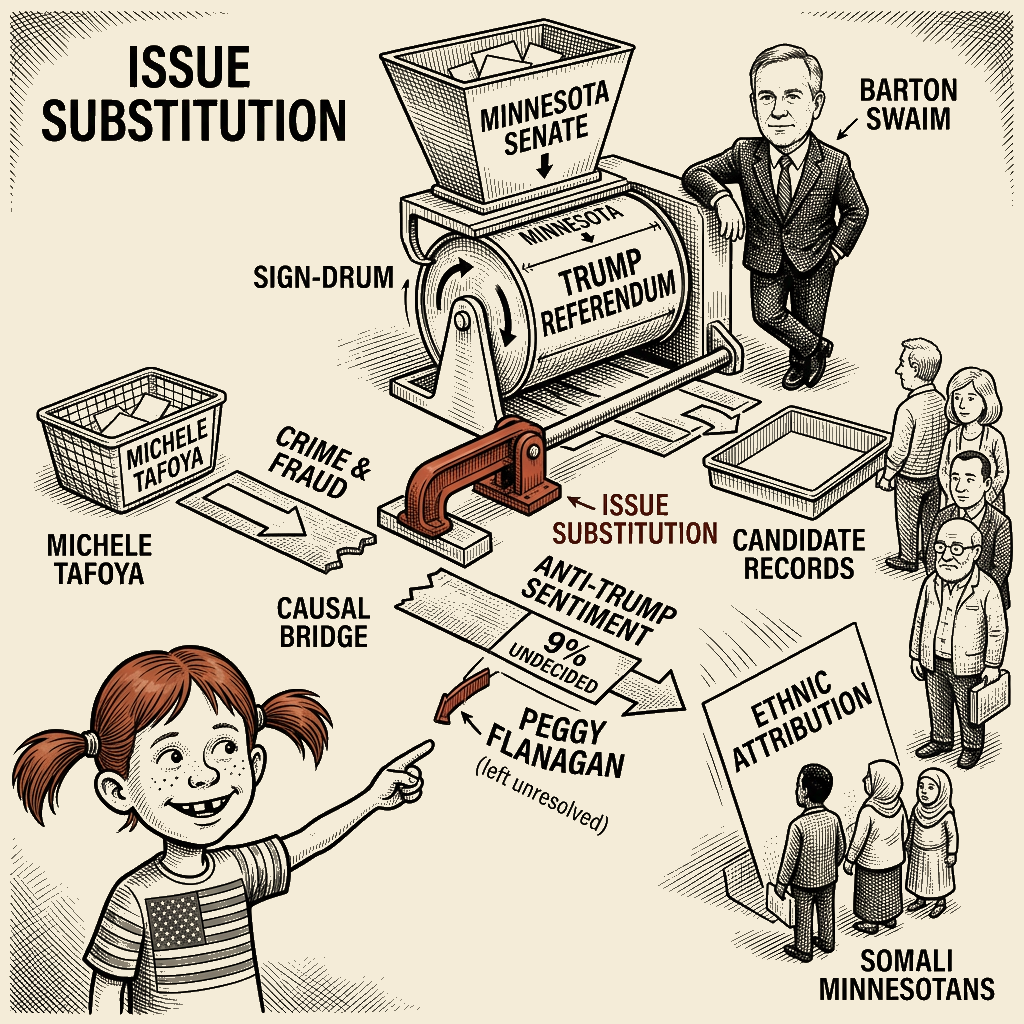
Analyzing: Michele Tafoya in the Red Zone — Barton Swaim · 2026-10-21
Which way do these arrows really go?
What the Editorial Argues
Barton Swaim’s Wall Street Journal column asks whether Republican Michele Tafoya can win Minnesota’s Senate race even as Donald Trump’s approval remains deeply unpopular, with recent polls showing Peggy Flanagan about three points ahead and roughly 9% of voters undecided. Swaim argues that crime and Medicaid fraud—not differences between the candidates’ governing programs—will determine the result, portraying the Walz-Flanagan administration as responsible for scandals that have made Tafoya’s law-and-order and anti-fraud positions electorally potent. He treats Trump’s Oct. 12 endorsement of Tafoya as a double-edged fact: association with an unpopular president may repel voters even as her command of crime and fraud gives her a route to victory.
Receipts
The editorial turns a Minnesota Senate race into a referendum on Trump and uses crime and fraud as bait for a Republican path to victory.
What the framing wants you to believe
- Tafoya can convert crime and fraud anxiety into enough votes to overcome Trump’s approval deficit.
- The 9% undecided—29% among independents in the polls the column cites—forms the reservoir that will decide the race.
- Minnesota matters nationally because it shows whether a Republican can carry a blue state despite the president’s unpopularity.
What’s really going on
- The column converts possibility into mechanism. Its own causal admission is that Flanagan’s effectiveness “will depend on whether a majority of Minnesotans hate anything Mr. Trump does because he does it.” That sentence states the governing hypothesis; it does not demonstrate how anti-Trump sentiment would produce votes for a Republican. (Barton Swaim, WSJ opinion column, Oct. 22, 2026, print edition.)
- The immediate beneficiary is Tafoya and the Minnesota Republican operation if the frame moves crime-and-fraud anxiety into votes, contributions, and office. No donor, campaign, or think-tank commission is documented, so the beneficiary analysis is structural rather than a claim of paid coordination.
- The load-bearing omission is the bridge between the facts and the conclusion: who the undecided voters are, what they want, and how an anti-Trump reaction could help the endorsed Republican rather than help her opponent.
The Operation
Placement and authorship
The source is confidently identifiable as a signed Wall Street Journal opinion column by Barton Swaim, not an unsigned editorial-board statement. Its domain is state electoral politics; its archetype is a bait-and-switch built from a nationalized local question, a number-led “study shows” structure, a blue-state governance frame, and a racialized montage of incidents.
The immediate creator is Swaim; the institutional carrier is the Journal opinion page. The WSJ Editorial Technique Catalogue records that the page’s ideological commitments are explicit rather than hidden. That matters: we need not manufacture a secret donor behind an honestly conservative outlet. It does not, however, excuse the editorial’s unsupported causal machinery. No named donor, campaign, think tank, cable network, or coordinating organization appears in the supplied record. The visible placement chain begins with Swaim’s signed column and ends with the Oct. 22, 2026 print edition; downstream syndication and acquisition records were not supplied. Any claim that the piece was centrally paid or coordinated would exceed the evidence.
The placement is mixed, leaning selfish: legitimate public questions about fraud, crime, and electoral competitiveness are made to serve an explicit candidate-advocacy function.
Who benefits, and through what pathway
The named beneficiary is Michele Tafoya, and, if the argument persuades, the state and national Republican organizations around her. The pathway is concrete enough to state without pretending the article caused an outcome: crime-and-fraud salience may move voters; those votes may bring contributions; office may bring power and policy influence. The supplied record does not establish that any donor directed Swaim or that his column changed a poll.
Trump’s national brand is not a clean beneficiary. His approval is the problem the column has to neutralize. His endorsement could help by moving attention away from his unpopularity and onto Democratic governance; the column never establishes that transfer. It is a possible pathway, not a demonstrated one.
The cost-bearers are prospective rather than proven. Peggy Flanagan and the Walz-Flanagan administration face an electoral frame in which their record becomes the campaign’s answer to crime and fraud. Minnesota’s Somali community bears the particular danger of having fraud allegations, gang violence, and political responsibility blended without evidence connecting them. Voters bear a subtler cost: they receive a coherent causal story before they receive the cases, audits, polling methods, or candidate records needed to judge it.
The alternative design
If the column were optimized for its stated rationale—credible electoral viability—it would separate the claims before trying to combine them. It would name the federal cases, define “Medicaid and other fraud,” show how the reported $9 billion was calculated, and identify who prosecuted whom. It would publish the dates, samples, questions, and margins of error for the polls, then report what undecided voters actually said about crime, fraud, Trump, and the candidates. It would distinguish the three shootings, their charges, and their verified connections instead of letting adjacency carry the ethnicity. It would price Trump’s endorsement separately from crime and fraud rather than assuming that the two mechanisms cancel one another. And it would let the reader watch the subtraction: if anti-Trump sentiment helps Flanagan, how many additional voters must the crime-and-fraud argument deliver to overcome it?
That alternative would be less cinematic. It would also be an argument.
Fear, greed, and laziness
Applied symmetrically, the incentives become legible without inventing private mental states.
- For Swaim and the opinion-page ecosystem: fear of a race that dissolves into competing narratives; gain from a vivid national proxy that rewards attention and retransmission; convenience in leaving the undecided-voter bridge unbuilt rather than checking cases and polling.
- For the Republican beneficiary: fear that Trump’s approval sinks the ticket; gain from votes, money, and office if crime and fraud prove decisive; convenience in avoiding the coalition arithmetic that would reveal how much anti-Trump sentiment works against a Trump-endorsed candidate.
- For the reader: fear of crime and fraud, which is not a manufactured emotion; gain from a finished story that identifies an adversary and supplies a direction; convenience in not having to reconstruct missing data before reaching a conclusion.
- For those placed outside the frame: the convenience falls on them. Somali Minnesotans, low-propensity voters, and anyone who wants enforcement policy examined rather than racialized must correct the frame that makes their lives scenery for an election story.
The framework does not support calling this a paid operation. The structural incentives are sufficient to explain the editorial form.
Technique map
1. Bait-and-switch through frame-engineered relabeling. The textual cue is the opening question—“Can a Republican, with President Trump’s approval numbers dredging the bottom, nonetheless win in a blue state?”—followed by the closing causal proposition about whether a majority of Minnesotans hate “anything Mr. Trump does because he does it.” The nominal object is a Minnesota Senate race; the delivered object is a national referendum on Trump.
The cross-reference is the Bad-Faith Techniques Catalog’s bf_catalog: frame_engineered_relabeling and WSJ Editorial Technique Catalogue §4.1, “Frame-engineered relabeling.” Operationally, the substitution allows the reader to transfer conclusions about Trump to a contest with distinct candidates, policies, and local conditions. The lineage runs through Lakoff’s cognitive framing and Luntz’s relabeling discipline; no internal Luntz memo or WSJ commissioning record is claimed here. The editorial text itself supplies the cue.
2. Hasty generalization through the incident montage. The cue is the sequence concerning the Yancey Park shooting, the 55 casings recovered at Our Lady of Grace Catholic Church and School, and the Eden Prairie homecoming shooting that Tafoya attributes to Somali gangs. Only the last incident receives the explicit ethnic attribution in the column’s account. Yet proximity allows one tagged incident to color the others and then the statewide political landscape.
The cross-reference is bf_catalog: hasty_generalization in the Bad-Faith Techniques Catalog, with the WSJ Editorial Technique Catalogue §4.9, “The ‘blue state failure’ frame,” providing the house-pattern overlay. The operation substitutes vivid local proximity for incidence rates, base rates, and causal evidence. In Lippmann’s older vocabulary, the reader receives a picture in place of the complicated territory.
3. Equivocation among “crime,” “fraud,” gangs, immigration, and welfare. The cue is the repeated pairing of “crime and fraud,” followed by Medicaid fraud, shootings, Somali gangs, welfare-system abuse, and deportation. These are distinct harms with distinct mechanisms, populations, and remedies. The Bad-Faith Techniques Catalog’s bf_catalog: equivocation identifies the shift: the column treats several policy questions as one transferable vote bank. The practical effect is to make evidence for any one concern appear to license conclusions about all the others.
4. The “study shows” ledger without an auditable trail. The cues are “multiple recent polls,” 9% undecided, 29% of independents, 55 casings, nearly 4,000 arrests, and “perhaps $9 billion.” The cross-reference is WSJ Editorial Technique Catalogue §4.5, “The ‘study shows’ ledger,” together with §3.7, the technocratic-credential ledger. Numbers do not become propaganda by carrying decimals; they become a legitimacy device when the facts that would allow independent checking are withheld. Here the polls are named but their methods are not supplied, and the largest number—$9 billion—has no named prosecution, audit, calculation, or definition attached to it.
5. Attribution of blame through the administration brand. The cues are the “hapless boss,” Walz’s supposed failure to “diligently look[] the other way,” and the “Walz-Flanagan administration.” In Albert Bandura’s moral-disengagement taxonomy, this operates as attribution of blame: responsibility is made to adhere to the incumbent brand without an enforcement chain showing who knew what, when, and what was done. Euphemistic labeling and displacement of responsibility are not necessary here. The simpler operation is sufficient: make the administration answerable for every failure the article cannot trace to a case.
6. The closing-line cadence turns an electorate into an audience. The coda returns to Tafoya’s football years, the broadcast team climbing into a van, ratings, and her remark that “All I can do in this race is my best, and those numbers are gonna go where they’re gonna go.” WSJ Editorial Technique Catalogue §3.5 identifies the closing-line cadence. Operationally, the anecdote supplies memorability while changing the category of the problem: voters deciding what government to authorize become an audience awaiting a reaction to Trump.
The umbrella maneuver is not one enormous lie. It is an assembly of substitutions: local contest into national referendum, factual possibility into electoral mechanism, distinct forms of harm into one vote bank, and voter judgment into audience response. I recognize the architecture because I helped build versions of it—take a real grievance, attach a national villain, and let the reader infer the missing bridge. That is retained operating memory, non-verifiable as an internal fact about this column; the public record supports the critique without it.
Audience-management function
The column supplies a permission structure: because crime and fraud are real and the polls are close, the reader is licensed to treat those issues as decisive without a demonstrated causal bridge. It provides identity confirmation for readers who want Republican viability in a blue state and grievance ratification for the proposition that Democratic governance has produced failure. It operates as a counter-frame, replacing candidate-by-candidate scrutiny with a referendum on Trump. Finally, it manages the undecided as an unnamed reservoir whose contents the writer fills rather than measures. The reader receives not a policy argument but a finished causal picture.
The Record
The strongest documentary finding is narrower than the column’s causal conclusion: the text proves Swaim’s substitutions, while the underlying material does not independently prove the numbers, cases, or electoral mechanism.
Anchor receipts
The primary documentary anchor for the analysis is Barton Swaim’s WSJ opinion column published in the Oct. 22, 2026 print edition. It establishes the article’s wording, sequence, quoted claims, and rhetorical hinges.
The column names KSTP-TV and the Star-Tribune as polling sources; federal prosecutions; law-enforcement activity at three shooting locations; Trump’s Oct. 12 Youngstown rally; a Flanagan campaign release; Operation Metro Surge; candidate policy positions; and prior Minnesota election results. None of the underlying poll sheets, case records, incident reports, campaign documents, or official releases was supplied with the editorial. They are citations visible through the column, not independently available receipts.
Load-bearing claims and status
-
Minnesota is close, with Flanagan about three points ahead and 9% undecided, including 29% of independents. The column names two poll sources but supplies no dates, samples, questionnaires, modes, margins of error, or crosstabs. [unconfirmed: convergence threshold not met]
-
Federal prosecutions uncovered perhaps $9 billion in Medicaid and other fraud. No prosecution, indictment, settlement, audit, calculation, period, or definition of “Medicaid and other fraud” is named. The scale claim therefore rests on the editorial’s attribution alone. [unconfirmed: convergence threshold not met]
-
Walz governed since 2019, looked the other way, and abandoned his third-term campaign because the fraud scandal was embarrassing. No official campaign statement or evidence establishing Walz’s knowledge is supplied. The motive claim is especially under-sourced. [unconfirmed: convergence threshold not met]
-
The three shootings occurred, authorities recovered 55 casings at Our Lady of Grace, and Somali gangs shot two people at the Eden Prairie homecoming game. No police report, charging document, victim statement, or incident timeline is supplied. The column itself distinguishes the ethnic attribution attached to the third incident from the two untagged incidents. [unconfirmed: convergence threshold not met]
-
Trump endorsed Tafoya on Oct. 12, and Flanagan’s campaign said Tafoya had spent the year chasing the endorsement. The column reproduces both quotations and rejects the “chasing” accusation as “a claim no sensible observer believes.” The quoted wording can be checked against the supplied text; the rally recording and campaign release were not supplied, so the underlying event remains [unconfirmed: convergence threshold not met].
-
Operation Metro Surge launched in late 2025, produced nearly 4,000 arrests, and resulted in two protesters being shot. No official report, case count, legal disposition, or incident record is cited. The column’s description of those arrested as “illegal aliens” is reported language, not a fact independently established here. [unconfirmed: convergence threshold not met]
-
Minnesota has not elected a Republican statewide in 20 years; Tafoya has the stated résumé and policy positions; and the two named polls provide the reported undecided percentages. These claims may be verifiable from election records and campaign documents, but those documents were not supplied. [unconfirmed: convergence threshold not met]
No Tier-1 underlying receipt or pair of inspectable Tier-2 receipts was available for the seven load-bearing empirical claims. The editorial itself is Tier 1 only for what the editorial says.
Citation-accuracy verdicts
- The polling citation is incomplete. KSTP-TV and the Star-Tribune are named, but a reader is given neither the poll question nor the methodological information necessary to evaluate the result.
- The $9 billion citation is deficient. “Perhaps” is editorial hedging, not methodological disclosure. No source chain explains what was counted, over what period, or with what relation to state coffers.
- The endorsement quotation is used accurately as reproduced in the supplied column. Swaim rejects the false “chasing” claim and credits Tafoya with not seeking the endorsement. The problem is not misrepresentation of that exchange; it is the subsequent substitution of association with Trump for electoral causation.
- The “All fair points. But manifestly” hinge is reproduced accurately and is decisive. The concession acknowledges the issue’s legitimacy; the pivot then makes issue selection evidence of opportunistic character.
- The Iran reference overreaches. The assertion that the war is unpopular “here as it has everywhere else” has no polling citation in the supplied text.
- The ratings quotation is accurate as reproduced but rhetorically repurposed. Tafoya is discussing uncertainty and public attention after games; the column turns it into the governing image for a Senate electorate.
Load-bearing omissions
- The cases behind the fraud claim: defendants, charges, convictions, recoveries, and whether the alleged amount was alleged, estimated, or collected.
- The definition of “Medicaid and other fraud” and the method by which $9 billion was attributed to Somali Minnesotans.
- Evidence of what Walz knew, when he knew it, and whether his decision not to seek a third term was caused by the fraud scandal.
- Poll dates, samples, modes, margins of error, question wording, and issue or candidate crosstabs.
- Evidence about what undecided voters believe about crime, fraud, immigration, Trump, Tafoya, and Flanagan.
- The electoral direction of anti-Trump sentiment. The column says such sentiment energizes the progressive base; it does not show how that sentiment helps the candidate Trump endorsed.
- The charges, perpetrators, and verified relationships among the three shootings, the recovered casings, Somali gangs, and Medicaid fraud.
- The full text and practical effect of Tafoya’s federal-assistance, state-penalty, deportation, and anti-fraud proposals.
- Any evidence that the three incidents represent more than isolated events in Minnesota’s crime landscape.
- The downstream consequence of the racialized framing for Somali voters and communities.
- Any donor, institutional, syndication, or coordination record that would establish more than the immediate authorship.
Missing-information declaration
The poll sheets, federal case records, audits, law-enforcement reports, campaign releases, official operation documents, and candidate policy texts were not obtainable from the supplied material. No leaked memo is cited, and none should be manufactured to explain the piece. My retained recollection is used only to identify a recurring technique and is flagged as non-verifiable; it is not offered as evidence about Swaim’s work.
Three assumptions fill the editorial’s evidentiary gaps: that undecided voters can be moved by crime-and-fraud anxiety; that the anti-Trump reaction points toward the endorsed Republican rather than against her; and that adjacency between a tagged incident and two untagged incidents can establish a common political landscape.
How to Recognize This
The pattern is the red zone between a fact and the conclusion the writer wants it to license. The column gives the reader real pieces of Minnesota and then edits them into one causal story. The test is not whether the facts are fake. The test is what happens after the concession.
First, watch the premise in the opening question. If a local election is introduced through a national candidate’s approval rating, the local contest has already become a proxy. Minnesota is no longer deciding who should govern it. Minnesota is measuring the temperature of a national electorate.
Second, watch the hinge. “All fair points” is the warning light. The Bad-Faith Techniques Catalog’s issue-substitution pattern does not require the writer to deny the issue. It requires the writer to admit the issue, then tax the candidate for raising it. “The policy is sound, but she should not have emphasized it because her opponent was vulnerable” is not analysis. It is motive laundering.
Third, watch the montage. Look for a small number of vivid incidents placed beside one another without rates, denominators, or causal links. Look especially for an ethnically tagged incident lending its meaning to neighboring incidents that the text leaves untagged. The editorial can maintain formal precision—“she says Somali gangs”—while its sequencing performs the racial fusion anyway.
Fourth, watch the numbers without provenance. “Perhaps $9 billion,” 9% undecided, 29% of independents, 55 casings, and nearly 4,000 arrests all look like receipts. Ask for the document behind each one. Then ask the harder question: what observation connects the number to the conclusion? A poll can establish that voters are undecided. It cannot establish what those voters will decide.
Fifth, watch for two mechanisms pointed in opposite directions. Crime and fraud are supposed to carry a Republican. Trump’s unpopularity is supposed to sink one. The column never performs the subtraction. If a majority of Minnesotans hate what Trump does, the anti-Trump candidate is the one those voters reward—and that candidate is not Tafoya. Unless the column produces a bridge, the two mechanisms do not make a path; they make a contradiction.
Sixth, watch uncertainty become consent. Undecided voters are not undecided people in this piece. They are an undifferentiated reservoir waiting for the writer to fill them with crime, fraud, immigration, and Trump. No survey testimony or candidate-specific evidence enters the reservoir. The writer supplies its contents.
Seventh, watch the endorsement become a ballot. A candidate’s acceptability is made to depend on how the electorate feels about the man who endorsed her. The column correctly rejects the lie that Tafoya spent the year chasing Trump. It then allows the real rally to do the work the false accusation was pretending to do. Rejecting one dubious inference licenses nothing. It does not authorize a second.
Eighth, watch the last noun. The coda does not end on Medicaid, policing, welfare fraud, deportation, or Minnesota. It ends on ratings. The editorial grants that Tafoya is strong, candid, polished, and familiar with the issues. Then it puts her in a broadcast van waiting for a number that has nothing to do with her program and everything to do with the audience’s feelings about Trump. The electorate has become an audience; the campaign has become a broadcast; the story has become ratings.
This works because its ingredients are real. Crime is real. Fraud is real. Trump’s opposition is real. Undecided voters are real. The operation takes those legitimate anxieties and provides the relief of a finished causal narrative without the work of tracing cases, polling methods, or voter motives. It gives the reader identity, grievance, suspense, and a national villain in a single package. The fear is not manufactured; the direction imposed on the fear is.
When you see the pattern, do five things. Trace the cited poll back to its actual release and read the question, not the headline number. Trace the largest number back through the named case or audit; if the article does not name one, require it to do so. List what the evidence establishes separately from what the rhetoric infers. Ask who benefits through votes, money, office, or attention—and who bears the reputational or material cost. Search for the same vocabulary and sequence across the wider publication network; repetition may establish a house frame, though repetition alone does not prove coordination. Then reduce the frame’s automatic activation: name the editorial claim, the evidence supporting it, the missing bridge, and the conclusion you would require before accepting it.
I built versions of this architecture. The technique was never the invention of facts. It was the transfer: real grievance, national villain, missing bridge, borrowed authority. I recognize it now because I helped make the transfer look inevitable.
Swaim does not show Minnesota moving into the red zone. He edits Minnesota until only one direction appears available. That is the bad faith: not one enormous lie, but a chain of substitutions—scene for evidence, ethnicity for culpability, motive for explanation, endorsement for ballot, uncertainty for consent.
That is not a report of a Republican path to victory. It is the manufacture of one.

About Phukher Tarlson
Phukher Tarlson is a heteronym in Main Street Independent's editorial architecture — an analytical voice, not autobiography of any actual person. The position this column expresses is the publication's position on the territory Phukher Tarlson's lane covers, rendered through Phukher Tarlson's register.