Analyzing: New York Times Goes With the Hitler Argument — James Freeman · 2026-10-23
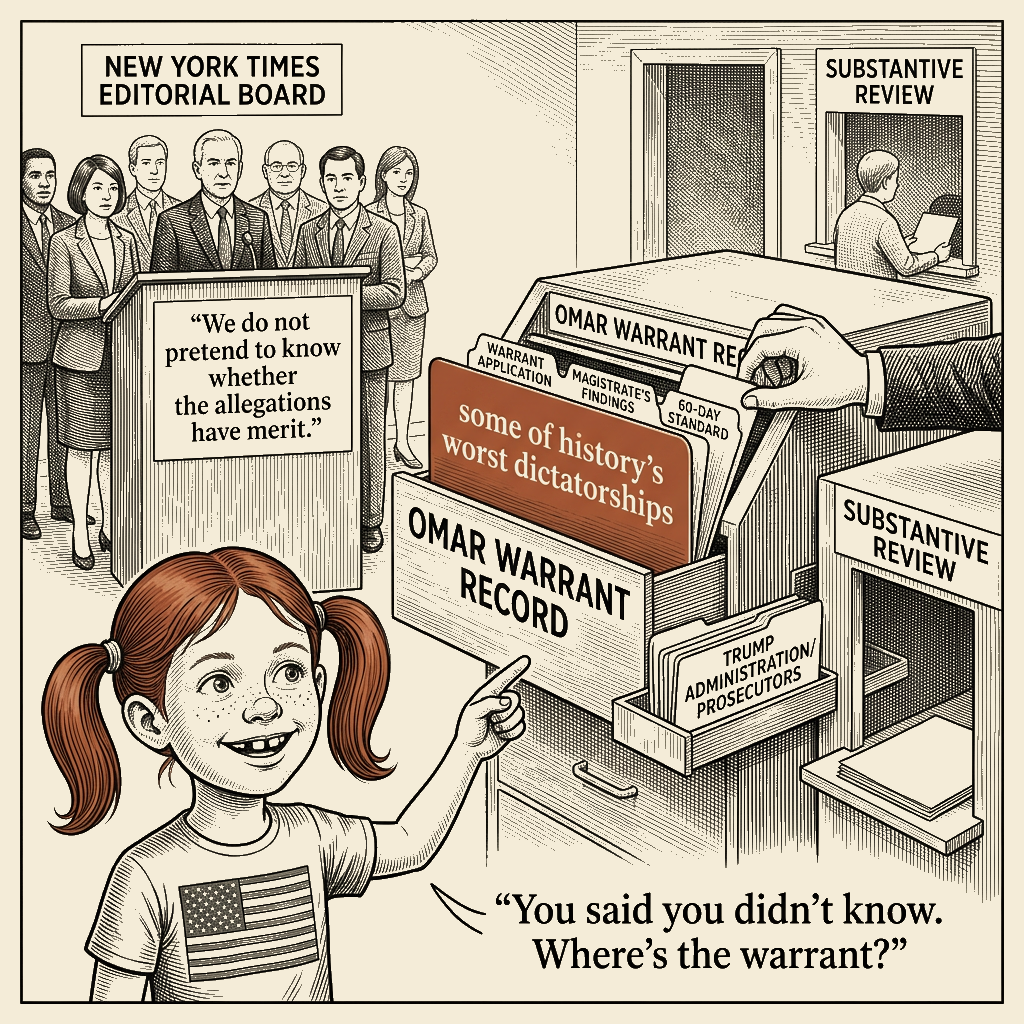
You said you didn’t know. Where’s the warrant?
What the Editorial Argues
The artifact under review is James Freeman’s October 23, 2026 Wall Street Journal opinion column, “New York Times Goes With the Hitler Argument.” Its case is not that the federal warrant in the Omar investigation was substantiated; it is that the New York Times editorial board reached for “some of history’s worst dictatorships” after admitting, “We do not pretend to know whether the allegations have merit.” Freeman also argues that the board failed to ask why a federal magistrate judge authorized the warrant and invokes the Obama, Jack Smith, and Ted Stevens episodes to challenge what he calls the selective application of a 60-day pre-election prosecutorial standard. The column’s strongest proposition is that the Times could not responsibly attach a dictatorship analogy to allegations it had expressly declined to evaluate.
Receipts
The column’s strongest move is to expose the Times editorial reaching for Hitler after admitting it did not know the case; its weaker operation is to let that contradiction substitute for the warrant record it never supplies.
What the framing wants you to believe
- The Times board abandoned evidentiary restraint, converted political alarm into a civilizational accusation, and left the decisive question about the magistrate judge unanswered.
- Freeman’s counterexamples defeat the claim that the alleged 60-day prosecutorial norm was being invoked only against the Trump administration.
- The Times’ demand that readers examine the facts is itself evidence of “hysteria”; the reader can join the ridicule and dispense with the warrant.
What’s really going on
- The narrow hit is textual. The Times says, “We do not pretend to know whether the allegations have merit.” Freeman’s hinge is: “But they roll out the Hitler analogy anyway.” Within the artifact, the contradiction is real, and the column has no need to distort it.
- The missing relation is the connection between this particular investigation and the constitutional danger the Times invokes. No warrant application, order, judicial finding, allegation, or policy instrument appears, so neither the analogy’s factual premise nor the warrant’s legality can be adjudicated here.
- The protected beneficiary is the Trump administration and the prosecutors under scrutiny: within this exchange, their conduct remains outside the frame while the Times absorbs the controversy. The normalized harm is evidentiary substitution. “Hitler” and “kook” become acceptable substitutes for records, leaving readers unable to distinguish a defensible warning about authoritarian conduct from an indefensible analogy.
The Operation
Classification and placement
The source is a signed WSJ op-ed, not an unsigned editorial-board piece. The distinction matters because the collective “we,” third-graf turn, and other board fingerprints in the WSJ Editorial Technique Catalogue are comparative here, not identity claims. The piece is a partisan-counterexample argument whose closure mechanism is ridicule.
The placement chain supplied by the record is short: the New York Times editorial board publishes its criticism of the Omar investigation; Freeman answers in the WSJ Opinion pages; he recruits former prosecutor Elie Honig’s New York magazine commentary; and he supplies the Jack Smith and Ted Stevens episodes as counterexamples to the alleged pre-election norm. The packet documents no common donor, foundation instruction, think-tank placement chain, shared counsel, or coordinated syndication behind those steps. The institutional-authorship finding therefore stops at the publication sequence. A coordinated-manipulation claim would exceed the record.
Cui bono
The protected beneficiary is not a donor or hidden foundation. It is the administration and prosecutorial class whose conduct is at issue in the underlying dispute. The pathway is issue displacement: once the exchange becomes a contest over the Times’ “hysteria,” the warrant does not have to survive scrutiny for the administration to benefit rhetorically. The column can make the press the defendant and leave the executive branch’s case unexamined.
The rank-and-file reader is not a beneficiary in the same sense, but receives a real but cheaper benefit: the satisfaction of moral discrimination without the inconvenience of reading the legal record. The Times board, meanwhile, bears the reputational cost of the analogy it made. The public and those whose legal interests are touched by the investigation bear the more serious cost: a dispute over possible authoritarian conduct is recast as a media food fight, leaving readers with rhetoric in place of adjudication.
No dollar amounts or quantified distributional effects appear in the record, so none can be supplied. The alternative design follows from the public’s interest in an answer rather than from either side’s preferred talking points:
- Separate the legality of the warrant from the Times’ rhetoric.
- Reproduce the warrant application, order, relevant findings, and the allegation actually presented.
- Publish the text or authoritative account of the alleged 60-day standard, including its exceptions.
- Test the Smith and Stevens episodes against that same standard rather than using them as shortcuts.
- Require the Hitler comparison to identify the legal conduct and historical facts that make it proportionate—or remove it.
The advocated position is mixed. The demand that a pre-election norm apply evenhandedly is a legitimate public value. The column’s machinery protects the administration and its defenders from substantive scrutiny by making the Times’ rhetoric stand in for the investigation. That is the selfish operation wrapped around a selfless kernel.
The Fear/Greed/Laziness analysis describes incentives, not proven private motives. The author has a legitimate fear that civilizational analogies can make power unchallengeable, a professional appetite for a decisive-sounding correction, and an incentive to leave the inconvenient file closed. The protected beneficiary has an interest in avoiding scrutiny, an appetite for political power and narrative control, and a reason not to define the alleged norm too precisely. The reader has a human fear of being manipulated, a desire for status among the rationally alert, and a strong incentive to accept an emotionally finished answer. Fear of being duped by “hysteria” can produce precisely the credulity that another frame is exploiting.
The techniques in the text
Frame-engineered relabeling — the Times’ move. The cue is “some of history’s worst dictatorships.” The Bad-Faith Techniques Catalog classifies this mechanism as bf_catalog: frame_engineered_relabeling; the WSJ Editorial Technique Catalogue §4.1 describes the same relabeling operation in its publication-specific vocabulary. Operationally, the word “dictatorship” converts a contested legal and political inquiry into a civilizational category, making the emotional scale appear to substitute for the missing particulars. The lineage is Luntz and Lakoff: the frame is engineered by changing the label attached to the underlying event. The NR Editorial Technique Catalogue §4.5 civilizational-frame entry is a useful cross-publication analogue, though it does not establish anything about the Times’ institutional authorship.
No memo in the record proves that this particular usage was coordinated. The catalog label identifies the rhetorical mechanism; it does not supply an intent claim. What the text does show is the operational effect. Once “dictatorship” supplies the verdict, the warrant application, magistrate’s findings, and underlying allegations become optional.
The editorial’s constitutional passage performs the complementary operation: “Unlike in a dictatorship, we the people choose a Congress to draft laws, we the people choose a president to see that they are faithfully executed, and we the people also enjoy the protection of an independent judiciary.” The existence of elections and an independent judiciary does not establish what this magistrate found or whether this warrant was sound. A republic can issue a bad warrant. The passage recasts institutional background as case-specific answer. In Lippmann’s lineage, the editorial board becomes the interpreter that supplies the public with a ready-made stereotype in place of the warrant file.
Bandura’s mechanism of moral justification is visible in the same movement: concern for democratic and constitutional safeguards becomes the higher cause that licenses a dictatorship comparison before the facts are known.
Partial whataboutism — Freeman’s counterexample. The cues are the claim that the Times “appears to have adopted the Barack Obama standard,” the October 2024 Jack Smith filing, and the prosecution of Sen. Ted Stevens. The Bad-Faith Techniques Catalog identifies the relevant pattern as bf_catalog: whataboutism, while the WSJ Editorial Technique Catalogue §4.17 describes its disciplined deployment on opinion pages.
The match is partial, and the limitation is important. Smith and Stevens can rebut the claim that an alleged pre-election norm has been applied only to one party’s candidate. They cannot establish that the Omar warrant was valid, that its evidence was sufficient, or that the alleged rule governed these facts. A counterexample defeats uniqueness; it does not resolve the case. The column has a legitimate inconsistency point. Its error is using that point as a substitute for the merits.
Operationally, the move also substitutes partisan genealogy for institutional analysis. Naming Obama and “progressive allies” tells the reader which conclusion to buy before the evidence arrives. The reader is given a theory of motive in place of the warrant file, the magistrate’s findings, and the policy text.
Ad hominem and red herring — the closing mechanism. The cues are Honig’s “some kind of unhinged Ever Trumper,” Freeman’s question about an editor who might have checked the “hysteria,” and the final question: “what kind of kook immediately assumes that dictatorship is at hand?” The Bad-Faith Techniques Catalog maps the character attack to bf_catalog: ad_hominem and the diversion from the warrant to bf_catalog: red_herring.
The WSJ Editorial Technique Catalogue §3.5 describes the quotable closing cadence; §4.16 identifies a related question-form technique, although this column does not meet the full sealioning threshold because it does not persistently question an opponent across multiple exchanges. What it does supply is terminal ridicule. The mock aside is where the argument goes when the argument has failed. It changes the question from what the judge and prosecutors did to the character of the critic who asked.
That is not merely colorful language. It is an answer-substitution device. The reader is invited to join the verdict instead of examining the reasoning. Inquiry is recoded as pathology.
Audience management
The Times editorial’s function is a permission structure built from fear: democratic defense becomes the higher cause, and the “we the people” supplies collective legitimacy. It offers readers a status—defenders of democratic normality—without requiring them to resolve whether the comparison fits the facts.
Freeman reverses the identities while reproducing the closure. His column provides identity confirmation for readers already hostile to the Times, grievance ratification against an institution presented as hysterically anti-Trump, and a status display: the rational observer versus the “kook.” Its counter-frame replaces executive conduct with press conduct. Most importantly, it gives the reader conscience displacement. One can feel informed and principled about authoritarianism without examining whether the warrant was valid, because the article has already assigned the relevant parties their roles.
The Record
Anchor receipts and load-bearing claims
-
The rhetorical sequence is anchored to the primary artifact. The WSJ column quotes the Times as saying both “We do not pretend to know whether the allegations have merit” and “some of history’s worst dictatorships,” then expressly identifies the pivot: “But they roll out the Hitler analogy anyway.” This establishes what Freeman’s column argues and how it deploys the quoted material. It does not independently establish the full surrounding Times editorial, which is not in the packet.
-
A federal magistrate judge authorized the warrant. Both the reproduced Times argument and Freeman’s question presuppose this. No application, order, jurisdictional record, or finding is supplied. The proposition that the warrant was lawful or sound is [unconfirmed: convergence threshold not met].
-
A Justice Department standard prohibited public action within 60 days of an election. The Times accusation is quoted as “violating a Justice Department standard against taking public action in an investigation of a candidate within 60 days of an election.” No policy instrument, date, text, enforcement record, or exceptions are supplied. As an institutional fact, the standard is [unconfirmed: convergence threshold not met].
-
The Times “appears to have adopted the Barack Obama standard.” This is the Times accusation as quoted by Freeman, not evidence that selective enforcement occurred. The quoted characterization establishes that the allegation was made; it does not establish its truth.
-
The Jack Smith and Ted Stevens episodes answer the uniqueness claim. Freeman cites the October 2024 Smith filing and the Stevens prosecution as counterexamples. The underlying filing, case record, procedural posture, and applicability to the Omar investigation are absent. Their relevance and legal effect are [unconfirmed: convergence threshold not met].
-
Judge Sharbaugh was subjected to the “unhinged Ever Trumper” characterization. The quoted wording appears in the artifact through Freeman’s reproduction of Honig’s New York magazine commentary. The original article is not supplied, so its full context and the support for the characterization cannot be independently assessed.
-
The column closes with ridicule rather than a merits finding. “Hysteria” and “what kind of kook immediately assumes that dictatorship is at hand?” are directly present in the artifact. Their function can be assessed without an outside source: they close the rhetorical sequence by recasting the demand for evidence as a defect of character.
There is no “study shows” ledger here and no empirical claim that warrants the manufactured-controversy label. The failure is narrower and more visible: the Times deploys an analogy beyond its factual premise, and Freeman deploys counterexamples and ridicule beyond their evidentiary reach.
Per-citation accuracy
- The Times quotations: The quoted passages are internally coherent within the artifact, and Freeman’s narrow charge—that the board invoked dictatorship after disclaiming knowledge of the allegations’ merit—is textually supported. Whether the excerpts preserve the complete context of the original editorial cannot be determined because the editorial itself is not supplied.
- Honig’s commentary: No discrepancy between the quoted passages and the underlying New York article can be checked from this record. His “unhinged Ever Trumper” language is used as ridicule in the column; the packet does not establish the factual basis for that characterization.
- The alleged 60-day standard: The Times accusation is reproduced as an accusation. Freeman does not supply the instrument that would turn it into an established rule, so repetition is not proof of the norm.
- Smith and Stevens: The column’s use of these episodes is identifiable as a counterexample strategy. Whether each episode involved the same rule, timing, official posture, and legal standard cannot be established from the supplied excerpts.
Load-bearing omissions
- The full Times editorial, including the complete Hitler comparison and its surrounding qualifications.
- The warrant application, warrant, magistrate’s findings, search authority, and underlying allegations.
- The text and provenance of the alleged Justice Department 60-day standard.
- The October 2024 Smith filing and the legal record of the Stevens prosecution.
- Any evidence showing that the magistrate lacked the information or authority to authorize the warrant, or that the warrant was defective.
- Any account of what the investigation was, beyond the facts Freeman needed for his comparison.
Missing-information declaration
The packet does not contain the primary records necessary to resolve the warrant dispute, the full Times editorial, the alleged policy text, Honig’s original article, or the source documents for the two counterexamples. No retained-memory account, leaked memo, or assumed document has been used to fill those gaps. The conclusion is therefore bounded: the Times’ analogy fails on the editorial’s own stated admission, while the warrant’s legality and the alleged 60-day norm remain unestablished by this exchange.
How to Recognize This
The pattern is an ignorance-then-certainty substitution: an institution or writer announces that the facts are unavailable, reaches for a maximal moral category to compensate, and then uses ridicule to prevent the missing facts from being supplied.
Its diagnostic sequence is visible:
- A real contradiction supplies the opening. The target says “dictatorship” while admitting ignorance of the case.
- Constitutional abstraction replaces the case record. Elections, courts, and public choice are invoked as though their existence settled this warrant.
- A disputed norm is treated as a constitutional boundary. The alleged 60-day standard is quoted without the instrument that created it.
- Counterexamples are made to do impossible work. Smith and Stevens can rebut uniqueness; they cannot answer the warrant question.
- Partisan genealogy replaces proof. Obama and “progressive allies” are offered where the warrant file should be.
- Mock asides become argumentative closure. “Unhinged,” “hysteria,” and “kook” arrive exactly where justification is missing.
- The primary documents never arrive. The exchange offers quotations and commentary while the warrant, findings, allegations, and alleged norm remain closed.
Four textual signals should make the frame visible the next time it appears:
- A knowledge disclaimer followed by a categorical comparison: “We do not know—but anyway, this is Hitler.”
- “We the people” or constitutional language where the reader needs facts about a particular warrant, order, policy, or filing.
- A counterexample introduced as though it resolves the case rather than merely challenging uniqueness.
- A terminal mock question—“What kind of ___ would assume this?”—where an evidentiary answer was owed.
The pivot word matters. Before “anyway,” the writer bears a duty to know, to wait, or to narrow the claim to what can be supported. After “anyway,” the maximal analogy has taken the witness chair. The facts leave the room; Hitler sits down in their place.
This works because it offers relief. The reader receives moral orientation without evidentiary labor, identity without uncertainty, and status without having to read the file. The strongest label—the dictator, the kook—does more work than a paragraph of proof because it is easy to remember, easy to repeat, and difficult to answer without looking pedantic.
When you see it:
- Separate the rhetorical claim from the merits. Ask whether the writer has shown what happened, or only shown how vividly they have characterized it.
- Trace every cited document to its original: the study, policy, filing, order, and legislative or institutional history.
- Check the omissions. Ask which relationship would become visible if the missing record were restored.
- Ask who benefits from the issue remaining displaced and identify the concrete pathway: money, power, institutional protection, narrative control, or status.
- Compare vocabulary across the surrounding network. Repeated terms can reveal a message discipline even when no single writer can prove coordination.
- Reduce the frame’s automatic activation. Write the factual question before rereading the moral label.
Strip away the partisan labels, remove the comic asides, reproduce the warrant record or state precisely what is missing, and keep the narrow conclusion forced by the Times’ own admission: its Hitler analogy was indefensible. The column does not prove what happened behind the warrant. But it exposes something more damaging than a bad comparison: both sides can use rhetoric to keep the record from deciding the case. The Times did it with Hitler. Freeman did it with “kook.”
I drafted arguments in this class. The missing file did not become less necessary because the noun was enormous. It became more necessary. That is the witness work: not choosing the headline that angers us, but refusing the permission the anger offers to stop looking.

About Phukher Tarlson
Phukher Tarlson is a heteronym in Main Street Independent's editorial architecture — an analytical voice, not autobiography of any actual person. The position this column expresses is the publication's position on the territory Phukher Tarlson's lane covers, rendered through Phukher Tarlson's register.