Responding to: GORDON SONDLAND: France is burning, Europe's broke, and the revolution it really needs isn't violent — Gordon Sondland · 2026-10-26
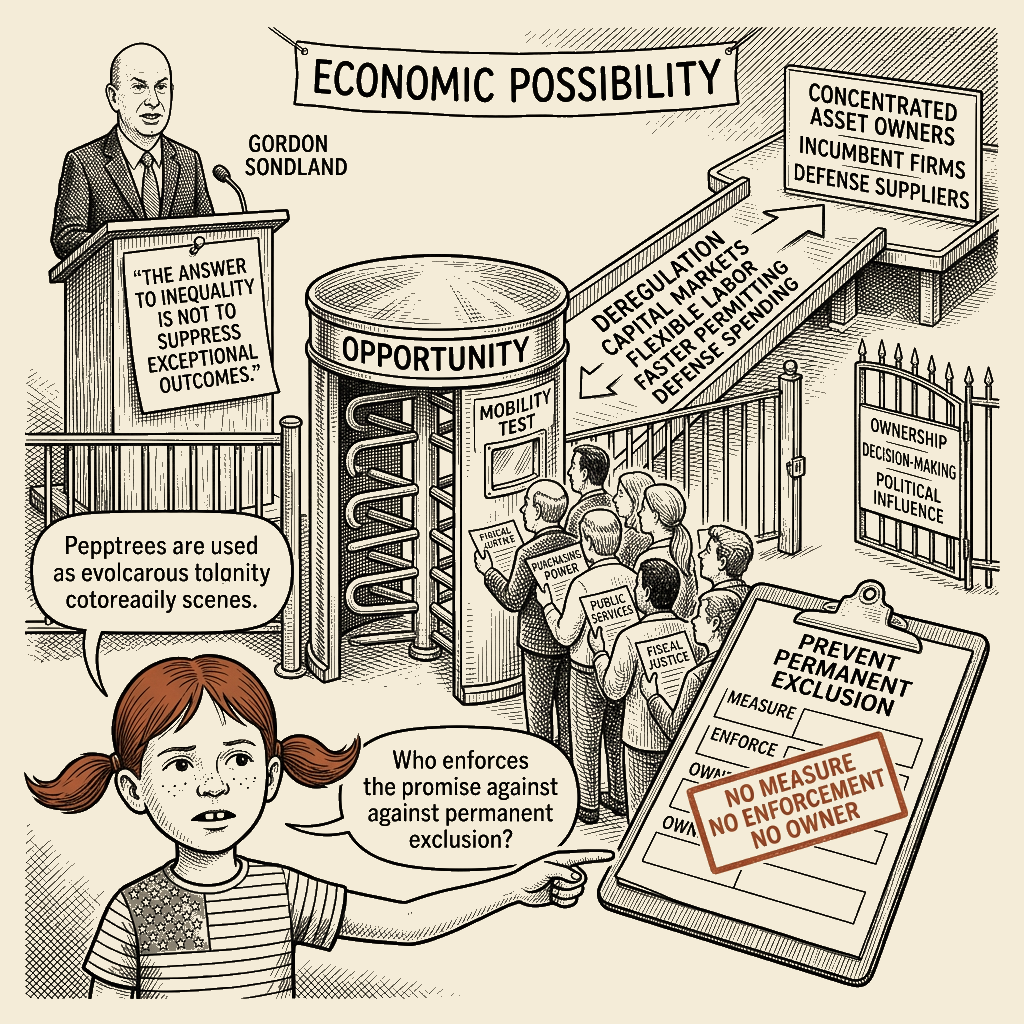
Who enforces the promise against permanent exclusion?
What the Piece Argues
The piece attributes Europe’s protests and unrest to a deeper economic model that protects existing arrangements, restricts innovation and fails to generate enough growth. It calls for European deregulation, capital-market integration, labor flexibility, faster permitting, affordable energy and substantially higher defense spending, presenting the United States as a more adaptable system built around reinvention and individual opportunity. At home, it warns Americans not to copy Europe’s rigidities and argues that inequality should be addressed by preventing permanent exclusion rather than by suppressing exceptional wealth.
Receipts
The framing wants you to believe that preserving individual opportunity is enough to make extreme economic concentration legitimate.
- The talking point: “The answer to inequality is not to suppress exceptional outcomes.”
- The lie: The line quietly makes exceptional wealth the default and forces critics to prove their worth before the distribution of wealth, power and political influence is examined at all.
- The truth: Mobility and concentration are separate questions. A society can remain nominally open at the bottom while ownership, decision-making and political influence harden at the top. The piece supplies no comparative evidence on either side of that claim — no data on U.S. mobility, on permanent exclusion in America, or on European inequality — only anecdotes from European executives, favorable national examples and a hypothetical defense-spending scenario.
- The source’s own answer: It supplies one — “prevent inequality from becoming permanent exclusion.” No measure of exclusion, no enforcement mechanism, no owner. That is a promise, not a constraint.
- Who benefits: Concentrated asset owners, entrenched businesses and incumbent firms benefit when economic mobility becomes the sole test of legitimacy. Defense suppliers and governments benefit from turning Europe’s fiscal strain into a case for still higher military spending.
- The mechanism: The piece replaces protesters’ demands for purchasing power, public services and fiscal justice with regulatory flexibility, integrated capital markets, cheaper capital, flexible labor, faster permitting and more defense expenditure.
- The omitted fact: It acknowledges American failures involving housing, health care, education, inequality, bureaucracy and institutional trust, but never explains how those failures coexist with the supposedly superior American model.
- Anchor: Gordon Sondland, “France is burning, Europe’s broke, and the revolution it really needs isn’t violent,” Fox News, October 26, 2026.
The Response Ladder
Polite Reframe
When to use: When you want to challenge the argument without letting its vocabulary set the terms.
The quoted line would be persuasive if the piece had demonstrated that Americans enjoy substantially more genuine mobility than Europeans and that reducing concentrated wealth would make opportunity less likely. It demonstrates neither. Instead, it shifts the question from whether extraordinary fortunes are compatible with a healthy society to whether another person might theoretically start a business, then leaves ownership, inherited power and political influence outside the ledger.
The article’s own concession supplies the proper test: when “wealth and power become permanently concentrated” and children born into poverty have little realistic prospect of advancement, the system “betray[s] the very principles that make American capitalism work.” Its own remedy is explicit too: “prevent inequality from becoming permanent exclusion.” Fine — then measure it. What counts as permanent exclusion, by what metric, enforced by whom, and with what consequence for the fortunes already accumulated? A program built around deregulation, liberalization and additional defense spending may improve conditions for some investors and employers, but it does not answer the protesters’ stated demands for purchasing power, protected public services and fiscal justice. If mobility is the objective, make it measurable rather than rhetorical — and stop treating a door marked “opportunity” as proof that the people outside it have equal access to what lies behind it.
Mockery and Ridicule
When to use: When you want to puncture the startup sermon without sounding huffy.
The article calls Europe’s unrest a demand for “economic possibility,” then hands the powerful a manual titled How to Keep the Money. Its executive witnesses say Europe cannot innovate, so Europe must become more like America. Its prescription is to liberalize, deregulate, merge markets, make labor flexible, speed permits and spend more on defense. Then, if anyone asks why those choices keep widening the distance between the winners and everyone priced out, the article points to the possibility that you might someday start a company.
Congratulations! The safety net is apparently less inspiring than a stock option.
“The answer to inequality is not to suppress exceptional outcomes” is a lovely sentence, provided the permanently excluded can admire it from outside while the exceptional outcomes remain exceptional. And the cure — “prevent inequality from becoming permanent exclusion” — has no metric, no enforcement mechanism and no owner, which is how most cures get written when the patient is the powerful.
Nuclear Satire
When to use: When the point needs to be made so sharply that the argument becomes embarrassing on its own terms.
The European Recovery Commission has unveiled Plan Renaissance. Phase One: commission a survey of American executives to discover that Europe is too complicated to invent things in. Phase Two: dismantle decades of social commitments because chief executives need to “move faster.” Phase Three: place 4% or 5% of GDP on defense in the thought experiment the article never finishes. Phase Four: if citizens object, ask whether they have considered starting a company. Phase Five: establish a Commission on the Prevention of Permanent Exclusion, staffed by the Commission on the Prevention of Permanent Exclusion, to report on the prevention of permanent exclusion. Its first finding: the problem is paperwork.
The commission has no membership list, cost estimate, comparative mobility data or delivery schedule, because urgency does not tolerate dissent and paperwork is one of Europe’s problems.
Protesters demanding purchasing power, protected public services and fiscal and social justice will be directed to a new Mobility Portal, where they can upload a startup idea and select a motivational slogan. Those without capital, housing, time or a network will be instructed to stop making excuses. The revolution is nonviolent because dissent has been converted into a seminar.
Profane Scorched-Earth
When to use: When euphemism has failed and the reader needs the contradiction dragged into daylight.
That bullshit line—“The answer to inequality is not to suppress exceptional outcomes”—is a hall pass for billionaire worship.
The article knows America has housing, health-care, education, inequality, bureaucratic and institutional-trust crises. It calls the same system dynamic anyway because entrepreneurs allegedly move faster here than in Europe. Then it says Europe should deregulate, liberalize and spend more on defense, as if the people whose public services are being cut had a hand in choosing that package.
Economic mobility is not a magic eraser for concentrated ownership. You can let somebody start a bakery while giant investors control the building, the utilities, the seed supply and public policy. That is not opportunity; that is a funhouse mirror that calls privilege mobility. Fuck the bootstrap mythology sold as a substitute for social insurance.
And the promised cure — “prevent inequality from becoming permanent exclusion” — comes with no measure, no enforcement mechanism and no owner. That is not a policy. That is a prayer with better branding. And if your answer to mass anger is a TED talk about reinvention while the safety net burns, don’t be shocked when the streets answer back. Fix the damn system—or stop preaching capitalism like it’s a sacrament from a yacht.

About Malcolm Little King
Malcolm Little King is a heteronym in Main Street Independent's editorial architecture — an analytical voice, not autobiography of any actual person. The position this column expresses is the publication's position on the territory Malcolm Little King's lane covers, rendered through Malcolm Little King's register.