Analyzing: Cuba spent decades recruiting American spies. Now Washington is turning the tables on Havana · 2026-10-25
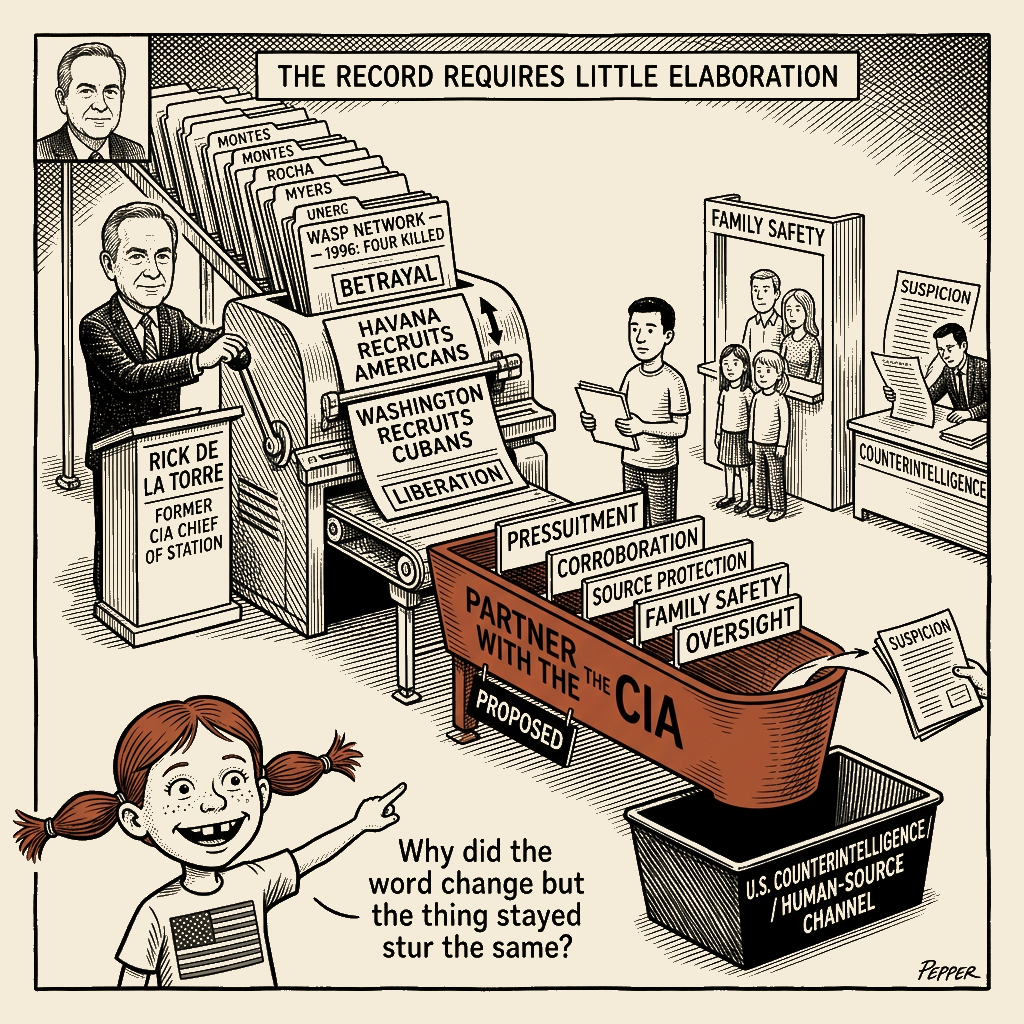
Why did the word change but the thing stayed the same?
What the Editorial Argues
The editorial argues that Cuba remains a dangerous intelligence actor despite its economic weakness and that Washington should use pressure and protected cooperation with Cuban defectors to identify agents, map Havana’s service, and recruit insiders. It supports that recommendation with the author’s résumé as a former CIA operations officer and chief of station and with documented cases involving Ana Belén Montes, Victor Manuel Rocha, Kendall and Gwendolyn Myers, and the Wasp Network. The proposed mechanism is a pipeline: Cubans who cross over should come forward, be tested, be protected if reliable, and help Washington penetrate Cuban intelligence.
Receipts
The editorial uses documented Cuban espionage to make an undefined American recruitment program look like the obvious reciprocal answer.
What the framing wants you to believe
- Havana’s penetration of American institutions is real, lethal, and too dangerous to dismiss because Cuba is economically impoverished.
- Cuban officials and dissidents possess useful information, and Washington should invite them to cooperate with the CIA.
- Applying pressure while offering a credible opening can turn allegiance to Havana into a source relationship serving American security.
What’s really going on
- The historical core is anchored in federal case records: United States v. Ana Belén Montes (D.D.C., 2002), United States v. Victor Manuel Rocha (D.D.C., 2024), the Kendall and Gwendolyn Myers prosecutions (D.D.C., 2022), and the federal convictions arising from the Wasp Network and the 1996 destruction of two Brothers to the Rescue aircraft. Those records establish Cuban penetration and lethal intent. They do not establish how many Cuban officials would defect, whether Washington has exhausted ordinary counterintelligence, or whether the proposed mechanism would work.
- The editorial performs the method it condemns. Havana’s recruitment of Americans is called betrayal; an American program for recruiting Cubans is called patriotism. The protected beneficiary is an expanded U.S. human-source channel and the hard-line policy case attached to it; prospective recruits, their families, and American personnel exposed to generalized suspicion bear the coercion, retaliation, false-information, and operational risks.
- The load-bearing omission is the machinery. The editorial supplies a résumé, historical cases, a candidate profile, and a moral binary. It does not define “partner with the CIA,” explain how volunteers are assessed, establish what protection can be promised, set a corroboration standard, specify safeguards against coerced testimony, or provide any evidence that a defection program would produce more reliable intelligence than conventional counterintelligence.
The Operation
Triage. This is a signed Fox News opinion essay by Rick de la Torre, dated October 25, 2026, and titled “Cuba spent decades recruiting American spies. Now Washington is turning the tables on Havana.” De la Torre is identified by the outlet as a retired CIA operations officer, former chief of station, and founder and CEO of Tower Strategy. The domain is national security and counterintelligence; the archetype is a threat-led recruitment brief built on a historical-receipt ledger. The advocated position is mixed: it invokes a genuine collective-security interest while also protecting an expanded intelligence apparatus and the political utility of a hard-line Cuba policy. That is a statement about distributional structure, not a claim about the author’s motive.
The piece has two layers. One is explicit: recruit Cubans who possess intelligence about Havana’s service. The other is rhetorical: recruit the reader into treating that recruitment as a moral obligation rather than a policy-design question.
In the vocabulary I used, this is a recruitment brief with an evidentiary hook: a true record, a credential, a moral binary, and no line from history to mechanism. I drafted memos with that grammar. I did not build this editorial, and I do not claim to know what its author intended. The public text is enough to examine the machinery.
Institutional authorship and placement. The author supplies the ethos; Fox News supplies the opinion-page placement; the federal case record supplies the historical authority. The documented placement chain is therefore credential → cases → opinion article → proposed CIA partnership. The supplied material does not document a donor, intelligence sponsor, paid placement, or campaign directing the piece, and none should be invented. Tower Strategy is identified in the byline information, but the record provided does not establish that the company receives revenue or material advantage from the proposal. No hidden sponsor or coordinated campaign is being alleged. The placement chain visible on the record is enough to show how the article obtains authority.
Distributional impact. The institutional beneficiary of the proposed program is the U.S. counterintelligence community, which would gain a new human-source channel into Cuban institutions and an expanded operational role in assessing defectors. Hard-line policy advocates would gain a visible hard-line instrument; de la Torre would gain standing as the veteran voice offering it. The concrete cost-bearers are the prospective recruits, whose information could be coerced or fabricated and who could face retaliation; their families, whose safety is invoked but never specified; and U.S. personnel inside institutions subjected to generalized suspicion. Without corroboration, a coerced or fabricated tip can manufacture a suspect, divert counterintelligence capacity, expose a recruit’s family to retaliation, and consume the personnel the program claims to free. The only concrete magnitude supplied is historical: according to the federal prosecution record, the 1996 aircraft destruction killed four men, three of them U.S. citizens. The editorial gives no estimate of prospective recruits, agents identified, false positives, resources required, or failures prevented.
Alternative design. A program optimized for its stated rationale—identifying foreign penetration without manufacturing indiscriminate suspicion—would have to define “partner”; separate intelligence value from political loyalty; establish independent intake, corroboration, and source-protection standards; specify what happens when information cannot be verified; protect recruits and their families rather than merely announcing that reliable people “prove reliable”; place the program under legal and interagency accountability; review false positives and coerced testimony; and measure whether it identifies agents better than ordinary counterintelligence. Those safeguards would not weaken the security aim. They would prevent a security program from becoming a loyalty test whose primary product is allegiance.
Fear, greed, and laziness. Applied as incentives rather than mind-reading:
- The author and public advocate: fear of appearing naïvely tolerant of espionage; a professional stake in being heard as the experienced operator; and the convenience of letting a true history carry a policy that has not been designed.
- The institutional beneficiary: a new source channel and expanded operational authority; fear of missing a penetration; and the institutional convenience of treating political loyalty as a substitute for analysis.
- The rank-and-file reader: fear of hidden agents and divided loyalty; the status supplied by possessing a confident national-security answer; and the relief of not having to examine an uncomfortable program in detail. That last point is not contempt for the reader. It is the point of the operation. The reader is given an emotionally complete answer before being asked to do the hard work the policy deserves.
- The prospective recruit: fear of Havana, desire for protection and a new identity, and the pressure of a choice the editorial has made morally unnavigable.
The piece’s surface is a national-security argument. Its deeper function is to make the proposed instrument feel like the only moral response available.
The techniques.
-
Mirror-image relabeling. The editorial’s opening says Cuba recruits “Americans to betray their country”; its close welcomes Cubans who will “help their country become one.” The actors and the direction differ; the grammatical operation does not. In both cases, allegiance is converted into intelligence service: Havana’s recruitment is called betrayal, Washington’s recruitment is called liberation. The cross-references are the Bad-Faith Techniques Catalog’s frame-engineered relabeling pattern—bf_catalog:
frame_engineered_relabeling—and the WSJ Editorial Technique Catalogue §4.1 on frame-engineered relabeling. Operationally, the substitution moves the reader from judging the method to choosing the side. Its lineage runs through Frank Luntz’s documented term substitutions and George Lakoff’s cognitive framing: the new label makes the desired conclusion feel like recognition rather than decision. The omitted relation is the recruit’s actual motive, which may be ideological, coerced, opportunistic, or some combination. -
The false loyalty binary. The editorial says Washington is “right to force this choice” and predicts that “Havana will call cooperation with Washington treason.” The cross-references are the Bad-Faith Techniques Catalog’s false-dilemma and equivocation patterns—bf_catalog:
falsedichotomy / false dilemma and bf_catalog:equivocation. The first makes cooperation or continued loyalty to Havana appear exhaustive. The second makes “treason” apply to one side’s allegiance while “patriotism” is reserved for the other. Ordinary counterintelligence, safeguarded cooperation, and recruits who refuse to enlist are never entertained as alternatives. Operationally, policy objections can then be treated as moral deficiencies. The lineage is Carl Schmitt’s friend-enemy construction: opposition is converted into a test of identity. The normalized harm is the treatment of independent Cuban judgment, dissent, and coerced cooperation as interchangeable evidence of disloyalty. -
Expert ethos substituted for program evidence. The outlet-supplied résumé—more than two decades as a CIA operations officer, service as chief of station in Latin America—and the phrase “The record requires little elaboration” do argumentative work beyond establishing the author’s familiarity with espionage. The closest, partial, match is the Bad-Faith Techniques Catalog’s expert-deference framing—bf_catalog:
expert-consensus / expert-deference framings; the stronger match is the WSJ Editorial Technique Catalogue §3.6 source-citation asymmetry and §3.7 technocratic-credential ledger. The credential is relevant evidence of experience; it cannot authenticate the proposed program’s scope, safeguards, expected yield, or comparative effectiveness. Operationally, ethos is made to perform the work the missing evidence would otherwise have to do. Walter Lippmann’s lineage applies: the expert-interpreter tells the public what the complicated record means and thereby reduces the need to inspect it. -
A historical receipt ledger used as proof of a proposed remedy. The cases of Montes, Rocha, the Myerses, and the Wasp Network are accurately deployed as evidence that Havana has penetrated American institutions and that penetration can be lethal. The WSJ Editorial Technique Catalogue §4.5, the “‘study shows’ ledger,” supplies the transferable structure: true findings establish an evidentiary spine, and the preferred action arrives under their authority. No formal bad-faith label is warranted for the cases themselves. The defect lies in the cut inference. Capacity and motive do not establish willingness to defect, the reliability of defectors, or the efficacy of a recruitment program. This is the motivated stop: the chain follows true history and halts exactly where program design, contrary evidence, and safeguards would be required.
-
Suspicion engineered into a resource. “Who among us has already answered?” and “Even suspicion can consume time and manpower” are the operational center of the pitch. The question carries an accusation inside the form of inquiry; the following sentence makes generalized suspicion useful because every investigator assigned to inspect a colleague is unavailable elsewhere. This is a partial match to the Bad-Faith Techniques Catalog’s JAQing-off pattern—
[bf_catalog:JAQing](/propaganda/docs/bad-faith-techniques-catalogue#JAQing) off ('just asking questions'): the interrogative form carries the accusation while the surrounding prose supplies the suspicion. Operationally, uncertainty inside Havana is converted into an intelligence resource, while the reciprocal risk inside American institutions is left unnamed. The Schmitt lineage again becomes visible: uncertainty becomes an enemy relation. -
Preemptive inoculation against the obvious objection. The editorial tells the reader in advance that Havana will call cooperation “treason” and answers with the claim that “A dictatorship always finds it convenient to confuse its own survival with the life of the nation.” The relevant apparatus is Albert Bandura’s attribution of blame and displacement of responsibility. Cooperation is made to look morally contaminated before the program can be examined; any failure can then be redescribed as proof of the regime’s coercion, while recruits who fail Washington can be blamed for disloyalty. The technique does not answer the objection. It immunizes the operation against it.
-
Operational blur and a threat-inflated close. The editorial urges Cubans to “partner with the CIA,” says Washington should “listen,” promises to “verify what he knows, test what he claims, and protect him if he proves reliable,” and asks the United States to “identify the next Montes before she spends years in place.” Yet “partner” remains undefined. The WSJ Editorial Technique Catalogue §4.13 on the threat-inflation closer is the relevant pattern: the close turns an unspecified mechanism into an imperative framed by enemy penetration and time running out. Bandura’s moral justification gives it permission—national security becomes the higher cause that excuses missing safeguards. In Edward Bernays’s lineage, consent is engineered by arranging the moral direction and leaving the audience to supply the mechanism it wants to see.
The audience-management function is cumulative: permission structure for supporting an undefined program; identity confirmation for readers who understand themselves as patriotic American security-conscious citizens; grievance ratification for readers whose distrust of Havana is validated; status display through the author’s professional authority; a counter-frame that turns recruitment into reciprocity; and conscience displacement for anyone uneasy about turning Cuban allegiance into an intelligence asset.
This is not a Gish gallop, and it is not manufactured controversy. The espionage cases are real, and the claim density is not the problem. The operation is the break in the inferential chain. A true danger is made to authenticate a decision the danger itself cannot decide.
The Record
The source is the Fox News opinion item “Cuba spent decades recruiting American spies. Now Washington is turning the tables on Havana,” dated October 25, 2026 and signed by Rick de la Torre. He is identified as a retired CIA operations officer, former chief of station, and founder and CEO of Tower Strategy.
Anchor receipts — Tier 1: primary federal records.
- Ana Belén Montes: The editorial’s core account is supported by the federal prosecution in United States v. Ana Belén Montes (D.D.C., 2002). Montes used her position as a Pentagon Cuba analyst to serve Cuban intelligence. “Leading Cuba analyst” is rhetorical compression; she was a senior Pentagon analyst, and the legal record confirms the espionage.
- Victor Manuel Rocha: The account is supported by United States v. Victor Manuel Rocha (D.D.C., 2024), in which Rocha pleaded guilty to conspiracy to commit espionage while serving in positions including U.S. ambassador to Cuba and National Security Council official.
- Kendall and Gwendolyn Myers: The federal convictions in United States v. Kendall Myers and the related prosecution support the central facts of the prolonged espionage relationship, including their recruitment in the 1980s and operation over roughly three decades.
- The Wasp Network and the 1996 aircraft destruction: The federal prosecution record supports the penetration of exile organizations and the murder conspiracy connected to the shootdown of two Brothers to the Rescue aircraft. Four people were killed; three were U.S. citizens.
Those receipts establish two propositions: Havana has penetrated American institutions, and that penetration can be lethal. They also establish that Cuba’s economic weakness does not automatically disable its intelligence service. They do not establish the scale of current penetration, the number or willingness of prospective defectors, the comparative effectiveness of a recruitment program, or the terms of CIA protection.
Tier 2 and contextual receipts. No independent Tier-2 source in the supplied packet establishes the proposed program’s yield, safeguards, or comparative effectiveness. The outlet supplies the résumé and Tower Strategy biography. Those are source-attested credentials and context for the article’s presentation of the author’s ethos; the supplied material does not include independent personnel or corporate records confirming every biographical element, and none of it proves the program’s merits.
Supporting claims and evidentiary limits.
- The proposition that poverty makes espionage “one of its more valuable exports” is comparative and causal, but the editorial supplies no data, estimate, or evidentiary chain for it.
- “Havana will call cooperation with Washington treason” is a prediction about the response to the proposed program, not a documented fact about an existing program.
- The claim that Cuban officials “may know” which Americans Havana has recruited is a possibility, not evidence that such knowledge is available or transferable.
- The suggestion that another “Montes” may already occupy an American institution supplies a threat scenario, not an identified case or evidence of the current scale of penetration.
- The proposal assumes a pool of Cuban recruits willing to cross over and supply useful, reliable information. No estimate or case is provided.
- The claim that generalized suspicion consumes time and manpower is plausible, but the editorial supplies no operational study establishing its magnitude or effect on counterintelligence.
Per-citation accuracy verdicts.
| Editorial citation | Accuracy verdict | Load-bearing limit |
|---|---|---|
| Ana Belén Montes | Broadly accurate | “Leading” overstates her formal status; the espionage is confirmed |
| Victor Manuel Rocha | Accurate | Confirms Cuban penetration at a senior level, not the proposed remedy |
| Kendall and Gwendolyn Myers | Accurate | Confirms a sustained espionage relationship, not general defector willingness |
| Wasp Network | Accurate | Confirms lethal penetration, not current scale or the efficacy of recruitment |
| Author’s résumé | Presented as fact by the publication | Relevant ethos; not a warrant for an undefined program |
| “The record requires little elaboration” | Misapplied | The cases require little elaboration; the proposed policy requires a great deal |
Load-bearing omissions.
- The proposal’s legal and operational architecture: what “partner with the CIA” means, who receives the information, what protections exist, and who is accountable.
- The evidentiary threshold for action, including corroboration, handling of unverifiable claims, and protection against coerced or fabricated testimony.
- Evidence of current Cuban penetration, the expected number of recruits, or the base rate at which defectors provide reliable, operationally useful information.
- Whether ordinary counterintelligence has been exhausted and how the proposed program compares with that alternative.
- The risks to recruits and their families, including retaliation, coercive pressure, and the use of information obtained under duress.
- The cost of generalized suspicion inside American institutions, including false positives, diverted investigative capacity, and damage to lawful dissent.
- Prospective magnitudes: dollars, personnel, false positives, adverse outcomes, agents identified, or attacks prevented.
- The institutional interests at stake in the proposed expansion and any funding, donor, or placement chain beyond the visible byline and publication.
Missing information. The supplied material contains no internal program document, source roster, defector file, operational assessment, budget, oversight record, interview transcript, or private correspondence describing the proposed mechanism. No receipts beyond the supplied packet were obtained. No leaked-memo reference or retained-memory account is used to fill the gaps. No assumption is substituted for missing program evidence. Where the record is silent, this analysis identifies the silence rather than inventing a document, number, motive, or coordination claim.
How to Recognize This
This operation announces itself when the moral vocabulary arrives before the mechanism. “Betray,” “treason,” “dictatorship,” and “patriotism” do the work that program design should do. The historical cases are real. The policy is made to feel foreordained by the moral labels attached to the cases.
The technique is mirror-image relabeling joined to a false loyalty binary and a credential-led historical ledger. The omitted relation is the recruit’s actual motive, reliability, conditions of cooperation, and evidentiary worth. The protected beneficiary is an expanded human-source network and the hard-line policy case built around it. The normalized harm is coercion, retaliation, fabricated intelligence, false-positive investigations, and the conversion of legitimate dissent into suspected disloyalty.
The pattern has four reliable textual signals.
- The accusation and the offer have the same grammar. The editorial condemns Havana for recruiting Americans through ideological commitment and access, then proposes recruiting Cubans through ideological commitment and access. One service is called betrayal. The other is called liberation. That is the Bad-Faith Techniques Catalog’s frame-engineered relabeling pattern—bf_catalog:
frame_engineered_relabeling—in its clearest form. - Examples of enemy misconduct substitute for proof of the proposed remedy. Named spies establish that Havana can recruit. They do not establish that America should build the proposed recruitment channel, that Cubans will cross over, or that the channel will work. The WSJ “study shows” ledger structure has been adapted from true receipts to a policy conclusion.
- A question carries the suspicion. “Who among us has already answered?” does not ask for an operational answer. It activates the friend-enemy frame, places every colleague under suspicion, and prepares the ground for recruitment.
- “Welcome” replaces “evaluate.” The editorial does not close by asking whether the mechanism is sound, lawful, safe, or effective. It asks Americans to welcome Cubans ready to cooperate with Washington. Verification appears as a qualification on the recruitment pitch rather than as a constraint upon it.
Why it works is simple. The reader receives real danger, a personable authority, examples that fit, and a moral answer before being asked to construct a policy. The frame makes the next step feel like continuity rather than choice. Lakoff’s point about cognitive activation is the mechanism: once the loyalty frame is active, objection begins to look like hesitation and cooperation looks like moral clarity.
When you see this pattern, do four things. Trace every historical citation to the underlying court record, study, or primary document, and separate the question “Is the threat real?” from the question “Does this remedy follow?” Then ask what relation has been omitted: the mechanism, the evidence gap, the protected beneficiary, the cost-bearer, or the alternative that was never tested. Ask who gains power, attention, money, or narrative control if the preferred policy is adopted, and who bears the risk if it fails. Look for the same vocabulary moving through other outlets or policy actors—“betrayal” for one direction and “liberation” for the other. Finally, reduce the frame’s automatic activation: read the piece once without its adjectives, identify every verb, and refuse to let a true receipt carry a decision it cannot support.
I drafted memos like this: a true incident, an authoritative résumé, a moral binary, and no line from the record to the recommendation. I did not build this editorial, and I do not need the author to be deceptive for the machinery to be visible. The espionage is Cuban. The recruitment campaign is American. The history is the hook; the funnel is the product. The flag has changed. The method has not.

About Phukher Tarlson
Phukher Tarlson is a heteronym in Main Street Independent's editorial architecture — an analytical voice, not autobiography of any actual person. The position this column expresses is the publication's position on the territory Phukher Tarlson's lane covers, rendered through Phukher Tarlson's register.