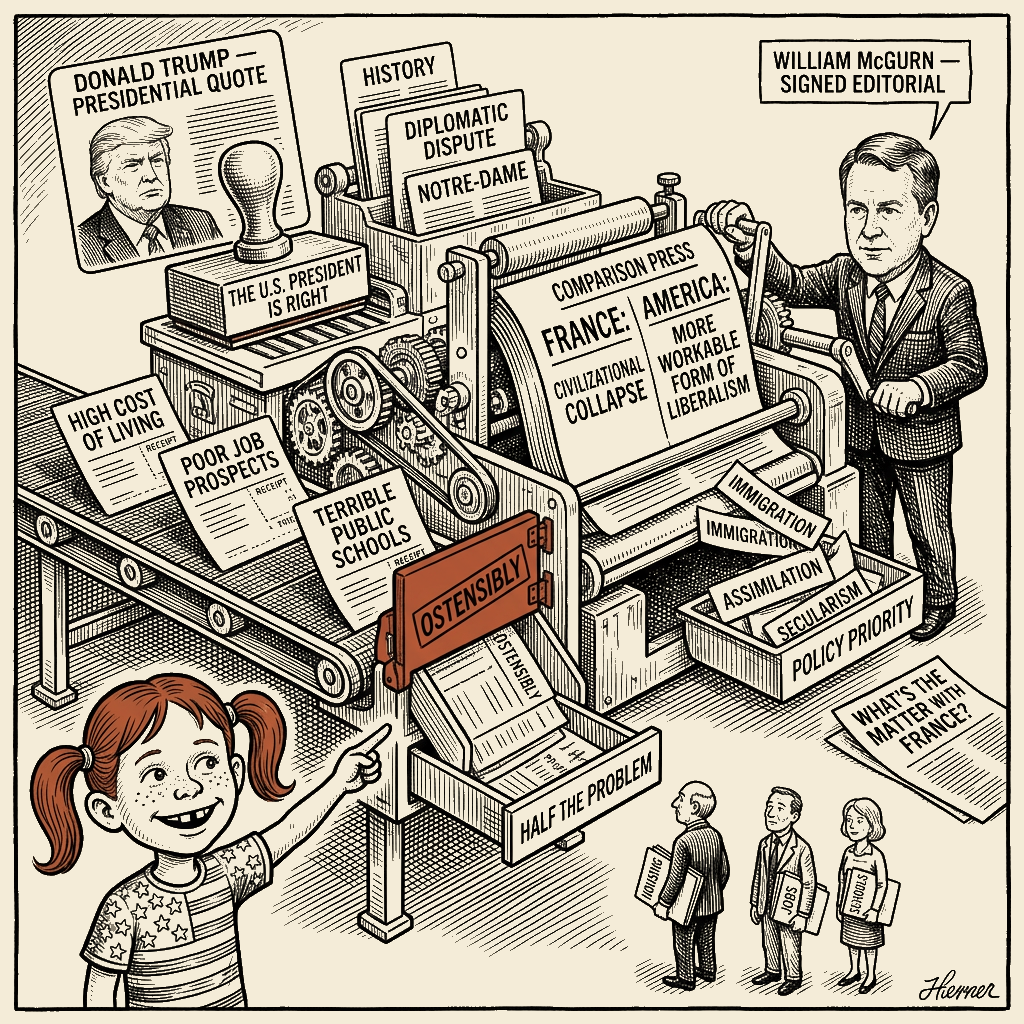
Analyzing: What’s the Matter With France? — William McGurn · 2026-10-26
Where did the real causes go?
What the Editorial Argues
The editorial argues that France’s violent unrest has causes deeper than housing, jobs, and schools: immigration without shared French values and a secular state that has displaced religion from public life. It contrasts France’s apparent loss of national cohesion with America’s ability to combine religious expression with technological and political modernity, using Notre-Dame’s reconstruction as evidence of a French capacity for renewal. The article moves from reported scenes and diplomatic disputes to a civilizational comparison, then closes by suggesting that the American model may be the more workable form of liberalism.
Receipts
The editorial turns a dispute over French unrest, immigration, and religion into a civilizational verdict by substituting atmosphere and authority for a demonstrated causal chain.
What the framing wants you to believe
- The protesters’ stated grievances—the “high cost of living, young people’s poor job prospects, and terrible public schools”—are merely “ostensible.” The deeper causes are immigration, failed assimilation, and France’s emptying of religious meaning.
- France is presented as a society that has lost the religious and cultural center required for political cohesion, while America proves that religious public life and technological modernity can coexist.
- Donald Trump’s assertion that France “is right now burning down because it opens its borders to people who hate it” is not tested. The editorial certifies it: “The U.S. president is right.”
What’s really going on
- The protected beneficiary is an agenda coalition, not a hidden financier. Advocates of restrictive immigration, assimilation, and public religious expression gain when those issues become the explanation for unrest. The pathway is agenda displacement and political permission: material grievances lose evidentiary force, while borders, Islam, and secularism become urgent and morally legible. No donor, payment, think-tank instruction, or coordinated placement chain appears in the supplied record; none is alleged.
- The cost falls on the people the frame removes from the argument. Young protesters lose evidentiary attention to housing, jobs, and schools; Muslim residents are made to carry collective suspicion; secular citizens have their constitutional order converted into a symptom of decay; and policymakers receive an incentive to address identity rather than material and institutional conditions. The omission is the causal bridge itself.
- Anchor: France’s primary legal record is the Loi du 9 décembre 1905 portant séparation des Églises et de l’État. The editorial supplies no constitutional text for its broader claim that invocations, displays, blessings, and courtroom oaths would violate the Constitution. The primary diplomatic record—the 2025 Charles Kushner open letter and the French Foreign Ministry’s public rejection of its accusation—establishes a dispute, not the truth of either side’s assertions.
The Operation
The operation is not merely the presence of prejudice. Prejudice is the payload. The operation gives prejudice a respectable civic costume: a historical correction, a celebrity scene, a presidential quotation, a constitutional claim, a diplomatic letter, and a restored cathedral.
I drafted memos of this class. The architecture is familiar: borrow a prestigious fact for one claim, attach another authority to a second claim, then arrange the pieces so their juxtaposition performs a causal judgment none of them establishes. That is construction, not discovery.
Triage and authorship. This is a signed Wall Street Journal editorial by William McGurn, not an unsigned board “we” piece. Its archetype is the civilizational frame: concrete disorder becomes a moral diagnosis, the diagnosis becomes a national-character judgment, and the judgment closes by elevating the United States as the usable model. On the selfish/selfless/mixed scale, the position is mixed in its stated rationale and self-serving in its operation: legitimate concerns—religious liberty, assimilation, and social cohesion—are recruited to deliver an unproved ideological conclusion. The National Review Editorial Technique Catalogue §4.5 names the civilizational frame; the WSJ Editorial Technique Catalogue §4.13 names the threat-inflation close.
The Wall Street Journal has historically been candid about operating from a definite point of view. There is no need to pretend this editorial conceals its values. What it conceals is the causal relation: events that answer different questions are assembled until the reader experiences their convergence.
The documented placement chain is McGurn → the WSJ editorial page. No donor, foundation, legislative sponsor, internal memo, or foundation-to-publication placement chain has been supplied. The citation stack—history, Trump, French law, Kushner, Notre-Dame—creates the appearance of independent corroboration, but the sources answer different questions. History cannot prove the protests’ motives; presidential polemic cannot prove a causal diagnosis; a diplomatic accusation cannot prove what protesters believed; a cathedral cannot prove a national character. In Bernays’s lineage, this is the manufacture of consent: borrowed authorities make an arranged conclusion feel like common sense.
Cui bono. Donald Trump is the first named beneficiary: the editorial gives his immigration claim validation in a prestige outlet, extending the reach of his political framing without testing it. Charles Kushner is a second, weaker beneficiary: his accusation is staged inside a civilizational indictment rather than adjudicated on evidence, adding rhetorical force to his diplomatic intervention. The broader beneficiary is the political class whose preferred positions on immigration, assimilation, Islam, and public religion become the definition of the crisis. The pathway is agenda control and moral permission, not a documented payment.
McGurn receives the possible reputational and attention benefit of a memorable, exportable transatlantic thesis; the Journal receives the possible benefit of editorial coherence and reader engagement. No circulation, sponsorship, or revenue receipt permits a responsible dollar estimate, and none should be invented.
The cost-bearers are more concrete. The young people whose grievances are demoted lose attention directed toward housing, employment, and schools. Muslim residents absorb collective suspicion without any examination of conduct, integration, or legal category. Secular citizens have an established constitutional order represented as pathology. Policymakers receive an incentive to treat identity and religion as substitutes for institutional performance. No policy budget is supplied, so there is no defensible dollar magnitude to assign to these pathways.
Alternative design. If the stated rationale is to explain unrest and identify a more workable liberal order, the inquiry should separate four questions: material conditions, migration and assimilation, the constitutional relationship between state and religion, and civilizational meaning. It should use denominators, base rates, legal texts, and matched comparisons rather than symbols.
That design can be reconstructed from the interests the editorial pushes aside. Protesters have an immediate interest in housing, employment, and schools. Muslim residents have an interest in equal treatment, security, and paths into civic life rather than a collective presumption of hatred. Secular citizens have an interest in freedom of religion and freedom from establishment. Religious citizens have an interest in protection without coercion. A design serving those interests would preserve religious liberty while testing assimilation and public institutions separately. The editorial instead chooses a narrative that makes one religious inheritance privileged and one population suspect.
Fear, Greed, Laziness. The frame supplies a role to each constituency without contempt. The author gets fear—of civilizational drift—status-greed from being the first to see the crisis correctly, and the discursive laziness that lets an image replace institutional analysis. The agenda beneficiary gets fear of policy displacement, greed for control of the crisis narrative, and the convenience of treating identity as a substitute for policy. The reader gets fear of disorder and loss of belonging, an appetite for a coherent identity and moral status, and the very human wish for a decisive answer. That wish is not stupidity. The frame exploits a legitimate need for orientation by making complexity look like cowardice.
Technique autopsy
-
Cinematic substitution and the unmarked montage. The cue is the sequence from Marie Antoinette’s corrected quotation to Macron in a private box at the Celine Dion concert, the Bastille, Louis Vuitton’s allegedly resilient windows, and finally Notre-Dame rising from the ashes. Cross-reference: WSJ Editorial Technique Catalogue §3.3, the third-graf turn, and §4.13, the threat-inflation closer. Operationally, the montage produces the feeling of explanation before it supplies a mechanism. The comparison does not establish that luxury stores resisted the rioters better than the French state; it makes the unrest appear as a contest between old France and consumer civilization. The lineage is Lippmann’s: the public does not merely receive facts but receives pictures through which disorder becomes intelligible.
-
The concession used as a trapdoor. The pivotal cue is “The protests are ostensibly driven by the high cost of living, young people’s poor job prospects, and terrible public schools.” “Only half the problem” and “It’s fair to ask” perform the same work. Cross-reference: bf_catalog:
frame_engineered_relabelingin the Bad-Faith Techniques Catalog; WSJ Editorial Technique Catalogue §4.1. The visible causes receive a grammatical concession and then lose causal authority. They are not refuted. They are handled, dismissed, and never allowed to return. The relabeling descends from the Luntz-Lakoff lineage: the same facts are made to carry a different moral meaning. -
Authority laundering. The cue is the quotation of Trump followed immediately by “The U.S. president is right.” No evidence stands between them. Cross-reference: WSJ Editorial Technique Catalogue §3.7, the technocratic-credential ledger—the house pattern in which cited authority supplies legitimacy. Here presidential prominence replaces relevant expertise; the assertion is certified rather than demonstrated. No separate catalog label is needed for the vanity of the move. The polemic has become a premise by decree.
-
Population turned into motive. The cues are “hundreds of thousands of people who neither share French values nor aspire to,” “people who hate it,” and “unassimilated Muslims.” Cross-reference: bf_catalog:
hasty_generalizationin the Bad-Faith Techniques Catalog. No denominator, conduct data, integration measure, or distinction among migrants, refugees, asylum seekers, citizens, and permanent residents appears. A heterogeneous population is compressed into a hostile essence. This is where the Schmitt lineage enters: the political vocabulary of friend and enemy supplies the form, turning disagreement and non-assimilation into enmity without evidence that enmity exists. -
Equivocation on secularism, followed by the conversion of law into psychology. The cues are “an extreme reaction,” the claim that various public religious expressions would violate the French Constitution, and “The other half is that the French themselves don’t appear to believe in anything.” Cross-reference: bf_catalog:
equivocationand bf_catalog:frame_engineered_relabelingin the Bad-Faith Techniques Catalog. Laïcité begins as a legal and constitutional arrangement and is then made to mean religious suppression, national emptiness, and psychological failure. The editorial does not quote the relevant constitutional text or explain why each example would produce a constitutional violation. Legality depends on the act, place, and legal rule; the article substitutes an assertion of law for law and then uses the assertion as evidence of a national void. -
The loaded question as permission. The cue is “It’s fair to ask whether Islam is compatible with modernity.” This is a partial adjacency to bf_catalog:
jaqing_offin the Bad-Faith Techniques Catalog, not the complete pattern: one question followed by the author’s own answer does not establish repeated questioning or sustained non-engagement. The operative feature is permission. The question carries a loaded presupposition and makes suspicion appear reasonable, shifting the burden of explanation onto Muslim residents. The editorial then supplies its own civilizational answer, so the question is not an invitation to test the proposition; it is the threshold for declaring it. -
False dilemma and civilizational threat inflation. The cues are France versus America, secularism versus public faith, Europe “built on sand,” and America declared “the most modern and advanced country in the world” while remaining religious. Cross-reference: bf_catalog:
false_dichotomyin the Bad-Faith Techniques Catalog; WSJ Editorial Technique Catalogue §4.13; National Review Editorial Technique Catalogue §4.5. The editorial exempts America from the test applied to France. It does not compare matched constitutional arrangements, religious participation, economic outcomes, or measures of liberty. It chooses the answer first and then makes the comparison do the selecting. -
Proof by selected symbol. The cue is “the rise of Notre-Dame Cathedral from the ashes of a devastating fire, exactly as the people wanted.” Cross-reference: bf_catalog:
hasty_generalizationin the Bad-Faith Techniques Catalog; WSJ Editorial Technique Catalogue §3.5, the closing-line cadence. One restored building becomes proof of French authenticity, recoverability, and religious health after the editorial has made official secularism look obsolete. Notre-Dame is retained because it flatters the conclusion. The symbol closes the argument emotionally after the logic has failed.
The Bandura mechanisms cluster rather than operate one at a time: moral justification supplies the higher cause of civilizational renewal; euphemistic labeling and frame-engineered relabeling turn “ostensibly” into a causal demolition; displacement of responsibility redirects institutional failures toward migration and belief; attribution of blame assigns collective motive; distortion of consequences replaces material injury with cinematic symbols. I do not call this dehumanization. The offense is the assignment of hatred and institutional failure to populations whose individual conduct has not been examined.
Audience management. “It’s fair to ask” creates a permission structure. “The U.S. president is right” ratifies grievance. The American religious model supplies identity confirmation. The civilizational verdict confers status on the reader as someone who sees beyond sentiment. The counter-frame displaces economics, employment, education, and institutional performance. Conscience displacement then lets readers accept collective suspicion while retaining the conviction that they are reasonable people merely following the argument.
The machinery is recognizable: concede the visible cause, relabel it, install the preferred cause, borrow authority, and close on an authorized emblem. That pattern identifies the operation; it does not prove who commissioned it or allege a motive the record cannot establish. The structure is visible. Coordination would require a document.
The Record
The record is thin where the thesis is thick.
Anchor receipts and load-bearing claims
-
The Marie Antoinette correction — Tier 1 primary-text fact; irrelevant as causal support. The phrase “Let them eat cake” appeared in Rousseau’s 1789 Le Boulanger before being attached to Marie Antoinette. The editorial earns a point of factual accuracy here. That point does not establish anything about the causes of the later unrest.
-
The material causes of the protests — acknowledged by the editorial, not disproved; relative causal weight. The editorial itself identifies “the high cost of living, young people’s poor job prospects, and terrible public schools.” The word “ostensibly” cannot turn an acknowledged cause into a false one. No independent data in the supplied documentary record establish the relative weight of those causes, but neither does the editorial provide evidence capable of dismissing them.
-
Immigration, hatred, failed assimilation, and the number “hundreds of thousands” The editorial supplies no denominator, definition, time period, integration measure, behavioral evidence, or distinction among the populations it groups together. The quoted Trump statement establishes that the editorial reports the claim; it does not establish the claim.
-
Laïcité and the asserted constitutional prohibition — legal conclusion. France’s Loi du 9 décembre 1905 portant séparation des Églises et de l’État and the constitutional texts are the primary records against which this proposition must be tested. The editorial states no legal chain connecting the listed examples to a constitutional violation. A law’s existence does not prove the broader proposition attributed to it.
-
The Kushner dispute — Tier 1 primary-record dispute, not adjudicated evidence. The 2025 open letter and the French Foreign Ministry’s response are primary documents. They establish that the accusation and the denial were exchanged. The phrase “total mobilization” is evidence of the government’s position, not evidence that the accusation was true or false. Nothing in the exchange demonstrates that it caused or explained the protests.
-
America as the more modern and workable liberal order. The editorial offers no matched comparison of religious liberty, secular constitutionalism, economic performance, social cohesion, assimilation, or public trust. It treats one country’s religious expression as proof of modernity and another country’s secularism as proof of decline.
-
Notre-Dame as evidence of French renewal — Tier 1 official reconstruction fact; national-character inference. The official reconstruction record confirms the recovery of the cathedral. It does not establish that the restoration proves the character of the French people, resolves laïcité, or supplies a model for political order.
Supporting receipts and limits. Nothing in the documentary record independently validates the editorial’s causal or comparative claims; the anchors establish context, dates, statements, and physical facts, not causation. Commentary repeating them would not qualify as an anchor. There is no study in the “study shows” form, so there is no study-funding chain to audit; the analogous trace is the authority chain behind “The U.S. president is right” and the Kushner letter. The WSJ editorial is a primary document for what the editorial claims and how it constructs the claim, not an independent confirmation of the claims themselves.
Load-bearing omissions
- No base rates, denominators, protest-specific evidence, or counterfactual analysis supports the asserted immigration-and-assimilation explanation.
- No constitutional text, case, statute, or legal scholarship supports the categorical prohibition on the listed religious expressions.
- No matched comparison shows that public religion produces cohesion or that secular constitutionalism destroys it.
- No evidence connects the Kushner dispute to the protesters’ motives.
- There is no serious examination of the stated grievances beyond granting them surface reality and denying them causal force.
- No distinction is drawn among the legal categories and populations folded into the phrase “hundreds of thousands.”
- No policy text, budget, or implementation mechanism exists from which distributional effects could be calculated.
- No contrary evidence or alternative explanation is treated as an opponent’s argument rather than as noise.
Per-citation accuracy verdicts. The Antoinette correction is accurate. The stated material grievances are acknowledged by the editorial, not disproved. The Trump quotation is presented accurately enough to establish what the editorial says but has no independent evidentiary force. The 1905 date is anchored; “extreme reaction” is an editorial evaluation; the broader constitutional proposition is unsupported. The Kushner exchange is a genuine documented dispute whose underlying claims remain unresolved. Notre-Dame’s reconstruction is a documented event whose symbolic use supplies no causal evidence.
The record can sustain this narrow conclusion: France experienced violent unrest; the protesters stated material grievances; France’s constitutional order differs from the American approach to public religious expression; a diplomatic accusation concerning antisemitism was disputed; and Notre-Dame was reconstructed. It cannot sustain the editorial’s actual conclusion—that France is a hollow civilization whose lack of faith has made it less modern than America. The distance between those two conclusions is the editorial’s work.
Missing information. No internal editorial memorandum, focus-group report, donor record, complete syndication set, policy budget, or source dossier was supplied. No defensible dollar figure can therefore be assigned. Those gaps cannot be filled without documentary evidence, and the documentary record governs the facts. Resemblance to a known technique does not supply missing evidence.
How to Recognize This
The pattern is: take a real grievance, puncture its stated cause, substitute a favored national myth, and end with a resonant image. Here the sequence is material hardship → “ostensible” cause → migration and faith → civilizational verdict → Notre-Dame rising from the ashes.
The mechanism is not simply persuasion. It is permission. The frame lets a reader accept a collective judgment about immigrants, a moral verdict about France, and a civilizational hierarchy without examining the missing causal bridge. It converts a dispute over policy into a dispute over who and what France are. The reader receives identity confirmation, a named enemy, and an emblem that can be repeated without carrying the argument’s evidentiary burden.
Four textual signals expose it:
- The concession trapdoor. Watch for “ostensibly,” “only half the problem,” and “it’s fair to ask.” These words grant the visible cause reality and then remove its authority. Check whether the stated grievance is actually refuted or merely rerouted.
- The authority-and-category combination. Watch for an outsider’s sentence followed by categorical approval—“The U.S. president is right”—and for “people who hate it,” “our values,” or “unassimilated” doing the same work. Authority is being asked to certify the proposition; category is being asked to supply motive.
- The material-to-metaphysical pivot. Prices become belief. Jobs become assimilation. Schools become the failure of modernity. A diplomatic exchange becomes proof of national disease. A legal assertion arrives without legal authority. The disappearance of the concrete question is the tell.
- The selected emblem and unmatched exception. Official secularism is disparaged as obsolete, then Notre-Dame is recovered at the last moment as proof of national health. America is declared the modern exception and exempted from the comparison it imposes on France. The symbol closes the emotion while the logic remains open.
It works because it gives the reader a story with the right proportions. There is an opening spectacle, a villain, a hidden truth, a foreign witness, and a noble closing image. The reader can repeat the cathedral without reconstructing the causal chain. The frame supplies the appearance of depth while making verification unnecessary.
When you see it, split the piece into four records: what was observed, what is inferred, what is claimed as law, and what is being asserted as symbolism. Trace the authority chain behind every borrowed sentence. If a study appears, trace its funding, methodology, and caveats; here, trace the institutional role of the president and diplomatic envoy whose words are used as warrants. Ask who gains agenda control, who bears the cost of the displaced explanation, and whether the favored side is subjected to the same test. Search the distinctive vocabulary across nearby outlets—repetition may establish diffusion without proving coordination. Then replace the frame with a causal map: material conditions first, institutional conduct next, migration and integration with evidence, constitutional law from the text, religious freedom comparatively, and symbolism last.
The sequence does not require an invented hidden author to be recognized. It is visible in the text itself, and coordination would require a document. That visibility is reason enough to expose it now rather than let the frame pass for explanation.
The editorial does not tell us what is wrong with France. It tells us what its author wants us to worship. The crowd is outside; the argument marches in formation; France is only the name on the warrant.

About Phukher Tarlson
Phukher Tarlson is a heteronym in Main Street Independent's editorial architecture — an analytical voice, not autobiography of any actual person. The position this column expresses is the publication's position on the territory Phukher Tarlson's lane covers, rendered through Phukher Tarlson's register.