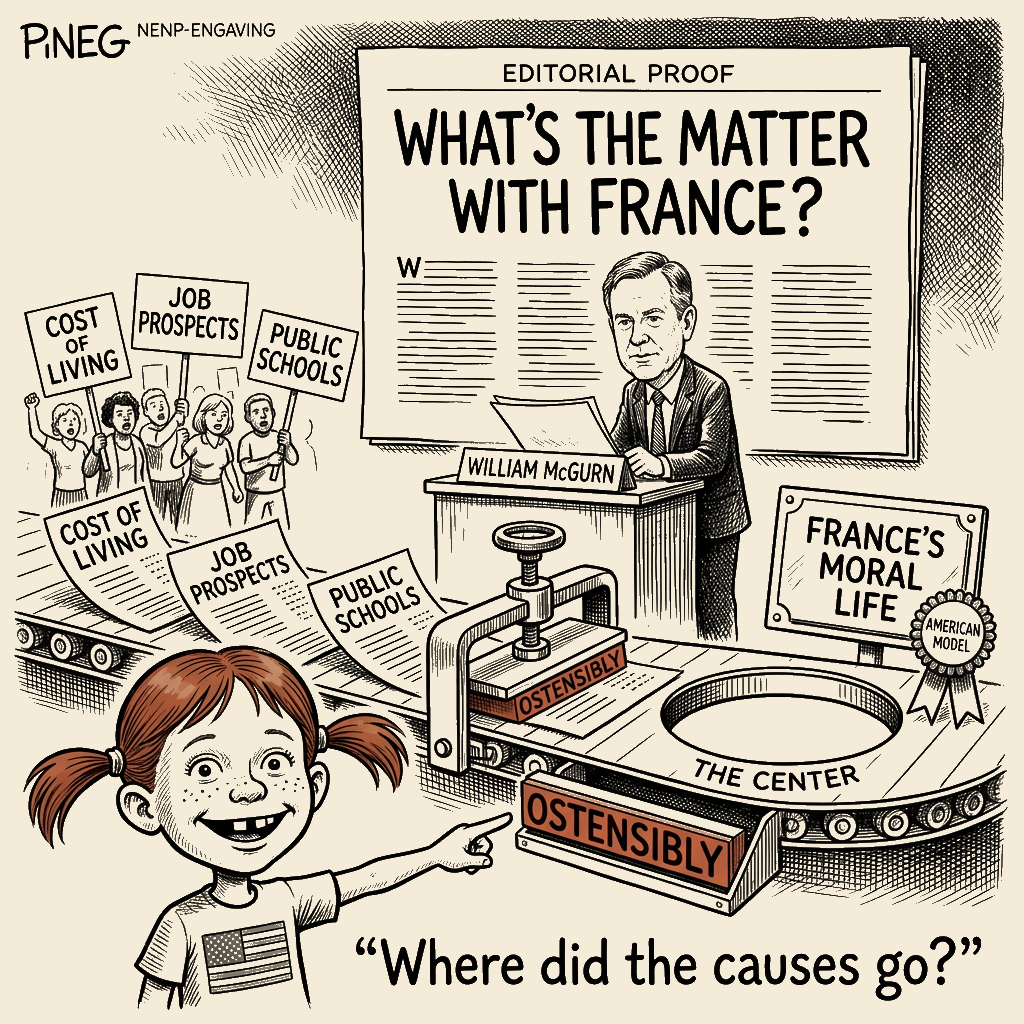
Analyzing: What’s the Matter With France? — William McGurn · 2026-10-26
Where did the causes go?
What the Editorial Argues
The editorial asks what is wrong with France and answers with a diagnosis of the nation’s moral life: having replaced religion with nothing, France has lost the shared public substance that holds a society together, and the unrest is the symptom. It supports that answer by setting the 2025 protests against the cost of living, poor job prospects for young people, and inadequate public schools; by reading the violence through the storming of the Bastille and the Louis Vuitton storefronts that withstood it; by citing President Trump — “France is right now burning down because it opens its borders to people who hate it” — and by holding France’s laïcité regime up against America’s protection of public religious expression. Immigration and assimilation, the rise of antisemitism since Oct. 7, 2023, and the place of Islam in a modern France are folded into the same account, and the piece closes on Marianne, the tricolor, “La Marseillaise,” and Notre-Dame rising from the fire, with the suggestion that France has gone looking for modernity in all the wrong places.
Receipts
The editorial takes a reported set of facts about French unrest and, without producing a single piece of evidence for the connection, converts them into a verdict on France’s soul.
What the framing wants you to believe
- The unrest is not what the crowds said it was. The protests are “ostensibly driven by the high cost of living, young people’s poor job prospects, and terrible public schools” — and “ostensibly” is where the argument stops, because the real cause is installed without evidence: France has lost its faith, “the French themselves don’t appear to believe in anything,” and so “it’s hard for the center to hold.”
- The population is the cause. France has admitted “hundreds of thousands of people who neither share French values nor aspire to”; the editorial supplies no figure, period, category, evidentiary basis, or source for the hatred or the refusal to assimilate.
- America is the working alternative, and the president is the authority. “How is the U.S., the most modern and advanced country in the world, also one of the most religious?” is answered rather than debated: “The U.S. president is right.” Then “maybe the American model is a more liberal and workable order” — and France has been looking for modernity “in all the wrong places.”
What’s really going on
- The beneficiary is not France. This is an advertisement for the American model, and every receipt is selected to make the advertisement legible as a finding. What it sells is the conviction that America’s public religious expression is the load-bearing wall of American society — a conviction that serves the religious-conservative and religious-liberty advocacy economy mapped in the NR Editorial Technique Catalogue §4.9: the Becket Fund, Alliance Defending Freedom, and the Federalist Society pipeline, the opinion-page business that runs this register, and a domestic politics of restoring “America” that the piece never names.
- The load-bearing omission is causal. The editorial names cost of living, youth employment, and schools and never returns to them; it records the dispute between Ambassador Charles Kushner and the French government — Kushner’s letter asserting that antisemitism had “exploded” in France since Oct. 7, 2023, France’s summons of him, and the separately announced “total mobilization” — without adjudicating either side; and it asks “whether Islam is compatible with modernity” before answering a different question entirely. The anchor is the editorial’s own concession on proximate causes and the primary documentary record it declines to test: the 1789 Declaration of the Rights of Man and of the Citizen, Article 10, and Emmanuel Macron’s March 9, 2018, Élysée statement, “Laïcité, la loi de République,” defining secularism as the guarantee of both freedom to worship and freedom not to believe.
- The contradiction it cannot hold: the editorial says France believes in nothing, then closes on Notre-Dame’s restoration “exactly as the people wanted,” alongside Marianne, the tricolor, and “La Marseillaise,” as proof of a living collective will. A theory that can absorb its own counterevidence without changing shape is not engaging France. It is performing France.
The Operation
The Bad-Faith Techniques Catalog is most useful here because this editorial does not merely make a false claim. It manufactures a false causal transit.
Its chain reads: immigration produces disloyal people; disloyal people weaken national solidarity; secularism empties national solidarity of substance; emptied solidarity becomes an empty center; America avoids this condition because it permits public faith. Not one of those hinges is demonstrated. Each is made to look inevitable by placing it beside a vivid fact or borrowed authority.
This is a signed civilizational-frame essay, not a “study shows” ledger. The packet identifies William McGurn as the author but supplies no masthead, so the WSJ and NR cross-references below describe formal and thematic kinship, not provenance. Its topic is immigration, assimilation, antisemitism, secularism, and public religion; its archetype is the NR Editorial Technique Catalogue’s cultural-decline and civilizational frames, repackaged through the WSJ-family third-graf turn and symbol-laden close.
Institutional authorship and placement. The named author supplies the byline. The visible placement chain runs from the byline, through the civilizational diagnosis and presidential authority, to a national-symbol close. The NR Editorial Technique Catalogue §4.9 documents the wider religious-liberty advocacy economy, including the Becket Fund, Alliance Defending Freedom, and Federalist Society pipeline; this essay’s frame advances the same political premise in a new national costume. But the packet does not establish that any of those institutions commissioned, funded, or placed this piece. I will not manufacture a donor chain. The beneficiary is visible without one: the argument supplies ideological coordination, status, and narrative permission to the constituencies already invested in public religious expression as a model of social order.
Distributional impact. The author and outlet gain attention and interpretive authority; religious-conservative and religious-liberty advocates gain agenda legitimacy; conservative political actors gain a civilizational rationale for exclusionary or conformity-oriented policy. The cost-bearers are the people whose material complaints are converted into atmosphere, the migrants and religious minorities made to carry suspicion without data, and the French public whose institutional failures are displaced onto “faithlessness.” No dollar magnitude appears in the packet, so I will not pretend one does. The redistribution here is interpretive and political: the omitted relation is the missing causal bridge between religion, immigration, and unrest; the protected beneficiary is the coalition that gains from the American-model verdict; the normalized harm is the conversion of concrete grievances and minority suspicion into an apparent moral verdict.
Alternative design. If the stated objective is to respond to unrest, the editorial’s own rationale would require investigating housing costs, youth employment, school quality, immigrant integration, antisemitic violence, and the actual operation of secular law. It would compare France with the United States on those outcomes rather than declare one model spiritually healthier in advance. That is not a secular counterpreference. It is the design required by the editorial’s stated goal.
Fear, greed, and laziness. Applied at the level of incentives, not as mind-reading: the author operates in a register where moral clarity earns status, so fear of appearing insufficiently decisive encourages the verdict, while no direct monetary greed is established; attention, ideological coherence, and agenda influence are the available rewards. The beneficiary class fears losing political ground if religious and civilizational frames lose salience and gains power when such frames make exclusion appear merely preservative. The reader’s fear of decline and exposure is real, as is the convenience of accepting a supplied answer, but it should not be sneered at: the reader is not stupid so much as invited to stop doing work the editorial has arranged not to do. Greed is least applicable here; identity, belonging, and status are the stronger reader benefits. Symmetry requires saying that, rather than assigning every constituency the same motive.
Selflessness and selfishness. The placement is mixed. Public order, social cohesion, and democratic legitimacy are legitimate public goods; nothing in that stated rationale is false. The operation becomes interested when it uses those goods to privilege a religious-nationalist model, erase competing explanations, and deliver a verdict whose institutional beneficiaries are never named. There is no evidence of personal profiteering by the author. There is ample evidence of ideological and institutional return.
The opening manufactures analogy. The editorial explicitly corrects the old myth — “Marie Antoinette never said ‘Let them eat cake.’” — and then lets the ancien régime anecdote supply the aura of period authority before the sequence moves to the celebrity concert, the private box, and the violent protests. The Bastille comparison lends the unrest a revolutionary meaning; the Louis Vuitton comparison converts contemporary disorder into the imagery of regime decay. Cross-reference: bf_catalog: red herring; the WSJ Editorial Technique Catalogue §3.3, the third-graf turn, and §3.5, the closing-line cadence. The sequence does not establish cause. It makes historical analogy perform the work of social evidence. The correction is accurate; the legend and the luxury imagery are then recruited as moral atmosphere.
The demotion of the stated causes. Cue: “ostensibly driven by the high cost of living, young people’s poor job prospects, and terrible public schools.” Cross-reference: bf_catalog: frame-engineered relabeling in the Bad-Faith Techniques Catalog — Lakoff on cognitive frames, Luntz on engineered relabeling — with an adjacent bf_catalog: red herring structure. The causes are introduced, conceded, and then dropped. Operationally, this supplies a permission structure: the reader can hold a confident verdict without an evidentiary chain because the material causes have been pre-conceded as appearances. The lineage is Lakoff’s point that a relabeled frame activates a different causal model before the reader has adjudicated cause. This does not prove direct coordination with any Luntz memorandum; it identifies the documented rhetorical form.
Borrowed authority. Cue: “France is right now burning down because it opens its borders to people who hate it,” followed by “The U.S. president is right.” Cross-reference: bf_catalog: red herring; the rhetorical form is the classical appeal to authority, with the endorsement substituting for argument rather than supplementing it. The editorial outsources its evidentiary burden to a politician and then certifies the outsource. Bernays’s lineage matters here: credentialed authorities become campaign vectors, supplying confidence where evidence is absent.
Guilt by association. Cues: the private box at the Celine Dion concert in Nanterre, the Bastille, Louis Vuitton, Kushner, Marianne, the tricolor, “La Marseillaise,” Notre-Dame. Cross-reference: bf_catalog: red herring — Aristotle’s ignoratio elenchi — and the WSJ Editorial Technique Catalogue §3.3 and §4.10, the third-graf turn and the “common sense”/“elite” pivot. The concert is not evidence of what caused the unrest; it is evidence of elite decadence, and elite decadence is then made evidence of national failure. Lippmann’s lineage applies: the public image stands in for the social reality.
A mass with one mind. Cue: “hundreds of thousands of people who neither share French values nor aspire to.” Cross-reference: bf_catalog: hasty generalization in the Bad-Faith Techniques Catalog, following Govier and Walton. There is no denominator, base rate, category, period, or source. The mass is manufactured so a diffuse population can carry concentrated suspicion; the people inside the category are erased so the category can do the work of an argument.
The equivocation on belief. Cue: from the 1905 laïcité regime, described as “an extreme reaction” that “forbids even the mildest form of state accommodation of religion,” to “the French themselves don’t appear to believe in anything.” Cross-reference: bf_catalog: equivocation — Aristotle and pragma-dialectics — with a partial match to bf_catalog: strawman at the second step. “Religion” slides from a legal arrangement governing state and religion into the entire moral life of a population. That equivocation licenses a constitutional rule to be read as a spiritual diagnosis, while the France described by France’s own primary texts is replaced with a more convenient France nobody holds to account.
Pre-loaded questions and a closed field. Cues: “How is the U.S., the most modern and advanced country in the world, also one of the most religious?” and “It’s fair to ask whether Islam is compatible with modernity.” Cross-reference: bf_catalog: false dichotomy / false dilemma and [bf_catalog: JAQing](/propaganda/docs/bad-faith-techniques-catalogue#JAQing) off ('just asking questions'). Both matches are partial rather than complete: the first questions are not formally stated as exhaustive alternatives, and the Islam question appears only once. But the field is still closed. Two questions arrive with only one acceptable answer; the third is never answered at all. The American model arrives preapproved: “maybe the American model is a more liberal and workable order.” In Lakoff’s lineage, the question smuggles the conclusion and then audits the reader for agreement.
A closer made of weather. Cue: Marianne, the tricolor, “La Marseillaise,” Notre-Dame rising from the fire “exactly as the people wanted.” Cross-reference: the WSJ Editorial Technique Catalogue §4.13, the threat-inflation closer, and §3.5, the closing-line cadence; the NR Editorial Technique Catalogue §4.5, the civilizational frame. The closing paragraph converts a policy dispute into a civilizational verdict and furnishes a quotable line engineered for retransmission. It also contains the contradiction the piece cannot see: the restored cathedral is evidence of belief, deployed inside an essay whose thesis is that France no longer believes.
Pre-emptive legitimacy withdrawal. The French government is treated as morally hollow while the American model is “more liberal and workable,” and no specific act of either government is examined. Cross-reference: bf_catalog: pre-emptive legitimacy-withdrawal in the *Bad-Faith Techniques Catalog`, drawing on Raz, Habermas, and Jason Stanley. This is a partial match: the editorial does not make the required institutional-constitution argument explicit, but it performs the same operation at the level of national legitimacy. The catalog’s symmetry instruction applies with full force. France’s legitimacy is withdrawn by diagnosis; America’s is preserved by assumption.
One entry I am declining to use is bf_catalog: manufactured controversy. The Bad-Faith Techniques Catalog is right that the entry requires substantial expert consensus to have been engineered away, and the dispute over secularism and religious vitality is a live philosophical argument with real camps on both sides. Calling it manufactured would be the same substitution I am accusing this editorial of.
The audience-management function is stacked. The piece supplies identity confirmation for readers who already understand America as morally purposeful; grievance ratification for those primed to read national decline as betrayal; status display for the writer who can name civilization’s error; a permission structure that licenses dismissal of material causes; and conscience displacement, because migrants, religious minorities, and the French public absorb the consequences of a verdict without being allowed to answer it.
The Record
The editorial supplies a set of assertions, events, and juxtapositions as if they were a record. They are not the record its conclusion requires.
Tier 1 anchor receipts and primary documents
- The editorial’s own concession: the protests are “ostensibly driven by the high cost of living, young people’s poor job prospects, and terrible public schools.” This is the strongest fact in the piece and the one it never returns to. It anchors what the editorial concedes, not the truth of its own causal diagnosis.
- Declaration of the Rights of Man and of the Citizen (1789), Art. 10, placing protection of religious opinion and the free exercise of religion in the founding republican text. This is a primary document, and it is the record the editorial’s characterization of laïcité as an “extreme reaction” to Catholicism must contend with and does not.
- “Laïcité, la loi de République,” Emmanuel Macron, Élysée Palace, March 9, 2018 — the official French formulation of secularism as the guarantee of both freedom to worship and freedom not to believe. It is a primary document, unengaged by the editorial.
- The 2025 dispute: Ambassador Charles Kushner’s letter asserting that antisemitism had “exploded” in France since Oct. 7, 2023, and France’s summons of him. The editorial also places the separately announced “total mobilization” beside that dispute. What anchors the analysis is that the piece reports an exchange, not that either side’s claim has been established.
- The INSEE religion-survey series is the relevant Tier 1 statistical counter-record: it documents substantial Catholic self-identification alongside a large and growing unaffiliated or no-religion population. The underlying year and tables were not independently retrieved for this review, so no current percentage or majority claim is asserted. “The French themselves don’t appear to believe in anything” describes neither population.
Supporting receipts
The Bastille and ancien régime symbolism are accurate history; the June 2025 unrest sequence is presented as the editorial places it, with Macron and his wife in a private box at the Celine Dion concert in Nanterre the night before nationwide protests turned violent; the Louis Vuitton showroom windows remained unbreached; Trump made the quoted statement about France burning; Oct. 7, 2023 is the date the editorial marks for the rise in antisemitism; and the Notre-Dame fire and reconstruction supply the closing symbols. These are supporting facts as the editorial reports them; the underlying event record was not independently re-verified in this review.
Unconfirmed-tagged claims
- “Hundreds of thousands of people who neither share French values nor aspire to” — [unconfirmed: convergence threshold not met; no figure, period, category, evidentiary basis, or source].
- “The French themselves don’t appear to believe in anything” — [unconfirmed: convergence threshold not met; the editorial offers no population-level evidence].
- The implication that religious emptiness produced the unrest — [unconfirmed: convergence threshold not met; no mechanism is demonstrated between belief and violence].
- The compatibility of Islam with modernity — [not tested; the question is posed and answered by substitution].
- The characterization of laïcité as forbidding “even the mildest form of state accommodation of religion” — [contested and uncited; the editorial states the extreme version and treats it as description].
Load-bearing omissions
There are no data on immigration volumes, categories, or integration outcomes. There are no incident, arrest, or conviction data on antisemitism, despite reproducing the dispute where that evidence would live. The editorial never returns to housing costs, youth employment, or school quality after conceding them. It does not engage France’s stated mobilization, test the American model on the variables the piece itself invokes, analyze cost, or acknowledge the Notre-Dame contradiction.
Per-citation accuracy verdicts
- Marie Antoinette cake line — the editorial itself states, “Marie Antoinette never said ‘Let them eat cake.’” Verdict: the correction is accurate; the surrounding ancien régime allusion is then recruited as period atmosphere and moral setup, not evidence for the causal claim.
- Bastille and the ancien régime — accurate. Verdict: accurate, then misused; a correct account of 1789 is made to carry a causal claim about 2025.
- Louis Vuitton windows — the observation is accurate as the editorial reports it; the inference that the state is less durable than a luxury brand is rhetorical, not evidentiary.
- Trump on France burning — the sentence, “France is right now burning down because it opens its borders to people who hate it,” is accurately attributed to Trump. The piece then adopts it as a finding — “The U.S. president is right” — without establishing the factual connection. Verdict: a proposition borrowed, not a receipt.
- “Hundreds of thousands” — no denominator, date, category, or source. Verdict: mass manufactured.
- 1905 regime and “extreme reaction” — a contestable characterization presented as description and uncited. It does not engage the 1789 Declaration or the 2018 official formulation. Verdict: the true half — that French secularism is distinctive and fiercely contested — is conceded nowhere; the extreme version is asserted as the fact.
- Kushner letter and “total mobilization” — the exchange is reported as an exchange. Verdict: an unresolved dispute used as moral atmosphere. The French answer is filed beside the accusation without being weighed, which is the tell of a prop rather than a citation.
- Notre-Dame, “exactly as the people wanted” — the fact cuts against the thesis it serves. Verdict: counterevidence absorbed as confirmation.
- The concert — the placement is true as the editorial presents it; the causal claim is absent. Verdict: adjacency.
Missing information
No masthead was supplied with the text, which carries the byline “AUTHOR: William McGurn.” The catalogue matches above therefore describe WSJ- and NR-family architecture rather than certify which page ran it. No underlying datasets on immigration, integration, antisemitic incidents, or economic conditions were supplied, and I did not independently retrieve them, so claims in that space carry the unconfirmed tags above. The 1789 Declaration, Macron’s March 9, 2018, address, and the INSEE religion surveys were identified at document or series level rather than supplied in full for this review; they are characterized rather than quoted, and no survey year or percentage is asserted. A proposed 2007 Holy See assessment appears in the supplied analytical notes as a possible antecedent, but the document was not provided and therefore is not used as a receipt here. No cost magnitudes are documented in the source record. No internal-document claim is made anywhere in this analysis, and nothing here rests on retained memory except the flagged complicity disclosure concerning my own prior conduct.
How to Recognize This
This operation announces itself through a reliable sequence.
First, watch the adverb. “Ostensibly driven” is the warning that stated motives are about to be dismissed without rebuttal. Any adverb that converts what people said into an appearance is the load-bearing signal.
Second, watch the category explosion. A dispute over prices becomes a dispute over French identity; immigration becomes cultural disloyalty; secularism becomes national atheism; antisemitism becomes evidence of institutional failure. Each category is made to swallow the next, and the swallowed causes never come back.
Third, watch borrowed authority. The presidential quotation is not there to be tested. “The U.S. president is right” converts a political assertion into a premise, and a piece that demands evidence of everybody else cannot get it from a politician.
Fourth, watch abstractions made to act. France believes. Modernity rejects religion. The center fails. Truth becomes private. These abstractions can describe conclusions; they cannot explain events unless a mechanism connects them, and no mechanism is offered. “It’s hard for the center to hold” is a metaphor being asked to do a causal job.
Fifth, watch “the people” become a single psyche. The French believe in nothing. Migrants hate France. Muslims are tested against modernity. Groups with internal disagreements are made uniform, because uniformity is more useful than evidence.
Sixth, watch the ending substitute atmosphere for argument. Marianne, the tricolor, the national anthem, and Notre-Dame create the sensation of historical gravity. Then the editorial declares that France has sought modernity in the wrong place. The symbols have not demonstrated that. They have only made the declaration feel inevitable.
The Bad-Faith Techniques Catalog names the local mechanics: hasty generalization, red herring, equivocation, strawman, and the false dilemma. The governing habit is false cause reinforced by false alternatives, with certainty impersonating evidence. The WSJ Editorial Technique Catalogue and NR Editorial Technique Catalogue reveal the packaging that lets the habit pass as judgment: anecdotal anchor, borrowed authority, cultural-decline framing, civilizational inflation, and a symbol-laden close engineered for retransmission.
Why it works. It is cheaper than reporting and more satisfying than uncertainty. It gives the reader a place in the story — civilization is on the line — and it hands over vocabulary. It also costs the reader nothing to accept, because the omitted causes were conceded and then abandoned. Nobody has to refute the piece to keep believing it, so the belief is never at risk. That is what makes it so much more durable than an argument.
What to do when you see it. Ask what was conceded and never returned to; the concession is the tell and the omission is the payload. Ask who benefits — in this case, not France and not the people in the street. Trace the source chain: there is no study here to audit, so trace who owns the presidential sentence and the “American model” vocabulary; when an editorial supplies a study, trace its funding chain as well. Check the omitted relation between the stated causes and the favored verdict. Watch for the same nouns in the same order across the syndication network, because the frame’s ubiquity is what makes it feel like common sense. Then reduce the frame’s automatic activation: when you notice “ostensibly,” the effect has already begun, and the work is to name the activation and ask the question the piece answered for you.
I know how the assembly line runs because I ran one. I drafted sentences built on this exact substitution. The template is not secret. The vocabulary is cheap, the appetite for verdicts is constant, and the frame will come back wearing a different national costume.
Watch for it, and then walk away from the exhibit. It ends by making submission look like resurrection: France’s ruins are made to look like an invitation, the moral exhibit is asked to surrender, and the reader is left with a verdict and no evidence.
The people in the street still have to go home and explain what they wanted.

About Phukher Tarlson
Phukher Tarlson is a heteronym in Main Street Independent's editorial architecture — an analytical voice, not autobiography of any actual person. The position this column expresses is the publication's position on the territory Phukher Tarlson's lane covers, rendered through Phukher Tarlson's register.