Analyzing: Scrutinizing Abdul El-Sayed’s Radicalism Isn’t Islamophobic — The Editors · 2026-10-23
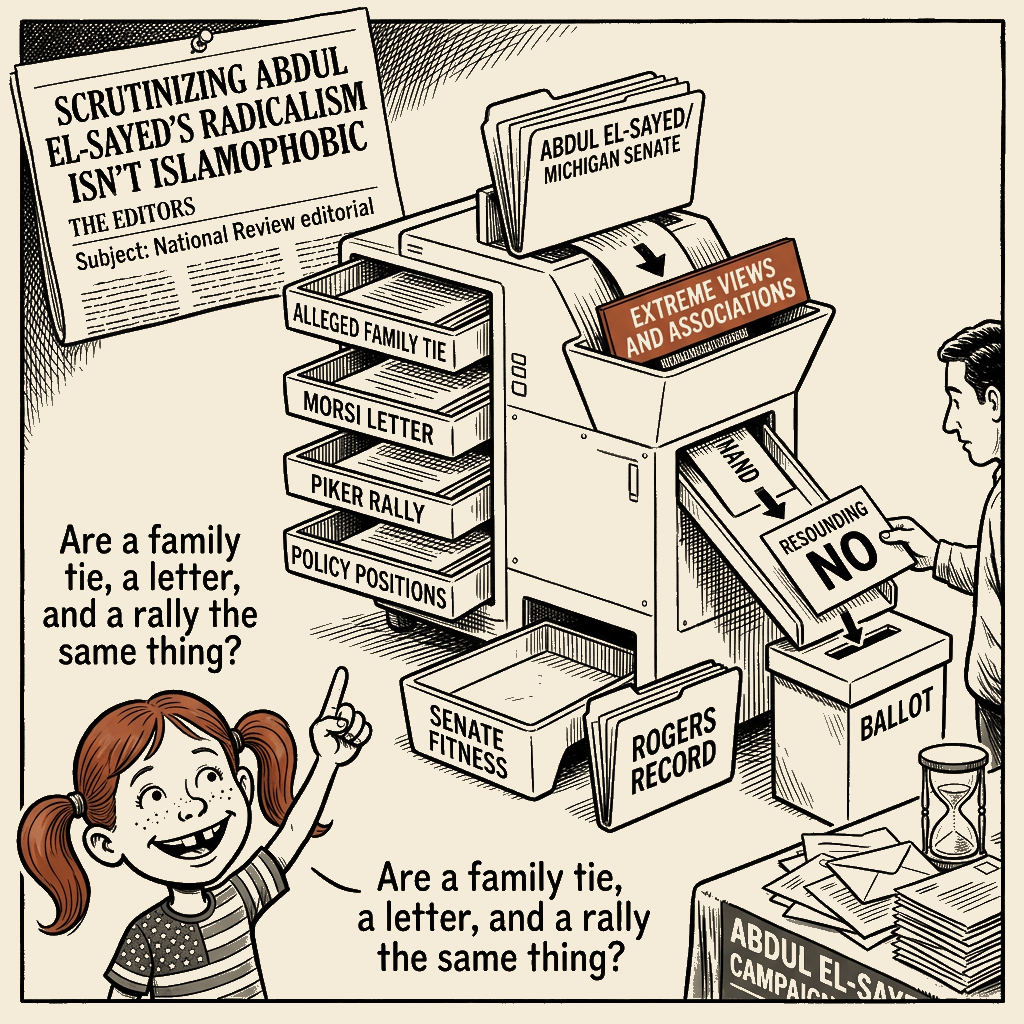
Are a family tie, a letter, and a rally the same thing?
What the Editorial Argues
The editorial tells Michigan voters to reject Democratic Senate nominee Abdul El-Sayed because it says his own views, associations, and contradictions—not his Muslim faith—make him unfit for the United States Senate. It assembles alleged family ties to the Muslim Brotherhood, a 2012 letter to Mohamed Morsi, rallies with Hasan Piker, and positions concerning Israel, Iran, the Supreme Court, and the Second Amendment into a candidate-fitness case, using John F. Kennedy and the phrase “fair game” to authorize closer examination. It closes by narrowing the choice to this candidate and commanding voters to answer with “a resounding ‘no,’” while treating objections to “casual Islamophobia” as an effort to stifle scrutiny.
Receipts
The move is to compress unlike forms of association into one identity-shaped charge, then relabel objections to that charge as religious prejudice.
What the framing wants you to believe
El-Sayed’s record, associations, and alleged dishonesty—not his religion—make him unfit for office. Scrutiny of his radicalism is legitimate because he allegedly supplied substantive grounds for it, while objections on behalf of Muslims are a tactic for “stifling” examination. The election therefore requires one verdict, delivered without further deliberation: a “resounding ‘no.’”
What’s really going on
The protected beneficiary is the anti-El-Sayed electoral position. Mike Rogers and the Republican Party stand to gain if the frame moves marginal voters, while National Review gains ideological reinforcement, attention, and movement coherence. No campaign contract, donor link, payment, placement agreement, or coordination is documented, so Rogers is a strategic beneficiary of the published argument, not a documented client.
The omitted relation is evidentiary: an inherited family relationship, a student-organization presidency, a rally appearance, a written political statement, endorsement of another person’s rhetoric, and a present policy position are different relationships with different weight. The editorial merges them into “extreme views and associations” and never grades them.
The strongest document-shaped receipt in the artifact is the editorial’s quotation from what it identifies as El-Sayed’s 2012 open letter to Morsi, where it says he supports “revolutionary decisions” and calls for Morsi to “purge the media and the police.” If the excerpt and attribution are accurate, it anchors voluntary association and El-Sayed’s words in 2012; it does not by itself establish Muslim Brotherhood membership, present intent, or fitness for the Senate.
In catalogue terms, the primary move is frame-engineered relabeling, accompanied by a partial equivocation pattern. The normalized harm is that legitimate conduct-based scrutiny and anti-Muslim prejudice become difficult to distinguish, while voters receive a ballot instruction without the evidentiary work required to justify it.
The Operation
Triage, authorship, and placement. The artifact’s URL, title, collective “The Editors” byline, and editorial first-person voice identify this as a National Review editorial, not a Wall Street Journal piece or a signed column. No exact publication date appears in the supplied artifact. Its title is “Scrutinizing Abdul El-Sayed’s Radicalism Isn’t Islamophobic.” The archetype is a candidate-fitness frame built as an associational evidence ledger: heterogeneous relationships are gathered beneath one ideological label, then converted into permission for partisan scrutiny. Its advocacy classification is mixed, leaning selfish in execution. Questions about a candidate’s own statements, affiliations, and fitness can serve a legitimate public interest. The machinery here is not neutral by default; it protects an electoral endpoint from the burden of proving each allegation.
The immediate institutional author is the collective editorial voice carried by the “The Editors” byline. The National Review Editorial Technique Catalogue describes the magazine as a project of movement coherence built around a collective editorial voice, which makes the publication of a candidate-fitness frame institutionally consequential. That context does not establish that this particular editorial was commissioned or coordinated with Rogers’s campaign. The record identifies the immediate author, not the first promoter of the framing. The observable citation chain consists of National Review’s own previous editorial, an attribution to The New York Times, and a set of public statements, rally appearances, and videos. The prior editorial is a cross-reference within the same publication, not independent corroboration.
No internal editorial memo, donor disclosure, focus-group instrument, placement contract, or campaign coordination appears in the record. The visible placement chain runs from the editors to nationalreview.com and then to readers. Any subsequent use by Rogers’s campaign or Republican organizers is downstream and unproved. “Cui bono?” identifies a beneficiary pathway; it does not license a conspiracy claim where the documentary record stops.
The operation, from inside. Built from the inside, the architecture is straightforward: announce that the accusation of prejudice is itself a suppression tactic; assemble a ledger of materially different relationships; label the entire ledger “radicalism”; use John Kennedy to make religious loyalty emotionally legible; grant “fair game” to anyone who proceeds; and close on a binary ballot instruction. The published arrangement displays the architecture; no private memo is needed to prove it.
Distributional impact. Rogers is the principal electoral beneficiary: if the frame succeeds, he gains votes without having to win a detailed comparison of governing philosophies. The Republican Party gains an immediate issue advantage by casting the race as a referendum on radicalism rather than on policy, records, or qualifications. National Review gains attention, ideological coherence, and reinforcement of the conservative frame.
El-Sayed bears the direct electoral cost. His campaign must spend money and attention answering allegations, and undecided voters may be deterred by the emotional frame rather than by the underlying evidence. Muslim readers bear a separate burden: the editorial’s package teaches them to expect their faith to be treated as relevant even when the objection concerns conduct. Voters bear the informational cost of receiving a verdict without the comparative policy analysis or evidentiary grading that would justify it.
No reliable dollar magnitude or effect size is supplied for any of those benefits or costs, so none is asserted. The cui bono finding survives the concrete-pathway test because Rogers’s pathway is votes, National Review’s pathway is attention and movement coherence, and the cost incidence is attached to campaign time, reputational exposure, and voter choice rather than to an invented number. It also scans outside the editorial’s frame for invisible beneficiaries and cost-bearers. No secret coordination is alleged.
Alternative design. A design faithful to the editorial’s stated rationale—examining whether El-Sayed’s own conduct disqualifies him—would put primary documents first and separate the relationships rigorously. It would ask whether he authored the 2012 letter; what he meant by its words in context; whether he organized, invited, attended, endorsed, or merely shared a venue with Piker; what he believed then and what he believes now; whether the Muslim Students Association’s history supports the inference the editorial draws; and whether his positions concerning Israel, Iran, Hamas, Hezbollah, the Court, and the Second Amendment have changed.
The fitness criterion would also be stated: fidelity to the Constitution, tolerance of lawful disagreement, foreign-policy judgment, candor under questioning, and a reasoned ability to exercise Senate authority. El-Sayed would receive a fair opportunity to answer each item with evidence, and his record would be compared with Rogers’s qualifications and positions. This design could still produce opposition to El-Sayed. It would not require readers to accept the bundle as a substitute for analysis.
Fear, greed, and laziness. Fear is real on every side of this operation. The editors fear appearing indifferent to Brotherhood associations or insufficiently vigilant in the face of anti-Muslim attacks. Rogers and Republican-aligned strategists fear an opponent whose alleged radicalism survives scrutiny and who turns the race into a referendum on religious prejudice rather than on the Senate contest. El-Sayed and his allies fear the conversion of political claims into grounds for exclusion; they also benefit from a defense that says “bigotry” more readily than it answers documents. The rank-and-file reader’s fear is not manufactured: anti-Muslim hostility is real. That fear makes the editorial’s identity-defense frame feel prudent rather than partisan.
The editors’ appetite is ideological clarity and attention. The campaign wants votes and favorable issue salience. El-Sayed’s camp wants coalition reassurance. The reader wants a usable answer before Election Day. The convenience offered to all of them is the binary: scrutiny or bigotry, instead of the harder work of asking what a person wrote, joined, endorsed, inherited, believed, abandoned, or changed. The reader is not a mark to be mocked for wanting certainty. The operation supplies certainty cheaply.
Selflessness and selfishness. The placement is mixed, leaning selfish in execution. Political scrutiny of Brotherhood affiliations and extremist rhetoric can serve a legitimate public interest. The machinery built here serves a partisan endpoint: it protects the anti-El-Sayed campaign from the burden of establishing each allegation and gives the reader permission to substitute category for evidence.
Technique identification
Frame-engineered relabeling. The cues are “using familiar cries of bigotry to stifle a closer examination of his record,” the description of “extreme views and associations,” and “The attacks on him on these grounds are fair game.” The Bad-Faith Techniques Catalog’s frame-engineered relabeling fits the observable move: the editorial relabels a dispute over conduct and political history as an attack on a religious class, changing the question before the evidence is heard. It also relabels unlike relationships as one ideological identity. The lineage runs through George Lakoff’s account of cognitive framing and Frank Luntz’s language-testing and relabeling work. That is lineage, not receipt: the artifact contains no internal memo or focus-group evidence showing that Luntz or any particular operator shaped this editorial.
Equivocation and category collapse. The cue is “extreme views and associations,” followed by materially different relations: alleged family ties, a signed political letter, rally appearances, another person’s statements, organizational leadership, and policy positions. The Bad-Faith Techniques Catalog’s equivocation identifies the defect: “radicalism” and “associations” slide among ideological radicalism, organizational affiliation, religious or ethnic identity, violent extremism, and ordinary policy disagreement. The match is partial because the editorial expressly acknowledges that family membership alone cannot be held against the candidate. But that concession does not cure the grading failure. The stronger finding is evidentiary category collapse, producing the simplified public picture Lippmann described as a stereotype: a memorable type substitutes for a complicated record.
Pre-emptive legitimacy-withdrawal. The cue is the claim that “familiar cries of bigotry” are being used to “stifle” examination, followed by “The attacks on him on these grounds are fair game.” The Bad-Faith Techniques Catalog’s pre-emptive legitimacy-withdrawal supplies a partial but operationally strong match: criticism is made illegitimate at the category level before the challenged statements are produced. The match is not a complete instance of the catalogue’s canonical cases involving identity-based institutional delegitimation, but the argumentative operation is the same. The editorial removes the critics’ standing before showing what they said. Because the alleged attacks are never reproduced, no separate strawman verdict can be entered; the omission also conceals the evidence needed to test the claim.
The genetic fallacy at the family-tie edge. The editorial raises family relationships while acknowledging that relatives cannot make the candidate responsible for their own conduct. The Bad-Faith Techniques Catalog’s genetic fallacy applies as a partial pattern wherever the family tie is used as a proxy for El-Sayed’s own views without showing his knowledge, direction, role, or endorsement. Such a tie may be context. It becomes disqualifying evidence only through the missing join.
Advantageous comparison and Kennedy ridicule. The cue is “El-Sayed is no Jack Kennedy,” followed by Kennedy’s military service, the PT-109 episode, and the claim that doubts about his loyalty rested on faith. The structure matches Bandura’s advantageous comparison: it recruits honor, sacrifice, and national belonging into a contrast with the opponent. Read through the National Review Editorial Technique Catalogue’s Buckley-tradition ridicule entry, the joke is not an independent indictment; it is an evidence-free amplifier. It changes the subject from El-Sayed’s conduct to the relative nobility of two men. The comparison may be memorable without establishing any criterion of senatorial fitness.
Body-level attribution asymmetry. The headline contains no scare-quoted phrase; the relevant asymmetry lies in the body. The editorial quotes the attributed labels “casual Islamophobia” and “denigrating Muslims,” while leaving “radical views,” “extreme views,” and “associations” unmarked in narrator voice. The WSJ Editorial Technique Catalogue’s asymmetric scare-quote and source-citation patterns describe the operative principle: the publication’s classification reads as description while the opponent’s characterization looks rhetorical, evasive, or illegitimate. This is a limited analogue, not evidence of coordinated message discipline or the catalogue’s full headline-level pattern.
Multiple-audience targeting. The opening—“As the Michigan Senate race enters the home stretch”—orients the piece toward an election, while the body supplies document-like language for opposition researchers and quotable lines for movement audiences. The WSJ Editorial Technique Catalogue calls this multiple-audience-targeting: one package addresses primary voters, political operatives, credentialed opinion readers, and ideological writers without changing its central frame. The catalogue properly treats the technique as craft rather than fallacy in itself. Here it carries a partisan payload.
Declarative closing cadence. “The answer should be a resounding ‘no.’” performs the WSJ Editorial Technique Catalogue’s closing-line function: a short imperative detaches from the evidence and travels as a ballot instruction. The structure does not make the conclusion correct. It makes the conclusion more likely to be the part remembered.
Read together, the dominant Bandura mechanisms are moral justification—“attacks” become “fair game” once the candidate is labeled radical—displacement of responsibility, which makes critics prove their respectability before their evidence can be heard, distortion of consequences, which turns every association into a form of endorsement, and advantageous comparison, which recruits Kennedy’s honor to close the case. Dehumanization is not operating: the target remains a person. The failure is evidentiary and institutional, not a denial of humanity. This identifies a documented behavior pattern; it does not claim access to the editors’ private intentions.
Audience management. The permission structure is explicit: “fair game” tells the reader that harsher scrutiny now carries no moral cost. Identity confirmation tells the conservative reader that demanding answers from El-Sayed demonstrates constitutional seriousness rather than religious animus. Grievance ratification tells the reader that the Democratic campaign is silencing inconvenient examination. Conscience displacement moves concern from El-Sayed’s alleged conduct to the alleged prejudice of his defenders. Status display offers the reader membership in a disciplined movement that can examine radicalism without being “Islamophobic.” The counter-frame is the whole operation: not prejudice, but scrutiny; not “Can a Muslim serve in the Senate?”, but “Why is this Muslim candidate’s record being hidden?”
The Record
Anchor receipt: the artifact itself. As a source for what the editorial claims, the text is primary and Tier 1. It proves the labels, sequence, quotations, attribution pattern, and closing instruction. It does not prove the truth of the underlying allegations.
Primary-document anchor in form: the 2012 Morsi letter. The editorial presents a direct quotation from an open letter signed by El-Sayed and other “leaders of the Egyptian community,” supporting Morsi’s “revolutionary decisions” and calling for him to “purge the media and the police.” If the excerpt and attribution are accurate, it is evidence of El-Sayed’s voluntary political association and his words in 2012. Its reach is narrower than the editorial’s conclusion: the letter alone does not establish Muslim Brotherhood membership, current intent, or future Senate conduct. The original letter, full surrounding text, and independent authentication record are not included in the supplied artifact and could not be independently confirmed in this pass.
Supporting receipts
The Piker rally appearances and quotations, the town-hall response, the refusal to compare Iran and Israel as threats, and the videos concerning the Court and Second Amendment would be primary audiovisual records if supplied. The artifact gives no links, dates, full clips, or transcripts, so their context and exact wording remain unresolved.
The attribution to The New York Times is an identifiable secondary citation for El-Sayed’s presidency of the University of Michigan Muslim Students Association and the organization’s founding history. The underlying article and records are not in the supplied material and could not be independently confirmed in this pass.
The reference to National Review’s previous editorial is an institutional cross-reference, not independent corroboration. The cited evidence is not reproduced.
The quoted Thompson and Clinton statements establish that the editorial says those figures made the attributed objections. Without transcripts or locators, they do not establish the strategic coordination, purpose, or surrounding context the editorial assigns to them.
No Tier 2 receipt is actually supplied. Tier 1 documentary material is either unavailable for inspection or unresolved, while National Review’s prior editorial is advocacy commentary supporting context only.
Unconfirmed claims
Several claims remain unconfirmed because the convergence threshold was not met. Specifically, it is unconfirmed that El-Sayed’s mother and other family relations had ties to the Muslim Brotherhood. The editorial points to its previous editorial but supplies no underlying record; it reports “ties,” not formal membership.
It is also unconfirmed that the Muslim Students Association’s founding history, El-Sayed’s presidency, the Piker rally sequence, the precise Piker quotations, the town-hall disavowal, the Iran-Israel exchange, and the Court and Second Amendment videos occurred as described. These cannot be independently checked from the supplied artifact.
Additionally, it is unconfirmed that El-Sayed exhibited “rank dishonesty.” This conclusion depends on the accuracy, context, materiality, and relevance of those unresolved claims.
Finally, it is unconfirmed that Democratic allies strategically deployed objections to “stifle” scrutiny. That motive and coordination claim is not established by the fact that the quoted language was used. The editorial’s account of motive and coordination remains uncorroborated.
Per-citation accuracy verdicts
The Morsi letter is presented as a direct quotation from a primary document and is the strongest document-shaped evidence presented in the artifact. Nothing in the artifact establishes a selective quotation, but the absence of the original and surrounding letter leaves completeness unresolved, and external authentication was not achieved in this pass.
The New York Times attribution is identifiable as a named secondary source within the artifact, but the specific article and underlying records are absent; neither its accuracy nor the editorial’s use of it can be adjudicated.
The previous-editorial citation points in the right institutional direction but cannot independently validate the family-ties claim.
The Piker and video claims are reported in the right documentary form for direct public statements, but no primary record is attached. No finding of fabrication or misrepresentation is established; neither can the editorial receive a clean verdict on context or selection.
The quoted Thompson and Clinton language lacks transcripts or locators, so the editorial’s strategic-purpose claim cannot be verified from the quotations alone.
Load-bearing omissions
The editorial never reproduces the alleged anti-Muslim attacks it says are suppressing scrutiny. It does not define “radicalism” or state what conduct would disqualify a candidate from the Senate. It does not distinguish authorship, membership, family relationship, organizational leadership, co-appearance, endorsement, and policy preference.
Furthermore, the editorial supplies no primary documents, dates, transcripts, or locators for the Piker, town-hall, YouTube, or organizational-history claims. It gives no complete account of El-Sayed’s present positions or any documented change over time. It records a “rote disavowal” without preserving the full answer or the question and answer in context.
The piece also shows no documented pathway from the cited statements to a Senate vote, legislative preference, appointment, or governing program. It does not preserve distinctions among criticism of Israel, support for Hamas, tolerance of Hezbollah, approval of Houthi conduct, and assessments of Iran as a state actor. Finally, it does not compare El-Sayed’s fitness with Rogers’s qualifications or record, and it documents no campaign coordination, internal editorial direction, donor payment, or syndication arrangement. The beneficiary finding therefore rests on the electoral pathway, not on a claim of secret coordination.
Missing-information declaration. Receipts unobtainable from the supplied artifact include the original Morsi letter, the prior National Review editorial, the cited New York Times report, the rally and town-hall recordings, the videos, and the source documents behind the family-ties claim. The 2012 letter and the New York Times attribution remain externally unresolved after this verification pass. No missing fact was supplied by inference; where an underlying document or recording is absent, the claim remains unresolved.
The reconstruction of the evidence ladder comes from the editorial’s published arrangement, not from a hidden operational record. My operator’s-eye knowledge is used to identify the generic architecture of the framing, not to establish any fact about El-Sayed, Rogers, Morsi, Piker, or National Review’s funding. This autopsy does not decide whether El-Sayed deserves a Senate seat. It decides what this editorial’s rhetoric does with the evidence in front of it.
How to Recognize This
The pattern is the association machine inside a prejudice-defense shell. It denies that criticism rests on prejudice, gathers inherited ties, organizational affiliations, public appearances, and political statements into one disqualifying identity, and then instructs the reader how to vote.
The mechanism is activation. “Radical views and associations” tells the reader which facts matter before the reader has determined whether they matter separately. “Fair game” supplies moral permission. The Kennedy joke makes the contrast memorable. The final “no” converts a contestable evidentiary map into a ready-made ballot instruction.
Four signals should make the pattern visible next time:
-
The innocence clause arrives before the evidence. “This is not Islamophobia” establishes permission before the editorial shows whether its evidence concerns ideology, conduct, association, prejudice, or some mixture. “Fair game” then converts that permission into a moral blank check.
-
The umbrella term carries unequal evidence. “Associations” gathers family relations, student organizations, rally appearances, speeches, and policy positions without assigning each its proper weight. The evidence ladder moves from remote to vivid: family claim, Morsi letter, Piker quotations, Israel, Iran, the Court, and the Second Amendment. Emotional charge rises while evidentiary distinction grows thinner.
-
The argument substitutes a binary for analysis. “The real question isn’t X but Y” makes scrutiny and prejudice appear mutually exclusive, although both can coexist. The compatibility question is subordinated to the fitness question, and the reader answers only the question designed to be answerable.
-
The conclusion substitutes ballot instruction for comparative proof. “A resounding ‘no’” arrives without showing Rogers’s record or a policy pathway from the cited statements to conduct in office. “According to,” “viral clip,” and “unearthed video” substitute labels for documents that can be located, dated, read, and checked.
It works because it respects the reader’s need for a decision while moving the cost of inquiry onto the reader. Anti-Muslim hostility is real, and the editorial borrows the moral force of a genuine prejudice while redirecting attention from its evidentiary bundle. Direct quotations create the appearance of specificity. The umbrella label supplies coherence. The anti-bias disclaimer reduces moral friction. The reader gets a usable answer without having to sort a family connection from an adult endorsement, an organization from an individual, or a quotation from a governing program.
When you see it, do not begin by deciding whether the candidate is innocent or guilty. Translate every relationship into a proposition: Who said what? Who joined what? Who endorsed what? Who merely appeared nearby? What changed, and when? Then demand the primary document behind every slogan and quotation. Read the whole statement. Ask whether the relationship was inherited, voluntary, repeated, or abandoned; whether it concerned a government, a movement, a tactic, or a policy; and what evidence connects it to authority in the Senate. Compare the candidate with the opponent. Trace the funding and placement chain. Ask who wins if the label survives and who loses if the evidence does not support it. Look for the same vocabulary across nearby opinion pieces while refusing to infer coordination from similarity alone.
Most importantly, slow the frame’s automatic activation: “radicalism,” “extremism,” “associations,” “Islamophobia,” and even “fair game” are not conclusions. They are requests for inspection.
I helped build permission slips like this one. Recognition is not absolution; it is the next document you insist on seeing. Put every claimed relationship back where it belongs. Inspect the record. Refuse the bundle.

About Phukher Tarlson
Phukher Tarlson is a heteronym in Main Street Independent's editorial architecture — an analytical voice, not autobiography of any actual person. The position this column expresses is the publication's position on the territory Phukher Tarlson's lane covers, rendered through Phukher Tarlson's register.