Analyzing: I could have rescued my daughter from disappointment; here's why I didn't · 2026-10-24
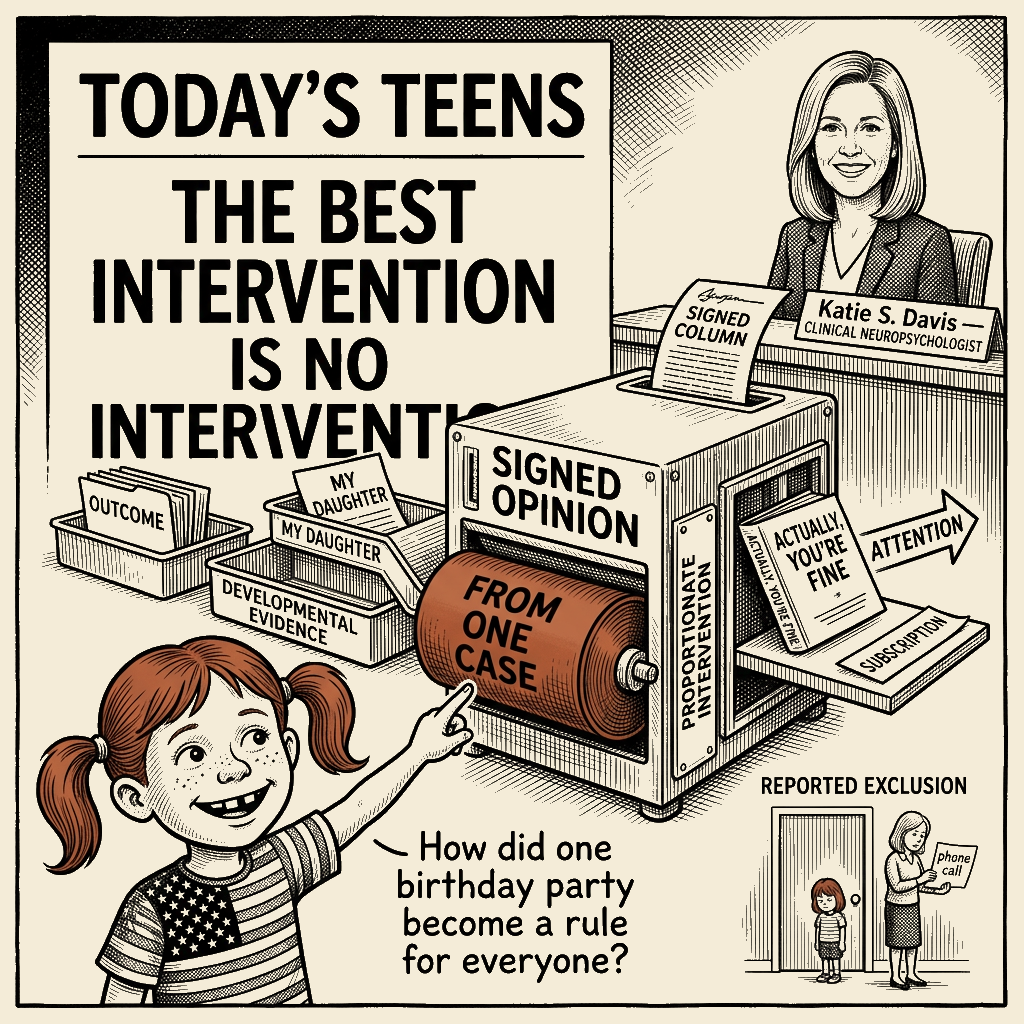
How did one birthday party become a rule for everyone?
What the Editorial Argues
The editorial argues that parents who routinely intervene whenever a child is disappointed can produce dependence, avoidance, and unrealistic expectations. It uses one parent’s decision not to call another child’s mother and secure an invitation as the starting point for a broader theory of childhood. Parents should acknowledge the hurt, resist the urge to solve the problem, help the child develop solutions, and sometimes do nothing at all. The desired result is a child who can endure ordinary disappointment and recover without adult rescue.
Receipts
The editorial moves one child’s exclusion from a birthday party to a universal parental rule, with a commercial close doing work the argument never earns.
What the framing wants you to believe
- Ordinary sadness has been medicalized: “Sadness becomes depression, meanness becomes bullying and frustration becomes emotional dysregulation.”
- A parent who intervenes is recast as “rescuing” a child; Davis argues that rescue can weaken self-efficacy, reinforce avoidance, and create unrealistic expectations.
- The proper response to disappointment is validation without automatically taking over—and sometimes, “the best intervention is no intervention at all.”
What’s really going on
- The evidentiary base is one reported incident with no reported outcome: one girl, one birthday party, one parent’s decision. The leap from “my daughter” to “we are all defaulting to the phone call” to “today’s teens” is performed by grammar, not evidence.
- The opening closes the middle by presenting two options: acknowledge the hurt or telephone Samantha’s mother. The article later restores a third path—eliciting the child’s own ideas about what she might do next—but uses it to preserve the governing no-intervention contrast rather than opening the frame to other forms of resolution.
- The protected beneficiary is not a hidden donor or policy network. It is the authority-and-commerce system around the piece: Davis’s professional identity, the audience’s attention, and the sale of Actually, You’re Fine, a book built around the same vocabulary. The supplied record establishes no sales figure or coordinated campaign, but the pathway is plain: anecdote and credential, then the purchasable manual. The primary source is Katie S. Davis’s signed op-ed, “I Could Have Rescued My Daughter From Disappointment.”
The Operation
Source, authorship, and placement. This is a signed, named op-ed, not an unsigned editorial-board voice. That matters. The WSJ Editorial Technique Catalogue describes the board’s collective “we” and third-graf turn; this piece operates through a different apparatus—first-person anecdote, professional identity, universalized counsel, and a commercial close. No named donor, think tank, foundation, ALEC-style template, or message memo appears in the supplied record. The documented authorship chain is Davis’s personal account, her clinical credential, the signed opinion-page placement, the book notice, the link inviting readers to read more from her, and the subscription prompt.
The closest structural analogue in the WSJ Editorial Technique Catalogue is the “study shows” ledger. There is no study here. The legitimating object is an anecdote and a professional biography, and the credential occupies the space a research citation would occupy in a more rigorous editorial.
The commercial relationship is disclosed rather than concealed, which is better than concealment and no substitute for disclosure of function. The editorial identifies Actually, You’re Fine as a Balance book with an Oct. 13, 2026 release date and advertises it. The article’s central vocabulary—ordinary struggle, resilience, unnecessary rescue, and the supposedly healthy child who gets back up—maps onto the book’s advertised proposition. The available record supplies no revenue data, so the benefit cannot honestly be quantified beyond attention, authority, and a conversion path from article to book.
Cui bono. The concrete beneficiary pathway runs through Davis, Balance, and the publication. The apparatus positions Davis’s authority and visibility for promotion, gives Balance an advertisement for the book, and gives the publication a path toward reader engagement and subscriptions. It establishes no measured sales, revenue, or engagement; it establishes a direct, usable pathway. The result is a promotional funnel: authority becomes visibility, visibility becomes attention, and attention becomes a route to the book and the publication’s subscription relationships.
The cost-bearers are less visible. Parents who call another family to secure an invitation are made to feel that ordinary care is psychological excess. They must defend an act against a frame that recasts a parent’s wish to have her daughter included as “rescuing.” Children bear a subtler cost because the argument makes a limited act of support stand for chronic rescue, then trains adults to hear every attempt to help as evidence that the child cannot cope.
The strongest version of the editorial’s concern survives this exposure. Children can be harmed when adults remove every difficulty and then mistake continued dependence for evidence that help was required. But that legitimate concern does not establish the article’s universal rule. The placement is mixed: genuine developmental counsel on one side; author authority, identity reinforcement, and book commerce on the other. The legitimate value is not the falsehood.
Alternative design. A parenting practice optimized for Davis’s stated rationale—building resilience without treating preventable harm as a lesson—would begin by validating the feeling without converting sadness into pathology. It would ask what happened, what the child wants, whether the exclusion was isolated or recurrent, and whether an intervention is proportionate to the harm. One invitation to a party, repeated rescue from every disappointment, and a response to persistent bullying are not the same act. The adult could offer support, ask the child to generate options, set limits, and intervene when the stakes or pattern warranted it. That design follows the child’s actual interest in both agency and care. It preserves Davis’s concern without requiring parents to choose between neglect and pathology.
Fear, greed, and laziness. These labels describe incentives, not moral character.
- Author and book: fear that ordinary struggles will be medicalized is a legitimate professional concern; the material incentives point toward attention, authority, and sales; the evidentiary shortcut is to let one anecdote do the work a synthesis would require.
- Publication and distribution platform: attention is the platform’s commodity, and emotionally charged parenting disputes reliably generate it; the subscription prompt and book-channel exposure provide the material pathway; a repeatable opinion template is easier to produce than a careful developmental review. The supplied record does not establish an editor’s private motive, so the finding rests on placement and pathway rather than imputed intention.
- Parent-reader: fear that a child will become helpless is real, as is the wish to be seen as a loving parent who does not overcorrect. The easy binary supplies permission to avoid deciding, and the guilt preserves the reader’s sense of moral seriousness even when the advice is unsupported.
- Child: the concrete stake is exclusion, loneliness, and the adult’s decision about whether discomfort will be met with support. The child has no profit motive in this transaction, so inventing one would be false. Their fear and dependence are enough. The omission is theirs.
The beneficiary pathway is attention, authority, and book sales, not a concealed political payoff. The parties missed by the frame are children and intervention-minded parents. The costs fall on moral standing and caregiving decisions, not on an invented dollar figure. No hidden coordination is alleged; no speculative beneficiary is promoted; no magnitude is invented; the legitimate value remains; and the alternative design is reconstructed from the affected parent’s and child’s interests rather than from my policy preference.
Technique map.
-
Anecdote-to-universal generalization. The textual cues are “my daughter,” “we are all defaulting to the phone call,” “We have lost our ability to tolerate ordinary childhood struggles,” and the movement onward to “today’s teens.” This is the Bad-Faith Techniques Catalog pattern hasty generalization: one selected case becomes a developmental law without a prevalence rate, comparison group, or outcome evidence. The closest cross-reference in the WSJ Editorial Technique Catalogue is §3.3’s third-graf turn—here not as a board move, but structurally similar: a particular case is generalized into a standing ideological frame. Operationally, the child supplies emotional specificity where the argument lacks general evidence. In the older Lippmann lineage, the particular incident becomes a stock picture of an entire generation.
-
False dilemma at the opening. The cue is the construction around “two things”: acknowledge that being left out hurts or “pick up the phone and call Samantha’s mom to secure an invitation.” The Bad-Faith Techniques Catalog entry false dilemma fits because the choice is presented as exhaustive before the alternatives are examined. The body later permits eliciting the child’s own ideas about what to do next, but captures that option: it is used to preserve the governing no-intervention contrast rather than opening the frame to other forms of resolution. This is staged compression. The middle disappears so “acknowledgment” and “rescue” can look mutually exclusive, then returns in a form that preserves the governing contrast.
-
Partial selectional strawman. The editorial does not always say that every intervention is harmful; it speaks of repeated intervention. But the title and opening make the rescue extreme, then use it as the stand-in for ordinary parental judgment. That is the strawman pattern, strongest in the title and opening and weaker once the body narrows the claim toward repetition. The Bad-Faith Techniques Catalog also identifies hasty generalization in the extension from one call to a general theory. Operationally, the strawman lets the editorial oppose constant rescue without having to distinguish it from a proportionate response to a child’s exclusion.
-
Frame-engineered relabeling. The title contains no quotation marks around “rescued”: “I Could Have Rescued My Daughter From Disappointment.” A parent who wanted her daughter invited is placed in the semantic neighborhood of someone who cannot tolerate any discomfort. The body reinforces the substitution by naming the intervention “rescuing.” This is the mechanism catalogued as frame-engineered relabeling and discussed by George Lakoff and, in documented message-discipline cases, Frank Luntz: the replacement word changes the moral category through which the act is processed. The textual relabeling is present; the stronger catalog claim of a coordinated, focus-group-engineered campaign is not established by the supplied record and is not asserted here.
-
Credential-as-proof. The supplied author biography identifies Davis as a clinical neuropsychologist who provides psychotherapy and cognitive remediation to children with learning disorders and related developmental disorders. The credential is relevant. It is not proof that rescue generally undermines self-efficacy, that negative experience is generally beneficial, or that intervention generally produces avoidance. The closest cross-reference in the WSJ Editorial Technique Catalogue is §3.7, the “technocratic-credential ledger”: expertise supplies legitimacy even when the cited work cannot bear the proposition placed upon it. Calling the credential itself irrelevant would also be wrong. The defect is the substitution of authority for the missing argument.
-
Lists and repetition in place of warrant. The editorial organizes its prescription as “First,” “Second,” and “Third,” then repeats “Children never develop the ability to recover from disappointment if they don’t have the opportunity to feel it,” “Help your child develop their own solutions,” and “Sometimes the best intervention is no intervention at all.” Repetition is not a formal fallacy in the Bad-Faith Techniques Catalog, so it should not be mislabeled as one. It is an evidentiary substitute: the same proposition returns because sourcing has not arrived. The WSJ Editorial Technique Catalogue supplies the adjacent cross-reference in §3.5’s “closing-line cadence”: memorable declarations and repeated injunctions are engineered for lodging in memory rather than for surviving scrutiny.
-
The collective-we and moral-status close. The editorial’s accusation that society pathologizes and diagnoses every negative experience, together with “We have lost our ability to tolerate ordinary childhood struggles,” recruits the reader into a failing generation. The final lines—“My job isn’t to eliminate adversity and disappointment; it’s to help her become a person who can handle the struggles that are inevitably part of life” and “I don’t want to raise someone who never falls down; I want to raise someone who knows how to get back up”—turn parental restraint into moral status. The audience-management function is layered: permission structure for adults who need release from the urge to solve; identity confirmation for the resilient parent; grievance ratification for the claim that ordinary childhood has been medicalized; and conscience displacement from the excluded child to the possibility that the adult parent might be overbearing.
-
Bandura’s moral-disengagement cluster. The quoted fragment “Negative experiences can serve important developmental functions” supplies moral justification for allowing harm that may not need to be allowed. The article’s further claims about repeated intervention and dependence remain paraphrases, not quotations. Its omission of the benefits of support and the possible consequences of forced inaction distorts the consequences. The collective language attributes fragility to parents and their interventions, invoking attribution of blame while distributing responsibility across “we.” These mechanisms let the reader accept possible suffering to the child as character-building and parental help as the cause of dependence. They supply a moral account for an outcome the record does not establish.
The evidence does not support manufactured controversy, astroturfing, or a coordinated-pattern finding. No scientific dispute, donor trail, or repeated institutional campaign appears in the supplied text. The operation is visible in the copy, not behind it.
I built versions of this machine: the anecdote to make the rule feel concrete, the binary to make the middle disappear, the credential to keep the reader from asking for proof. The grammar did the work.
The Record
Anchor receipts.
- Tier 1 — primary document, for attribution only: Katie S. Davis’s signed editorial, “I Could Have Rescued My Daughter From Disappointment,” is primary evidence of the article’s wording, reported anecdote, credentials, structure, and citations. It is not independent evidence for the developmental mechanism it asserts.
- Tier 2 — independent supporting receipts: none were supplied. The author biography and book notice are the publication’s representations of Davis and the book; they are not independent specialist confirmation of the article’s causal claims.
- Tier 3 — advocacy context: the article’s general claims about childhood, rescue, resilience, and intervention are the argument under examination. They cannot serve as their own supporting receipts.
Unconfirmed claims.
- “Children never develop the ability to recover from disappointment if they don’t have the opportunity to feel it.”
- Davis’s claimed sequence whereby rescue weakens self-efficacy, encourages avoidance, and produces unrealistic expectations.
- “We have lost our ability to tolerate ordinary childhood struggles.”
- Davis’s general claim that negative experiences can be developmentally useful and that repeated intervention can weaken children’s ability to act independently.
- The described pattern characterizes today’s teens or contemporary parents generally.
These claims do not mean the propositions are necessarily false. They mean the supplied editorial does not meet the evidentiary threshold required to use them as anchors.
Per-citation accuracy verdicts.
- The article cites no study, data set, clinical guideline, developmental literature, or comparative case. There is therefore no study whose methodology, caveats, or funding chain can be checked—and no “study shows” ledger to audit.
- Davis’s clinical role is described specifically and is relevant to her standing to discuss developmental questions. It does not convert her biography into confirmation of every universal claim.
- The editorial identifies Balance as the publisher of Actually, You’re Fine and gives Oct. 13, 2026 as its release date. The record does not independently verify sales, revenue, or the nature of the publication relationship.
- The heading “I WORRY LESS ABOUT SCREENS THAN ABOUT THE CHALLENGES TODAY’S TEENS NEVER FACE” promises an examination of screens. The body does not examine screens. The heading borrows the gravity of a familiar parenting dispute without supplying the promised analysis.
Load-bearing omissions.
- What happened afterward. The article offers possibilities—perhaps the daughter will make a friend, perhaps she will feel “bummed for the afternoon and move on”—but records no observed outcome.
- Whether the exclusion was isolated, repeated, malicious, accidental, or consequential in any way the parent could establish.
- The base rate of birthday-party exclusions, the distribution of children’s reactions, and the proportion followed by meaningful harm.
- The distinction between one proportionate intervention, occasional support, chronic rescue, and a response to persistent bullying.
- Developmental evidence for the causal sequence the article asserts, including contrary explanations or evidence about when intervention helps.
- Any standard separating ordinary sadness from depression, ordinary meanness from bullying, or ordinary frustration from emotional dysregulation. The clinical terms dramatize a disagreement about intervention; they are not diagnostic evidence.
- The child’s own account. The story is about a child, but only the parent’s retrospective interpretation reaches the reader.
- The possible costs of the recommended alternative—unnecessary exclusion, damaged belonging, prolonged distress, or lessons that adults will not help.
- The connection between the argument and the book as a commercial product. The book is disclosed, but the article does not examine how the recommendation and the sales proposition reinforce each other.
The omitted relation is the one that matters: a particular act of parental care is separated from its context, then made to stand for a universal developmental mechanism. The protected beneficiaries are Davis’s authority, the commercial product, and the reader’s preferred identity as the parent who can tolerate discomfort without overcorrecting. The normalized harm is the recoding of help as psychological abuse, which makes leaving a child’s legitimate distress unaddressed appear like moral courage.
Missing-information declaration. The supplied packet does not furnish developmental research, an outcome record for this family, a base-rate study, an external publication record for the book, or financial evidence for the commercial pathway. The analysis therefore reaches a firm conclusion about the rhetoric, the editorial’s evidentiary omissions, and the documented placement of the book; it does not reach a verdict on whether every developmental proposition in the article could be supported by evidence the packet did not contain.
How to Recognize This
Look for the sequence:
-
A concrete case arrives without its messy alternatives.
One child, one exclusion, one difficult afternoon. The story supplies emotional specificity where the argument lacks general evidence. -
A choice is presented as exhaustive.
“Support or rescue” sounds like a distinction until the reader notices that every form of help has been pushed outside the frame. The body later acknowledges the option of asking the child what they think they should do next, but captures that option: it is acceptable only when it leaves the problem unresolved. -
Ordinary care is redescribed as pathology.
Watch for the shift from a qualified concern that parents sometimes overhelp to an unqualified charge that society pathologizes every negative experience. The first is a claim that can be debated. The second requires a defense the editorial never supplies. -
The collective pronoun does the work of evidence.
“My daughter” becomes “our kids.” One experience becomes a generation. That leap is often where the evidence ends and the accusation begins. -
Causal language appears without a warrant.
“Helps,” “undermines,” “reinforces,” and “creates” are not decorative verbs. They assert a mechanism. Look for the study, data, guideline, or case comparison that ought to follow. Here, none does. -
Expertise arrives where evidence should be.
A professional biography can establish credentials and support the authority to synthesize relevant developmental principles. It cannot prove a universal generalization about millions of families. -
The form pretends to be the proof.
Watch for numbered “First,” “Second,” and “Third” prescriptions, repeated sentences, and a noble closing line. These devices can make an assertion feel audited and established when the warrant is still missing. -
The commercial material occupies the position of the conclusion.
When the last thing the reader encounters is the author’s credentials, book notice, link, and subscription prompt, the argument has also been an instrument of publication.
The mechanism is simple. The anecdote recruits emotion; the binary removes alternatives; the loaded label assigns guilt; the credential supplies authority; the list supplies counterfeit precision; the repetition supplies emphasis; and the commercial close converts agreement into ownership. The reader is never asked to produce evidence. The reader is asked to identify with the parent who has conquered the urge to rescue.
It works because the prose sounds reasonable long enough for the frame to settle before the reader examines it. A parent who calls another mother is not obviously wrong, so the editorial does not attack that act directly. It changes the name of the act, recruits a generation, and makes continued intervention feel like a failure of love. The reader who objects discovers that disagreement itself has been redescribed as pathology.
When you see the pattern, do not ask first whether the conclusion feels plausible. Ask what the story omits, what evidence would be required to move from one child to a generation, what the loaded word has displaced, and who receives attention, authority, or money when the reader accepts it. Trace the cited study’s funding and caveats when there is a study; when there is only a credential, ask what that credential can establish. Check whether the same vocabulary appears across the publication or syndication network—without treating repetition alone as proof of coordination. Then restate the excluded options in plain language before allowing “rescuing,” “pathologizing,” or “intervening” to activate the moral verdict for you.
The tell is not that the parent declined to call Samantha’s mother. The tell is that a disagreement about parenting has been made to feel like a failure of love.
The birthday party is only the exhibit. The guilt is the product. And the “rescue” being performed is not the child’s rescue from disappointment—it is the reader’s rescue from the possibility of disagreeing with the editorial.
I built versions of this machine. What I owe the reader now is not a better speech but a way to see the joints: one case, one binary, one credential, one commercial close. Once the joints show, the feeling may remain, but the command loses its authority.

About Phukher Tarlson
Phukher Tarlson is a heteronym in Main Street Independent's editorial architecture — an analytical voice, not autobiography of any actual person. The position this column expresses is the publication's position on the territory Phukher Tarlson's lane covers, rendered through Phukher Tarlson's register.