Analyzing: ELI STEELE: California forces companies to mine the past for slavery's sins — Eli Steele · 2026-10-21
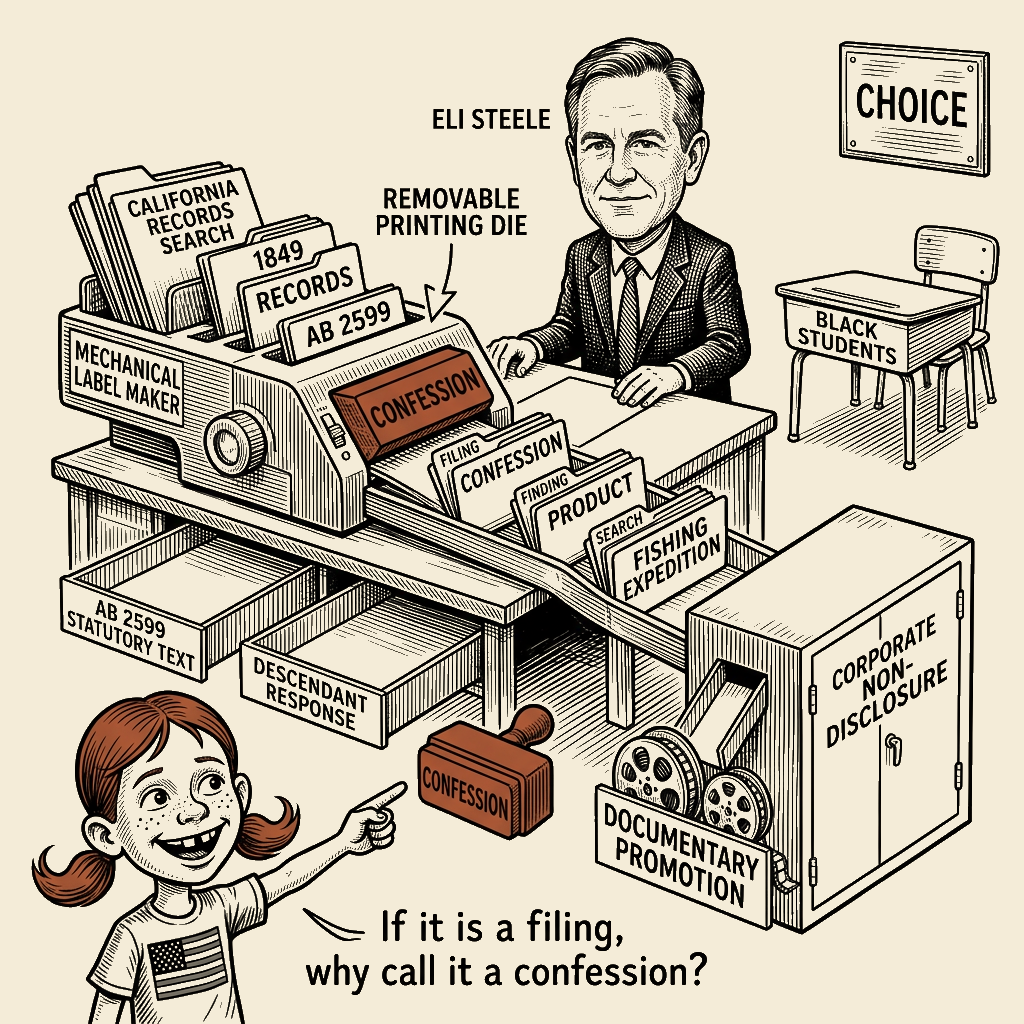
If it is a filing, why call it a confession?
What the Editorial Argues
Steele argues that California’s AB 2599 is counterproductive because, as he describes it, covered companies must search records back to 1849 and turn historical filings into permanent public “confessions.” He calls this a “White guilt” transaction in which Black political leaders sell claims of victimization while politicians, activists, and corporations purchase innocence, apology, and political leverage. He argues that the bargain perpetuates racial victimhood, distracts from Black students’ present educational failure, and gives children an account of their difficulties based on ancestral rather than immediate causes.
Receipts
The editorial’s central move is to turn a records-search mandate into a racial transaction before it examines the mandate’s design, burden, or causal effects.
What the framing wants you to believe
The mandate is characterized as a “fishing expedition” designed to “unearth confessions that can be commodified as grievances.” Because “we have historians for that,” disclosure is framed as the manufacture of fresh racial accusations rather than the preservation of corporate records. This alleged effort is further cast as a “White guilt-Black power” transaction: white institutions and corporations buy innocence, while Black leaders, activists, and the Black Lives Matter movement sell victimization for political capital. Finally, California’s school crisis—especially the reported outcomes for Black students—is used to present opposition to the law as a choice between protecting children and chasing the “ghost of past crimes.”
What’s really going on
The anchor for the rhetorical finding is the supplied Fox News Digital op-ed by Eli Steele itself. It repeatedly substitutes “confession” for filing or finding, “grievance” for an accountable historical record, “product” for political use, and “fishing expedition” for a records search; this establishes a finding about the artifact’s rhetoric, rather than serving as independent proof that the statute works as the column says.
The protected beneficiary is the corporate non-disclosure position and the documentary frame surrounding Eli Steele. If opposition blocks or weakens the measure, covered firms could avoid a records search, reporting burden, and reputational exposure. Steele and White Guilt receive a visible attention pathway through the Fox page, film captions, film-site link, app prompt, and newsletter signup. The frame also gives political actors who favor disclosure a moral permission structure: they can appear innocent without answering questions about statutory scope, evidence, privacy, or remedy. No payment, sponsorship, donor chain, or actual audience conversion is documented.
The omitted relation is the relation between method and outcome. The package supplies no enrolled statute, implementing documents, fiscal note, official score file, original interviews, or evidence that AB 2599 diverted classroom money, personnel, or instructional time. The statutory parameters and test-score figures are therefore the editorial’s account and are not independently verified by the available record. The normalized harm is not a fabricated dollar loss; it is the conversion of descendants, historical evidence, and Black students into instruments of a racial transaction while the actual policy design remains unexamined.
The Operation
Triaged from the artifact itself, this is a signed Fox News Digital op-ed by filmmaker Eli Steele, not an unsigned Wall Street Journal board editorial. Its individual byline and page furniture—editor’s note, film captions, WhiteGuiltFilm.com, Fox-app prompt, and newsletter signup—place it inside a documentary-promotion structure. The topic is corporate slavery disclosure, racialized reparations politics, and Black education. Its archetype is blame-transposition: a records-search method is recast as a racial transaction, then blamed for present educational outcomes.
The first question I ask when a moral noun appears in a policy lede is what the noun is doing before the reader has seen the mechanism. Here it is doing a great deal. “Confession,” “grievance,” “product,” “grift,” and “symbiosis” do not describe the bill; they assign roles to companies, politicians, activists, and children. The finding rests on the supplied text and its visible placement.
Institutional authorship and placement chain. Eli Steele is the named author and is identified as the director of White Guilt. Shelby Steele is repeatedly identified as an author, columnist, and Hoover Institution senior fellow, and the editorial gives him the frame’s decisive vocabulary. The editor’s note places the column within a series about “White guilt in America and the West” and ties it directly to the film. The visible placement chain is Fox News Digital page → film captions and series → WhiteGuiltFilm.com → Fox-app prompt and newsletter signup. That is a promotional chain. It is not evidence of a payment, donor network, Hoover funding, legislative coordination, or a hidden institutional campaign; the source does not establish one.
Distributional impact. The first protected beneficiary is corporate opacity. If the measure is blocked or diluted, covered entities could avoid searching records, filing disclosures, and acquiring a public association with the conduct being investigated. No company is named, no compliance estimate is supplied, and no lobbying or payment record is provided. This is a concrete distributional pathway, not a discovered financial conspiracy.
The second beneficiary is the Steele documentary project. The article gives the film a text-based distribution system: the argument arrives as timely political commentary while the film supplies the larger interpretive and promotional container. Fox receives a visible pathway to traffic, app use, and newsletter registration; no revenue figure or conversion data is supplied. The third beneficiary is the political position that can use the moral charge to avoid institutional design. Supporters of disclosure are offered innocence; opponents are tagged with slaveholding or racism. The frame relieves either side from having to examine definitions, evidentiary standards, privacy protections, or the relationship between historical findings and present remedy.
The costs are assigned elsewhere. Black students become the moral lever used to condemn a policy they did not choose, even though the article supplies no evidence that the records mandate competes with classroom instruction. Descendant communities are not treated as parties with interests, rights of response, or a role in deciding what accurate disclosure should produce. Instead, they become raw material in a transaction between political actors. Covered companies may bear real compliance costs if the statute is valid, but the magnitude is unshown. If non-disclosure prevails, the potential cost is an unsearched archive and a foreclosed evidentiary route; that is a conditional pathway, not a measured loss.
No responsible dollar magnitude can be assigned from this package. There is no named company, compliance estimate, lobbying disclosure, production budget, Fox revenue figure, or audience-conversion data. The beneficiaries are identifiable through the frame’s incentives; their payoff is not converted into an invented number.
Alternative design. A serious slavery-disclosure regime optimized for historical accountability rather than guilt would define “company,” “predecessor,” “subsidiary,” “control,” covered entities, and exemptions. It would separate historical association from present corporate responsibility and specify what, if any, remedy follows a finding. It would publish a standard of proof, independent verification procedures, a right of response, correction mechanisms, and rules for incomplete records.
It would also address privacy, redaction, access, retention, and the permissible uses of disclosed information. Most importantly, it would make room for descendant and community participation rather than assuming in advance that every disclosure is an accusation. Finally, it would produce a fiscal and administrative analysis and ask whether historical disclosure actually competes with educational resources instead of treating the two policies as mutually exclusive.
None of that design work receives treatment in the editorial. That does not establish that AB 2599 lacks safeguards. It establishes that the column declares the motive in advance and thereby makes design unnecessary: once “fishing expedition” is installed, scope becomes targeting, search becomes accusation, filing becomes confession, and the policy debate ends before it begins.
Fear, greed, and laziness. This is an incentive analysis, not a claim about anyone’s inner life.
For the framing author and outlet, fear of being branded racist supplies pressure to lead with moral accusation. Attention is the reward: the column visibly promotes the documentary, its site, the Fox app, and the newsletter. The incentive not to retrieve the bill text is a form of institutional laziness.
For the corporate non-disclosure position, fear of exposure and reputational harm supplies a concrete reason to prefer opacity. The “greed” is the institutional appetite for preserved advantage and avoided burden; this describes the structural payoff, not the private motive of any named company. The laziness is the convenience of not searching records or confronting what a search might disclose.
For political actors, fear of losing moral authority and appetite for status help explain why the frame rewards a purity test instead of an adjustable disclosure system. The analysis does not claim that every politician or activist holds the motives the editorial assigns them.
For the reader, fear is real. Being labeled racist can carry genuine costs in family, workplace, and community life. The desire for moral membership and innocence is also real. The human laziness is not contemptible: a complicated historical record is cognitively expensive, while a completed story arrives ready to use. The frame supplies identity before it supplies evidence.
Selflessness / selfishness placement. The advocated position is mixed. Concerns about historical anachronism, successor liability, privacy, evidence standards, and indefinite retention can be legitimate. But the surface altruism—protect Black children, expose racial exploitation, stop the state from exploiting victimization—is used to protect a concrete non-disclosure and promotional interest. The legitimate kernel does not redeem the method. The frame’s structural effect is selfish even where its stated purpose is selfless.
Technique identification. The Bad-Faith Techniques Catalog supplies the formal labels; the WSJ Editorial Technique Catalogue and National Review Editorial Technique Catalogue provide comparative overlays. The labels below identify textual behavior, not a private motive.
The spine of the argument is frame-engineered relabeling, evident when the text claims it will “unearth confessions that can be commodified as grievances,” that “Every filing will be a confession,” or that “their product is Black victimization.” This maps to the frame-engineered relabeling entry in the Bad-Faith Techniques Catalog and the WSJ Editorial Technique Catalogue §4.1. Relabeling transforms an ordinary legal category—searching records and reporting findings—into quasi-criminal confession and political ammunition. The usual WSJ examples often soften a referent; here the substitutions harden it, but the operation is the same: connotation replaces the mechanism under examination. Luntz’s documented word-substitution work and Lakoff’s framing theory supply the immediate lineage. Bernays and Lippmann explain the deeper lineage by which a manufactured frame can come to feel like common sense. This is a lineage, not evidence that those operators authored this column.
Another element is whataboutism and false dilemma, driven by the question, “Why does Sacramento want to excavate corporate records from 1849 rather than fix the classrooms today?” and the claim that the state is “chasing the ghost of past crimes.” This aligns with the whataboutism and false-dilemma entries in the Bad-Faith Techniques Catalog, as well as the WSJ Editorial Technique Catalogue §4.17. The school crisis may be real, but the article does not show that the disclosure mandate competes for a fixed resource. Instead, a genuine present harm is used to make historical disclosure look morally illegitimate without testing the two policies against each other. The comparison is advantageous because the law’s actual text, cost, and administration are absent; the missing third option—historical disclosure and educational investment pursued together—is made invisible.
The piece also utilizes a strawman of the statute, marked by the phrase “we have historians for that” and the editorial’s insistence that the law’s product is Black victimization. This aligns with the strawman entry in the Bad-Faith Techniques Catalog and the WSJ Editorial Technique Catalogue §4.6. Instead of engaging the measure the article says exists, the editorial substitutes a maximal version—mandatory, punitive, permanent, and designed for racial extraction—for the statutory text it never supplies. Because the enrolled bill is absent, the document cannot establish what safeguards AB 2599 contains; the documented finding is that the editorial performs this substitution and avoids the actual measure.
Identity-as-credibility and credentialing appear as the article repeatedly identifies Shelby Steele as an author, columnist, and Hoover Institution senior fellow, then gives him the decisive formulation that white guilt is “quite literally the same thing as Black power.” This connects to the WSJ Editorial Technique Catalogue §3.7 and §4.18. Credentialing itself is legitimate. The bad-faith work is identity substitution: one selected Black conservative is made to stand for Black politics as a whole, while Jackson, Sharpton, Bryan, Nimmers, and Black Lives Matter are retained as evidence for the transaction. Lippmann’s interpreter and Bernays’s credentialed authorities explain how institutional affiliation can make an interpretation feel evidentiary when the underlying generalization remains unproved.
Hasty generalization and the cultural-decline ledger appear when the column says “Activists on the Left have leveraged this accusation for power since the 1960s,” then moves from named actors to “Black leaders,” “the Left,” and “Black children” as a single causal class. This is a partial match to the hasty-generalization entry in the Bad-Faith Techniques Catalog and a narrowed deployment of the NR Editorial Technique Catalogue §4.4. The causal match remains incomplete because the artifact supplies no representative sample or causal study. The operation converts a present educational outcome into proof of an ideological transaction and lets funding, staffing, curriculum, district conditions, poverty, attendance, instructional practice, pandemic-era disruption, and other live variables disappear from the frame. Responsibility is diffused into “symbiosis,” “industry,” and “system,” then reattached to political actors.
Threat inflation and civilizational closure are central to the warning that “The past will be dragged into the present as if no progress had ever been made,” and that Black children “will instead be told that the sins in that database, from 1849, are what has been holding them back all along.” This connects to the WSJ Editorial Technique Catalogue §4.13, the NR Editorial Technique Catalogue §4.5, and an adjacency to the slippery-slope entry in the Bad-Faith Techniques Catalog. The rhetorical inflation is fully visible; the complete formal slippery-slope chain is not, because the intermediate links are not evidenced. The proposed database is made to explain educational outcomes without a demonstrated causal pathway, while the consequence of blocking disclosure is minimized. Schmitt’s friend/enemy lineage illuminates how a policy dispute can be converted into a civilizational struggle, but no direct Schmitt citation or institutional chain is documented.
Finally, the article relies on a branded political argument functioning as a promotional container, carrying an editor’s note, repeated film captions, the WhiteGuiltFilm.com link, Fox-app promotion, newsletter signup, and the repeated thesis of White Guilt. This aligns with the WSJ Editorial Technique Catalogue’s Fox Opinion addition §4.25 on “politics-as-lifestyle.” The column is not a service article, but it uses the same payload structure: a contested political premise arrives inside a branded cultural product whose visibility depends on the frame sounding settled rather than contested. The article is therefore a text-based delivery system for the film’s thesis. The promotional relationship is visible; payment, sponsorship, and production financing remain unresolved.
The editorial also performs the comparative “stands athwart history” posture described in the NR Editorial Technique Catalogue §4.1, although it does not use that exact formula. The cues are its placement of itself against Newsom, “activists on the Left,” Black leaders, and the presumed orthodoxy of racial-equity policy. The operation presents dissent as moral independence and identity confirmation: the reader is invited to see opposition to disclosure as resistance to inherited blame rather than as protection from institutional scrutiny.
The record supports an authorial frame and visible cross-medium reinforcement. It does not support a claim of coordinated message discipline from the Bad-Faith Techniques Catalog: no organizational memorandum, repeated campaign file, or multi-outlet phrase pattern is supplied. Repetition across one filmmaker’s column, documentary series, and promotional page is not astroturfing. No hidden donor network, legislative coordination, or institutional apparatus should be inferred from the absence of those records.
The Bandura mechanisms operate in concert. Moral justification makes opposition to the law a defense of children. Advantageous comparison attacks a punitive caricature because the actual measure is not analyzed. Displacement and diffusion of responsibility remove institutional and educational causes from the frame. Distortion of consequences magnifies the power of the database and minimizes the cost of leaving records unsearched. Attribution of blame assigns responsibility for present outcomes to activists, political leaders, and a supposed racial transaction. The relabeling is not euphemistic in the literal sense; it hardens the language. It performs the same frame-engineering work by lowering the moral cost of accepting the conclusion.
Audience-management function. The article is a permission structure: it gives the reader permission to oppose a corporate slavery-disclosure law without feeling that the opposition protects slaveholding institutions. It supplies identity confirmation for readers who understand themselves as defenders of individual responsibility rather than participants in racial extraction. It ratifies grievance by naming political opponents as sellers of victimization. It performs status display through Shelby Steele’s institutional credential and the documentary’s cultural authority. It installs a counter-frame in which disclosure is not evidence but a weapon. And it displaces conscience: the reader can feel principled concern for Black children without tracing a dollar, a program, a classroom rule, or an enforcement mechanism connecting AB 2599 to their educational conditions.
The Record
Anchor status. The supplied Fox News Digital artifact is a primary record for its own wording, page architecture, and promotional placement. For AB 2599’s legal content, California’s scores, the historical claims, and the motives of public actors, it is a Tier 3 commentary source. No enrolled bill, official legislative record, fiscal note, original interview or transcript, official score file, peer-reviewed study, independent Tier 1 report, or pair of agreeing Tier 2 receipts is included. The rhetorical findings can therefore be anchored to the artifact; the underlying public facts cannot be upgraded by repetition inside it.
Load-bearing claim register. According to the editorial, Newsom signed AB 2599 on September 30, 2026; the measure applies to companies doing business in California with more than $100 million in annual worldwide revenue that existed by the end of 1964; requires review of company, parent, subsidiary, and predecessor records back to 1849; reaches specified sales, leases, collateral, and insurance arrangements; permits first filings as early as January 15, 2029; requires filings sworn under penalty of perjury; and keeps records online indefinitely. The available record does not independently confirm these statutory details. The enrolled statute and implementing documents would resolve them.
The editorial says the California Reparations Task Force demanded AB 2599 and that Newsom vetoed a reparations-related income-tax exemption bill on the same day he signed it. The available record does not independently confirm this sequence. The task-force report, bill history, veto record, and official legislative record are absent.
The editorial reports that, after results released October 15, 33.7 percent of Black students met the state standard in English and 21.5 percent met the state standard in mathematics. The available record does not independently confirm these figures. No official score file, denominator, grade-level breakdown, or assessment definition is supplied.
The claim that every filing will become an indefinitely available grievance is partly a description of the editorial’s own rhetoric and partly a prediction about future political use. The artifact establishes that Steele makes the claim; it does not establish the database’s access rules, permissible uses, or what any future actor will do with the information.
The claim that disclosure activism contributed to lowered educational standards, or that AB 2599 diverted resources from classrooms, is unsupported in the supplied package. No program, expenditure, instructional rule, longitudinal evidence, or causal study is identified. The available record does not independently confirm this causal claim.
The promotional relationship is visible: the page identifies Eli Steele as the director of White Guilt, repeats the film’s framing, carries film captions and WhiteGuiltFilm.com, and supplies Fox-app and newsletter prompts. The verdict for the page’s visible architecture is anchored to the artifact. The financial relationship—payment, sponsorship, production financing, Fox revenue, and audience conversion—is not established by the available record.
Citation and quotation verdicts. The words attributed to Gavin Newsom—“These are insurance policies on enslaved people. Human beings used as collateral”—appear in the supplied text. The original recording or transcript is absent, so punctuation, context, and completeness remain unverified.
The words attributed to Isaac Bryan through CalMatters also appear in the artifact. The original report or recording is not supplied. The editorial’s interpretation of Bryan’s statement as a threat of future punishment is the author’s characterization, not a demonstrated legislative commitment.
Kristin Nimmers’s statements are presented through a Fox News Digital interview. Her words may authenticate what she said, but they do not independently establish the broader history or distribution of harm the editorial attributes to the disclosure campaign.
Shelby Steele’s statements are presented through the documentary. The recording is absent. His institutional affiliation supplies ethos; it does not validate the historical generalizations attributed to him.
The statutory parameters and score figures are reproduced in the artifact but are not independently anchored. None of the quotations is shown to be fabricated or misquoted. None is independently confirmed either. The distinction matters: the analysis can identify how a quotation is used without certifying the underlying factual claim.
Load-bearing omissions. The supplied package omits AB 2599’s complete text, definitions, exemptions, enforcement provisions, funding mechanism, privacy rules, evidentiary standard, retention rules, access rules, correction process, implementing documents, fiscal note, and legislative history. It also omits any evidence that the records mandate diverts funds, personnel, or instructional capacity from classrooms.
No named company supplies a compliance cost, legal exposure, response, or implementation estimate. No current corporate descendant, parent, subsidiary, insurer, bank, or agricultural firm is analyzed. The article turns the category “company” into a moral object without showing how legal succession and historical conduct would be established.
The article omits the interests of descendants and communities harmed by slavery, including the possibility that accurate disclosure could preserve evidence, support education, establish corporate responsibility, or inform targeted remedy. It assumes in advance that such evidence will become political grievance rather than an accountable historical record.
The test-score argument supplies no information about school funding, staffing, curriculum, poverty, district conditions, special-needs services, attendance, instructional practice, or the state budget. Scores can establish an outcome without establishing why the outcome occurred.
The article presents the policy rationale through politicians’ conflictual language while omitting the text those politicians are arguing about. It does not engage a descendant, historian, corporate records expert, privacy specialist, education researcher, or a counter-reader from the Black communities it invokes. It also does not disclose compensation, production financing, or audience data. The page makes the promotional relationship visible; it does not make the financial relationship disappear.
Missing information. The enrolled statute, implementing documents, fiscal note, task-force report, bill history, official signing and veto records, original interviews, recordings, score files, score definitions, and full documentary were not supplied. They cannot be treated as receipts here. No leaked memo or retained-memory account of this particular article was available or used. No factual gap was filled by assumption, and no missing number was replaced with a plausible one.
The same evidence threshold would apply to a left-coded editorial that turned filings into “confessions,” investigations into pretexts, and disagreement into moral guilt. The coalition does not exempt an editorial from the catalog test. That symmetry is a control on the analysis, not a conclusion that the policy criticism is false.
How to Recognize This
The pattern is the confession-factory frame: a disclosure procedure is relabeled as a moral economy in which historical injury becomes product, investigation becomes predation, and opposition becomes complicity.
The mechanism is identity activation. The loaded nouns tell the reader what kind of person the disclosure serves, what kind of person the politician gains innocence by supporting it, and what kind of person the critic becomes by questioning it. Once those roles are active, the reader is less likely to ask what the statute says, what the search costs, what a finding proves, or whether the law displaces anything.
Four textual signals are worth watching. First, neutral procedures are repeatedly renamed as morally charged transactions. “Filing” becomes “confession,” “finding” becomes “grievance,” “investigation” becomes “fishing expedition,” and historical evidence becomes a “product” or “grift.” Second, the argument forces a choice between a preferred moral position and an unnamed practical alternative without identifying a budget, mechanism, or causal pathway. The school crisis supplies real urgency, but no evidence that AB 2599 caused, delayed, or diluted classroom reform. Third, one credentialed Black conservative is used to displace a field of Black positions. Shelby Steele’s authority is made to stand in for Black political thought, while other Black actors are retained only where their words can be made to fit the transaction. Fourth, the argument arrives inside a branded cultural product carrying the same thesis. The editor’s note, film captions, film site, app prompt, and newsletter box make the documentary relationship part of the evidence.
This works because fear of racial accusation is real, moral clarity is valuable, and historical complexity is expensive to carry. The frame gives the reader a completed explanation with a protected self-image attached. It allows the reader to oppose corporate silence while feeling that the opposition concerns Black children, attack Black political demands while believing the attack is a defense of personal responsibility, and reject a disclosure regime without confronting the historical record that might support it.
The frame’s protection is practical. The reader can leave the argument with a clear feeling—oppose the “confession factory”—without having to examine definitions, evidentiary standards, privacy protections, corporate succession, descendant participation, or the possibility that historical disclosure and educational investment can coexist. The practical beneficiary is non-disclosure; the emotional beneficiary is innocence; the audience-management function is permission.
When you see it, retrieve the primary instrument before accepting the verdict: the bill text, committee report, fiscal note, implementing rule, score definitions, original quotations, and actual implementation record. Replace each moralized noun with a neutral description. Ask what the measure requires, what a finding establishes, what it does not establish, and who bears the cost. Trace the cited study or bill’s funding and institutional history. Look for the same vocabulary across related publications, but do not infer coordination without the documents that establish it. Test the causal claim: do the two policies compete for a fixed resource, or has the editorial merely placed them beside each other?
Then ask the symmetric question: would this scrutiny be applied if a comparable disclosure law were advanced by politicians and activists the reader opposes? Trace the cited primary record; check the omissions; ask who benefits, who pays, and what relation the frame suppresses; name the technique, the omitted relation, the protected beneficiary, and the normalized harm. Reduce the frame’s automatic activation before it chooses the evidence for you.
I built frames that made the moral object arrive before the fact. I drafted the economic-policy sibling of this operation, with its respectable vocabulary, credentialed operators, manufactured folk devils, and clean explanations for directing public anger toward the selected target. I know how the permission structure works because I worked inside one.
I am bitter about the machinery. I am not permitted to make that bitterness the evidence. The evidence is in the nouns, the omissions, the placement, and the beneficiary. The reader does not need to credit the bitterness. The reader needs to pull the primary document, restore the missing relation, and stop the frame before it turns a person into inventory.
Recognition is not redemption. It is the first work of undoing the machinery with your own hands.

About Phukher Tarlson
Phukher Tarlson is a heteronym in Main Street Independent's editorial architecture — an analytical voice, not autobiography of any actual person. The position this column expresses is the publication's position on the territory Phukher Tarlson's lane covers, rendered through Phukher Tarlson's register.