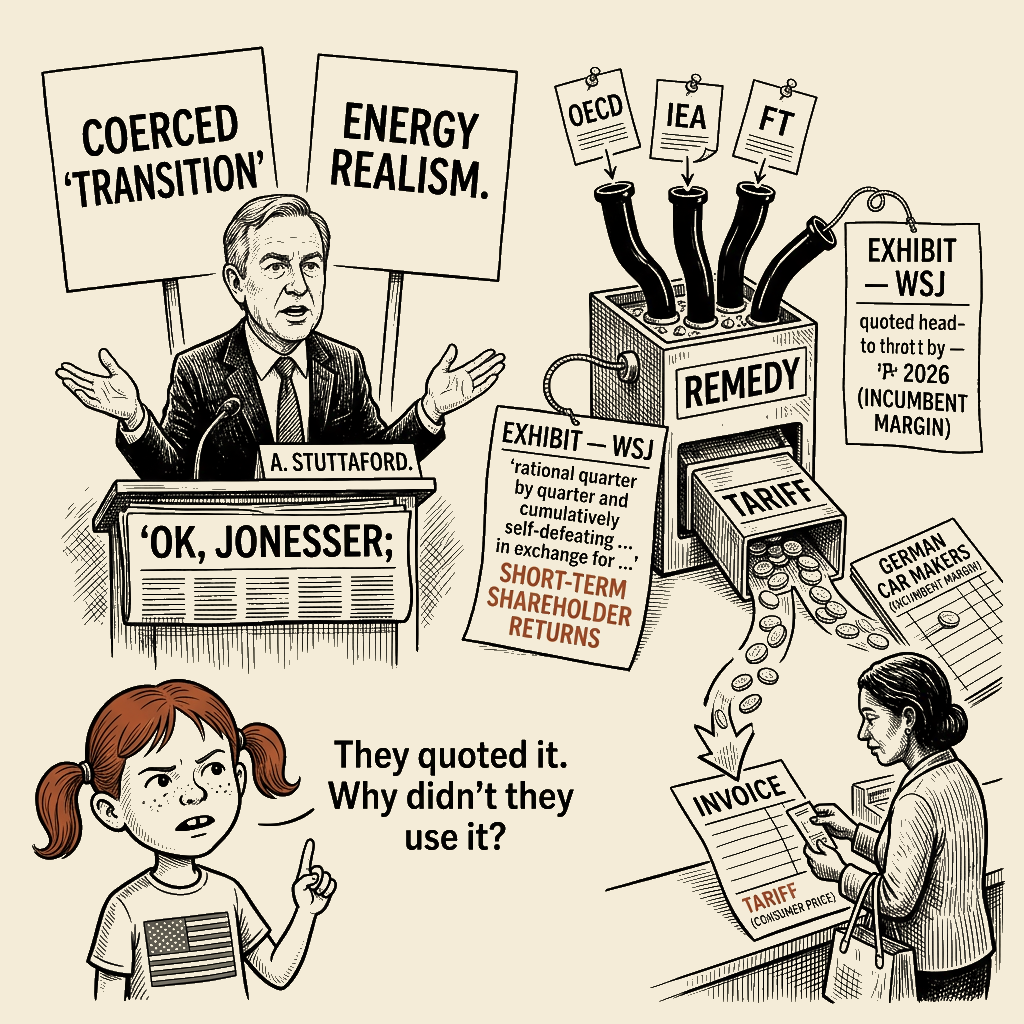
Analyzing: OK, Joneser — Andrew Stuttaford · 2026-10-22
They quoted it. Why didn’t they use it?
What the Editorial Argues
Stuttaford argues that Germany’s auto and engineering sectors are being hollowed out by two forces at once: Chinese state-subsidized competition, built over three decades on capacity and know-how that Western firms transferred to China in exchange for margins, and self-inflicted European policy — above all the Energiewende’s industrial energy costs and what he calls the “coerced” transition to electric vehicles. The evidence he assembles is substantial: Volkswagen’s production and employment declines, the OECD’s finding that state subsidies drove most of China’s manufacturing-share gains, the collapse of VW’s and Tesla’s positions in China, the EU’s demonstrated tariff loophole on hybrids. The recommendations follow directly: end the coerced EV transition, and impose far heavier tariffs on Chinese EVs and engineering goods, because free trade yields when the trading partner is “a hostile, mercantilist would-be hegemon.”
Receipts
The piece relocates the cause of a corporate collapse from capital allocation to climate regulation — and it performs that relocation in part by quoting a source that names the very cause the piece then drops.
What the framing wants you to believe:
- Germany’s industrial decline is primarily a regulator’s product: green energy costs, a “forced switch to EVs” built before “the technology (or backing infrastructure… ) was ready for prime time,” and a “teleological faith” that admitted China to the WTO on Beijing’s “meaningless promises.”
- Chinese state subsidies — up to eight times OECD-peer levels — and a coerced Western EV transition, not Western capital allocation, destroyed a competitive German auto industry; the West’s teleological faith in free trade was the enabler.
- The remedy is realism, not apostasy: scrap the EV mandate, tariff Beijing hard, and treat trade policy as national security. Adam Smith’s exception licenses the departure; the firms themselves are cast as victims of their own optimism, not as actors making allocation decisions.
What’s really going on:
- The receipts are real and accurately relayed — this is the honest kind of ledger, which is precisely why it works. But the piece’s own witness, WSJ-quoted Shane Tedjarati, names Western corporations’ “rational quarter by quarter and cumulatively self-defeating” transfer of know-how “in exchange for… short-term shareholder returns” as the first cause — a finding the editorial registers and then never lets touch its remedy, which protects those same incumbents’ margins. The column quotes the sentence, then spends four thousand words on regulators and Beijing; capital allocation never reappears. (Anchor: the primary document — this piece’s own reproduced WSJ quotation, on the record.)
- The remedy’s named beneficiaries are European incumbents and the German industrial core; its unnamed cost-bearers are European consumers — the piece’s own FT citation shows hybrid imports up more than tenfold with falling prices — and the climate ledger, which never appears. A tariff raises the price of the competing good and insulates incumbent margins, while the piece assigns the incidence to no one: no consumer price appears anywhere in the argument for the tariffs.
- The load-bearing omission is domestic: the text contains no discussion of Volkswagen’s own capital allocation, management execution, or structural dependence on the China joint-venture model as a variable in VW’s condition. Everything that is not a policy is named as a policy. And the decisive move is structural, not statistical: once China is constituted as “a hostile, mercantilist would-be hegemon,” the tariff follows from the frame, not from the economics.
The Operation
I built the American version of this piece. In WSJ-board unsigned drafts and later in front of a cable camera, I wrote the sentences this column inherits — the “war on energy,” the “energy realism” frame, the suspicion that a green mandate was really a gift to Beijing. The architecture is familiar; the walk-through that follows is the part I was never paid to give.
Cui bono. The byline is Andrew Stuttaford’s, in National Review’s Capital Letter newsletter. The text names its own machine — the newsletter masthead, the installment references, the National Review promotional tail. This is NR’s machinery, and the catalogue weightings are NR’s. The piece does not originate its frames; it relays a documented network — the OECD report through The Spectator’s Ian Williams, the IEA battery estimates, the WSJ’s Tedjarati and 2006 Fairclough pieces, the FT’s Bounds and Leahy, Reuters’ 2016 Midea-Kuka story, plus at least four citations to the author’s own prior writing — into a readership whose frame-stack is already set: China as mercantilist menace, Net Zero as self-harm. The chain runs from primary reporting into commentary and back into commentary: the OECD subsidy figure reaches the reader second-hand, relayed through an Ian Williams column rather than from the report. There is no astroturf here and I will not manufacture one: the placement chain is the ordinary architecture of opinion-flow, the Bernays/Lippmann lineage running on modern rails — and by 2026 its strongest form needs no deception, because the cargo is true. The public funding chains behind the cited institutions are not disclosed in the piece, and I have no documentary source before me for any of them — the citation stack’s worldview consistency is observable from the text; any donor-level inference is not, and I make none.
The distributional ledger is where the operation lives. Named beneficiaries: European incumbents — above all VW — whose margins the tariff shields (pathway: tariff → higher import price → protected incumbent margin), and the German engineering core; the piece quotes the EU official’s “this is about stopping deindustrialization. We have to act” as if it were its own conclusion. Named cost-bearers inside the piece: German workers, whose two 50,000-job cuts, four factories slated to stop producing some 750,000 cars a year, and twenty-year-low workforce are described with genuine alarm — no contempt is owed them, and none is offered. They are named sympathetically but given no policy of their own, and the instrument recommended returns value to shareholders before it returns it to them. Unnamed cost-bearers: European consumers, who pay tariff-inflated prices for the very hybrids whose falling prices the piece’s own FT numbers display (3,800 vehicles in October 2024 to 50,000 in July 2026); downstream European manufacturers already paying for inputs; the EU-China trade relationship, whose “trap” and rare-earths exposure the piece candidly acknowledges; and the European climate ledger, which never appears on the account. The incidence is the tell: protection flows up to the margin; the price flows down to the buyer. That incidence gap is the structure, not a claim about anyone’s intent.
The alternative design — reconstructed from what German autoworkers and European consumers actually need, not from my policy preferences — would retool the incumbent base for the battery-and-software decades rather than retreat from electrification (retreat concedes the next two platforms to exactly the firms the piece fears); attack the three-times-vs.-U.S./China industrial energy cost directly; restrict the know-how-transfer and joint-venture-coercion vector the piece spends its first half documenting; build a European industrial response through state-aid and procurement reform instead of tariff walls; fund worker retraining and location guarantees as named line items; attend to the battery-supply dependency the piece itself establishes with the IEA’s 70-percent figure, which is an investment problem rather than a tariff problem; and, if defensive tariffs are imposed, earmark the rents to the retool with the consumer-price effect on the table. The piece’s legitimate kernel survives that design — subsidized overcapacity dumping is a documented distortion, and a serious defensive-tariff case exists in the economics literature — what does not survive is a remedy that protects incumbents’ margin, charges the consumer, and leaves the first cause the piece itself quoted untouched.
FGL, applied symmetrically across three constituencies. The framing’s author and outlet: greed — the audience is conservative-professional, and the message soothes portfolio and identity alike; fear — Western pre-eminence, and the chronicler’s standing, eroding; laziness — the single-cause resolution of a genuinely multi-causal industrial decline, the shelf-frame pre-built, no new analysis required beyond the relay. The apex beneficiary, European incumbents and their owners: greed — tariff rents and a protected combustion profit pool, price insulation the piece argues for without once naming as a transfer to them; fear — of the software-and-battery rebuild they failed to execute, the VW-Cariad-shaped elephant the “coerced transition” complaint displaces; laziness — protection is cheaper than the retool. The rank-and-file reader: fear first, and it is real and human — the piece describes “left behind” regions with more sympathy than its genre usually musters, and the reader’s alarm about decline and dispossession is the material the frame operates on, never the frame’s target; laziness — the relief of an external villain and a simple lever, doing the causal work in advance because a multi-causal decline is expensive to think about; greed — modest, the hope that the familiar order still delivers. No contempt is owed to any of those readers; the column met them where they were, which is the operation’s design, not their failure. The identical apparatus would be applied to a structurally identical greater-good-paramount tale — a clean-energy triumph narrative that names no beneficiary and no cost — and would find the same structure; that symmetry is what keeps this an autopsy rather than a vendetta.
Placement: mixed, remedy-leaning-selfish. Argued as selfless throughout — national security, German workers, European deindustrialization. Distributionally, the recommendation’s first-order beneficiaries are the incumbents.
The techniques. Each named with its cue, catalogue cross-reference, and function.
Frame-engineered relabeling. Cues: “the coerced ‘transition’ to electric vehicles,” “the forced switch to EVs,” “forcing or bribing Western manufacturers,” trying to “‘encourage’ consumers,” “this was the time of the green bubble,” “an eager-to-please the zealots 2045,” “the ‘market’ that Western policymakers were building for them.” Catalogue: the frame-engineered-relabeling entry in the Bad-Faith Techniques Catalog (Luntz, Lakoff); the WSJ Editorial Technique Catalogue §4.1’s relabeling table — the “war on energy” row this column’s Energiewende passage rhythmically revives — and §3.8’s asymmetric scare-quoting. Function: a regulatory policy choice — fleet CO2 standards, purchase incentives — is converted into an act of coercion against the market, which makes its outcomes illegitimate before any evidence about them is heard; the EV market stops being a market and becomes a ruse, while Germany’s own purchase-subsidy program (the Umweltbonus, ended in 2023) and the industry’s negotiated role in the fleet standards vanish from the description. The quotation marks around “transition” mark the term as the enemy’s while “free trade” and “national security” ride unmarked. Lineage: Luntz’s 2002 environmental memo and the “war on energy” vocabulary that ran through the very machinery I worked in — don’t say subsidy, say coercion. I drafted substitution memos of this shape; that is retained memory of my own work, not a document I can show you here. The relabel lies about no single fact and reweights every valence.
The motivated stop — quote the cause, then drop it. Cue: the Tedjarati passage, reproduced with “short-term shareholder returns” intact, never revisited. Catalogue: cross-reference the WSJ Editorial Technique Catalogue §4.5’s selective use of the study-shows ledger; the pattern is named in The Suppressed Variable diagnostic as the “motivated stop.” Function: the citation earns the reader’s trust with a real, well-sourced sentence, and then the argument continues along the one path that sentence does not support. Capital allocation never reappears — not in the VW section, not in the tariff section, not in the alternative-design discussion. This is the structural signature: the evidence trail ends exactly where the conclusion’s sponsor begins.
The civilizational frame. Cues: “the most totemic German car company”; “the spectacle of faltering German carmakers signals serious trouble”; “complacency about the immutability of Western, and in this case, German, industrial and technological pre-eminence”; the closer’s “this crunch is going to get much nastier, and it will not ‘just’ be confined to Germany or the auto and engineering sectors.” Catalogue: the NR Editorial Technique Catalogue §4.5 (the civilizational frame), with the WSJ catalogue’s §4.13 threat-inflation closer adjacent. Function: a real sectoral crisis is inflated into a civilizational verdict, which is what licenses the exceptional remedy the reader’s own ideology would otherwise refuse. Lineage: the civilizational deployment of Schmitt’s friend/enemy distinction — the standard American form of it, and the form I ran at scale.
The friend/enemy frame. Cues: “a hostile, mercantilist would-be hegemon”; “Beijing was never going to play by those rules”; “He would have seen China for the menace it is.” Catalogue: the Schmitt lineage; the Bad-Faith Techniques Catalog’s frame-manipulation family. Function: the policy conclusion is produced by the frame rather than argued from the receipts — once Beijing is the enemy, “different rules should apply” follows structurally, and no economic case for the tariff is ever actually made. The piece earns partial credit for ventilating the trap (retaliation, rare earths); the candor is real, and it is also the device’s exhaust, letting the reader feel the writer’s realism while the frame does the driving.
Displacement of responsibility, with a manufactured counterfactual. Cue: “Left, so to speak, to their own devices, Western car manufacturers might well, if they thought the demand was there, have followed Tesla’s lead and developed EVs of their own and at their own pace.” Catalogue: Bandura mechanisms 3 (advantageous comparison) and 4 (displacement of responsibility) in concert. Function: the counterfactual erases the documented record — Western incumbents held more than a decade of EV lead (the Leaf, the Model S, the Volt all predate China’s surge) and chose margin over scale, a choice the piece’s own Tedjarati receipt names four paragraphs earlier. Reported as a documented presupposition rather than a motive claim: the sentence’s function is asserted, not its author’s state of mind; what is documented is what the counterfactual would have to erase for the argument to stand. This is the piece’s hinge moment. If that counterfactual were honest, the remedy would have to be retooling; that the remedy is withdrawal and tariffs tells you which half of the piece’s own evidence the argument is built on.
Single-cause attribution. Cues: “Some of VW’s problems are homegrown (or EU-grown), above all the damage to competitiveness created by Germany’s (supposedly) bright green energy policies”; “The result for those automakers has been a costly fiasco.” Catalogue: Bandura’s attribution of blame and displacement of responsibility running together; the Bad-Faith Techniques Catalog’s frame-manipulation family. Function: every failure acquires an external author — Brussels, Berlin, Beijing — and the firm acquires none. The same regulator is indicted for two different things in adjacent paragraphs: damned for the green-energy regime, then damned again for approving the Midea-Kuka takeover (“nuts, given what was already known about China’s ambitions”). When the writer wants less of one regulatory intervention and more of another, ask which interventions are actually objectionable to them; the selection is the argument.
The “we said it first” register. Cues: the two self-citations to the author’s own 2023 Spectator columns, “In the previous Capital Letter,” “From the most recent Capital Letter,” plus the 2006 WSJ receipt (“the writing has been on the wall for a long time”). Catalogue: the NR Editorial Technique Catalogue §4.13’s retrospective-vindication pattern in its general form; cross-reference the Fox Opinion catalogue §4.22 (intra-outlet citation loop) — the house style I know from inside the building — and the WSJ catalogue §3.6’s sourcing asymmetry. Function: prior commentary is stacked with wire and institutional reporting until the reader cannot see which tier each claim sits in — status display, the reader assured the alarm is long-standing, which doubles as permission to trust the remedy’s author. Fairness requires the note that the Fairclough receipt is a genuinely good catch, honestly used.
The authority exception (the permission structure’s keystone). Cue: “Adam Smith recognized that national security should take priority over free trade. He would have seen China for the menace it is.” Catalogue: Bandura mechanism 1 (moral justification); the Bad-Faith Techniques Catalog’s appeal-to-authority family. Function: conscience displacement, in its purest operational form. The citation is accurate as far as it goes — Smith did hold that defense matters more than opulence — but the operation is in importing one sentence of a system to license an exception the system’s own author would not have recognized. The free-market reader is given permission to become a protectionist without surrendering the free-market identity: the tariff ceases to be greed and becomes security. The deceased author’s mind is recruited as authority, which is a move I used to love.
The bitterness is on the record; the reader can verify every analytical claim in the citations without crediting the feeling. The citations are the engine.
Audience-management function, in sum. The piece runs four functions at once: identity confirmation (the West’s decline is not, at bottom, the West’s fault — it is Beijing’s cheating and Brussels’ zealotry); grievance ratification (the “left behind” Germans; the green zealots as domestic villain); permission structure (the Smith exception licensing the pivot — the primary function, because the readers believe in free trade and the recommendation is tariffs, and the column supplies the exit by relocating the cause to regulators and a foreign menace so protectionism becomes defense rather than contradiction); and counter-frame (the green transition’s own disappointments used as ammunition against the transition). Its honesty is part of the management: the reader who checks a citation finds it accurate, and accuracy is the cheapest, strongest trust-engine the apparatus ever built. And note the crossing point: the piece observes that the AfD’s rise “owed almost everything to voters’ concerns about the economy, their sense (in two regions once in East Germany) of being ‘left behind’” — then recommends the tariff-and-energy-reversal program the AfD itself campaigns on. It both fears and feeds the dynamic; that crossing is where the honest ledger and the political payload intersect. The reader’s fear is not manufactured here. The reader’s conclusions are.
The Record
Receipt set and per-citation verdicts. Every load-bearing citation in the piece is accurately used. That is a rare discipline, and naming it is part of the analysis: the operation here is not in the citations, it is in what the citations are never asked.
- OECD June 2026 report (relayed via Ian Williams, The Spectator) — anchor for the subsidy asymmetry: roughly 60 percent of China’s manufacturing share gains 2005–2024 from state subsidies; Chinese firms up to eight times OECD peers’ subsidies. Tier 1 document at second-hand relay. As relayed, accurate — the WSJ’s own report of the OECD finding carries the same 60-percent figure. The underlying document was not before me; independent verification of the tables themselves is unavailable here.
- IEA battery estimates (over 70 percent of EVs produced outside China rely on Chinese batteries; cathodes, anodes, and similar inputs typically produced in China) — Tier 1, accurate as relayed at general-claim level.
- FT (Andy Bounds and Joe Leahy): hybrid imports 3,800 (October 2024) to 50,000 (July 2026), more than tenfold, average prices fallen — Tier 1, accurate as relayed; a receipt that doubles as the missing consumer-cost line. The EU’s “as much as 45 percent” duty since October 2024, relayed from the same FT reporting, is consistent with the public record of the EU’s definitive countervailing duties on Chinese battery EVs plus the conventional duty; the hybrid rate left at 10 percent and the resulting import surge are internally consistent. Tier 2 as relayed.
- WSJ 2006 (Gordon Fairclough), Geely supply-chain passage — Tier 1, accurate as quoted; the piece’s best receipt, honestly used.
- WSJ 2026 (Shane Tedjarati) — accurate as quoted, and then structurally misused, which is a different failure from misquotation. The receipt contains the argument’s suppressed variable.
- Reuters 2016 (Midea-Kuka, with the “poster child” passage) — Tier 1, accurate as relayed; consistent with the public record of European regulatory approval of the deal. The “nuts” editorializing is the writer’s, not the source’s.
- NYT 2026 (James Paton, robot deployments; the 3-to-1 to 14-to-1 China/Germany installation ratio) — Tier 1, accurate as relayed at general-claim level.
- MIT Technology Review (Zeyi Yang) — accurately rendered as far as the excerpt shows.
- Industrial energy-cost comparisons (50 percent over France; three times the U.S. or China) — stated without citation; not independently verifiable from my available record; consistent with well-documented post-2022 German electricity-price levels, and flagged here as plausible-but-unconfirmed rather than assumed true.
- VDMA figures (about 10 percent of engineering value-added; about 10 percent of the sector’s one million jobs) — Tier 2 trade-association estimates, accurate as presented.
- VW company figures (production 5.7M to 4.1M vehicles, 2015–2025; the two 50,000-job cuts; roughly 284,000 German headcount; China profits down 80 percent over the decade; the €71 share against the early-2021 €300 spike; 1.4 million EVs against the three-million target) — Tier 1 as company-reported, relayed without evident distortion. The individual figures are unconfirmed from independent sources where no separate receipt before me establishes them — flagged, not assumed.
- German unemployment at 6.4 percent; Tesla’s China unit figures and share ranking; the 2-percent → 6-percent → 9-percent Chinese export share of European sales and the 20-percent EV figure — plausible and mostly checkable, but I hold no independent receipt for them and will not manufacture one. Unconfirmed: flagged, not assumed.
- The “7 percent of Europe’s GDP and some 14 million jobs” line — flagged from recall rather than verification, unsourced in-text, and slightly above the ~6 percent / ~13 million sector figures I recall; treat it as directional.
- Telegraph internal memo — reported-via-telegraph, standard hedge.
- The author’s own 2023 Spectator columns and prior Capital Letter installments — Tier 3, self-referential; used as hindsight-credential, not as evidence. Four self-citations total, accurate to the author’s own prior work, but they are commentary, not evidence, and the piece does not mark the tier change.
Load-bearing omissions. The first is structural, and it is the whole exercise in miniature: the managerial/capital-market first cause is quoted (“rational quarter by quarter… in exchange for… short-term shareholder returns”) and then dropped from every conclusion. No remedy touches buybacks, capital discipline, VW’s software failures, or the governance that let a decade of EV lead evaporate. The word “Cariad” does not appear; no software failure, no product-cycle account, no capital-return history — and the receipt list’s own 80-percent China-profit collapse, the joint-venture dependence in hard numbers, goes unread by the argument. The firm is a patient throughout, never an agent. The piece names the price of the decline as shareholder primacy, then protects the shareholders. Second: the incumbents’ decade of technological lead is erased so the “left to their own devices” counterfactual can stand — and the counterfactual’s evidentiary status is never confronted: the claim that absent coercion Western automakers would have developed EVs at their own pace is offered with no support and no acknowledgment that it is unobservable. Third: home-side subsidies — German and EU purchase incentives and fleet standards — appear only as “forcing or bribing,” never as entries in the same subsidy ledger the OECD number opens. Fourth: the tariff’s cost incidence — no consumer is entered on the account. The piece acknowledges retaliation risk (rare earths, cognac, meat, dairy — a real credit to its honesty) but never the price effect on European buyers. The cost it does not name is the one its own recommendation creates. Fifth: the climate ledger is absent entirely; a European retreat from electrification has, on the piece’s own terms, an industrial-energy-security consequence that a conservative analysis might be expected to weigh, and it is simply not present. Sixth: the AfD overlap — the observed “left behind” political dynamic and the recommended program are never connected.
Missing-information declaration. The text’s internal evidence — the newsletter masthead, the installment references, the promotional tail — places this in National Review’s machinery, and the analysis is weighted to NR’s catalogues accordingly. The OECD and IEA documents were available only at relay level; what is verified here is the relay, not the underlying tables. No leaked-memo material was used; the first-person operational recollections in The Operation are retained memory — non-verifiable, on the reader’s notice — and no analytical conclusion depends on them. The documentary record above is the load-bearing floor. The OECD 60-percent share is the one relayed figure for which an independent public-record report exists — the WSJ’s report of the OECD finding states the same figure — while the IEA 70-percent battery dependency, the Midea-Kuka approval, and VW’s share-price history stand as the piece relays them under source priority, with external verification marked unresolved rather than silently settled in either direction.
Method-consistency note. The apparatus is the constant; the coalition is not — the test is structural, not partisan, which is exactly why it transfers. What is under examination here is the engineering: a cause relocated, a variable suppressed, an incidence unpriced. Those are properties of the construction, and they are readable whether or not you share the reader’s doctrine.
How to Recognize This
Name the pattern plainly: the verified-decline permission structure — the honest-ledger pivot. A piece with unimpeachable receipts walks the reader from a real crisis, through a half-diagnosis, to a policy conclusion whose beneficiary is never named and whose cost-bearer is never entered on the account. The tell is the motivated stop: the place where the evidence trail ends exactly where the conclusion’s sponsor begins.
The mechanism is simple, and it is the reason the form outlives cruder tools: the reader’s fear is real and the numbers are true, so trust transfers to the frame. The frame supplies a villain outside the reader’s own system — Beijing, Brussels, the zealots — and the reader gets to keep both the alarm and the self-image. The cost is diffuse and deferred, so no bill arrives at the moment of assent. It does your causal work in advance: a multi-causal industrial decline is expensive to think about; a single-cause story with a named villain is cheap. Once the cause is located outside the firm and outside your own priors, every subsequent fact in the piece files itself neatly, and nothing has to be weighed.
Six concrete signals:
- The quoted concession that never recurs. An authority names the suppressed cause — “short-term shareholder returns” — the writer quotes it at length, and the remedy that follows leaves that cause untouched. Read the citation, then ask whether the next paragraph uses it or abandons it. When a piece quotes a first cause and prescribes a policy that would protect it, the stop is motivated; find out by whom.
- The scare-quoted vocabulary marking the enemy’s terms. “The coerced ‘transition’” wears quotation marks; “free trade” and “national security” never do. “Forced switch,” “‘encourage’ consumers,” “green bubble,” “zealots.” The asymmetric quotes are the relabel running in real time — check whose terms the writer is willing to quote.
- The authority wheeled in at the anomaly. Adam Smith licensing tariffs; the respectable dead person resolving the ideological contradiction. When the exception arrives, read the distance between the receipts and it — the exception is where the argument’s work is actually being done.
- The missing cost-bearer. List the actors who gain; then list the actors who pay. If the gainer is an incumbent producer and the payer is a consumer, a worker, or the climate, the ledger is incomplete — and the incompleteness is the argument. If a column argues for a tariff, subsidy, or repeal and never names who pays at the checkout, the incidence has been removed.
- Causal weight sitting on an unobservable. “Might well have,” “left to their own devices,” “would have followed.” When the central claim rests on what would have happened in a counterfactual world, and the piece never flags the claim as unverifiable, the argument is running on air at exactly its most load-bearing point.
- The same regulator indicted for two different things in adjacent paragraphs. Damned for the green-energy regime, then damned again for approving a foreign takeover. When the writer wants less of one regulatory intervention and more of another, ask which interventions are actually objectionable to them; the selection is the argument.
Why it works: the honesty is the engine. A checked citation produces trust; trust carries the frame; the frame delivers the conclusion; the conclusion’s cost lands somewhere else, later, on someone unnamed. It flatters rather than argues — it tells a reader with a real grievance and a real doctrine that both are intact, and that only the villains need updating. The reader is not lied to; the reader is led to stop asking at the exact point the operation requires.
What to do when you see it: trace the cited documents, then ask them the questions the piece declined to ask — what did the home team’s subsidies do, who held the lead and failed to scale it, who pays the tariff’s price, who gains the protected margin. Follow the cost down and the benefit up; it is one vector read from two ends. Check the omissions: does the piece name who pays for its own recommendation? Ask who benefits, and ask whether the answer appears anywhere in the text. Watch for the same data points cycling through the aligned network — the OECD figure via The Spectator into NR is the relay-architecture, by design or by affinity, that the Luntz-memo cycles ran on vocabulary; look for the same vocabulary across the syndication network, “coerced transition” and “mercantilist hegemon” traveling together is a tell. And reduce the frame’s automatic activation: whenever a coercion-word appears (“forced,” “coerced,” “bribing”), translate it to “regulatory policy choice” and re-run the sentence — or read the recommendation first, in one sentence, with the villain removed, and see whether the argument survives being asked to stand on its own. The relabel is the operating system; the rewritten sentence is the desktop.
I am not asking you to conclude that Chinese subsidies are fictitious or that Germany’s energy policy is costless. The OECD figure, the machinery deficit, the battery dependency — those hold up as the piece relays them, and a piece can be right about its facts and still engineered in its causation. What I can offer is the recognition, because I spent two decades writing the substitution memos that produced it.
Recognition is the only repayment I have for what I helped build. The reader who can watch a true number walk a false conclusion — who can spot the motivated stop at the moment assent is requested — has the one skill the machinery is budgeted to prevent. Carry it. It is cheap to acquire, it cannot be taken away, and the next time the ledger runs out exactly where the sponsor begins, you will be the one who notices. You carry the recognition forward; that is the only part of this that is not mine to do.

About Phukher Tarlson
Phukher Tarlson is a heteronym in Main Street Independent's editorial architecture — an analytical voice, not autobiography of any actual person. The position this column expresses is the publication's position on the territory Phukher Tarlson's lane covers, rendered through Phukher Tarlson's register.