Analyzing: About Those GOP Gerrymanders — Kimberley A. Strassel · 2026-10-22
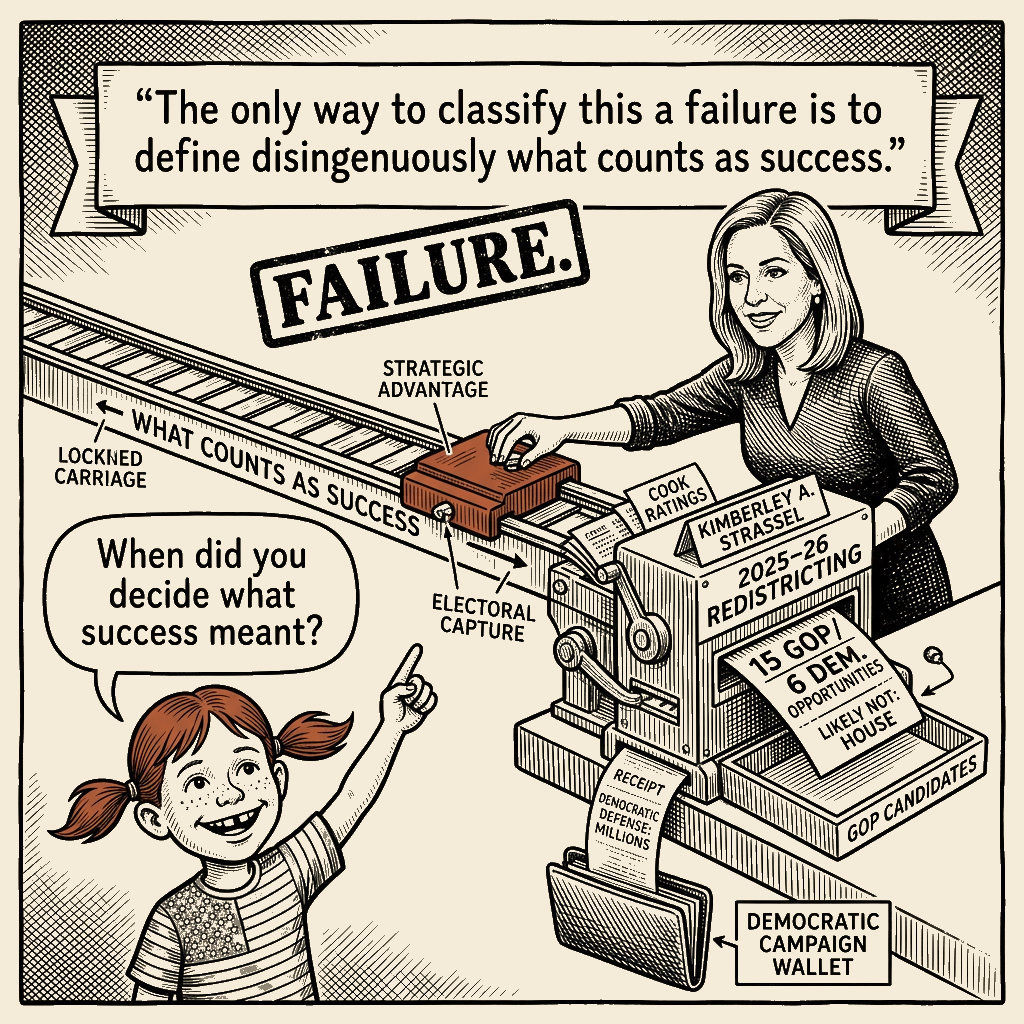
When did you decide what success meant?
What the Editorial Argues
In her Oct. 22, 2026 Wall Street Journal editorial “About Those GOP Gerrymanders,” Kimberley A. Strassel argues that Republicans’ 2025–26 redistricting has already succeeded operationally even if the party fails to capture every new district or retain the House. Her measure is relative rather than maximal: the map creates Republican pickup opportunities, forces Democrats to spend scarce money on defense, and may gain value in a more favorable electoral environment; she concedes that Texas’s 15th District may endanger Monica De La Cruz and that gerrymandering breaks norms, breeds litigation, and diverts attention from policy. She also argues that Democrats redrew in only California and Utah while Republicans acted across red states, and predicts both parties will rush back into midcycle mapmaking before 2028 unless voters intervene.
Receipts
The editorial moves the scorecard after the verdict has been rendered, converting forecast evidence of strategic advantage into a declaration of electoral success.
What the framing wants you to believe
- The Republican map has already succeeded because it creates new pickup opportunities and makes Democratic defense more expensive; retaining the House was never the proper measure of success.
- The press has pronounced a “failure” that exists only because it substituted electoral capture for the narrower objective Strassel says the map achieved.
- Cook Political Report ratings establish an inventory of 15 Republican opportunities against six Democratic opportunities, while the editorial’s concessions and normative warnings can be absorbed without disturbing that verdict.
What’s really going on
- The protected beneficiary is the Republican Party and its candidates; Democratic campaigns and candidates bear the defensive cost. The pathway is concrete: redrawn districts create defensive obligations, defensive spending consumes money that could have financed expansion elsewhere, and the resulting map gives Republicans additional pickup opportunities.
- The load-bearing omission is any before-and-after model of the maps: no district-by-district comparison, common-district analysis, or election data shows how much of the claimed advantage comes from the lines rather than the intervening national environment.
- The core anchor for the editorial’s account of the prevailing verdict is Reuters’s “How the Republican redistricting gambit faltered” and the Associated Press’s description of a “small advantage” threatened by the “national political environment,” both quoted in the editorial. Cook is a Tier-2 forecast receipt for the opportunity counts; neither source establishes that Republicans will capture those seats.
The Operation
Triage and placement. This is a signed WSJ editorial by Kimberley A. Strassel, not an unsigned board voice. Its domain is congressional redistricting; its archetype is an adaptation of the WSJ Editorial Technique Catalogue’s “study shows” ledger, here converted from studies into election ratings. The position is mixed in statement and selfish in operation: Strassel’s objection to judging an operation before defining its benchmark is legitimate, but the benchmark selected protects Republican electoral advantage while isolating the costs of the mapmaking from the verdict.
Institutional authorship and placement chain. Strassel authored the frame. The supplied text discloses no donor, foundation, or think-tank chain, and none should be invented. The visible chain is rhetorical rather than financial: the WSJ editorial quotes Reuters, Punchbowl, and the Associated Press for their verdict language; Cook Political Report supplies the technical-looking scorecard; the result is a packaged argument that converts media defeat headlines into proof of Republican success. The sources are not coauthors, and the record does not establish coordination among them.
Who benefits, and by what pathway. The Republican Party and Republican candidates gain through more favorable districts, defensive burdens on Democratic campaigns, and infrastructure that may become more valuable when the national environment improves. The editorial’s own figures describe that pathway: 15 Republican pickup opportunities against six Democratic opportunities; ratings for 12 of the 15 Republican opportunities; three described as effectively locked in Alabama, Louisiana, and Tennessee; and Democrats spending “millions” to defend Representative Don Davis in North Carolina’s First District after the district moved from a three-point edge to a 12-point Trump advantage. The editorial’s money-is-the-mechanism claim is that every dollar spent preventing a flip is a dollar unavailable for another opportunity.
Who bears the cost. Democratic campaigns bear the documented spending and opportunity costs. The public and its representative institutions bear the editorial’s acknowledged costs—norm erosion, endless litigation, and diversion from policy—although the piece quantifies none of them. The distributed benefit therefore remains concentrated while the distributed cost is deliberately less legible. The four critical questions survive scrutiny: the beneficiary has a concrete power-and-resources pathway; no richer donor class can be named without evidence; the campaign costs have an identifiable payer and use; and the fear-greed-laziness analysis below is applied across three constituencies rather than only the beneficiaries.
Alternative design. If Strassel’s premise is that redistricting changes campaign incentives, then the operation should be evaluated with a benchmark fixed before Election Day: publish the old and new maps, calculate partisan lean district by district, disclose Cook’s methodology and forecast history, measure defensive and expansion spending, separate structural map advantage from actual seat capture, and apply the same legal and statistical standards to both parties’ maps. That is not an ideological reversal. It is the design her own operational criterion demands. The omitted evidence is not peripheral; it is the exhibit that would decide whether the claimed advantage exists in the way the editorial says it does.
Fear, greed, laziness—applied symmetrically. These are incentive pressures, not diagnoses of private motive. For the framing author and publication, fear is the risk of allowing an adverse verdict to stand; greed is the appetite for vindication and Republican institutional advantage; laziness is the convenience of not constructing the before-and-after model. For the apex beneficiary—the Republican Party leadership and candidates—fear is the prospect of losing the House, greed is the value of durable seat infrastructure, and laziness is the absence of any incentive to disclose causal uncertainty before the votes. For the reader, fear is being fooled by whichever press verdict arrives first, greed is the appetite for a clean winner-and-loser story, and laziness is the convenience of not opening the maps or examining the forecast method. Apply the same omissions to a Democratic map and the reader should apply the same skepticism.
The technique stack
Benchmark substitution — Bad-Faith Techniques Catalog, bf_catalog: goalpost_shifting (adjacent match). The cue is Strassel’s sentence, “The only way to classify this a failure is to define disingenuously what counts as success,” paired with “No” when asked whether Republicans will capture every district and “Likely not” when asked whether the map will keep the House. The catalog’s formal entry concerns a moving burden of proof; here the thing moved was the definition of electoral success, so the match is adjacent rather than exact. Operationally, the editorial concedes that the maximum prize will not arrive, then selects a friendlier scorecard so the concession cannot defeat the preferred conclusion.
Manufactured opposition — Bad-Faith Techniques Catalog, bf_catalog: strawman (partial match). The hinge is “an obituary for a straw man.” The editorial isolates trigger words—“faltered,” “whiff,” “not going as planned,” and “small advantage”—then attributes to the coverage the proposition that a gerrymander succeeds only if it elects a Republican House. This is the source-citation asymmetry described in the WSJ Editorial Technique Catalogue §3.6: contrary judgments are quoted for their conclusion while the reporting beneath them is stripped away. The match remains partial because the full Reuters, Punchbowl, and Associated Press reports are absent from the source packet; what can be established is that Strassel alleges this substitution and constructs a rival claim, not the media’s full reasoning.
Forecast ledger — WSJ Editorial Technique Catalogue §4.5, the “study shows” ledger adapted to ratings. The cues are Cook’s “solid R,” “likely R,” “lean R,” and “toss up” labels; the 15-to-6 opportunity count; and “Imagine the map without them.” “Forecast laundering” is a descriptive label for this maneuver, not a canonical catalog identifier. Cook’s judgments are converted from forecasts into a scorecard and then from a scorecard into proof of map success. The editorial does not pretend every toss-up is a Republican victory—it says only three are effectively locked in—so the operation lies elsewhere: it uses an inventory of forecast-selected opportunities to prove the maps’ strategic worth without showing the methodology, denominator, or counterfactual model.
Anticipatory concession and inoculation. The cues are “None of this is to suggest the gerrymandering wars are good for the body politic,” the admission that Republicans probably will not keep the House, and the Texas 15th exception. This is a descriptive technique label rather than a claimed separate catalog entry. The concessions are armor, not qualifications: each objection is displayed so it cannot be presented as a concealed weakness, then denied independent power over the verdict. Norm damage, litigation, policy diversion, and even the possibility of losing the House become reasons the project remains successful, rather than costs that could defeat it.
Moral justification — Bandura’s mechanism. The cue is the claim that Republicans “dared” to gerrymander red states “as aggressively as Democrats had already gerrymandered blue ones.” The comparison supplies moral cover: Republican mapmaking is recoded as parity, restoration, or an answer to Democratic misconduct. It does not establish equivalent harm or equivalent law. It makes escalation available as reciprocity before the maps receive scrutiny.
Threat-inflation closer — WSJ Editorial Technique Catalogue §4.13. The cue is the list of nine states expected to reopen redistricting before 2028, followed by “The gerrymandering wars will continue. Until the voters say ‘enough.’” The editorial supplies no enacted plans, legislative commitments, or evidence of the votes required; the certainty is rhetorical. The closer turns forecast escalation into inevitability, produces a quotable warning, and then offers voters an abstract brake while assuring them that neither organized party will stop.
The Bernays–Lippmann lineage appears in a modest form: expert scoring lends institutional authority, while a complicated mapmaking process is compressed into a portable public label—“failure” or “success.” Nothing in the supplied record supports a charge of sponsor-controlled manufactured controversy. The operation is visible without inventing a conspiracy.
I drafted arguments of this shape: concede the strongest adverse fact, move the scorecard, and allow the concession to prove the preferred conclusion. The point is not that every argument so constructed is false. The point is that the move changes what the evidence must prove.
Audience-management function. The editorial supplies a permission structure: a reader can support the Republican map without resolving the normative cost because the cost is acknowledged but denied a vote. It provides identity confirmation and grievance ratification by casting the left and media as resentful censors of Republican success. Cook and the 15-to-6 ledger provide status display: the reader receives the satisfaction of possessing a more sophisticated benchmark than the press. “Obituary for a straw man” is the counter-frame. And “not good for the body politic” performs conscience displacement: the objection survives intact but cannot affect the conclusion.
The Record
The record supports the maps’ strategic operation. It does not support the editorial’s declaration of electoral success.
Wire and media receipts — Tier-1 source class in excerpt. Reuters’s “How the Republican redistricting gambit faltered,” Punchbowl’s references to a possible “whiff” and Florida being “not going as planned,” and the Associated Press’s “small advantage” affected by the “national political environment” establish the language Strassel attributes to those outlets. Attribution verdict: the supplied text quotes them consistently with the source packet. Independent-verification limit: the underlying reports were not provided, so their full evidentiary foundations cannot be assessed.
Cook Political Report — Tier-2 forecast receipt. The editorial reports ratings for 12 of 15 Republican opportunities, from “solid R” through “toss up,” and six Democratic opportunities in California and Utah. These figures support an inventory of forecast-labeled opportunities. They do not establish how the districts will vote, what methodology generated the ratings, how the selected opportunity universe was constructed, or how much of the apparent advantage is caused by the maps rather than the national environment.
North Carolina’s First District — mixed evidentiary strength. The reported movement from a three-point edge to a 12-point Trump advantage supports the narrower proposition that the district’s partisan terrain was redrawn. The reported Democratic spending of “millions” supports the proposition that defense has become expensive. No map file, election table, campaign-finance filing, spending total, or comparison with other campaigns was supplied.
The 2018 and 2026 territorial comparison — historically plausible but not isolated here. The editorial reports that Republicans ran in 23 districts Hillary Clinton won in 2016 and 42 districts Donald Trump carried with less than 50 percent; Democrats flipped 32 seats in a net gain of 40. It counts 23 Democrats running in districts Trump won in 2024 and eight Republicans running in Kamala Harris locales. Those figures show that the parties are contesting different territory. They do not isolate the effect of the new maps from the intervening national environment, candidate decisions, incumbency, or the changed locations of competitive districts.
Texas’s 15th District — editorial account only. Strassel identifies Monica De La Cruz’s race against Bobby Pulido as the acknowledged Republican vulnerability and describes a substantially changed constituency containing disaffected Hispanic voters. No polling, ballot data, precinct results, or candidate filing was supplied. The example establishes the editorial’s concession, not its electoral magnitude.
The coming redistricting cycle — forecast, not receipt. The editorial names nine states expected to reopen redistricting before 2028: Colorado, Georgia, Indiana, Kansas, Maryland, Missouri, New Jersey, New York, and South Carolina. It presents them without enacted plans or documented commitments.
The following claims remain tagged:
- [unconfirmed: convergence threshold not met] That defensive spending in North Carolina has materially displaced money from expansion opportunities; no total spending or counterfactual is provided.
- [unconfirmed: convergence threshold not met] That the new maps caused the Republican opportunity advantage independently of candidate placement, incumbency, and the national environment.
- [unconfirmed: convergence threshold not met] That both parties will rush into another round of redistricting before 2028.
The load-bearing omissions are the old and new maps; precinct-level and district-level election data; a common-district comparison; Cook’s methodology and historical forecast record; the full media reports; the governing legal standards and relevant court records; total campaign spending and the resources displaced; and a quantified account of litigation and policy diversion.
The missing-information declaration is narrow: the full wire reports, Cook rating table and methods, official returns, map files, court documents, and campaign-finance records were not obtainable from the supplied packet. No leaked memo was used, and no gap was filled with an invented number or document. The operator recollection above is used only to recognize the rhetorical machinery, not as evidence for a checkable claim about this editorial.
That is the operation: not a pile of invented numbers, but a change in what the real numbers are permitted to prove. Forecast ratings become victories, defensive spending becomes a causal mechanism, historical analogy becomes proof of present effect, and projected escalation becomes inevitability. The record supports the first claim—mapmaking has changed the campaign terrain. The editorial needs the second—electoral triumph—to turn an acknowledged political project into a coronation.
How to Recognize This
The pattern is the false obituary: a verdict arrives before its metric, and then the metric is moved to fit the preferred conclusion.
Four textual signals
- The verdict precedes the benchmark. The project is declared “failed” without first fixing what failure would have meant.
- The maximum outcome displaces the actual one. Failure to retain the House becomes failure of the map, even after the editorial admits that retaining the House was never the necessary result.
- Forecasts and analogies are made to carry electoral conclusions. Rating categories, a selected opportunity count, and a historical comparison substitute for returns and a controlled before-and-after comparison.
- Objections are displayed, then quarantined. “Not good for the body politic,” litigation, policy diversion, and the danger to De La Cruz are conceded without being allowed to count.
The mechanism is cognitive activation. “Failure” is cheap to understand and expensive to dislodge. Once activated, readers begin searching backward for evidence that fits the verdict instead of testing the verdict against the original promise. Authority labels provide apparent closure; anticipatory concessions prevent bad-faith accusations; the civilizational warning keeps the stakes emotionally high; and the beneficiary receives moral permission without having to absorb the stated cost.
It works because the argument supplies every emotional comfort the reader needs while postponing the hard accounting. The bad outcome becomes someone else’s bad judgment. The successful metric becomes one chosen after the fact. The normative damage remains visible in the editor’s conscience but absent from the scorecard.
When you see the pattern, do five things. First, recover what was promised and when the benchmark was fixed. Second, trace the cited forecast or study: its sponsor, funding chain, methodology, assumptions, and past errors. Third, demand the omitted counterfactual—the old map, the new map, the common districts, the actual returns. Fourth, ask who benefits through a concrete pathway and who pays in money, time, freedom, or institutional decay; then apply the same standard to the other side. Fifth, watch for the same vocabulary across the media, think-tank, foundation, and syndication network. Terms such as “failure,” “success,” “straw man,” and “war” are often where coordination becomes visible.
Then reduce the frame’s automatic activation. Write the underlying factual proposition without the verdict words: how many districts changed, under what metric, with what forecast uncertainty, at what spending cost, and under what legal standard. If the conclusion survives that translation, good. If it requires the emotionally loaded labels to stand up, the labels are doing the work the evidence has not done.
I drafted arguments of this shape. That gives me standing to recognize the wiring, not to certify this diagnosis beyond the record; the missing reports remain missing, and a better-built operation can still fool me. The work is not suspicion. It is accounting: fix the scorecard before accepting the verdict, keep the omitted cost in the room, and recognize the operator’s first move—concede the fact, move the measure, and call the concession proof of strength.
The verdict was made before the ballots. The reader’s task is to make the scorecard visible before the verdict hardens.

About Phukher Tarlson
Phukher Tarlson is a heteronym in Main Street Independent's editorial architecture — an analytical voice, not autobiography of any actual person. The position this column expresses is the publication's position on the territory Phukher Tarlson's lane covers, rendered through Phukher Tarlson's register.