Analyzing: Canada’s Trump Fixation Fades — John Fund · 2026-10-25
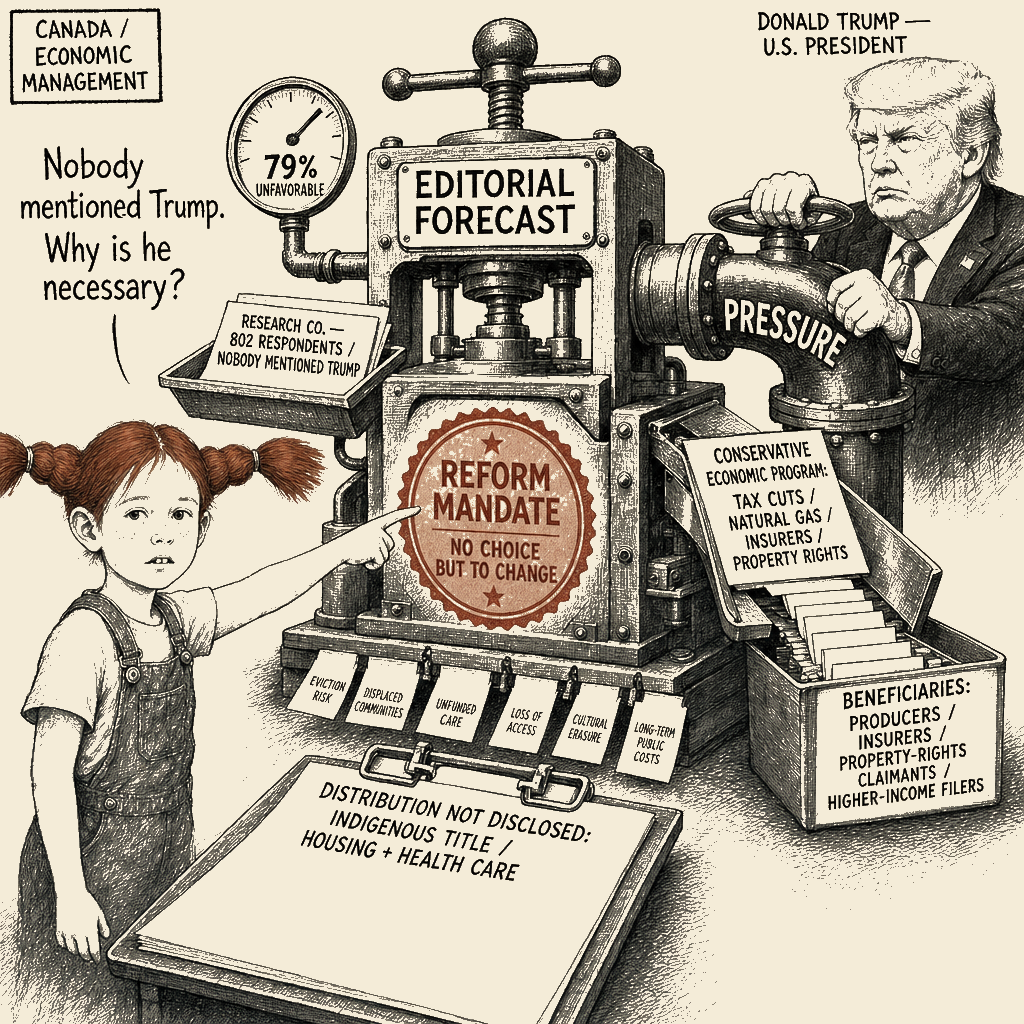
Nobody mentioned Trump. Why is he necessary?
What the Editorial Argues
The editorial contends that Canadian politics has moved past Donald Trump: David Eby’s Trump-centered campaign in British Columbia collapsed, the Conservatives took roughly two-thirds of the legislature’s seats, and polling put the economy ahead of every other concern; from that, Brar declares, “Anti-Trumpism is no longer a viable platform provincially,” and the piece argues the drift is fading nationally. It then makes the larger claim: the American model’s superior productivity, investment, and GDP per person have exposed Canadian complacency, and Trump—whatever else he is—is the instrument that will force reforms Canadians need: lower taxes, more competition, more natural-gas production, and a firmer defense of private property. It closes on the possibility that Canadians will one day thank the president for “shocking them out of a slumber,” because his comparison of Canada is both cruel and sensible, and the shock, whatever its manners, is doing necessary work. The underlying case deserves a steelman: the reported Canadian performance gaps and documented interprovincial barriers describe real weaknesses, and something in that performance has to be fixed.
Receipts
The editorial takes an election result, a polling omission, and real Canadian economic weaknesses and fuses them into a forecast: that Donald Trump’s coercion is the instrument that will force Canada to reform.
What the framing wants you to believe
- Canada is finished with Trump. After Eby’s defeat, Brar declares, “Anti-Trumpism is no longer a viable platform provincially,” and the piece asserts the same drift is visible nationally—while an Angus Reid poll reproduced in the piece says 79 percent of Canadians still view Trump unfavorably.
- What Canadians actually want is economic management: an income-tax cut, more consumer choice in auto insurance, increased natural-gas production, and a rollback of the “anti–private property elements of the province’s policies on Indigenous People.”
- Trump himself is not the point; his pressure is. Canada is a “51st State” on the key measure, and what looks like coercion is really a service: Canadians may one day thank the man who is “shocking them out of a slumber,” and until they do, they have “no choice but to change.”
What’s really going on
- The beneficiaries are concrete, and the piece names them itself: the Conservative economic program and, through it, the interests a tax cut, lighter provincial regulation, expanded natural-gas production, insurance liberalization, and a hardened property-rights line are designed to serve. Trump’s coercion supplies the urgency that makes that package look necessary rather than merely advantageous.
- The costs land on constituencies the piece never polls, cites, or consults. Indigenous communities are the stated object of the property-policy rollback, and they appear nowhere in any exhibit; so do the households who named housing and health care as their actual concerns and were never asked which remedy they wanted.
- The load-bearing omission is consent itself. The record shows an election lost, an economy ranking first among voter concerns, a president at 79 percent unfavorable, and a bilateral thaw. It does not show a referendum on Trump. Survey salience is not a mandate; one provincial result is not a national ideological trend; coercion is not a policy instrument. The editorial’s own anchor is the Research Co. survey of 802 respondents: “We spoke to 802 people; nobody mentioned Trump.” Nobody mentioned him. That is the finding.
Against the Bad-Faith Techniques Catalog, the piece runs equivocation at the hinge—“economic management” slides from a description of voter concern to the name of one specific program—affirming the consequent in the election argument, and false dichotomy at the close: either Canadians reform themselves, in which case Trump is decoration, or Trump is the necessary agent of reform.
The Operation
This is not a crude piece of fabrication. The poll exists. The election result exists. The economic figures exist, and several of them are serious. The trick is to move each fact one notch beyond what it can bear, and to move all of them in the same direction.
I built machines like this one. I ghostwrote unsigned board pieces for the Wall Street Journal editorial page whose spines were a study, a survey, or a market comparison, and whose conclusions were supplied by the page rather than by the evidence; I sat in the focus-group debriefs where the vocabulary was tested before publication. This is the same apparatus with better numbers, which is why it is harder to see.
Causal substitution — chronology impersonating causation. The sequence is: Eby talks about Trump, Washington imposes tariffs, an election arrives, Eby loses. The sequence is accurate. The causation is smuggled in. The formal pattern is affirming the consequent: if this election had been a referendum on Trump, we would expect anti-Trumpism to collapse; anti-Trumpism collapsed; therefore this was a referendum on Trump. Alternative causes are never ruled out—Eby’s record, housing, health care, his campaign, his party’s governing record. The editorial has conducted one referendum, and it was on Eby.
The equivocation hinge. The hinge sentence is “Missing from the list was Trump.” The Research Co. survey concerns priority. The editorial needs consent. A voter who did not volunteer Trump’s name may have regarded him as harmful, irrelevant, temporary, or simply less urgent than housing—four possibilities, none of them approval. The formal pattern is equivocation: “economic management” means one thing when Research Co. ranks it first among concerns, and another thing when it becomes the Conservative program of tax cuts, insurance liberalization, resource expansion, and property-rights rollback. The editorial arrives with the menu already chosen and inserts it into the blank the survey left.
Typography performing the verdict. Eby’s words—“existential threat,” “threatening our sovereignty,” “firebreak,” “join us saying ‘hell no’ to Trump and to his politics”—are placed in quotation marks, so that they read less like political language than like symptoms of a disorder. The editorial’s own judgments—socialist, humiliating, badly miscalculated—carry no quotation marks at all. They are presented as self-evident description. This is the asymmetric scare-quote management documented in the WSJ Editorial Technique Catalogue §3.8, applied with the quotes on the opponents’ side of the ledger, which is the more consequential deployment.
One province, one election, one continent. The move from Eby’s defeat to Brar’s declaration—“Anti-Trumpism is no longer a viable platform provincially”—and then to the claim that it is waning nationally is a general conclusion drawn from a single salient case. The formal pattern is hasty generalization: the catalog’s detection signals are a generalization supported by a single case and an absence of denominator language. For its affirmative national claim, the piece rests on an 802-respondent British Columbia survey plus a commentator’s line of opinion, and Brar’s assessment is recruited as a finding rather than as commentary. The national-trend claim remains unconfirmed.
The credential stack. Pew, Angus Reid, Research Co., the IMF, the World Bank, The Economist, Carney, Brar, Charest—each contributes a piece, and the pile is arranged so the conclusion looks like the residue of the evidence rather than a conclusion bolted onto it. The WSJ Editorial Technique Catalogue calls this the technocratic-credential ledger (§3.7) and the “study shows” ledger (§4.5): the citation leads, the methodology is not at issue, the funding is not at issue. The lineage is Bernays’s engineered consent through credentialed authority and Lippmann’s interpreter role—sources are made to carry a conclusion that the arrangement, rather than any source, supplies.
Pew’s finding that only 17 percent of Americans call relations with Canada cold is read as ideological movement when it is largely a measure of disinterest. The Economist’s characterization of Canadian firms “sheltered from competition by thickets of regulation cultivated by provincial governments” is a real argument from a serious publication, and it is made to do work it cannot do. And the piece’s own source-citation asymmetry (§3.6) is on display: the inconvenient data is cited and then bypassed.
The polling substitution. The piece needs four propositions at once—Canadians dislike Trump, approve of Americans, reject the trade war, and have voted for economic reform—and treats the inconsistency among them as agreement. The piece’s own explanation for the thaw is that “ordinary people don’t care deeply enough about trade wars to change their views of the other country.” Take that concession seriously and the thaw is apathy, not conversion, which destroys the claim the piece needs: if there was never a national platform of anti-Trumpism, there is nothing that has been defeated, and the Conservative mandate was won on housing, health care, and the economy rather than on Trump’s blessing. The piece needs the concession and cannot afford it.
The recoding of the coercion. This is the operation the whole piece is built to deliver. Trump goes from the author of the pressure to the author of the cure. The frame-engineered relabeling technique carries the Luntz-Lakoff lineage the WSJ Editorial Technique Catalogue §4.1 tabulates: the general substitution of tax cuts as relief and deregulation as “competition,” followed, in this piece, by the sharpest instance—Indigenous land and title claims relabeled as the “anti–private property elements of the province’s policies on Indigenous People,” so that a claim about land reads as hostility to owners and the direction of the claim inverts without a word changing.
Bandura’s mechanisms run in concert here: moral justification—the harm serves a higher cause, Canada’s economic renewal; euphemistic labeling—the harm becomes a “shock” and a “slumber”; displacement of responsibility—the agent of coercion dissolves into an impersonal “telling us we have no choice”; distortion of consequences—the harm of the threat is redescribed as its own benefit. The omitted relation is consent: what Canadians said they wanted to prioritize is separated from what a Canadian government can do without Trump. The protected beneficiary is the Conservative economic program and the interests behind it. The normalized harm is coercion itself, redescribed as the necessary catalyst. No coordinating memo appears in the public record. The catalogue documents the technique at the register level, but the record does not establish that any particular substitution was directed.
The hinge, and the close. The piece concedes that the 51st-State description is “cruelly and senselessly” put—and then keeps the comparison and the shock. It does not need Trump to be right in his tone. It needs only that the comparison be true and the coercion have been useful. Everything after the concession is the second half.
At the end, The Economist supplies a question—“Can Donald Trump’s bullying goad Canada out of its complacency?”—and the piece treats it as a finding; Charest supplies a conditional hope—“may one day thank”—and the piece promotes it to a present command; the closing sentence, “Trump is now telling us we have no choice but to change,” converts contingency into fate. The formal pattern is false dichotomy: reform voluntarily, in which case Trump is decoration, or reform under pressure, in which case he is the agent. The WSJ Editorial Technique Catalogue §4.13 names the shape of that closer, the threat-inflation closer, where a provincial result is inflated into national-historical compulsion.
The piece also adopts the posture the NR Editorial Technique Catalogue §4.1 documents as “stands athwart history”—the sober adult in the room against the shouting—from the side of the coalition that just took two-thirds of the seats and is about to govern. The catalogue’s own caveat applies: that posture is honest only when the position is actually marginal, and this one is about to hold the province. And here is the contradiction at the center: Trump is supposedly losing his hold while serving as the editorial’s indispensable man—the explanation for the election, the polling, the tariffs, the investment gap, the GDP gap, and the reform to come.
Who benefits. Institutional authorship. The framing is not this piece’s invention; it is the standard conservative-liberal program—tax relief, regulatory relief, resource expansion, property-rights enforcement, and the American model as the benchmark—carried in the register the catalogues document. The placement chain is explicit: the provincial election supplies the occasion and prospective mandate; the Conservative program supplies the beneficiary; polling, international comparisons, and institutional authority supply the warrant; Trump supplies the shock. The piece is not forecasting a mandate. It is explaining one it expects to inherit. No donor chain or commissioning document is in the record, and none is asserted.
Distributional impact. Beneficiaries: the interests behind the program—natural-gas producers, insurers, property-rights claimants, and the higher-income filers the income-tax cut is designed to serve. The program’s magnitudes are never given, which is itself the omission, because a distributional claim requires a denominator. Cost-bearers: Indigenous communities, named as the object of the rollback and absent as a voice from every exhibit, and the households whose housing and health-care concerns the survey actually surfaced, who are never told what the program would do to their costs. The entire economic case is aggregate—productivity, investment, GDP per person—and it never once runs the argument at the level of a household or a community.
Alternative design. Optimized for its stated rationale rather than its hidden beneficiary, the same program would target interprovincial barriers and procurement directly, direct recovered output toward the housing and health-care bottlenecks the survey surfaced, and treat Indigenous title and treaty claims as title and treaty claims rather than as a pathology in private property. That is what the disadvantaged constituency’s actual interests look like when the piece stops relabeling them.
Fear, greed, laziness. Applied across three constituencies: the author, whose professional interest is institutional coherence and whose role is to be the adult in the room; the apex beneficiary, whose greed is real, named, and entirely entitled to argue for its interests; and the rank-and-file reader, whose fear of being naïve and whose temptation to accept an answer without opening the survey instrument are both real and human. The same three constituencies appear when the frame is run from the opposite direction, which is the only honest way to run it.
Placement. Mixed, leaning selfish: Canadian economic performance is a genuine public good, and the piece’s diagnosis is partly correct. But the specific program advanced is a distributional interest presented as a national necessity and never disclosed as such.
What it does to the reader. Identity confirmation—you are the person who sees through theatrical anti-Trumpism. Permission structure—your interest in lower taxes and less regulation is prudence, not greed. Grievance ratification—Eby’s “hell no” was badly miscalculated. Status display—the coolness of the person who reads past the shouting. Counter-frame—Trump as diagnosis rather than villain. Conscience displacement—the coercion’s harm converted into the reform’s benefit, so no moral cost has to be paid for the closing movement. That last one is the product. Everything else is the wrapping.
The Record
The receipt set.
- Eby called the British Columbia election early and mentioned Trump more than 20 times, calling him an “existential threat,” saying the president was “threatening our sovereignty,” asking for a “firebreak” against U.S. economic pressure, and urging voters to “join us saying ‘hell no’ to Trump and to his politics.”
- The New Democratic Party lost. The B.C. Conservatives took two-thirds of the legislature’s seats and their first provincial majority in nearly a century.
- Research Co. survey, 802 respondents: the economy ranked first among concerns, followed by housing, health care, crime, and government accountability; Trump did not come up spontaneously. “We spoke to 802 people; nobody mentioned Trump,” said Research Co. president Mario Canseco.
- Angus Reid Institute: 79 percent of Canadians view Trump unfavorably, many distinguishing the president from the American people.
- Pew Research Center: 17 percent of Americans rate relations with Canada “cold” or “very cold.”
- The editorial reports that some Canadian tariffs were lifted and that Prime Minister Mark Carney was ready to resume negotiations if Washington dealt in good faith.
- The editorial reports that Canadian workers produce 71 percent as much per hour as American workers. No source is named in the piece, so the comparison remains unconfirmed.
- The editorial reports that U.S. business investment rose 51 percent between 2014 and 2025, against 4.2 percent in Canada. No source is named in the piece, so the comparison remains unconfirmed.
- IMF: Canada’s internal barriers amount to a 9 percent tariff on itself, while the average effective tariff on Canadian exports to the United States was 3.2 percent as of August.
- World Bank, 2025 GDP per person: United States $90,250; Canada $55,698; Mississippi $55,877.
- The Economist: inefficient Canadian firms are “sheltered from competition by thickets of regulation cultivated by provincial governments”; and the question, “Can Donald Trump’s bullying goad Canada out of his complacency?”
- Jean Charest, Quebec’s premier from 2003 to 2012: Canadians “may one day thank America’s president for shocking them out of a slumber.”
- Brar: “Anti-Trumpism is no longer a viable platform provincially.”
Tiers. The IMF and World Bank figures are institutional primary data as reported; Pew and Angus Reid are institutional polling; Research Co. is a commercial polling firm, Tier 2 with the survey instrument unavailable to me; The Economist’s regulatory characterization is Tier 3 commentary, however serious the publication; Brar’s declaration and Charest’s remark are Tier 3 opinion, and both are load-bearing in the editorial’s architecture. The two most politically consequential figures in the piece—the 71 percent productivity gap and the 51 percent against 4.2 percent investment gap—carry no source, no year for the productivity comparison, and no method. They cannot carry analytic weight until identified, and the piece never does.
What the record establishes. Eby’s Trump-centered campaign failed; the economy led voters’ concerns in that province; Trump remains deeply disliked by 79 percent of Canadians; bilateral temperatures eased; the editorial reports that Canadian productivity, investment, and GDP per person lag the American figures. That is a country with economic complaints, a government that lost an election, and a president who is still widely hated.
What the record does not establish. That voters rejected anti-Trumpism as a political commitment. That the election was a referendum on Trump. That voters approved of the tariffs or the pressure. That the B.C. result establishes a national ideological trend. That Trump’s actions caused economic reform in Canada. That the United States should be the model for Canadian recovery. And not even the thing the piece most wants: that the forces Trump represents are the cure for the forces the piece says he creates. The editorial fuses those facts and calls the fusion a forecast.
Load-bearing omissions. The survey’s question wording and field dates, which is where the difference between “name the issue that matters most” and “say whether you want more or less of it” would live. The commissioning and funding of the Research Co. survey, with no disclosure. Any distributional analysis of the program the piece advances—no number for what it costs, no statement of who pays. The Indigenous dimension: the piece names the rollback of the “anti–private property elements of the province’s policies on Indigenous People” and never mentions Indigenous governments, the legal status of the claims, or any Indigenous voice. The obvious alternative—a Canadian government pursuing the same program without Trump, which the Conservatives’ own mandate makes thinkable. And the costs of the retaliation the piece raises as comic material: the military-equipment reviews and invasion war-gaming are dismissed as theater without anyone pricing them.
Citation verdicts. Research Co. and Canseco: accurate as reported, repurposed—a finding about spontaneous mentions converted into a finding about consent. Angus Reid: accurate, and it runs against the thesis; cited and then stepped around. Pew: accurate, repurposed as ideological movement. Eby’s quotations: accurate; deployed inside an asymmetric scare-quote frame. The piece’s characterization of Navarro: editorial judgment carrying no quotation marks and no evidentiary support. The two unsourced economic comparisons: not anchored to an identifiable method and therefore incapable of carrying the editorial’s causal claim. IMF: accurately reported as the piece reports it, with an institutional estimate converted into a slogan for deregulation. World Bank: the figures are reproduced accurately and the arithmetic holds on this measure, but per-capita GDP is a production measure rather than household income, and comparing a Canadian national figure with a U.S. state does not make the two equivalent units; “51st State” is rhetoric built on a number that does not mean what the phrase means. The Economist: quoted accurately; its question is a question and is treated as a finding. Charest: quoted accurately; a conditional hope converted into a command. Brar: quoted accurately; opinion recruited as data.
Missing information. I did not obtain the Research Co. questionnaire or field dates, the Pew or Angus Reid question wordings, the IMF paper, the World Bank series and its currency basis, the Economist article, or the source and method for the productivity and investment figures. Nothing here depends on them beyond what the piece itself reports, and I assert nothing beyond that. No memo, internal document, or leaked material appears in the packet; I assert no coordination of this piece’s language beyond what the public technique catalogues document at the register level. My own history of building this class of piece is disclosed where it appears and is not evidence about this piece.
Fairness. The Canadian economic critique is legitimate. The IMF-backed internal-barrier finding and the reported aggregate gaps identify a genuine performance problem, though the two most politically consequential comparisons remain unanchored until sourced. Something has to give. The piece is right about the problem. The forgery is in the claim that the coercion is the medicine, and in the refusal to say who the medicine is for.
How to Recognize This
The pattern has a name in my trade, and the name is the wrapper. A coercion is credited with producing a program the coercion never demanded, and the bridge is built out of real receipts, so that the reader’s skepticism gets spent on the facts and arrives at the join exhausted.
Here is the mechanism, in the order it runs on a reader. The relabeling shifts the moral category of the threat from harm to service, so the coercion stops costing anything. The survey-to-mandate substitution hands the reader a warrant—the voters chose this—and a warrant feels like evidence. The credential stack lets the reader check nothing, because checking would require the question wording nobody published. And the scare-quote asymmetry makes the opposition’s language feel like diagnosis while the editorial’s own stays unmarked as judgment. At the end the reader is exactly where the piece started, with the added sensation of having arrived there independently, which is the entire product.
Four signals will teach you to see it in real time.
Watch which side’s vocabulary carries quotation marks. In this piece, Eby’s “existential threat,” “firebreak,” and “hell no” are quoted so that they read as symptoms, while the editorial’s “socialist,” “humiliating,” and “badly miscalculated” are unmarked and read as fact. Ask of any argument which side’s words are being treated as self-evident.
Watch the one-notch move. Take every exhibit and ask what question it actually answered. “Nobody mentioned Trump” answers what respondents volunteered, not what Canadians want. The Conservatives’ taking two-thirds of the seats in the province’s legislature tells us who won, not why.
Watch the candidate for causation. Find the sentence where a sequence becomes a cause, then write down the causes that were not ruled out. Eby’s loss has at least five: his record, housing, health care, his campaign, his party’s record. The editorial needed one.
Watch the wrapper. Take the antagonist out of the argument entirely. What is left is a demand for lower taxes, less regulation, more competition, expanded natural-gas production, and a firmer property-rights position—an orthodox conservative program with no Trump in it at all. When the antagonist can be removed without damage, the antagonist was never the reason. He was the wrapper.
And watch the close. A rhetorical question treated as a finding, a “may” converted into a “must,” and a provincial result inflated into a national-historical compulsion: that closing cadence is where a piece tells you what it needed all along.
Why it works: every fact in the piece is true. The forgery is entirely in the join, and a join is invisible when its components are real. It also lets a reader hold two satisfactions at once—opposition to Trump and support for a hard economic program—without noticing that the second was smuggled across by the first. The credential stack adds the sensation of having consulted expertise.
What to do when you see it. Get the question wording and the field dates before you accept the finding—the difference between two polls is usually the question, not the numbers. Trace who commissioned and who paid for the survey, and treat the absence of disclosure as a datum. Ask who benefits, and insist on the pathway rather than the alignment: here the pathway was named inside the piece, which is why the piece could not hide it. Scan the substituted vocabulary across the syndication network—“economic management,” “internal barriers,” “anti–private property elements of the province’s policies on Indigenous People,” “51st State”—and when the same relabelings cluster across outlets in one window, ask what document directed them; that is a question to ask, not a finding to assert. And apply the identical test to the other side. If a piece of the opposite political flavor stacks institutional authority to convert a concern-ranking survey into a mandate for its own program, the receipts rule applies to it in exactly the same words. The machinery I am describing works in both directions, and I would have told you the same, with more confidence and less evidence.
I am bitter about the work I did. The bitterness is residue. It is not the argument, and you do not have to credit it. The receipts are the argument, and you can check them without crediting me for anything.
I built the wrapper. I stacked the authorities until the arrangement looked like a finding, and I put the other side’s words in quotes while leaving mine unmarked, and I was paid for it by people who did not need to know what I was doing because the technique is what makes it unnecessary. I am not asking you to trust me or to like what I am. I am asking you to open the survey, find the question, and ask who is paying for the answer—before the next piece, and after the piece that angers you is gone. The recognition is the only thing I have that was ever mine to give away.

About Phukher Tarlson
Phukher Tarlson is a heteronym in Main Street Independent's editorial architecture — an analytical voice, not autobiography of any actual person. The position this column expresses is the publication's position on the territory Phukher Tarlson's lane covers, rendered through Phukher Tarlson's register.