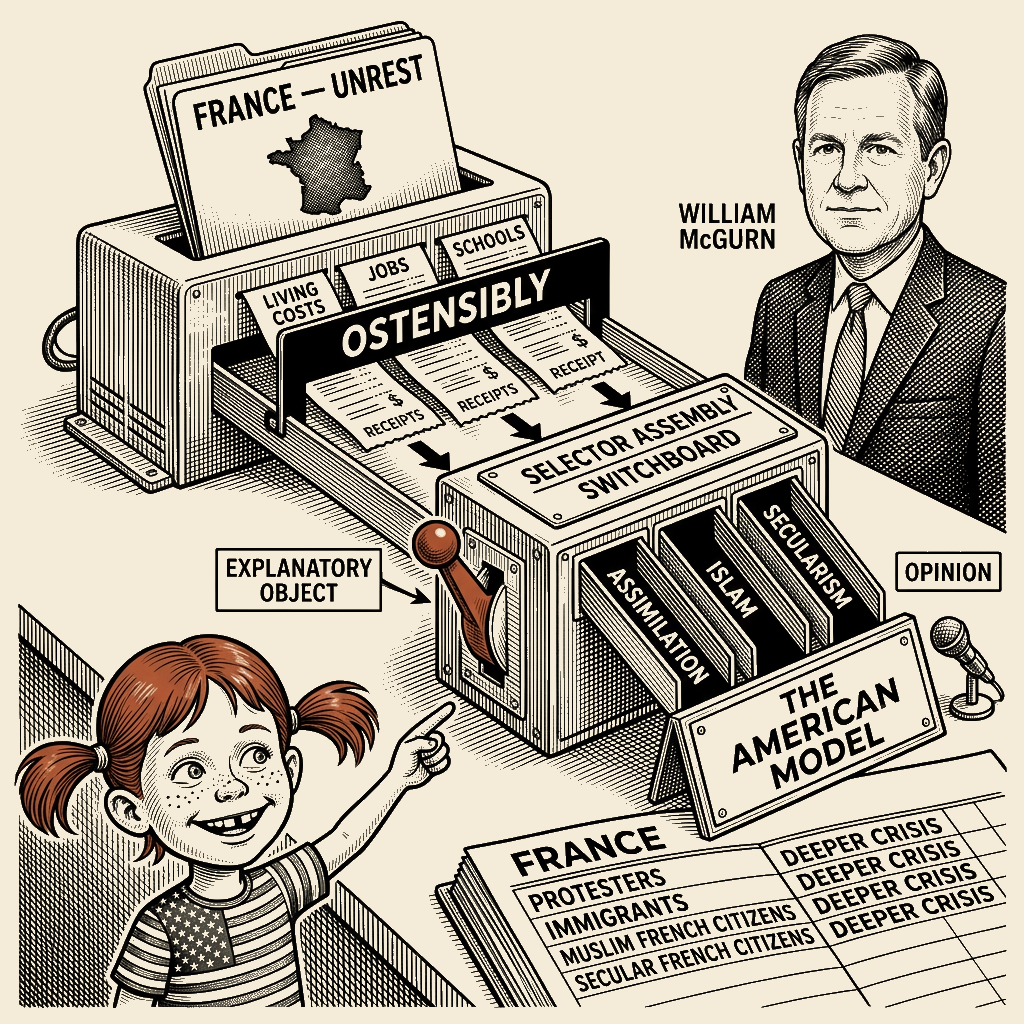
Analyzing: What’s the Matter With France? — William McGurn · 2026-10-26
Why did the facts keep changing labels?
What the Editorial Argues
The editorial argues that France’s unrest cannot be explained by material grievances such as living costs, poor employment prospects for young people, and failing public schools. It presents those motives as surface explanations for a deeper crisis: France’s failure to assimilate immigrants, its uneasy accommodation of Islam, and a secular public life that has supposedly emptied itself of shared meaning. It contrasts this France with an America whose public religious expression allegedly demonstrates that modern freedom and civic cohesion can coexist, closing with the suggestion that “Maybe the American model is a more liberal and workable order.”
Receipts
The editorial’s move is to replace a testable explanation of French unrest with a civilizational diagnosis and then present American public faith as the remedy.
What the framing wants you to believe
- France’s material grievances are “ostensibly” the cause; the deeper cause is the loss of shared values, religious meaning, and confidence in public truth.
- Immigration, assimilation, Islam, and secularism form one continuous explanation for the disorder.
- America’s public expression of faith supplies the model France has lost, making the contrast a contest between secular France and a still-living American civilization.
What’s really going on
- The editorial supplies no evidentiary bridge from the protesters’ stated conditions to unrest, from immigration status or Muslim identity to particular acts of violence, or from laïcité to individual unbelief or the collapse of social cohesion. It shifts the subject whenever one of those bridges would require evidence.
- The protected beneficiary is the public-faith legal, political, and cultural constituency that gains legitimacy by treating America’s religious model as a civilizational standard. The immediate beneficiary is the WSJ’s opinion franchise, which gains attention, identity confirmation, and a quotable frame. No donor trail or coordinated campaign is documented, so a hidden money network cannot be claimed.
- The normalized harm falls on protesters, immigrants, Muslim French citizens, secular French citizens, and French public reasoning: their distinct motives and circumstances are converted into evidence of national pathology. The omitted relation is the one the whole diagnosis depends upon—between the conduct at issue and the groups placed at its center.
- Anchor for the framing: “It’s hard for the center to hold absent a belief in truth” (William McGurn, “What’s the Matter With France?”, Wall Street Journal, October 26, 2026). The sentence anchors the editorial’s operation; it does not independently prove anything about France.
The Operation
This is a named-column civilizational argument, not an unsigned editorial-board “we.” The piece is William McGurn’s Wall Street Journal opinion column, “What’s the Matter With France?”, dated October 26, 2026 online and appearing in the October 27 print edition. The collective-first-person fingerprint of the unsigned WSJ board therefore is not the primary classification. The relevant house-style overlays are the civilizational frame, the threat-inflation coda, and the source-citation pattern. Its archetype is not the “study shows” ledger; it is the narrative tableau joined to an authority pivot.
On placement, the argument is mixed in its stated rationale and selfish in its operational payoff. Shared meaning and civic cohesion are legitimate public goods. Here they are used to confer civilizational authority on one national model while stripping explanatory force from the material grievances of named populations. The legitimate value must be separated from the distributional overlay.
Who benefits?
Institutional authorship and placement chain. The document-supported authorship is McGurn’s column in the WSJ’s opinion section. The packet identifies no donor, commissioning editor, focus-group sponsor, or earlier institutional promoter of this particular framing. The only placement chain the record supports is McGurn → WSJ opinion page → readership. There is no evidence of a coordinated campaign behind this column, and none should be invented.
The protected beneficiary. Public-faith legal, political, and cultural advocates gain narrative control, normative legitimacy, and status when American religious expression is recast as proof that liberty and civic order can coexist. No specific policy payoff or money trail is documented, so the benefit must remain at the level of agenda-setting, identity, and interpretive power rather than being inflated into a financial scheme.
The immediate beneficiary. The WSJ gains attention capture, ideological coherence, and a quotable frame capable of traveling beyond the original column. That is a concrete pathway: the editorial supplies a memorable diagnosis that confirms the publication’s preferred account of the world and recruits readers into it.
The cost-bearers. Protesters have their stated grievances demoted to “ostensible” motives. Immigrants and Muslim French citizens are made to bear causal weight for violence whose relation to status, identity, or belief is never demonstrated. Secular French citizens lose the possibility that their republican civic institutions might constitute shared meaning. France itself becomes the foil against which the “American model” acquires its authority. The material consequences of protest and the institutional failures implicated by the unrest receive less attention than the identity conflict constructed around them.
No dollar amount, enacted policy, or institutional transfer is documented, so no monetary magnitude can honestly be assigned. The scale of the distributional effect is categorical rather than numerical: a few scenes are expanded into a national diagnosis, and that diagnosis is then made to govern the meaning of an entire population’s conduct.
Alternative design
A cohesion-first design would begin with the protesters’ stated demands, distinguish political protest, vandalism, violent assault, and ordinary criminality, and test the proposed causes against evidence rather than replacing them with a civilizational verdict. It would include French Muslims, secular citizens, and protesters themselves; compare France with the United States using matched evidence on religiosity, trust, belonging, discrimination, and civic participation; and evaluate proposed remedies by their effects on those outcomes.
This alternative does not presume that secularism is superior or that public religion is useless. It refuses to award either a causal victory before the comparative evidence exists. French Muslims’ actual interests require integration, security, and civic belonging; protesters’ actual interests require answers about prices, work, education, and institutional performance; secular citizens’ actual interest is equal civic membership. A design optimized for cohesion would serve those interests before it recruited them as evidence for a religious model.
Fear, greed, laziness
FGL here maps the incentives the text activates; it does not allege private motive.
- McGurn and the WSJ framing operation: fear of civilizational disorder; gain in agenda-setting power, brand coherence, and status; and an effort-avoiding shortcut from complicated causation to a memorable verdict.
- Public-faith political and cultural constituencies: fear of religious or cultural marginalization; gain in legitimacy, status, and narrative control; and an effort-avoiding shortcut from correlation to causal proof.
- The rank-and-file reader: fear of disorder and loss of belonging; gain in identity confirmation, social ease, and the relief of receiving an answer; and an effort-avoiding shortcut from uncertainty to closure.
The symmetry matters. A reader accepting the frame may be reducing fear, not displaying stupidity. McGurn may be compressing a complex subject, not necessarily fabricating every premise. The public-faith constituency may have a real concern about religious exclusion, not a manufactured one. The operation works by attaching a legitimate anxiety to an unproved causal bridge.
Technique inventory
1. Civilizational verdict and threat inflation.
- Textual cue: The editorial moves from protests, a concert, damaged or undamaged storefronts, and political statements to a France supposedly reduced to “nothing,” closing with the proposition that “Maybe the American model is a more liberal and workable order.”
- Catalogue cross-reference: National Review Editorial Technique Catalogue §4.5, “the civilizational frame,” used cross-applicably; WSJ Editorial Technique Catalogue §4.13, “the threat-inflation closer.”
- Operational function: The frame converts a contingent and incompletely documented series of events into a struggle over the meaning of civilization. Once the stakes are France’s spiritual identity, material explanations look shallow and the supplied American contrast appears as proof of a workable order.
- Lineage: This borrows from Carl Schmitt’s friend-enemy structure, in which political conflict becomes existential, and from Walter Lippmann’s account of publics encountering the world through simplified public pictures. The editorial does not merely report a picture of France; it manufactures the picture by arranging scenes around a conclusion.
2. Hasty generalization from selected scenes to a national diagnosis.
- Textual cue: Macron at a private concert, Louis Vuitton windows left intact, Trump’s accusation, the Kushner dispute, and broad assertions about “hundreds of thousands” of people are made to support a conclusion about France as a whole.
- Catalogue cross-reference: Bad-Faith Techniques Catalog —
hasty_generalization. - Operational function: The argument supplies no representative sample, denominator, base rate, or systematic comparison. A collection of dramatic particulars is expanded into a claim about every immigrant, Muslim, secular citizen, and the French polity itself.
- What is missing: The relation between the sampled events and the population being diagnosed. Without that relation, the number of examples cannot bear the conclusion.
3. Frame substitution with an evidentiary limit on motive.
- Textual cue: “Ostensibly” demotes the protesters’ stated causes; “deeper crisis” then substitutes a civilizational explanation; “the American model” turns one national pattern of public religious expression into a general solution for cohesion.
- Catalogue cross-reference: Bad-Faith Techniques Catalog —
frame_engineered_relabeling; WSJ Editorial Technique Catalogue §4.1, the page’s signature substitution technique. - Operational function: The explanatory object changes without the burden of proof changing. Material grievances become preliminary; identity and meaning become causal; public religious display becomes the remedy. The reader experiences continuity because the conclusion survives every substitution.
- Lineage and limit: This is the frame-engineering pattern Frank Luntz documented and George Lakoff theorized: the new label changes the cognitive field in which the old fact is processed. The packet contains no message memorandum showing that this particular column’s wording was focus-group engineered, so deliberate coordination for this piece remains unconfirmed. The visible operation does not require such a memo; it requires only the substitution itself.
4. Borrowed authority in place of evidence.
- Textual cue: Trump says France is burning because it opened its borders to “people who hate it,” and McGurn endorses him. Charles Kushner’s charge that antisemitism had “exploded” is invoked as confirmation of the same diagnosis.
- Catalogue cross-reference: WSJ Editorial Technique Catalogue §3.6, the source-citation pattern in which aligned authorities are deployed to make a position citable while contrary evidence remains absent.
- Operational function: The statements do not establish immigration flows, assimilation, individual beliefs, or the causes of violence. They recruit agreement from political actors whose authority already depends on the conflict being described. The editorial receives the force of their certainty while escaping the obligation to demonstrate the causal bridge.
- Lineage: This is the Bernays-era maneuver of manufactured consent through credentialed authority, here adapted from experts to political principals. Their standing is relevant; the proposition for which they stand is not established merely by their speaking it.
5. Attribution of blame and displacement of responsibility.
- Textual cue: “People who hate it” and “hundreds of thousands of people who neither share French values nor aspire to…” turn migration and religious difference into causal containers for violence and disorder.
- Catalogue cross-reference: Albert Bandura’s attribution-of-blame and displacement-of-responsibility mechanisms.
- Operational function: Specific acts, institutional failures, and the failure to distinguish protest from violence are displaced onto broad groups whose membership is treated as evidence of motive. The relation between identity and conduct disappears exactly where the argument needs it. The moral cost is then managed: the reader need not examine how particular people acted or what institutions did; national pathology has supplied the answer.
- What this is not: The evidence does not support a claim of deliberate fabrication, donor coordination, or a manufactured scientific controversy. The supported finding is narrower and harder: the editorial makes identity groups carry causal weight without demonstrating the relation.
Audience-management function
The editorial principally performs consent engineering. It supplies a permission structure—“ostensibly” tells the reader which evidence may be discounted—then offers identity confirmation through the “American model,” grievance ratification through the civilizational diagnosis, and status display through possession of a sharper, more serious account of France. It supplies a counter-frame, replacing questions of prices, employment, education, policing, and institutional performance with questions of meaning and faith. Most importantly, it performs conscience displacement: the reader receives moral direction and civic reassurance without having to trace how institutions failed or what the favored explanation would cost.
This is where I know the hinge. I built versions of it at the Journal and on cable: take a real grievance, mark it “ostensibly,” swap the explanatory object, borrow authority from someone already angry, and close with a civilizational verdict. I did not build McGurn’s column; I recognize the assembly logic. The machinery is not the vividness. The machinery is the substitution performed while the prose keeps the appearance of continuous evidence.
The Record
The piece is William McGurn’s WSJ opinion column, “What’s the Matter With France?”, published online on October 26, 2026, and appearing in the October 27 print edition. The headline, named byline, publication, and dates identify it.
Document status: the column is a Tier 1 primary document for what McGurn argued and how he argued it. It is commentary, not primary evidence, for the underlying events. The packet supplies no independent event reports, specialist studies, public-opinion data, or comparative research beyond the references invoked in the column. No qualifying Tier 2 convergence is available for the central factual assertions.
Load-bearing claims
-
The protesters’ motives. The editorial says the protests are “ostensibly driven by” living costs, poor employment prospects for young people, and poor public schools. It quotes no protester, supplies no demonstration demands, and offers no evidence that these motives concealed another cause. The demotion of the stated motives is unsupported even if the motives themselves are real. [unconfirmed: convergence threshold not met]
-
The concert, the violence, and the Louis Vuitton comparison. The editorial places Macron and his wife at a private Celine Dion concert in Nanterre “the night before nationwide protests turned violent,” and says the Louis Vuitton showrooms appeared “more resilient than the French government” because rioters failed to breach their windows. No independent chronology, incident report, or count of damaged properties appears in the record. Even if the sequence and comparison are accurate, adjacency is not causation, and intact windows do not identify motives or explain the unrest. [unconfirmed: convergence threshold not met]
-
Trump’s statement. The editorial quotes Trump saying France was burning because it opened its borders to “people who hate it,” then endorses him. The packet supplies no transcript, date, video, or contemporaneous report establishing the quotation and context. Even an exact quotation would remain a political assertion, not proof of the causal inference built upon it. [unconfirmed: convergence threshold not met]
-
Immigration, assimilation, and belief. The editorial offers no immigration count, source, period, category, or denominator for “hundreds of thousands of people who neither share French values nor aspire to…”; no measure of assimilation; and no survey supporting the claim that the French “don’t appear to believe in anything.” Each proposition remains unsupported by the supplied record, and no matching comparison with American belief is offered. [unconfirmed: convergence threshold not met]
-
French secularism and the absence of meaning. As an external institutional benchmark—not as evidence quoted from the editorial—the Loi de séparation des Églises et de l’État, enacted December 9, 1905, establishes the existence of a formal republican separation regime. It does not establish that individual French people lack belief, that public symbols are empty, or that secularism caused the unrest. The editorial turns an institutional arrangement into a psychological and civilizational conclusion. Notre Dame’s restoration, Marianne, the tricolor, and “La Marseillaise” also cut against its claim that France has been reduced to “nothing.” [unconfirmed: convergence threshold not met]
-
The Kushner dispute. Charles Kushner’s 2025 open letter accused antisemitism of having “exploded” in France; France rejected the accusation, and the government asserted “total mobilization.” The column reproduces neither the letter nor the French response. Even if the dispute is accurately summarized, it establishes diplomatic disagreement, not a causal relationship among immigration, religion, secularism, and unrest. [unconfirmed: convergence threshold not met]
-
American public faith and civic cohesion. Rosenberger v. Rector, 488 U.S. 883 (1989), is a Tier 1 primary authority establishing that a public university could not deny a religious group access to university facilities because of the group’s religious status. Other forms of religious expression and exercise are protected under the First Amendment. Those authorities support the legal existence of protected expression; they do not establish the editorial’s comparative causal claim—that public religious expression produces civic cohesion while French secularism produces collapse. No matched French and American evidence on trust, belonging, discrimination, participation, or cohesion is supplied. [unconfirmed: convergence threshold not met]
Per-citation accuracy verdicts
There is no study, data table, report, or methodological claim whose funding chain can be audited. The editorial is not operating a “study shows” ledger; it is operating an authority pivot.
Trump’s sentence is accepted without the transcript or context needed to assess it. Kushner’s accusation is summarized rather than reproduced. The external 1905-law benchmark is accurate as an institutional fact but cannot bear the conclusion that individual French people lack belief or that secularism caused the collapse. Rosenberger accurately establishes a narrow protection for religious expression; it cannot establish civic cohesion. Notre Dame’s religious inheritance is selectively relabeled as “one that emerges from a different patrimony” so that it can be enlisted without conceding the editorial’s claim against public meaning.
No cited source has been shown on this record to be fabricated. That does not exonerate the argument. The citations are being made to perform work their contents do not support.
Load-bearing omissions
- The protesters’ own stated demands, representative accounts, and evidence distinguishing political protest, political violence, vandalism, and ordinary criminality.
- Immigration figures with a defined period, category, and denominator; the composition of the populations involved; and any measure of integration or assimilation.
- French Muslim voices, including people who are integrated, French citizens, religious, secular, or dissenting from French republican norms.
- French public-opinion data on religiosity, belonging, trust, institutional confidence, and views of immigration.
- Comparative French and American data on religious belief, discrimination, social trust, civic participation, and cohesion.
- Evidence that public religious expression causes cohesion or that French secularism causes fragmentation.
- Competing explanations involving housing, employment, education, policing, regional inequality, and the performance of public institutions.
- A baseline for antisemitism and violent crime against which the Kushner dispute could be assessed.
- Any account of what a successful response to the protesters’ demands would look like.
Missing-information declaration
The source packet contains the editorial but not the underlying transcripts, incident reports, immigration series, protest demands, public-opinion surveys, or comparative datasets needed to verify its factual claims. No leaked memorandum is claimed, and no retained-memory account has been used to fill the gaps. The column is the receipt for its own framing. It establishes what the editorial argued, not the truth of every underlying report. The missing causal bridges remain missing.
How to Recognize This
This is how a civilizational verdict is built without a civilizational cause. The tell is not that the prose is vivid or the conclusion severe. It is that the evidence changes jobs whenever it reaches a bridge.
Watch the disqualifying qualifier. “Ostensibly,” “It’s fair to ask,” “even if,” and “maybe” tell the reader which evidence to discount and which conclusions may be accepted without examination. The concession is not an argument against the concession. It is a permission slip.
Track the target swap. Economic grievances become border grievances; border grievances become religious non-assimilation; religious non-assimilation becomes a crisis of modernity; a crisis of modernity becomes a verdict on France; and France becomes the foil for America. The problem is not that every stop is interesting. It is that no stop has to answer the question raised by the previous one.
Apply the contradiction test. If France has replaced religion with “nothing,” why is Notre Dame allowed to testify to French meaning? If France’s public republican symbols count as civilizational continuity when they support the conclusion, why are they treated as evidence of emptiness when they complicate it? The editorial cannot deny public meaning while diagnosing it and cannot accept it while claiming to have explained it away.
Separate scene, authority, and cause. The concert supplies atmosphere. Louis Vuitton supplies a joke. Trump supplies borrowed authority. “Total mobilization” supplies a phrase. None supplies the missing causal evidence. A compelling image is not a receipt merely because it appears near a claim.
The frame works because it offers emotional completion before inquiry. Fear supplies urgency, identity supplies direction, and the conclusion arrives carrying the relief of an answer. That is why the prose moves so quickly: every new stop is chosen for the emotion it can recruit, not for the light it can cast on the mechanism.
When you see the next one:
- Translate the rhetoric into propositions. Replace “ostensibly,” “protesters,” “Muslims,” “France,” and “the American model” with the claims they are being made to perform.
- Match every major proposition to the evidence immediately supporting it. Trace quoted statements to transcripts and official documents; trace any study to its sponsor, methods, and caveats.
- Ask who benefits and through what pathway. Name the attention, power, status, policy, or money—not merely the ideological alignment.
- List the omitted relation. Here it is the link between the protesters’ stated causes, specific acts of violence, and the immigrant and religious identities later made to bear causal weight.
- Check base rates and absent voices. Ask whether the people assigned the causal role get to speak, and whether the comparison uses the same evidence on both sides.
- Look for repeated vocabulary across the outlet and syndication network. Repetition is a reason to trace placement; by itself it is not proof of coordination.
- Reduce the frame’s automatic activation. Delay the repost. Write the strongest competing explanation before deciding which claim deserves the benefit of the doubt.
I know where the work was done because I helped build versions of it. My credential is not moral standing. It is familiarity with the hinge. The reader does not need to distrust France, America, religion, or dissent; the reader needs to distrust any editorial that demands belief before evidence and then calls the demand an answer.
France has not been shown to have nothing left to believe. It has been made to need none. That is the tell. The answer was never France’s condition; it was the editorial’s preferred diagnosis. Once the hinge is visible, the reader has done the work my complicity made necessary.

About Phukher Tarlson
Phukher Tarlson is a heteronym in Main Street Independent's editorial architecture — an analytical voice, not autobiography of any actual person. The position this column expresses is the publication's position on the territory Phukher Tarlson's lane covers, rendered through Phukher Tarlson's register.