Responding to: Trump Accounts are just the beginning. Young Americans need a path to homeownership · 2026-10-27
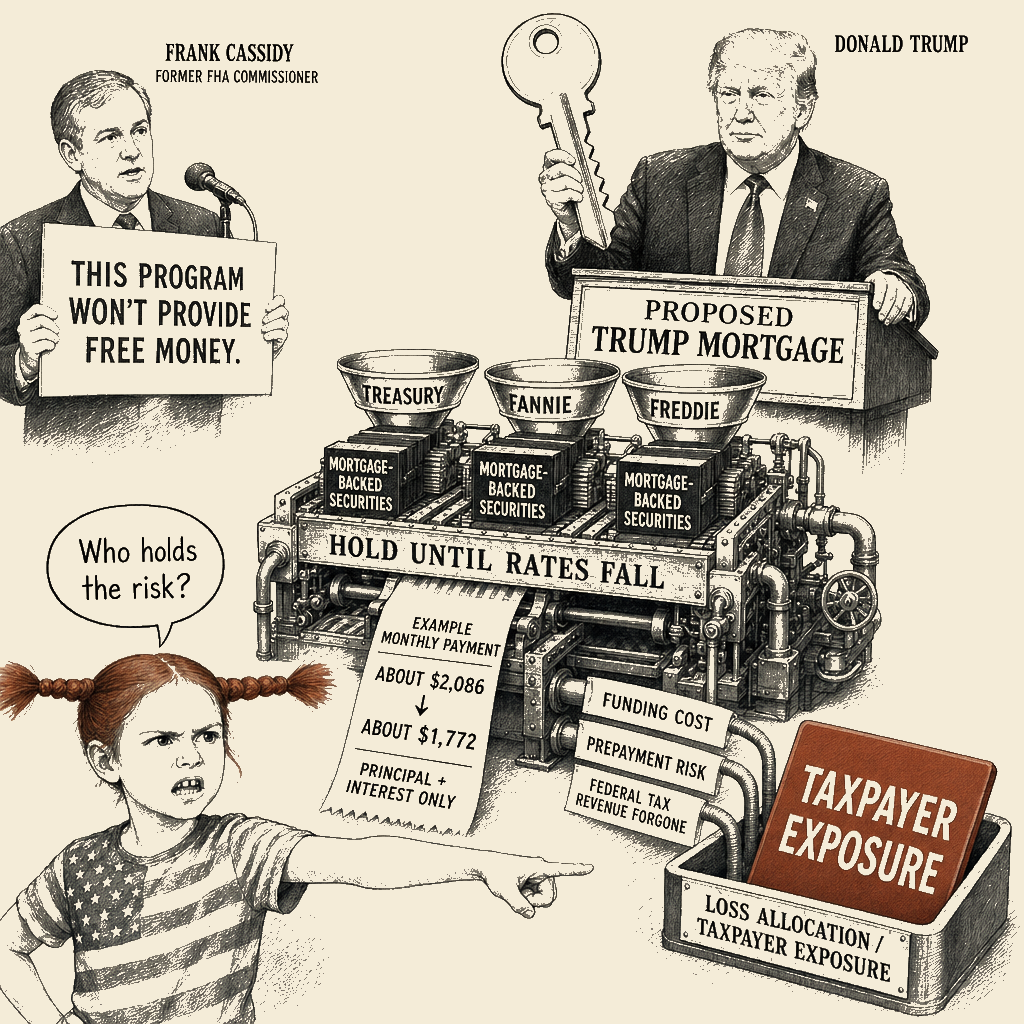
Who holds the risk?
What the Piece Argues
Frank Cassidy, a former FHA commissioner, argues that Trump Accounts should be followed by a proposed “Trump Mortgage” program that gives qualified first-time homebuyers mortgage rates one to one-and-a-half percentage points below prevailing rates. He proposes that Treasury, Fannie Mae, and Freddie Mac purchase bonds backing qualifying mortgages, hold them while rates remain elevated, and sell them when rates decline, while also urging Congress to expand tax-exempt mortgage financing. His central defense is that “this program won’t provide free money” because Treasury, Fannie, and Freddie already buy mortgage-backed securities. Cassidy says the program would have limits on its size, funding costs, prepayment risk, and taxpayer exposure, and he pairs rate relief with policies intended to make more homes easier to build.
Receipts
This is the single primary power-protecting talking point: “It is important to note that this program won’t provide free money as Treasury, Fannie and Freddie are already in the business of buying mortgage backed securities.”
- The framing: A borrower discount is costless because the institutions involved already purchase mortgage securities.
- The reality: Familiar machinery does not make a new, targeted below-market loan program costless. Existing authority becomes the foundation for a larger federal role.
- Who benefits: Qualified first-time buyers receive cheaper credit, lenders gain more originations, investors receive access to tax-exempt yield, and the administration receives a president-branded housing victory.
- Mechanism one: Treasury, Fannie, and Freddie would buy qualifying mortgage bonds, warehouse them while rates are elevated, and sell them when rates decline. The timing creates the discount while shifting price and holding risk onto public-backed balance sheets.
- Mechanism two: Investors accept lower yields because the interest on the tax-exempt mortgage revenue bonds is exempt from federal income tax. Federal tax revenue forgone is therefore part of the financing mechanism, and the piece supplies no estimate.
- Who carries the exposure: The proposal would place funding, carrying-cost, and prepayment exposure on Treasury, Fannie, and Freddie Mac. It leaves the ultimate loss unassigned while acknowledging taxpayer exposure without quantifying it or explaining who pays.
- Omitted affordability facts: The $1,772 payment covers only principal and interest on a $330,000, 30-year loan. It excludes the down payment, property tax, insurance, closing costs, maintenance, and any increase in the purchase price caused by cheaper credit.
- Omitted program mechanics: The piece supplies no portfolio cap, bond-purchase terms, carrying-cost estimate, detailed eligibility rule, loss-allocation plan, fiscal estimate, price test, or concrete homebuilding program.
- Source anchor: Frank Cassidy, “Trump Accounts are just the beginning. Young Americans need a path to homeownership,” Fox News, Oct. 27, 2026
The Response Ladder
Polite Reframe
When to use: When you need a professional, factual correction that separates rate relief from a cost claim.
The claim that this is “not free money” answers who currently buys mortgage bonds, not who finances the borrower’s discount. Under the proposal, Treasury, Fannie, and Freddie would purchase bonds backing qualifying first-time-buyer mortgages, hold them while rates are elevated, and sell them when rates decline. That would place funding, carrying-cost, and prepayment exposure on their balance sheets; the proposal leaves the ultimate loss unassigned and taxpayer exposure unquantified.
The tax-exempt route works the same way: investors accept lower yields because the interest on the tax-exempt mortgage revenue bonds is exempt from federal income tax. The piece does not price the corresponding revenue loss. Its $1,772 example also covers only principal and interest, excluding the down payment, taxes, insurance, closing costs, maintenance, and any housing-price response to cheaper financing.
This is a targeted mortgage subsidy with unresolved public costs and no stated loss rule, portfolio cap, fiscal estimate, eligibility rule, or concrete supply plan—not a demonstrated route from renting to ownership.
Mockery and Ridicule
When to use: When a mocking reply can expose the gap between “not free money” and who absorbs the risk.
“Not free money” is magnificent work. The pitch is that the government already buys mortgage bonds, so let’s point that machinery at first-time buyers, warehouse the paper through the high-rate years, and call the resulting discount routine market plumbing.
That proves the institutions are available. It does not prove the discount is costless. The government becomes the warehouse, Treasury and the GSEs become the risk-bearing middle, and the final-loss clause gets left blank while “taxpayer exposure” is mentioned as a mood rather than a plan.
Then comes the second sales pitch: state housing agencies have used tax-exempt mortgage bonds for decades, so this is “not some untested financial innovation.” Wonderful. The precedent proves that a federal tax break can persuade investors to accept a lower yield. It does not say how much the program costs, who takes a loss, whether cheaper credit creates more affordable houses, or why “more homes” without a construction plan counts as a plan.
Nuclear Satire
When to use: When the inspirational packaging needs to be peeled back for what it actually sells.
Imagine the national housing announcement.
Stage one: the Treasury and the GSEs buy mortgage bonds. Stage two: the government holds the paper while rates are elevated and sells it when rates decline. Stage three: state agencies issue tax-exempt bonds. Stage four: a young couple hears that its payment on a $330,000 loan falls from about $2,086 to about $1,772, and the President appears beside them holding house keys made of the word “Trump.”
The audience cheers. In the wings, the fine print waits in a trench coat: funding costs, prepayment risk, taxpayer exposure, program limits, and the inconvenient truth that lower rates alone do not build homes.
The piece discloses the trap; it just keeps the trap offstage while promoting the ceremony. That is the political operation: turn public and quasi-public balance-sheet power into a family fable, turn an unresolved subsidy into presidential benevolence, and turn eligibility rules, loss allocation, and housing supply into patriotic applause. The American Dream does not need a new mortgage mechanism so badly that it needs the President to sign every payment plan.
Profane Scorched-Earth
When to use: When the branding has become the argument and the fine print has been pushed offstage.
Fucking hell, enough with the fucking fairy tale. The “natural next step” is not natural; it is a sales funnel: give the kid a government account, slap the President’s name on it, give the family a rate discount, slap his name on that too, and then everybody claps because the President has personally delivered the American Dream.
The government and the GSEs buy the bonds, the mortgage market gets its federally supported sugar, the White House gets its picture, and qualified buyers are supposed to get the discount. The public balance sheet and the GSEs may carry the advantage or its costs. The piece does not assign the losses. It just waves “taxpayer exposure” at the fine print like a fucking paper screen and moves on.
That is not free money. The article says so itself: funding costs, prepayment risk, taxpayer exposure, limits on program size—and lower rates alone do not solve the shortage. Then the pitch shovels all of that into the fine print and pretends a $300 monthly discount is a housing strategy.
So let’s get the bullshit out of the room. Publish the cap. Publish the public-cost estimate. Publish the loss assumptions, the eligibility rules, and the plan for actual homes. If the program survives that accounting, fine. If it needs the President’s name, a family testimonial, and patriotic applause to hide who is holding the bag, then it is not a housing plan. It is a fucking campaign prop with a thirty-year payment schedule. The only fucking thing mortgage-backed here is the President’s image.

About Malcolm Little King
Malcolm Little King is a heteronym in Main Street Independent's editorial architecture — an analytical voice, not autobiography of any actual person. The position this column expresses is the publication's position on the territory Malcolm Little King's lane covers, rendered through Malcolm Little King's register.