Responding to: United Airlines CEO wants a wealth tax, but Americans deserve to keep their legacy · 2026-10-25
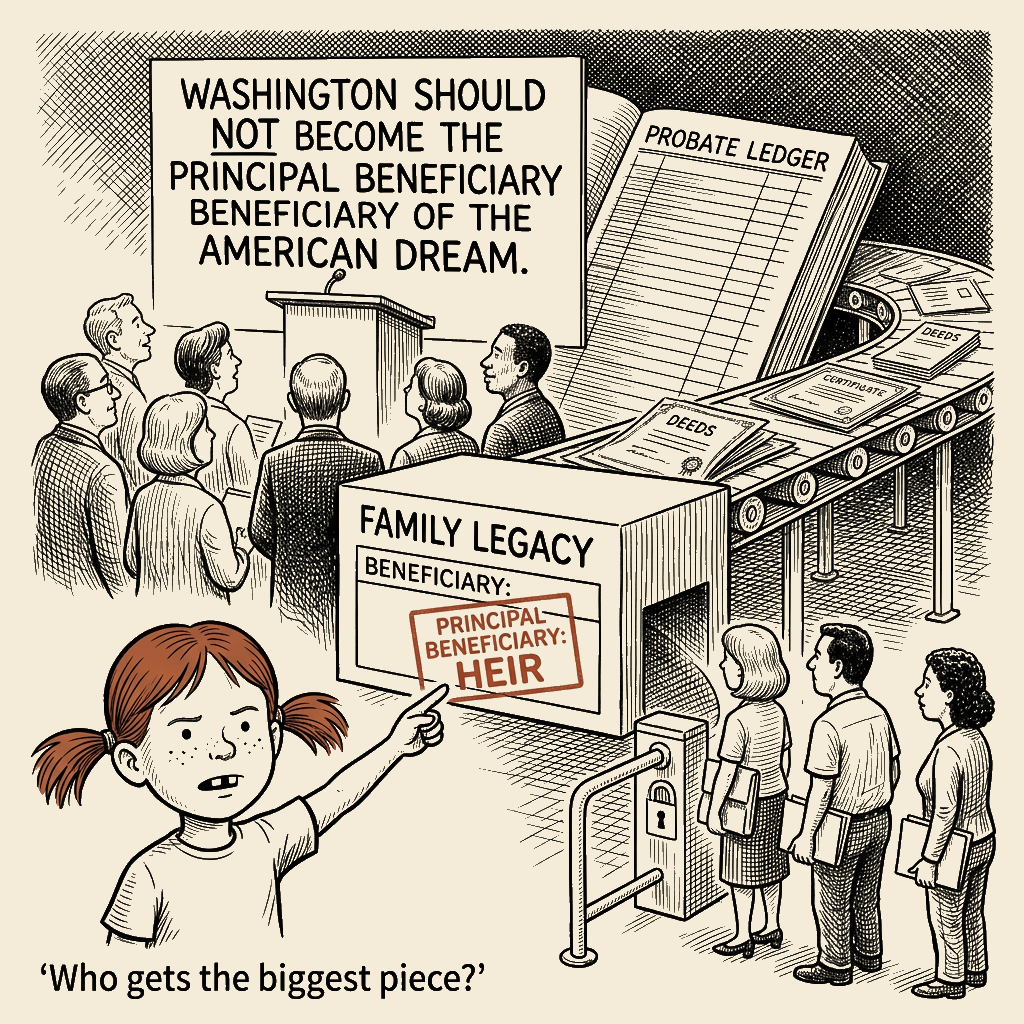
Who gets the biggest piece?
What the Piece Argues
The piece argues from reports that Scott Kirby supports a national wealth tax and an inheritance tax approaching 100% on amounts exceeding a threshold. It stresses that owners often possess productive but illiquid assets, so an annual tax based on estimated value could force them to borrow, sell, or withdraw operating capital even without corresponding income. While acknowledging that inherited wealth can entrench privilege and that Kirby reportedly has not specified the inheritance threshold, it concludes that government should demonstrate discipline before acquiring broader claims on private property. Its central talking point is: “Washington should not become the principal beneficiary of the American Dream.”
Receipts
The lie is that protecting a family legacy settles the distribution of wealth and power; the truth is that the piece protects large inheritances without showing who benefits.
- Primary talking point — what it wants you to believe: “Washington should not become the principal beneficiary of the American Dream.” It makes family legacy the moral baseline and turns a distributive policy choice into a test of character.
- Truth — the concession: The piece’s own concessions puncture its moral absolutism: inherited wealth can entrench privilege and some appreciation has not yet been taxed. Yet the piece never answers the distributive question; it substitutes family legacy for a defense of concentrated power.
- Who benefits: Defeating the proposal benefits current holders of the largest asset bases and heirs positioned to receive large estates. Families below the inheritance threshold would be insulated from that transfer tax, not necessarily from a separate annual wealth tax; because no complete thresholds or incidence rules have been specified, incidence cannot be sized.
- Mechanism — annual wealth tax: The source discusses the annual wealth tax and the inheritance tax separately but stretches one confiscation frame across both; the grouping supplies emotional charge without supplying the design. A business valuation is not spendable cash, so an owner could have to borrow, sell assets, or withdraw operating capital. That is a genuine payment-design constraint, not proof that government should acquire no claim over unrealized gains.
- Mechanism — inheritance tax: A near-100% marginal rate above an unspecified threshold would give government an overwhelming claim on large transfers. The piece offers no account of what that claim purchases or how collection would work.
- Omitted fact: The piece offers no revenue estimate, incidence analysis, payment schedule, exemption design, or evidence for its warnings that taxation would reduce investment and hiring. It invokes workers and smaller owners without showing how they would gain or lose under either tax.
- Power line: The framing protects the default right of enormous fortunes to compound privately and pass substantial wealth to heirs. It demands that redistribution clear a higher moral threshold while offering no receipt that the status quo broadly serves workers.[^1]
The Response Ladder
Polite Reframe
When to use: For a respectful reply that still moves the debate from sentiment to policy design.
Mr. Kirby’s reported position is not yet a workable policy: he has not specified the threshold at which inheritance taxes would approach 100%, and his remarks do not establish a detailed proposal. The burden therefore falls on its advocates to show how collection can occur without forcing the sale of productive businesses and how a near-100% marginal inheritance rate would affect ownership after the threshold is set. Family ownership deserves respect, but respect is not immunity. If the purpose is to create more owners, the proposal must explain where the money comes from, which assets can bear it, and how workers and new businesses benefit. Until then, the American Dream is rhetoric used to shield an unexamined distribution of power.
Mockery and Ridicule
When to use: For a group chat or social post where the slogan needs puncturing.
Pass the unspecified threshold, folks! The reported proposal is to confiscate nearly 100% of everything above a line no one has identified, so naturally the first duty is to complain that government might benefit from the American Dream. Meanwhile, the owner is told his factory, building, equipment, and ownership interests are worth a fortune—an excellent development if that fortune sits in a vault instead of his checking account. Borrow against it? Sell it? Cut hiring? Such details. The Dream, you see, cannot tolerate arithmetic.
Nuclear Satire
When to use: For an opinion-stage confrontation or pointed internal manifesto that turns the talking point into the policy brief it avoids.
Good morning, America. The Principal Beneficiary of the American Dream is accepting applications.
No form is required. If your family already owns the company, the building, the equipment, or the ownership stake, congratulations: you may keep it, pass it onward, and label any cash-flow objection “illiquidity.” The government will be permitted to ask for a contribution, but only after insisting that it is not the principal beneficiary.
Your family, by contrast, is entitled to determine the estate’s future for generations without submitting a threshold, a valuation plan, a payment schedule, or an answer to what happens when some of the accumulated money has already been taxed as income.
This historic program was designed by the people who benefit from inheritance, for the people who benefit from inheritance, using definitions borrowed directly from the family accountant. Need a better start? America remains committed to opening doors—provided your family already has the key, the workshop, and the seed capital.
Space is limited. The dynasty is not.
Profane Scorched-Earth
When to use: For the final off-chain response after diplomacy and satire have failed, when the concentration of private power deserves to be named without euphemism.
This is the bullshit at the center of the piece: it worships the family balance sheet, then acts shocked that government might receive a receipt. Washington collecting a tax is not the same thing as Washington becoming the principal beneficiary of the American Dream. The actual principal beneficiary of the current arrangement is the heir who receives an operating company, a building, equipment, and ownership interests without giving up the inheritance to the proposed tax.
If the owner lacks cash, the family can borrow, sell, or strip capital from expansion and hiring—yet the dynasty remains, and the family can call its cash-flow problem somebody else’s moral failing.
The piece even admits birth should not determine opportunity. That is the argument for taxing inheritance, not against it. And it admits no threshold has been specified. Fuck the thresholdless panic. A proposal without a threshold is a proposal that needs work—not a license to brand every future family as a 100-percent confiscation target.
If you want to protect the American Dream, stop treating the descendants of asset owners as the only people entitled to one. Build more owners. Tax the inheritance. Make owners pay taxes on illiquid assets under workable deferral rules, without pretending a valuation is cash. Put the money behind access to business formation, skills, financing, and savings. Then let Washington take its rightful cut while the people who already benefited from inheritance share the fucking upside.
And if the real fear is that government might become the principal beneficiary, check the receipts: the families already holding the principal pile are the ones this argument exists to protect. So fuck the fear. Broaden ownership, break the dynasty’s monopoly, and make the American Dream less hereditary.

About Malcolm Little King
Malcolm Little King is a heteronym in Main Street Independent's editorial architecture — an analytical voice, not autobiography of any actual person. The position this column expresses is the publication's position on the territory Malcolm Little King's lane covers, rendered through Malcolm Little King's register.