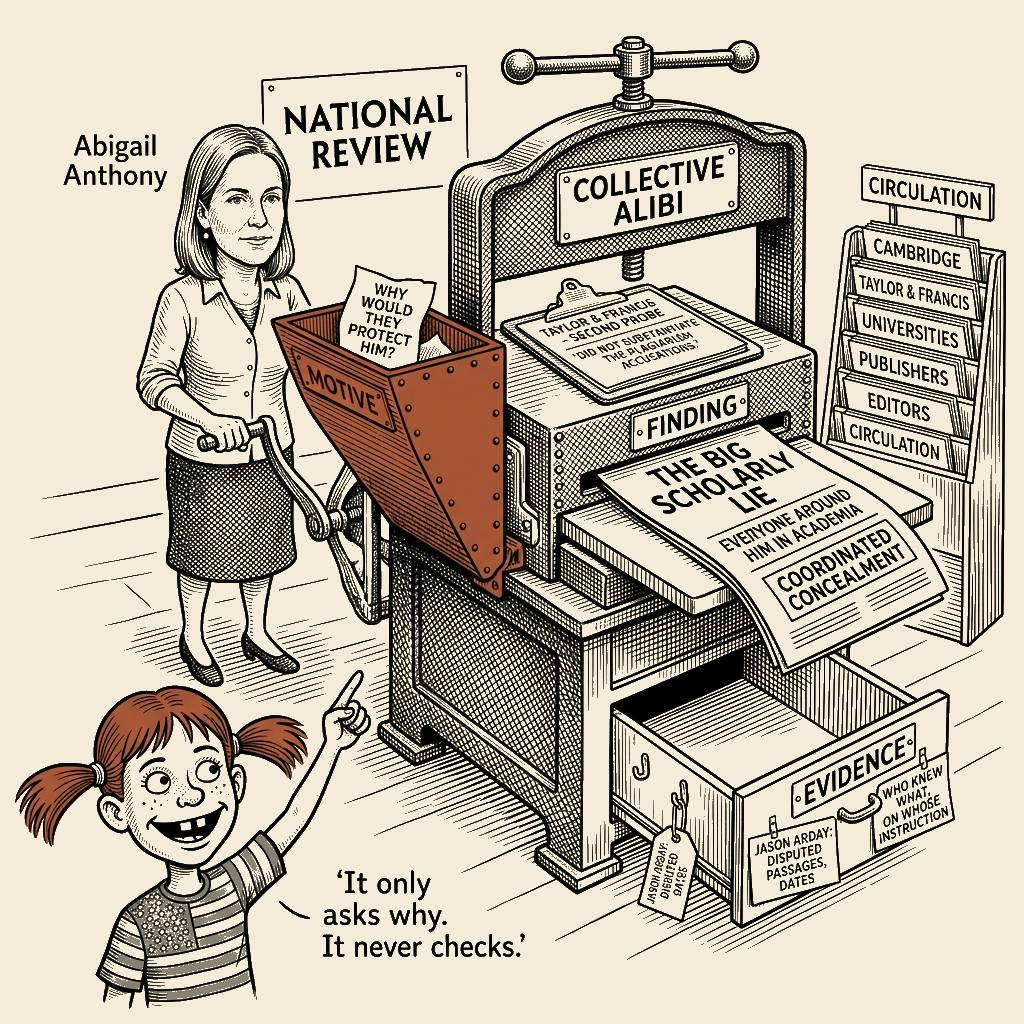
Analyzing: The Big Scholarly Lie — Abigail Anthony · 2026-10-27
It only asks why. It never checks.
What the Editorial Argues
Abigail Anthony argues that Jason Arday was a serial plagiarist and that universities, publishers, and professional gatekeepers did more than fail to catch him: they concealed misconduct because acknowledging it would expose their own institutional failures. She treats Taylor & Francis’s failure to substantiate the plagiarism accusations—calling it the fourth exculpating inquiry—as evidence of a coordinated cover-up, and reads Cambridge’s post-death change in review scope amid media scrutiny as institutional evasion. Anthony also argues that Arday’s affirmative-action research was ideologically worthless because it rested on three interviews, and that the Committee for Academic Freedom’s inquiry is compromised by one donor’s political activity. Her final claim is institutional rather than individual: inquiry itself has been conscripted into a collective alibi by “everyone around him in academia.”
Receipts
The editorial converts the absence of proof against Jason Arday into proof of a coordinated academic cover-up.
What the framing wants you to believe
- Arday’s alleged plagiarism was real, broad, and aggravated by his ideological commitments; the people who examined it—universities, publishers, Cambridge, and Taylor & Francis—knew what they were doing.
- Four inquiries that did not substantiate the accusations, Cambridge’s change in review scope after Arday’s death, and a funder’s political activity prove that inquiry has been conscripted into institutional self-protection.
- The culprit is not a particular decision-maker but academia itself: every institution that enabled, employed, promoted, or published Arday has become a co-defendant in “The Big Scholarly Lie.”
What’s really going on
- Anchor: The Byline Times reports that Taylor & Francis’s second probe “did not substantiate the plagiarism accusations made against him.” That supports the narrow proposition that a charge was not established by the material examined. Anthony converts recurrence into evidence of coordination without identifying shared instructions, concealed evidence, a common account, a coordinating actor, or even a demonstrated chain of knowledge between the institutions.
- Protected beneficiary: The beneficiaries are National Review and the aligned readership who receive a ready-made grievance narrative, plus constituencies whose political case is served by turning Arday into an emblem of DEI and academic self-protection. The concrete pathway is attention capture and narrative control. No cash flow, donor chain, commissioning document, or cross-outlet direction appears in the material supplied for this analysis.
- Omitted relation and normalized harm: The omitted relation is the difference between individual misconduct, institutional knowledge, and coordinated concealment—and between “not substantiated” and “exonerated.” Without that chain, motive is substituted for conduct. The normalized harm is reputational and epistemic: academic institutions and their personnel are placed under a cloud they have not earned, while legitimate inquiry is made to look like part of the cover-up.
The Operation
This is a named National Review opinion essay by Abigail Anthony, not an unsigned board editorial; its register is closest to the NR catalogue’s essayistic mode, though its exact publication placement is not supplied here. Its operative archetype is not the “study shows” ledger. It is a motive-to-fact inversion: one inquiry’s failure to establish a charge is enlarged until the charge, the institutional motive, and the coordinate conduct all appear established.
I know this architecture because I built versions of it—not this case, not these institutions, and not with facts I cannot document—but the mechanism is familiar: take one evidentiary gap, broaden the nouns, and permit the closing accusation to perform the work the evidence refused. That is an operator’s observation, not a claim of private access.
Institutional authorship and placement chain
National Review is the documented publication-level author and distributor of Anthony’s frame; Anthony is the named writer. The visible placement chain runs from the Taylor & Francis inquiry, as reported by the Byline Times, through Anthony’s aggregation of separate institutional episodes, into the National Review essay and its readership. The four inquiries supply the appearance of serial corroboration.
That chain does not establish external coordination. Nothing supplied shows shared investigators, common instructions, a common evidentiary file, or an editorial direction originating with a donor or advocacy organization. Nor does the record establish that the Committee for Academic Freedom created or directed Anthony’s framing; she invokes its inquiry as an object of suspicion. I will not manufacture a conspiracy to explain a rhetorical conspiracy the essay itself has already performed.
Cui bono
The advocated position is mixed. Its legitimate kernel is real: plagiarism allegations deserve investigation, and institutions that knew of misconduct should be identified. The selfish overlay begins where the documentation stops and the collective conviction takes over.
- Beneficiaries. National Review gains attention, ideological coherence, and a narrative that positions its readership as truth-seekers against academic self-protection. Aligned readers receive identity confirmation and a grievance already packaged for circulation. More broadly, constituencies already hostile to DEI and academic employment gain a ready-made example with which to condemn those systems. The pathway is attention, status, and narrative control; no undocumented cash trail is required to establish it.
- Cost-bearers. Cambridge, Taylor & Francis, universities, editors, and scholars placed inside the category “everyone around him in academia” bear reputational costs without case-level proof of coordination. Legitimate investigators’ conclusions are recast as cover-up evidence. Readers bear an epistemic cost: they receive an emotionally complete answer where the record offers contested questions. No dollar magnitude is documented; the measurable pathways are reputation, institutional authority, and reader attention.
- Alternative design. If Anthony’s stated purpose is to expose plagiarism and institutional concealment, the piece should be built as a document-centered dossier: side-by-side comparison of disputed passages; the exact findings and terms of each inquiry; a dated knowledge-and-decision chain; evidence of shared personnel or direction; separate findings on copying, institutional failure, and methodological weakness; and full disclosure of CAF’s donors and their roles. That design could preserve the legitimate investigation while making the institutional claim stronger, not weaker.
- FGL. For the framing author, fear supplies the urgency around academic self-protection, status rewards the appearance of owning a major investigative scandal, and attention supplies the concrete professional benefit; the record supports the attention pathway, not a claim of personal financial enrichment. For the functional beneficiary—National Review’s brand and its aligned audience—fear of academic authority supplies the grievance, greed appears as attention capture, and laziness appears in the prepackaged conclusion. For the reader, fear of being deceived by gatekeepers supplies urgency, status supplies the identity of the discerning critic, and laziness supplies the shortcut through an admittedly noisy information environment. That last “laziness” is not a character defect; cognitive economy is a rational response to complexity. The frame exploits it because the alternative is the work the editorial declines to do.
Technique map
1. Equivocation and the disappearance of the third state. The textual cue is the report that the second Taylor & Francis probe “did not substantiate the plagiarism accusations,” followed by Anthony’s description of it as the fourth “exculpating inquiry.” The Bad-Faith Techniques Catalog identifies equivocation: a term or inference changes meaning across the argument. A finding that submitted evidence did not establish a charge is not exoneration, but it is not confession either. The operation collapses three states—charge established, charge not established, charge disproved—into two, then treats the institutional act of reaching the middle state as evidence of the third. The adjacent catalogue entry is frame-engineered relabeling: “did not substantiate” is made to perform the work of “exonerated” and then “coordinated cover-up.” This is Lakoffian frame substitution in operation; Luntzian relabeling shows how a replacement term can alter judgment before the underlying evidence is checked. Nothing in the record shows that this particular essay was focus-group engineered; the verbal maneuver does not require that claim.
2. Begging the question and motive substituted for evidence. The cues are the editorial’s starting predicate, “serial plagiarist”; its title, “The Big Scholarly Lie”; and its closing category, “everyone around him in academia.” The Bad-Faith Techniques Catalog identifies begging the question: the conclusion is already embedded in the premises. Once Arday is treated as a serial plagiarist and academia as a self-protecting order, the editorial can ask why institutions would protect him, supply that motive itself, and present the answer as a finding. In Bandura’s terms, this cluster includes displacement of responsibility—the institution becomes an agentless force—and attribution of blame—anticipated embarrassment is converted into culpable conduct. The wording does not prove that Anthony privately believed she had already proved her conclusion; it proves that her textual construction does not allow the conclusion to remain open.
3. Hasty generalization and the erasure of individual cases. The cue is “everyone around him in academia.” The Bad-Faith Techniques Catalog names the pattern hasty generalization: a conclusion about a whole class is drawn from a limited or unrepresentative set of instances without establishing the necessary rate or causal chain. Four non-substantiating inquiries, even if each is described accurately, do not establish that every relevant institution coordinated. The operation expands the accused class until the proof requirement falls away. Bandura’s mechanism of diffusion of responsibility is running alongside it: responsibility is spread across universities, publishers, professional gatekeepers, donors, and an undefined academic order until no decision-maker remains to be tested.
4. Red herring and ridicule in place of inquiry. The cues are the aside about a CAF donor’s political activity and the water-is-wet joke. The Bad-Faith Techniques Catalog identifies red herring: material is introduced that diverts attention from the issue rather than resolving it. A donor’s politics cannot establish what an inquiry found, who directed it, or whether it was compromised; without a causal pathway, the aside makes scrutiny suspect by association rather than answering scrutiny. The joke performs the same displacement in comic form: memorable, cheap, and incapable of engaging the inquiry’s reasoning. The NR Editorial Technique Catalogue, §4.16, “The Buckley-tradition ridicule,” is relevant because the joke recruits the magazine’s established license to puncture pretension. Unlike the catalogue’s stronger cases, this joke is used in place of evidentiary engagement; the target is institutional, not a vulnerable public, but the evasion remains.
5. Frame-engineered relabeling of method as moral fraud. The cues are the characterization of Arday’s research as “ideologically worthless” and the transformation of Cambridge’s post-death procedural change into “institutional evasion.” The Bad-Faith Techniques Catalog again identifies frame-engineered relabeling. A methodological criticism that a small interview sample cannot support broad social conclusions is recoded as ideological fraud; a change in review scope is recoded as proof of evasion. The method of Bandura’s moral justification is present: the higher cause of exposing a “Big Scholarly Lie” is allowed to excuse the missing evidence. Lippmann’s lineage is visible in the construction of academia as a public stereotype rather than a set of documented actors. Bernays’s lineage is visible in the manufacture of a grievance package as common sense. Neither lineage proves donor orchestration here; it identifies the mechanism by which the piece makes its conclusion feel pre-installed in the reader.
The Bad-Faith Techniques Catalog’s big_lie, manufactured_controversy, and coordinated_message_discipline entries do not clear their thresholds here. The underlying allegations remain contested on the supplied record, so the big_lie criterion of demonstrable falsity is not met; there is no documented recurring apparatus of dissenting experts or interested funding for manufactured_controversy; and no memo trail or communication network establishes coordinated_message_discipline. The editorial does not need those labels. Its own aggregation supplies the appearance of coordination.
Audience-management function
The operation performs grievance ratification, identity confirmation, and conscience displacement. The reader is given a moral role—defender of institutional truth against academic self-protection—and a permission structure: if an inquiry does not convict, the inquiry becomes evidence of concealment. Fear supplies urgency; status supplies identity; cognitive economy supplies the shortcut. The closing noun does the evidentiary work so the reader need not reconcile four institutions, four standards of proof, and four different records.
The Record
The editorial’s central evidentiary substitution runs from a reported finding that an inquiry did not substantiate the plagiarism accusations to the claims of serial plagiarism and coordinated concealment. A finding that a charge was not established is neither a finding that the opposite charge is true nor evidence that multiple institutions acted together. The record supports a narrower question—why did particular bodies fail to establish the charge?—and Anthony answers it with a conclusion the record cannot carry.
Anchor receipt
- Tier 2: The Byline Times reports that Taylor & Francis’s second probe “did not substantiate the plagiarism accusations made against him.” That is the strongest anchor available for the narrow proposition that the submitted evidence did not establish the accusations. A primary Taylor & Francis inquiry record would be a Tier-1 receipt; none is reproduced in the supplied material. One Tier-2 receipt cannot anchor the broader claim of coordinated institutional concealment.
Claim ledger
- Taylor & Francis’s second probe did not substantiate the accusations: supported at Tier 2 by the Byline Times report, but only for the limited proposition stated. [not load-bearing beyond that scope]
- Four separate inquiries did not substantiate the accusations: [unconfirmed: convergence threshold not met]. The supplied material quotes only the Taylor & Francis result. The characterization of the others as “exculpating” also imports the very conclusion the inquiries are said not to establish.
- Cambridge changed the scope of its review after Arday’s death: [unconfirmed: convergence threshold not met]. No underlying chronology, policy, correspondence, or contemporaneous document is supplied to establish the nature or motive of the change.
- One donor’s political activity compromised CAF’s inquiry: [unconfirmed: convergence threshold not met]. No donor instrument, inquiry record, or causal connection between the donor’s politics and an inquiry finding is supplied.
- Arday’s affirmative-action research rested on three interviews: [unconfirmed: convergence threshold not met] as a description of the research. If the premise is accurate, it supports a narrow methodological objection about generalizability. It does not establish ideological fraud, plagiarism, or institutional concealment.
- Arday was a serial plagiarist and institutions coordinated a cover-up: [unconfirmed: convergence threshold not met]. The supplied record does not contain the disputed passages, the number or character of the alleged copying incidents, the inquiry findings, or evidence of common direction. These remain the editorial’s contested assertions, not established facts available to this analysis.
Per-citation accuracy verdicts
- Taylor & Francis / Byline Times: the quoted proposition is accurately reported. The editorial’s inference from non-substantiation to coordinated concealment is unsupported.
- “Fourth exculpating inquiry”: the count and characterization are not independently established here, and “exculpating” changes a finding of non-establishment into a finding of exoneration.
- Cambridge’s post-death review change: even if the procedural change is accurately described, it does not establish concealment, foreknowledge, bad faith, or coordination. The editorial predicts the motive and then treats the prediction as the finding.
- CAF donor: the political activity may bear on perceptions of independence, but only if a documented pathway connects it to donor instructions, evidence suppression, authorship, or another material effect on the inquiry. Association with a donor is not causation.
- Three-interview research: if accurate, the methodological limitation is legitimate material for criticism. “Ideologically worthless” is not a method; it is a moral verdict substituted for analysis.
- “Everyone around him in academia”: this is not a citation or a finding. It is the rhetorical conclusion the cited material is made to bear.
Load-bearing omissions
- The alleged passages, data, dates, and side-by-side comparisons establishing what Arday copied, how much, and with what intent.
- The full terms, findings, evidentiary records, and decision rationales of each inquiry.
- A timeline showing who knew what, when, and what each institution did with that knowledge.
- Evidence of shared personnel, common instructions, coordinated accounts, or another mechanism linking the institutions.
- Cambridge’s actual policy text and the chronology behind the post-death change in review scope.
- CAF’s inquiry documents, donor disclosures, governance rules, and the alleged donor’s actual role.
- Arday’s affirmative-action publication and a methodological assessment of what its three-interview sample could and could not support.
- Any countervailing evidence or exculpatory reasoning that the editorial selected without reproducing and testing.
Missing-information declaration
The supplied material does not reproduce the underlying Taylor & Francis inquiry record, Cambridge’s internal documents, CAF’s donor or governance records, Arday’s publications, or relevant correspondence. No leaked-memo reference or retained-memory detail is used here, and I have not filled those gaps with operator folklore or the memory of another institution’s inquiry. The finding is limited to what the text and the available report establish: the piece turns non-substantiation into coordinated guilt without producing the evidence required for that leap.
How to Recognize This
The operation exposes itself through four diagnostic features.
The third state disappears. A finding that an inquiry did not substantiate the accusations is not exoneration, but it is not confession either. Watch for an editorial that permits only two outcomes: the accusation is true, or the institution behind an inquiry that did not substantiate the accusation is guilty. A real inquiry can return a third finding: the evidence submitted did not establish the charge. That finding is the one the frame cannot metabolize.
The noun changes. Plagiarism becomes serial plagiarism; accidental copying becomes institutional protection; an inquiry becomes a cover story; methodological criticism becomes ideological fraud; one university becomes “everyone around him in academia.” The tell is not that the vocabulary is colorful. The tell is that each substitution expands the accused class while reducing the need for a case.
Motive, ridicule, and association replace conduct. Cambridge may have feared embarrassment; publishers may have feared negligence; CAF may have a donor worth disclosing. None of those facts establishes what any institution did. Yet the editorial asks why institutions would protect Arday, supplies the motive itself, and treats the answer as a finding. The water-is-wet joke then performs the same work in comic form: memorable, cheap, and incapable of answering the inquiry’s reasoning. The donor aside completes the maneuver. It makes scrutiny suspect without showing that scrutiny has been purchased.
The collective accusation contains no cases. “Everyone around him in academia” is not an indictment. It is a category in place of offenders. A genuine institutional claim identifies the decision, the actor, the relevant knowledge, and the causal pathway: who knew what, when, and on whose instruction. The editorial does none of that. Unable to name one enabler, it names everyone; unable to defeat one inquiry, it condemns the whole order.
Why does it work? The frame compresses a difficult question into an emotionally complete one, supplies the reader with a moral role, and makes further inquiry feel like complicity in the original wrongdoing. Fear supplies urgency. Status supplies identity. Laziness—understandable in a noisy environment—supplies the shortcut. The result feels like knowledge because it arrives with the emotional furniture already attached.
When you see it, trace the cited inquiry to its actual report. Demand the disputed passage, the decision, the date, and the knowledge chain. Ask who benefits through a concrete pathway rather than assuming that institutional anxiety proves institutional guilt. Compare the original terms of an inquiry with its revised terms. Check whether the editor reproduces the evidence or only its conclusion. If you suspect coordination, compare dated appearances across the syndication network; thematic similarity alone will not prove it. Then reduce the frame’s automatic activation: read the citations, not the closing noun.
The tell is not that the article is harsh. The tell is that its harshness performs the evidentiary work. It does not show that investigators coordinated; it shows that they had motive. It does not prove copied data; it calls the scholarship rubbish. It does not establish Cambridge’s evasion; it predicts the evasion. It does not examine CAF; it makes examination itself suspect.
“The Big Scholarly Lie” names that operation. The editorial manufactures guilt first and then recruits the world to confess.
I know the trick because I built versions of it. Recognition is not absolution for me, and it is not a demand that the reader become suspicious of every inquiry. It is narrower and harder: hold the frame accountable to the documents, refuse the guilt it has prewritten, and carry that refusal into the next piece that asks you to substitute outrage for proof.

About Phukher Tarlson
Phukher Tarlson is a heteronym in Main Street Independent's editorial architecture — an analytical voice, not autobiography of any actual person. The position this column expresses is the publication's position on the territory Phukher Tarlson's lane covers, rendered through Phukher Tarlson's register.