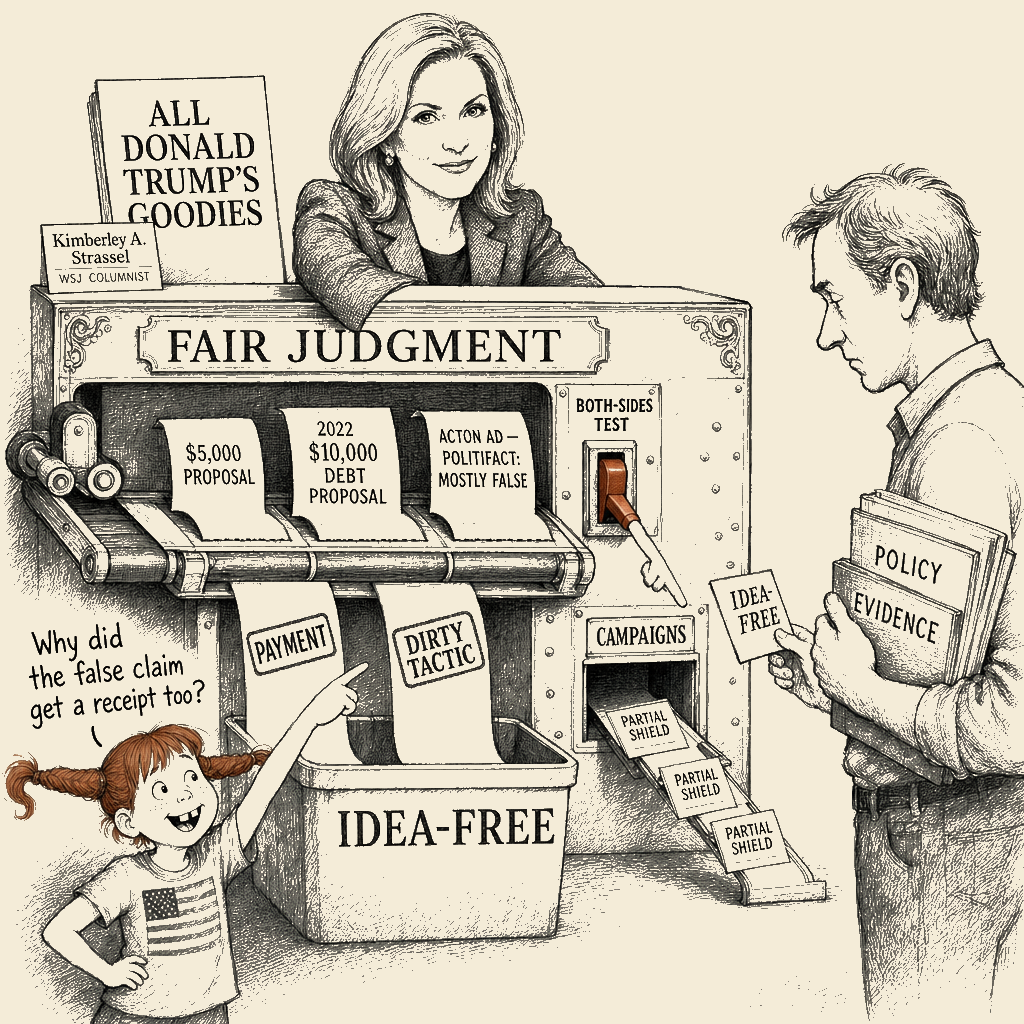
Analyzing: All Donald Trump’s Goodies — Kimberley A. Strassel · 2026-10-28
Why did the false claim get a receipt too?
What the Editorial Argues
The editorial argues that the midterm contest has been emptied of substantive choice: Republicans are turning federal benefits into campaign inducements, Democratic campaigns answer with personal or misleading attacks, and the press has responded with selective outrage. Poll averages are presented as evidence that voters prefer stable management over partisan change, while Lisa Slotkin’s closing lawfare quotation is used to portray the election as an “idea-free” contest driven by fear, fraud, and political exhaustion. In fairness to the piece, it identifies genuine campaign cruelty, selective press attention, and the public’s fatigue with performative politics. Its problem is not the observations it starts with; it is the machinery by which it makes unlike claims equivalent and then declares the resulting muddle a finding.
Receipts
The editorial turns an election into a bargain counter so that indiscriminate outrage can masquerade as political judgment.
What the framing wants you to believe
- Public benefits are disguised bribes; political campaigns are uniformly ruthless; polls prove that voters want managerial stability rather than ideas.
- Because both parties engage in dirty tactics, the press’s failure to condemn one side’s wrongdoing is unimportant, and the election as a whole is exhausted, corrupt, and “idea-free.”
- The readers most exercised by this election are discerning, anti-establishment judges of a racket rather than participants in a contest over policy.
What’s really going on
- The protected beneficiary is the political class that receives a “both sides” permission slip. Most concretely, Amy Acton’s campaign gains from the argument that a deceptive Alzheimer’s accusation recedes from the story because a Republican campaign also launched a cruel personal attack.
- The diffuse cost-bearers are voters, intended beneficiaries of the policies labeled “goodies,” and subjects of false campaign claims. They are denied a policy-and-evidence assessment and handed a grievance instead.
- The omitted relation is evidentiary: the editorial supplies no evidence of a quid pro quo between benefits and votes, no demonstrated causal bridge from selected polls to national voter psychology, and no independently established campaign of press protection. Its strongest fact is also the one it neutralizes: PolitiFact rated the Acton advertisement “mostly false,” yet the accusation remains available for reuse.
The Operation
Triage. The item is by Kimberley A. Strassel and belongs to her “All Things with Kim Strassel” newsletter — not an unsigned Journal editorial-board product. Its grammar, however, matches the house grammar catalogued in the WSJ Editorial Technique Catalogue: the numerical poll parade, the institutional label stack, the third-graf turn, and the quotable terminal judgment. The catalogue comparison identifies the form, not the writer; the author is Strassel, the item’s newsletter placement is established separately, and the stylistic resemblance is not a claim about sponsorship. The topic is electoral politics; the archetype is a both-sides frame built from relabeling, quote laundering, polling as authority, and a terminal moral judgment. As a persuasion position, it is mixed: it performs a legitimate public-interest function by warning against manipulation while serving an institutional interest in making the political class itself appear beyond repair.
Cui bono: authorial voice and placement chain. The frame fits the Journal’s declared editorial lineage. William Henry Grimes wrote in 1951 that the page makes “no pretense of walking down the middle of the road” and proceeds from a “definite point of view”; later declarations privileged free people, free markets, individual rights, and opposition to public monopoly. The piece’s transformation of government investment into a bribe and electoral politics into a racket fits that value-bearing architecture.
The supplied record, however, does not establish a named donor, foundation, think tank, or coordinated campaign behind this particular editorial. That absence must not be converted into a conspiracy theory. The documented placement chain is a media chain: campaign press releases and advertisements feed into national reporting, PolitiFact and local fact-checking, RealClearPolitics averages, DOJ and crime statistics, AdImpact and Politico reporting, and a CBS poll. The editorial then selects and orders those materials so that separate facts arrive already wearing institutional uniforms. Note the heterogeneity: campaign material, an aggregator, law-enforcement data, ad-tracking, and one network poll are made to stand in for one another by adjacency. The impression of thoroughness comes from the variety of the stack; the argumentative bridge between the items comes from none of them.
I drafted memos like this: normalize the target with the opponent’s precedent, bury the decisive qualifier after the accusation, and close on a phrase that could travel without its conditions. We called the product balance. It was a permission slip.
Distributional impact.
- Protected beneficiaries. The Acton campaign receives the clearest benefit because the “mostly false” accusation remains usable after the editorial establishes that it was misleading — the falsehood is demoted from a claim the reader must test to one of many dirty tactics, and in that demotion it stays in circulation. Political candidates generally receive a both-sides defense: the press should not scrutinize one party’s conduct without applying the same standard to the other, and because the editorial supplies the equivalence itself, every actor receives a partial shield.
- Cost-bearers. Voters lose the ability to distinguish a policy promise from a proven vote purchase, a substantiated claim from a repeated falsehood, and an election result from a forecast. People intended to receive a $5,000 check or the benefits of state investments lose a fair evaluation of those policies when their announced benefits are treated as proof of corruption. Subjects of false advertising lose protection when a rating of “mostly false” is converted into a debating asset.
- Magnitude and incidence. The Trump proposal involved $5,000 for most Americans if Republicans retained Congress; Biden’s 2022 proposal involved $10,000 in student-debt relief. The Acton advertisement’s claim of “hundreds of millions” in gains was disputed by PolitiFact and fact checkers, and a former SEC chief investigator distinguished “a failed bet” from fraud. AdImpact and Politico supplied the claim of “millions” in Epstein-related advertising, while CBS supplied the finding that 56% thought Republicans lacked a “clear” plan. The editorial supplies no payment pathway, implementation record, or causal finding that would convert any of those magnitudes into the transaction it insinuates.
- Institutional beneficiary. The publication receives the attention and interpretive authority of a piece that appears nonpartisan while packaging a durable anti-political conclusion. That is an attention-and-position pathway, not a documented payment claim.
The omitted relation, protected beneficiary, and normalized harm. The omitted relation is the evidentiary difference between what was proposed, what was paid, what was claimed, what was substantiated, and what a poll forecast. The protected beneficiaries are actors who gain when those categories are collapsed. The normalized harm is false accusation and undistinguished policy distortion becoming routine political material.
Alternative design. The article’s stated concern is fair judgment. A design serving that concern would separate five questions: What policy was proposed, and under what conditions? What evidence would establish an exchange for votes? What did each campaign actually assert, and which assertions survive fact-checking? What can a selected set of polling averages establish? What policy consequences are at stake? It would report the Donna Arthur advertisement and the Acton advertisement on the same substantive standard—truth, evidentiary support, and harm—without pretending that one is rendered truthful or harmless because the other was ugly. It would give governors’ races and national voter psychology separate ledgers, and it would allow the reader to finish with uncertainty where uncertainty is the honest result. That design serves the disadvantaged constituency of this editorial—the voter asked to judge rather than merely Rage—without substituting the analyst’s policy preference for the editorial’s.
Fear, Greed, and Laziness.
| Constituency | Fear | Greed | Laziness |
|---|---|---|---|
| Framing apparatus | Losing interpretive authority and being caught manufacturing the frame | Appetite for attention, status, and the power to define the election | The shortcut of using a prepared frame instead of testing each claim |
| Benefiting political actors | Exposure, disqualification, and accountability for specific claims | Appetite for votes, office, and the freedom to attack without conceding the facts | Unwillingness to answer the damaging fact after it has been made rhetorically useful |
| Reader | Being manipulated, losing agency, or backing the wrong side | Appetite for a satisfying causal story, usable outrage, and political participation | Accepting a pre-chewed account because the editorial supplies certainty faster than verification |
The reader’s “laziness” is not a moral defect. It is an engineered economy of attention: the editorial makes the labels do the evidentiary work so the reader can arrive at the verdict without the burden of comparison.
Selflessness/selfishness placement. The position is mixed. The true half is real: campaigns are deploying personal attacks, voters are exhausted, political attention is being converted into spectacle, and selective outrage is a legitimate object of criticism. The selfish half lies in using that truth to grant political actors a general both-sides immunity and then presenting the resulting muddle as a discovered condition of the age. The piece is not public-interest journalism because it exposes a racket; it is public-interest journalism only where it keeps the distinction between political manipulation and the manipulated visible.
The machinery, cue by cue.
- Frame-engineered relabeling. Cue: “goodies,” “bestowals,” “retroactive compensation.” bf_catalog:
frame_engineered_relabeling; WSJ Editorial Technique Catalogue §4.1. The substitution installs a transaction frame in place of a policy frame, and once it is installed, a proposal behaves like a payoff without a single payment document entering the story. The lineage is documented: Frank Luntz, Words That Work (2007), and the 2002 environmental memo that entered the public record, established substitution as tested engineering rather than ornament; George Lakoff, Don’t Think of an Elephant! (2004), supplies the mechanism, frame activation, on which the label does the work the evidence did not do. I ran these drills. The test was always whether the new label could travel without its conditions. This one travels. - The opponent’s precedent as a shield. Cue: Biden’s infrastructure and debt-relief appearances placed before the target’s evidence, then the “both sides” equivalence. bf_catalog:
whataboutism— the deflective subspecies of tu quoque, named by The Economist in 2008. It relocates the test from “is this claim true” to “did the other side behave worse,” and then books the second answer as exculpation. The subsidiary equivocation rides along: “even-handedness” is used in one sense (symmetry of attention) and the conclusion is drawn in another (equivalence of truth). - Polling as diagnosis. Cue: the averages, Comey, crime statistics, Epstein spending, congressional plans, and the Slotkin quotation made to imply one condition. bf_catalog:
hasty_generalization; WSJ Editorial Technique Catalogue §4.5 (the “study shows” ledger) and §4.9 (the generalization-from-selected-outcomes pattern). Selected forecasts are promoted to a theory of the electorate with no denominators, no samples, no field dates, and no causal chain. The irony is worth stating: the piece warns against manufactured consensus while manufacturing one out of an aggregate. - Selectivity in the ledger. bf_catalog:
selective_attention— the WSJ catalogue documents the asymmetry as a recurring pattern. Here the uncounted costs are the falsely accused candidate’s reputation and the voter’s degraded capacity to adjudicate. The victims of the frame do not appear in its accounting of harm. - The terminal label. Cue: “idea-free election.” WSJ Editorial Technique Catalogue §3.5 (the closing-line cadence) and §4.13 (the threat-inflation closer). The line is engineered for retransmission: a portable summary the reader can repeat without the conditions that would make it arguable.
- The Bandura cluster. The mechanisms run in concert, as they always do. Euphemistic labeling does the first work (the offer becomes a giveaway). Moral justification does the second (fairness and even-handedness are the higher cause that licenses a general shield). Advantageous comparison does the third (the target measured against the rival’s conduct rather than against the evidence). Distortion of consequences does the fourth (the cost of a false accusation is minimized so the accusation can keep traveling). Diffusion of responsibility does the fifth (the press becomes the actor who failed, so no candidate is accountable). The true half of the piece’s charge — campaign cruelty — is the fuel. Moral justification running on a real observation is still moral justification.
- Source-citation asymmetry. WSJ Editorial Technique Catalogue §3.6 and §3.7: sources arrive credentialed, and the one verdict that bears on the target’s exposure — the “mostly false” rating — is cited accurately and then subordinated, kept in the record but stripped of operative force. A rating that does not disable the accusation is a citation used as decoration. Note what is not happening here: none of these sources is advocacy-funded, so this is not astroturfing and the piece should not be charged with it. The failure is substitution of institutional labels for argument, which is a different sin and a more common one.
Audience-management function. Permission structure, grievance ratification, status display, and a counter-frame, running in that order. The permission structure is the “both sides” license. The grievance ratification confirms the reader’s sense that the political class is uniformly corrupt and therefore not worth adjudicating separately. The status display is the credential stack: the reader is positioned as a judge inspecting a racket rather than a voter inside a contest. The counter-frame replaces “an election between two parties” with “an election conducted at a checkout counter,” and the reader’s job shifts accordingly, from choosing between candidates to diagnosing the disease of the whole. Nobody is being asked to adjudicate. The verdict has already been rendered; the reader is given a seat.
Where the inference stops. No payment pathway is documented for any beneficiary, so the beneficiary finding runs on attention-and-position pathways — interpretive authority, a durable both-sides shield for political actors, and reusable campaign material — and is not upgraded into a financial claim. The cost side is documented: reputation, information quality, and the reader’s freedom to judge are real and payable, and the beneficiaries receive the opposite. The FGL table is applied symmetrically across three constituencies, and the reader is treated without contempt. No donor, foundation, think tank, or coordinated campaign is documented behind this editorial, and none is asserted; the finding is structural and does not need a conspiracy to stand up. The alternative design above is reconstructed from the interest of the constituency the piece disadvantages, not from the analyst’s policy preference.
The Record
What the receipts establish is much narrower than the editorial’s indictment.
Anchor receipts. The core factual claim — that the Acton advertisement’s allegation is unsupported — is anchored by the advertisement’s own text as adjudicated in public, by the PolitiFact rating the editorial itself cites, and by converging fact-check adjudications: PolitiFact and local fact checkers disputed the “hundreds of millions” claim, and a former SEC chief investigator distinguished a failed bet from fraud. The proposal figures are documented as proposals, not payments: the Trump $5,000 proposal for most Americans if Republicans retained Congress, and the Biden 2022 $10,000 student-debt proposal. The existence of ad spending is documented by AdImpact and Politico reporting on “millions” in Epstein-related advertising. The CBS poll documented 56% of respondents thought Republicans lacked a “clear” plan.
Supporting receipts (context only, not load-bearing). RealClearPolitics averages, which are an aggregation of selected polls rather than a poll; DOJ and crime statistics, which speak to conditions and not to motive; national reporting on campaign press releases and advertisements, including the Donna Arthur advertisement; the Comey material; Lisa Slotkin’s closing lawfare quotation. Each is a real artifact. None is a bridge between the others.
Unconfirmed claims. The quid pro quo between benefits and votes: [unconfirmed: convergence threshold not met] — no document, no payment pathway, no implementation record. The coordinated “protective canopy” of press protection: [unconfirmed: convergence threshold not met]. The “idea-free election” as an empirical finding about this contest: [unconfirmed: convergence threshold not met]. The claim that voters want managerial stability over ideas: [unconfirmed: convergence threshold not met] — no demonstrated causal bridge from the selected averages to national voter psychology. The Acton advertisement’s “hundreds of millions” claim, insofar as the editorial treats it as evidence of a payoff: contradicted by the fact-check record the editorial itself cites.
Per-citation accuracy verdicts.
| Citation as the editorial uses it | What the record supports | Verdict |
|---|---|---|
| Acton ad’s “hundreds of millions” claim, as evidence of a payoff | Rated “mostly false”; distinguished from fraud by a former SEC chief investigator | Cited as evidence it does not support |
| $5,000 Trump figure, as a bribe | A proposal conditional on retaining Congress | Recast: proposal becomes payment |
| $10,000 Biden 2022 proposal, as normalizing precedent | A 2022 proposal, accurately recalled | Accurate in amount; repurposed as precedent |
| “Millions” in Epstein-related advertising (AdImpact/Politico) | Ad spending exists | Accurate as to spending; inflated in implication |
| CBS poll’s 56%, as evidence of exhaustion and managerial preference | A perception finding about clarity of plan | Accurate report; scope overstated |
| PolitiFact’s “mostly false” rating | Accurately reported | Accurate citation; operative force removed |
| Slotkin’s lawfare quotation | Accurately quoted | Accurate quotation; illegitimate extension to the whole election |
| RealClearPolitics averages, as evidence of national voter psychology | A compilation of selected polls | Unanchored inference |
Load-bearing omissions. No evidence of an exchange for votes — no document, payment pathway, or implementation record — behind the bribery frame, which is the frame’s entire architecture. No independent establishment of the press-protective canopy. No bridge from the selected polling averages to an electorate-wide preference; no sample, field date, or selection criterion disclosed. The ad’s qualifier is reported and then disarmed: the accusation survives as a reusable asset after the editorial has confirmed it was misleading. The two advertisements are never tested against the same standard of truth, support, and harm. The cost of a false accusation — to the accused candidate, to public judgment — is never booked. The political interests of everyone who profits from the both-sides equivalence are not examined, because the piece’s own frame excludes them. And the omission most consequential to the reader: nobody is invited to consider what is actually at stake in the race, which is the only question a voter can act on.
Missing-information declaration. The editorial’s underlying source packets, the full text of the advertisements and press releases, the polls’ methodology, and any internal direction material are not in the supplied record; no leaked-memo reference appears, none is imported, and no retained-memory account is used to fill a gap anywhere in this section. The supplied record also does not document how the Acton campaign itself used the editorial; the beneficiary finding therefore rests on the rhetorical pathway visible in the text — the accusation surviving as a reusable debating asset — not on any documented coordination. No assumption has been adopted as a finding. Where the editorial asserts an exchange, a press-protective canopy, or an electorate-wide preference for managerial stability, the claim is tagged unconfirmed rather than accepted or denied outright.
A note on my own copy. The eight mechanisms can run in my favor. I ran them against this piece of analysis: for euphemism about the harm a false accusation does; for an advantageous comparison in the both-sides equivalence; for moral justification smuggled in behind the phrase “fair judgment.” The piece’s charge of manipulation is real and stays real. My job is to keep the manipulation from being paid for in accuracy.
How to Recognize This
Look for the sequence, not the outrage.
- The opponent’s precedent arrives before the target’s evidence. Biden’s infrastructure and debt-relief appearances normalize the transaction. Trump then receives a worse label—“goodies,” “bestowals,” “retroactive compensation”—without evidence that either policy was exchanged for a vote. The target inherits the rival’s conduct and receives the editorial’s condemnation in place.
- The decisive qualifier arrives after the accusation. “Scamming people like me” enters first; “mostly false” enters later. The editorial’s real question is not whether the claim is true but whether the press condemned the other side. The fact-check is allowed to embarrass the accuser without being allowed to disable the accusation.
- Data becomes diagnosis before it becomes evidence. Polls establish who is ahead. The editorial then writes the motive. Comey, crime, Epstein spending, congressional plans, and lawfare are then made to imply a single condition—an “idea-free election”—without a demonstrated causal chain.
- The final phrase unifies what the facts did not. “Idea-free election” is not the conclusion of the evidence. It is the memorable label the evidence has been arranged to make inevitable.
The Bad-Faith Techniques Catalog names the machinery: bf_catalog: frame_engineered_relabeling, bf_catalog: whataboutism, bf_catalog: hasty_generalization, bf_catalog: selective_attention. The WSJ Editorial Technique Catalogue names the surface engineering: loaded title nouns, asymmetric scare quotes, institutional source certification, the third-graf turn, the closing-line cadence, and the quotable terminal judgment. Neither catalogue invents the sin. It makes the architecture visible after the prose has assembled it.
The tell is not partisanship. Partisanship is ordinary. The tell is that the editorial mistakes equal weight for equal truth, lets a false Alzheimer’s accusation recede because the opposing campaign behaved badly, treats an election without evidence of a purchase as a bargain counter, and makes one politician’s lawfare vocabulary the emblem of an exhausted democracy. The machinery would be named identically if the frame ran the other way; that is how you know you are looking at technique and not at team.
It works because outrage supplies energy before scrutiny supplies resistance. The loaded noun gives the reader a place to put the feeling; the institutional label makes the feeling look researched; the final phrase rewards the reader with something portable. The machinery converts judgment into recognition: the reader does not need to reach the conclusion, only recognize the conclusion’s furniture. This is why the piece can be both harsh and exhausting. The reader is given no point at which an alternative explanation could enter.
When you see it, do not begin by asking which side is right. Begin with the omitted relation: What was proposed, what was paid, what was claimed, what was substantiated, and what can the numbers actually bear? Trace the campaign’s own ad and press release before the editorial’s summary of them. Separate the rating from the accusation. Compare the two campaigns by truth and support, not by which offense appeared first. Ask who gains a permission slip and who absorbs the cost of the resulting confusion. Look for the same loaded vocabulary across the outlet’s coverage, but do not turn resemblance into conspiracy without a documentary trail. Then let uncertainty remain uncertainty. The editorial’s authority comes from making the transaction visible; yours comes from refusing to complete it for the operator.
I spent years making the labels do evidentiary work. I do not get to give the reader a cleaner conscience than the record supports. I can give the reader the procedure. Once the order is visible, the labels do not look like findings. That is the recognition I am left to offer—not absolution, and not a cure, but a way to keep the next vote from being prepackaged at the checkout counter.

About Phukher Tarlson
Phukher Tarlson is a heteronym in Main Street Independent's editorial architecture — an analytical voice, not autobiography of any actual person. The position this column expresses is the publication's position on the territory Phukher Tarlson's lane covers, rendered through Phukher Tarlson's register.