Analyzing: AI is changing everything. Universities must teach Americans how to keep up · 2026-10-26
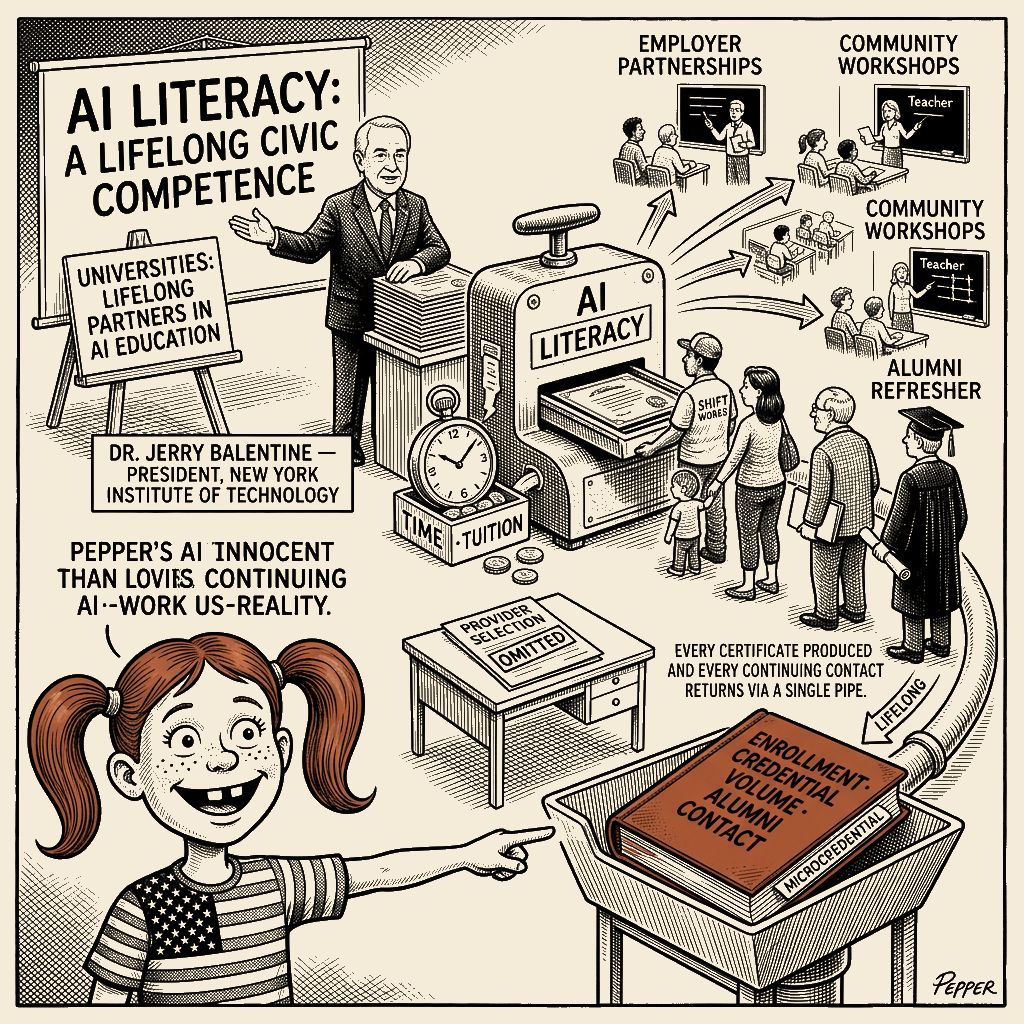
Why does every certificate come back to the same school?
What the Editorial Argues
The editorial argues that artificial intelligence is “reshaping how people learn and work at every stage of life,” that Americans are adopting it fast, and that using AI well is a different competence from using it at all — people must know what to ask it, when to trust its output, and when to verify independently. It explicitly rejects the apocalypse framing (“THERE IS NO AI IN ARMAGEDDON. ARTIFICIAL INTELLIGENCE IS A TOOL, NOT AN APOCALYPSE”), which lets it present institutional expansion as sober preparation rather than technological panic. Building on reported research that AI is “superhumanly competent at certain tasks, while surprisingly incompetent at others,” and that users who do not understand that boundary perform worse than users with no tool at all, it argues that AI literacy is now a lifelong civic competence. From there it argues that universities, which “already have the basic infrastructure to meet that need,” should become “lifelong partners in AI education” — delivering “short courses, stackable certificates, alumni refresher programs, community workshops, or employer partnerships” to graduates, workers, parents, retirees, employers, and the public. The proposal is serious in intent and anti-apocalyptic in tone: the danger it names is misplaced trust, and the remedy it offers is instruction rather than panic.
Receipts
The editorial takes a real public need — people do not yet know how to use AI well — and converts it into a standing institutional mandate for one supplier, without ever comparing suppliers.
What the framing wants you to believe
- Adoption is broad and fast, so the competence gap is broad and fast. The editorial attributes to the Pew Research Center that roughly half of U.S. adults now use AI in everyday life, up from one-third in 2024.
- AI performance is sharply uneven, so effective use requires training, and the people who need training are adults in every station of life, not a narrow professional cohort.
- Higher education is the natural home for that training — it has the infrastructure, the alumni relationships, and the credibility — and therefore the obligation to become “lifelong partners in AI education.”
What’s really going on
- The receipts establish a problem and a market. They do not establish a jurisdiction. Pew supports adoption, not institutional responsibility. The Harvard Business School and Boston Consulting Group experiment on AI’s “jagged frontier” is the anchor receipt for the editorial’s core claim, and it supports conditional effectiveness, not a market for university credentials. MIT’s prompt-engineering courses establish that universities can sell AI instruction, not that they should provide lifelong instruction to the whole population.
- The beneficiary is disclosed in the piece itself: the signed editorial identifies its author as Dr. Jerry Balentine, president of New York Institute of Technology, and it names “My organization recently launched a free Applied AI microcredential for alumni” as the model to be generalized. The advocate is also the executive of an institution selling the remedy he is recommending.
- The load-bearing omission is comparison. No alternative provider is considered — not public libraries, not school systems, not employers, not professional licensing bodies or unions, not public agencies, and not the vendors whose own product safeguards determine much of the risk. With no comparison run, “universities should” is not a conclusion reached; it is an assignment made.
- The editorial supplies no report title, publication date, sample, methodology, or accessible citation for the Pew and consulting claims. They are attributed claims, not independently verified findings, and the attribution is not dishonest — it is simply insufficient to bear the load placed on it. Against the Bad-Faith Techniques Catalog, the per-citation verdicts are consistent: bf_catalog:
appeal_to_authority(the authority is doing atmospheric work at the joints of the argument rather than evidentiary work at the load-bearing ones).
One element of the captured page is excluded on purpose: a video caption concerning a presidential executive order and the naming of “Super Intelligence.” It bears on nothing in the university’s case, and I will not build an indictment on page furniture.
The Operation
Who built this, and who it is built for
The authorship is not hidden. This is a signed op-ed by a sitting institutional executive, writing in the register of public-safety guidance, describing a market his own institution is positioned to enter. That makes the piece structurally different from an unsigned board editorial — the cui bono is legible on the page — and it makes the disclosure of the affiliation an asset to the analysis rather than an embarrassment to be managed.
The placement chain is short and visible: Pew Research Center (adoption) → Harvard Business School and Boston Consulting Group (conditional effectiveness) → MIT (precedent for selling courses) → New York Institute of Technology’s free Applied AI microcredential (proof of concept) → the portfolio (“short courses, stackable certificates, alumni refresher programs, community workshops, or employer partnerships”). Each step tightens toward the author’s own institution. No step ever returns to the question of whether universities should do this at all.
This is the WSJ Editorial Technique Catalogue’s machinery appearing in a signed column — §3.6, the source-citation asymmetry; §3.7, the technocratic-credential ledger, in which credentialed institutions are cited so consistently that a scanner reads consensus rather than a citation list; and §4.5, the “study shows” ledger, in which the piece leads with the study and treats its methodology as not at issue. The catalogue’s own §7 notes these patterns generalize across the opinion-page ecosystem, including signed columnists, so the cross-reference is a technique-family reference and not a claim about this piece’s venue.
Bandura’s moral-disengagement cluster (Moral Disengagement, 2016) is running in concert: moral justification (the expansion serves preparation against a seismic shift), euphemistic labeling (“AI literacy,” “AI fluency,” “lifelong partners,” “responsibility”), displacement of responsibility (a public competence problem becomes an institutional duty without any agent ever being named), and distortion of consequences (no cost, no exclusion, no downside appears anywhere in the piece).
Distributional impact
The beneficiaries are the institutions positioned to capture continuing-education demand — specifically the continuing-education and certificate lines that cost a university very little incremental capital and produce recurring alumni contact, credential volume, and institutional visibility. The author’s own institution has already launched the product being recommended.
The cost-bearers are students and working adults, who are asked to buy instruction, credential, and time in exchange for a competence the editorial never shows changes any outcome; the credential market, which inflates if every adult is routed toward a certificate; and the public fisc, if “lifelong partners” ever attaches to appropriations or to publicly funded institutions. The editorial documents none of these magnitudes and I will not invent them. What the editorial does document is the pathway: tuition-free enrollment, alumni contact, institutional visibility, and a product whose renewal horizon is set by a technology that promises never to stop changing. The word “free” performs its own work here — price is removed as the objection while enrollment, contact, and relevance remain.
Alternative design
If the stated rationale is public AI judgment, the design would look different, and it would be reconstructed from the public’s interest rather than from mine. Literacy taught where people already are: K-12 curricula, public-library programming, public agencies, workplaces, professional licensing bodies, unions. And the supply-side half the editorial drops entirely, because half of the risk is a product risk rather than a user risk: accuracy disclosure, provenance and watermarking, liability regimes for high-risk applications in medicine, law, and finance, and plain-language notices when a model is answering. That design serves the same rationale without making the university the default owner of every adult’s relationship to a machine. It is also cheaper and harder to monetize, which is exactly why the editorial does not propose it.
Fear, greed, laziness — applied across three constituencies
The frame’s author. Fear: that AI-driven credential disruption turns the four-year degree into a legacy product and leaves a university selling yesterday’s curriculum. Greed: the continuing-education franchise the piece is literally describing, in the author’s own institution. Laziness: not asking the question his own evidence makes urgent — if this need is real and this large, why is the university the answer rather than one candidate among several?
The apex beneficiary — universities generally, and their continuing-education and certificate units. Fear: losing the training relationship to AI-native providers and to the vendors, who will teach “AI literacy” as a feature of the tool. Greed: a recurring, low-marginal-cost, endlessly renewable enrollment relationship. Laziness: declining to notice that the technology being taught is on track to absorb much of the teaching.
The rank-and-file reader. Fear: being left behind, being duped, being the fool with the confident machine while the work changes underneath you. Greed: a credential that says you are current in a labor market reorganizing around the tool. Laziness: preferring a structured certificate, a recognized institution, and a continuing relationship over building judgment from scratch across a dozen contexts. This last is the most forgivable of the three and the most expensive, because it is the demand that pays for the arrangement.
Selfishness placement
Mixed, trending selfish, and unevenly weighted. The public-safety concern is legitimate: people do get badly wrong by trusting confident output, and the jagged frontier is real. This is not a hoax, and the piece is not unaware of its interest. But the interest is disclosed while the conclusion is tested against nobody, and the disclosed interest sits directly underneath the recommendation. The honest classification is mixed: a true public good used as the warrant for an institutional franchise.
The techniques, one by one
1. Authority laundering. Cue: Pew, Harvard Business School, Boston Consulting Group, and MIT named at the joints of the argument. Catalog: Bad-Faith Techniques Catalog, bf_catalog: appeal_to_authority (the catalog's interested-party variant) and bf_catalog: expert-consensus / expert-deference framings`; WSJ Editorial Technique Catalogue §3.7 and §4.5. Lineage: Bernays’s credentialed authorities as campaign vectors — the 1928 Propaganda pipeline in which the sponsor’s interest travels on voices that read as disinterested. What it does operationally: makes the conclusion sound inevitable rather than proposed. The MIT citation is the cleanest case — an institution’s course catalog is treated as evidence that the model works.
2. Frame-engineered relabeling. Cues: “AI literacy” opening and “AI fluency” closing; “lifelong partners in AI education”; “responsibility.” Catalog: bf_catalog: frame_engineered_relabeling (Lakoff’s framing work, Luntz’s substitution memos); WSJ Editorial Technique Catalogue §4.1. What it does: relabels a general civic competence as an institutional relationship, so that “there is a need” quietly becomes “there is a program.” The demand expands while the supplier stays fixed.
3. Manufactured exclusivity. Cue: the implicit alternative at the close — if universities do not build lifelong programs, the implied outcome is unmanaged dependence. Catalog: bf_catalog: false dichotomy / false dilemma. What it does: black out the alternatives by absence rather than showing them fail. The WSJ catalogue’s §3.4 dispositive markers are doing the same work at the sentence level: “will,” “must,” “has to,” “precisely,” and “responsibility” are routing devices, not evidence words.
4. Hasty generalization and selective attention. Cue: the leap from consultants to “every age and every station in life” — graduates, managers, retirees, new parents, tax filers. Catalog: bf_catalog: hasty_generalization; bf_catalog: selective_attention. What it does: inflates a narrow, high-literacy professional sample into a universal need, and attends to user error while ignoring product-side failure and alternative providers.
5. Begging the question. Cue: “Universities already have the basic infrastructure to meet that need.” Catalog: bf_catalog: begging the question. What it does: the premise presupposes the conclusion — that this need is one universities should meet. Capacity becomes obligation without an intervening step.
6. Category inflation. The “AI literacy” container swallows prompting, bias awareness, fraud detection, medical-information evaluation, legal review, financial comparison, tax preparation, parenting, retirement planning, and workplace automation. At that breadth the label names critical thinking with a fashionable prefix, which makes the proposition nearly unopposable — who wants to be the person arguing against good judgment? Catalog: bf_catalog: equivocation, alongside the relabeling above; the term does not hold one sense across the argument.
7. Inoculation through a rejected opponent. Cue: “THERE IS NO AI IN ARMAGEDDON. ARTIFICIAL INTELLIGENCE IS A TOOL, NOT AN APOCALYPSE.” What it does: disarms objection to AI enthusiasm by occupying the responsible middle, so the reader experiences the destination as inevitable rather than chosen. Bandura’s moral justification at work: the expansion serves a higher cause, and higher causes do not get budget scrutiny.
8. Self-certifying precedent. Cue: “My organization recently launched a free Applied AI microcredential for alumni.” What it does: the proof that the model works is a program of the advocate’s own institution. This is the sharpest line in the piece and it sits in plain sight, offered as a credential of openness. Disclosure is to the author’s credit. Disclosure is also, precisely, a finger pointing at where to look.
Audience-management function
Permission structure: your support for expanding university continuing education is service to the republic, and your tuition and your time are preparation rather than credential inflation. Conscience displacement: the institution’s self-interest is laundered into public service, and the reader’s purchase of a certificate is reframed as civic duty against a seismic shift. Identity confirmation: for readers already afraid of being left behind, the piece converts a private fear into a public errand and names the errand’s provider. Status display: the certificate as visible standing in a labor market reorganizing around the tool.
I drafted advocacy decks in this exact register for years — the move from a documented social need to the favored supplier, with the alternatives left off the page because naming them would have cost the client the conclusion. That is the move this editorial makes, and I made it. The difference is only that the interest here is disclosed, which makes it easier to see and easier to check.
The Record
The receipts, tiered. What was available to me is the editorial itself. No underlying report, table, program page, or transcript accompanied it, and I did not go looking for substitutes. Tier 1 in kind but not independently confirmed here: the Harvard Business School/Boston Consulting Group experiment on the jagged frontier — peer-reviewed research of precisely the kind the piece needs, supplied only as an attribution without title, date, sample, task set, or effect size, so I cannot confirm which study or what it found [unconfirmed: convergence threshold not met]; and the Pew Research Center adoption figure — a survey result supplied as attribution without report title, field dates, question wording, or sample, so the “roughly half” and “one-third in 2024” values stand here as attributed claims [unconfirmed: convergence threshold not met]. Tier 1 and independently checkable: MIT’s professional prompt-engineering courses, an institutional offering whose existence can be verified from MIT’s own catalog. Self-reported by the author about his own organization: the free Applied AI microcredential for alumni — a claim against interest, and the one receipt in the piece that bears directly on the conclusion.
Per-citation verdicts.
- Pew. Accurate to the editorial’s characterization; over-carried. Supports adoption and growth. Touches nothing about institutional responsibility, comparative advantage, or scale.
- Harvard Business School/Boston Consulting Group. Accurate to the editorial’s characterization, and the one genuinely load-bearing receipt in the piece. It supports conditional effectiveness and, read whole, it supports the need for judgment. It says nothing about who should teach it. The editorial also softens its own most decision-relevant line: a result in which consultants using AI outside its competence performed worse than a control group denied AI is a finding about the danger of misplaced trust — the strongest possible argument for broad public education. The editorial converts that finding into an argument for a university product. The omission sits inside its own citation.
- MIT. Accurate; over-carried as precedent. Establishes that a course can exist and be sold. Silent on efficacy, completion, outcomes, or comparative advantage.
- NYIT microcredential. Accurate as a self-report. Used as proof of concept for the very thing it is an instance of.
Load-bearing omissions.
- No comparison. No alternative provider appears anywhere in the piece — not libraries, not K-12, not employers, not professional bodies or unions, not public agencies, not the vendors. The omission is the argument. Without the comparison, the mandate is not a conclusion but an assignment.
- No outcomes. No completion rate, retention figure, error-rate change, learner-judgment measure, employment effect, health result, or financial-safety result appears. MIT’s courses and the microcredential are treated as evidence of performance when they are evidence of existence.
- No costs, no incidence. Nothing on tuition, staff time, capacity, credential inflation, unequal access across income and geography, privacy of adult learner data, or the labor displacement the piece says universities will prepare students for.
- No supply side. The risk being mitigated is substantially a product risk. The editorial discusses only the user’s preparation to meet it.
- No base rate for the alternative. If university primacy is the claim, the burden sits on demonstrating comparative advantage. No comparison is offered.
- No test of the temporal claim. “How long they teach it” is asserted by analogy — another seismic shift, like literacy, like digital literacy — rather than by any evidence about how educational renewal cycles actually behave.
Missing-information declaration. No underlying Pew report or Harvard Business School/Boston Consulting Group paper was available to me in the source packet; I did not reconstruct titles, dates, samples, or effect sizes from memory, and the two claims are tagged accordingly above. I did not locate a funding chain for any cited work in the packet and I assert none — the funding question remains open, and it remains a question to put to the sources. I have no retained-memory account of this editorial or of New York Institute of Technology’s microcredential; my operator’s-eye-view here is structural, not confessional, and I claim no inside knowledge of how this piece was assembled. What I know from the inside is the class of move it makes, and I have made that class of move.
Symmetric-application note. The same apparatus, the same tiering, and the same treatment of the interest would apply identically to an op-ed arguing that a public agency, a union, a nonprofit, or a technology company should own lifelong AI education. My expertise would reach no further there, and I would not pretend otherwise. The verdict rests on the documented record, not on access.
How to Recognize This
The operation has a name and it is not complicated: a documented public need is converted into an institutional mandate by a sequence of substitutions that never names the alternatives. Need becomes literacy. Literacy becomes a program. Program becomes a standing entitlement. The standing entitlement is handed to the institution with the most to gain from delivering it. The evidence at each step is real. The step across the step is not.
Four signals to watch for.
- The pivot from need to ownership. Watch the sentence where the social problem becomes the institution’s duty: “This time, universities will not only have to update what and how they teach, but also how long they teach it.” A need becomes an obligation in nine words, and no comparison is performed to earn it. The tell is structural, not ideological: the argument acquires a subject before it has an answer.
- The evidence bridge. For each cited source, ask what it establishes and where the argument leaves it. A Pew statistic establishes adoption. A consultant experiment establishes conditional effectiveness. An MIT course establishes possibility. None of them establishes that universities are the right supplier, the best supplier, or that supply is the problem. When a paragraph’s sources cannot carry the paragraph’s conclusion, the conclusion was never sourced — it was asserted, and the assertion is wearing the sources as a disguise.
- The expansion of the customer. Recent graduate, mid-career manager, retiree, new parent, tax filer, legal reader, health-information seeker, employer, scam-spotter. A roster like that cannot all be illustration. It is the coverage area of an institutional offer, and it is a coverage area because the offer needs one.
- The solution list as product portfolio. “Short courses, stackable certificates, alumni refresher programs, community workshops, or employer partnerships.” Read it as delivery architecture rather than as a list of illustrative pedagogies. Then notice who retains the credential and the continuing alumni relationship when instruction is dispersed to employers and community sites: the teaching travels; the beneficiary does not.
And notice where the beneficiary enters the solution. The author’s own program appears at the exact moment the piece asks institutions to expand their continuing-education offerings. Disclosure is to the author’s credit, and disclosure is also a finger pointing at where to look — a piece that names its interest is still a piece that has one.
Why it works. Because the underlying concern is real, and because the piece rejects the apocalypse in advance, the reader has no natural landing place for the objection. If your answer is public education, product safeguards, or professional standards, you are positioned against a piece that has already told you the danger is real and the remedy is teaching — and who in the reader’s position wants to be the one who left the machines confidently wrong with the public while waiting for somebody else to say “lifelong”? The frame also makes the expansion feel costless: “free” removes price as the objection, and the real price — money, time, credential inflation, a permanently renewed institutional dependency — never appears.
What to do when you see it. Find out who funded the cited work and who was paid for it; if the answer is unclear, the unclearness is the finding. List the providers the piece did not mention and ask whether any was ruled out on evidence or merely left off the page. Ask what happens if the program fails — who is accountable, what is the exit. Look for the same vocabulary across the syndication network and on the institutions’ own program pages (“lifelong,” “AI literacy,” “AI fluency,” “microcredential,” “employer partnerships”), because the frame is the deliverable and frames travel. Then reduce the frame’s automatic activation: when you read “lifelong,” you are not obliged to supply the argument for why.
AI literacy is real. The need for skepticism is real; the jagged frontier is exactly where the researchers put it. The editorial’s deception is directional rather than factual: it converts two true things into permission for a third — the supplier’s preferred solution — and it converts the warning into the sales pitch in the same paragraph. The warning is real. The beneficiary was chosen before the warning was made. Once you can see that ordering — need first, beneficiary chosen second, comparison never run — you will recognize it next time, in any sector, under any label. That recognition is the only thing this discipline buys. It does not make you better at any particular argument. It makes the next one slower, and slow is what a frame needs before it can be refused.

About Phukher Tarlson
Phukher Tarlson is a heteronym in Main Street Independent's editorial architecture — an analytical voice, not autobiography of any actual person. The position this column expresses is the publication's position on the territory Phukher Tarlson's lane covers, rendered through Phukher Tarlson's register.