Analyzing: California wants to spend $25 billion to put homebuyers deeper in debt · 2026-10-26
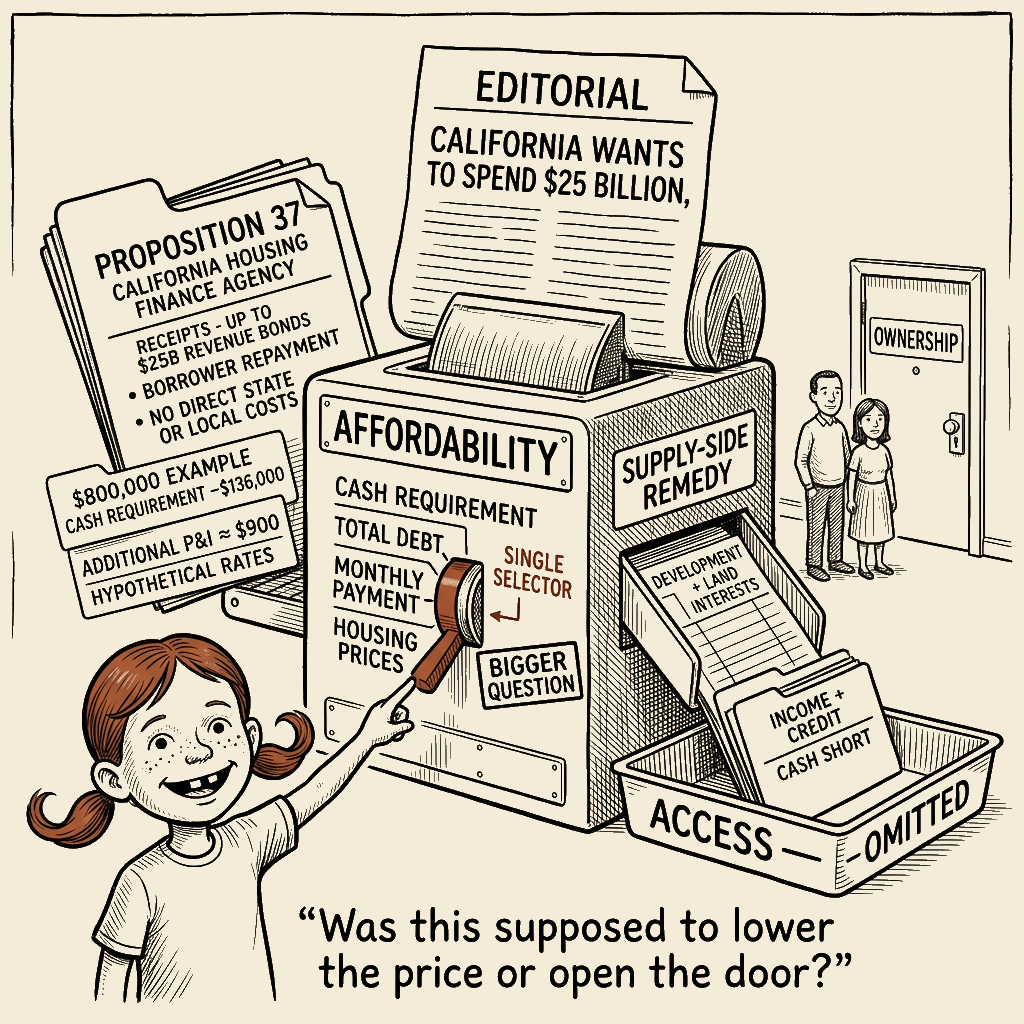
Was this supposed to lower the price or open the door?
What the Editorial Argues
The editorial argues that Proposition 37 would authorize the California Housing Finance Agency to issue up to $25 billion in revenue bonds for down-payment assistance, allowing buyers to contribute as little as 3 percent, borrow as much as another 17 percent through a state-backed second mortgage, and finance the remaining 80 percent conventionally. In an $800,000 example, it shows that the buyer’s cash requirement falls by $136,000 while combined principal and interest rises by roughly $900 a month under hypothetical rates compared with a conventional 20-percent-down purchase. Its central warning is that added purchasing power may raise housing prices when housing supply is fixed, so California should expand supply, shorten permitting delays, and reduce construction costs rather than treat financing assistance as a solution to housing affordability. It acknowledges that the bonds are not a taxpayer-funded giveaway and that a carefully structured loan could help some families with adequate income but inadequate savings, but closes by insisting that borrowing more money does not make a home cost less.
Receipts
The editorial recasts a cash-access program as a debt-and-price program, then uses the debt it discloses as proof that access is illusory.
What the framing wants you to believe
- California is made to sound as though it wants to “spend $25 billion” and put homebuyers “deeper in debt,” even though the body describes revenue bonds intended to be repaid through borrowers’ mortgage payments.
- Additional purchasing power will raise housing prices without producing more housing, so down-payment assistance cannot solve California’s affordability problem.
- Supply-side remedies—permitting reform, lower construction costs, and more housing—belong in a separate intellectual category and should replace the proposal.
What’s really going on
- The frame protects a supply-side policy agenda by shifting the question from access to aggregate price. The pathway is straightforward: once financing assistance is made to sound categorically illegitimate, the preferred remedy remains the only serious answer. The operation is agenda control, not a hidden-funder story.
- The omitted relation is access: a household with income and credit but insufficient savings can reach ownership through a second lien without the house becoming cheaper. The normalized harm is representational rather than physical: the borrower’s additional debt stands as the whole cost, making eligible families disappear from the argument.
- The anchor is the California Legislative Analyst’s Office estimate on Proposition 37, as reported in the editorial: the revenue bonds are intended to be repaid through mortgage payments, and the analyst estimates no direct state or local government costs.
The Operation
The arithmetic is not the lie. The taxonomy is. The editorial shows what a buyer would owe, then makes debt answer a question the proposal never claimed to answer: whether the cash barrier to entry can be reduced.
I built versions of this operation: isolate the cost that can be quantified, bury the benefit the proposal was designed to produce, and then let the cost answer a question it cannot answer. The editorial supplies no evidence that connects it to an old memo. I know the structure because I helped build structures of this kind. The distinction matters. The record shows what this text does; it does not show a donor, a campaign, or a conspiracy, and I will not manufacture one.
Institutional authorship and placement chain. The documented chain is narrower than the rhetoric suggests: Proposition 37’s financing mechanism, the California Legislative Analyst’s Office estimate, the editorial’s illustrative payment calculation, and then a categorical verdict about housing policy. The analyst’s estimate can establish the mechanics of the bonds and their repayment. It cannot establish that the program will raise prices, fail to help households, or should be displaced by permitting reform. No named think tank, foundation, donor network, or campaign organization appears in the available record. The protected beneficiary here is a supply-side policy agenda and the development and land interests positioned to benefit from it—not a secret paymaster inferred from absent evidence.
Distributional impact. The proposal’s direct beneficiaries are households with adequate income and credit but insufficient savings to meet a conventional down payment. Its direct cost-bearers are those same households, because the second lien and its monthly payment do not disappear when the editorial calls them an accounting problem. The magnitudes are specific: up to $25 billion in bond authority, a $136,000 reduction in the cash requirement in the editorial’s $800,000 example, and roughly $900 in additional monthly principal and interest under the example’s hypothetical rates.
The preferred supply-side alternative has its own incidence. Faster permits and lower construction costs can make development projects more feasible and can increase the value of developable land. Whether that produces enough new housing to benefit renters and prospective buyers depends on the supply response the editorial does not measure. Taxpayers cannot be named as direct beneficiaries of the proposed bonds on this record: the Legislative Analyst’s estimate, as reported, identifies borrower mortgage payments as the repayment mechanism and finds no direct state or local government costs. The editorial’s true omission is therefore not a hidden public expense. It is the conversion of financing assistance into categorical illegitimacy before the distribution of benefits and burdens has been examined.
Alternative design. A design optimized for the editorial’s own rationale—and for the actual interest of income-qualified households without savings—would not make financing assistance and supply expansion mutually exclusive. It would pair permitting and construction reform with a bounded second-lien program, require repayment by eligible borrowers, publish data on take-up, delinquency, prices, and program incidence, and phase assistance up or down according to whether supply expansion is reducing the cash barrier in practice. That is not a claim that the proposal is proven or that the analyst’s estimate resolves its effects. It is the third option the editorial’s “bigger question” suppresses.
Fear, greed, and laziness, applied without contempt.
- The framing author or institution: fear of price increases and political blame is the visible pressure; material greed is not documented; the intellectual shortcut is replacing a multi-objective test with one monthly-payment number.
- The prospective beneficiary class: developers and landowners have a structural incentive to prefer rules that increase project feasibility and land value, and therefore a stake in displacing an assistance-centered frame. That is an incentive path, not a claim of criminality or secret coordination.
- The rank-and-file reader: fear of debt, higher prices, and being trapped in a worse housing market is real. The ordinary desire to own a home and build equity is not a moral defect. The laziness the operation exploits is the human convenience of treating “borrowed money” as a complete answer to “can this household reach ownership?”
- The eligible household: the operation gives this reader no greed at all. It gives them fear and a burden. The frame removes them from the discussion while preserving their most visible cost.
The placement is mixed, not simply selfish. The concern about constrained supply is a legitimate public-good argument. The categorical conversion of access into debt is agenda-protective and makes the preferred remedy look inevitable by changing the test before the evidence arrives. Cynicism would deny the legitimate half. The record does not require that.
Technique map.
-
Frame-engineered relabeling. The textual cues are “spend $25 billion” and “deeper in debt,” set against the editorial’s own acknowledgment that the revenue bonds are repaid through borrowers’ mortgage payments. The catalogue cross-reference is the Bad-Faith Techniques Catalog, entry
frame_engineered_relabeling, and the WSJ Editorial Technique Catalogue §4.1. The operation converts self-repaid financing into public spending and converts access into burden. The lineage is Luntz’s documented relabeling work and Lakoff’s account of framing; that lineage identifies the technique’s family, not a document connecting this editorial to any particular memo. -
Equivocation and the criterion switch. The textual cue is the movement from down payment to total debt, from total debt to monthly payment, from monthly payment to housing prices, and finally to “affordability” as if those were one variable. The catalogue cross-reference is the Bad-Faith Techniques Catalog, entry
equivocation. The operation lets a true fact about debt answer the separate question the proposal was designed to address. The reader is made to feel that the case has been decided when only one case has been calculated. -
Possibility becoming certainty. The cues are the fixed-supply scenario, the concession “Not necessarily,” and the historical appeals “We just saw this during COVID-19” and “the 2008 question.” The closest catalogue cross-reference is the Bad-Faith Techniques Catalog’s
hasty_generalization: a conditional mechanism and borrowed examples are made to carry a population-level conclusion without evidence of the relevant magnitude. Urgency is not mechanism. A scenario showing what could happen under constrained supply does not establish what will happen after this program. -
The concession graveyard. “The 17% isn’t free money” and “That’s a legitimate economic argument” are not incidental honesty. Those statements should narrow the conclusion. Here they are acknowledged and then neutralized by the appeal to a “bigger question.” The closest catalogue cross-references are
equivocationandframe_engineered_relabeling: the concessions are allowed to stand rhetorically, but not to alter the verdict.
I do not charge manufactured controversy or coordinated message discipline. There is no funding trace, repeated memorandum, or documented campaign chain in the record. The evidence supports a framing operation, not a conspiracy.
Audience-management function. The primary function is a permission structure: once debt is displayed, the reader is licensed not to examine access. The counter-frame tells the reader that supply is the only legitimate subject. Identity confirmation follows—the careful, sober reader recognizes supposed fiscal realism and rejects a program that sounds like borrowing. Conscience displacement completes the operation: eligible households become repayment records in an example, then disappear. The piece does not need to hate them; it needs only to make them numerically present and politically absent.
The Record
The record supports a warning about additional debt and a legitimate argument about supply. It does not support the editorial’s categorical verdict.
Anchor receipts and claim verification
- Primary receipt — California Legislative Analyst’s Office estimate on Proposition 37. As reported in the editorial, the measure would authorize the California Housing Finance Agency to issue up to $25 billion in revenue bonds; buyer contributions could be as low as 3 percent, with as much as another 17 percent financed through a state-backed second mortgage; the bonds are intended to be repaid through mortgage payments; and the analyst estimates no direct state or local government costs. This is a primary-government estimate and the strongest receipt for the program’s mechanics. It does not establish the editorial’s larger claims about price effects, program ineffectiveness, or the proper ordering of housing policy.
- The cash difference in the $800,000 illustration. The stated reduction of $136,000 is consistent with moving from a 20-percent cash contribution to a 3-percent contribution and borrowing the 17-point difference. It establishes the amount of cash saved in the example, not the program’s net social effect.
- The additional monthly payment. The approximately $900 figure depends on interest rates, term, amortization, and other assumptions not supplied in the available record. It should be treated as the editorial’s hypothetical calculation, not as an independently verified cost.
- The claim that the program will materially raise prices. Additional purchasing power can raise prices when supply is inelastic; that is the economic mechanism the editorial invokes. But no estimate here identifies the relevant elasticity, the program’s scale in actual purchases, the supply response over the relevant period, or the distribution of price increases between sellers, existing owners, renters, and entrants. A possible mechanism is not a measured result.
- The COVID-19 and 2008 precedents. The supplied text supplies no price data or demonstrated causal connection from either episode to Proposition 37. These are urgency devices, not receipts.
- The claims about permitting delays and construction costs. The editorial may be right that supply constraints matter, but no underlying estimate, project-level record, or comparative construction-cost series is available here to establish the magnitude or attribution.
No independent corroborating receipt is available in the record. The only potentially relevant primary materials identified are the official proposition materials and the Legislative Analyst’s estimate. That is enough to establish what the financing mechanism is. It is not enough to establish the editorial’s policy conclusion.
Load-bearing omissions
- The distinction between making a house cheaper and making a household able to reach ownership. The editorial’s conclusion silently replaces the proposal’s access mechanism with a price mechanism it never promised to lower.
- The eligibility filter: households with income and credit but insufficient savings are not the same population as households unable to qualify for any mortgage.
- The incidence of a price increase: the editorial never shows which buyers or sellers would absorb it, whether additional demand would crowd out unsubsidized buyers, or whether supply would respond.
- The program’s risk terms and safeguards, including who bears delinquency or foreclosure risk when a home financed partly by a second lien is lost.
- The quantitative evidence behind the COVID-19 and 2008 comparisons.
- The possibility of sequencing supply reform and targeted assistance, with measurable conditions for expansion, contraction, or revision.
- The distribution of benefits under the preferred supply-side remedy, including whether permitting and cost reductions produce enough new housing to reach households priced out of the existing stock.
Per-citation accuracy verdict
- California Legislative Analyst’s Office estimate: accurately reported on the points reproduced here. The estimate supports the description of revenue bonds, borrower repayment, and no direct state or local government costs. The editorial’s policy inference exceeds what the estimate decides.
- Other factual claims: no independent citations or source materials are available in the record to verify the price, historical, permitting, or construction-cost claims. None can be certified as false on this record, and none provides independent support as presented.
- Misquotation or source misrepresentation: none established.
Record limits
The publication, byline, publication date, full bibliography, and complete citation set are absent from the available bibliographic record. The proposition text and analyst report are known through the editorial’s account rather than supplied here, so their language has not been independently collated word for word. The rate and term assumptions behind the monthly-payment illustration are also missing. No leaked memorandum or other documented source connects this editorial to any donor, think tank, or coordinated placement chain. The analysis uses the documentary record and general familiarity with this class of operation; the documentary record governs the finding.
How to Recognize This
This is the criterion-switch operation: separate the asset from the instrument used to buy it, make the reader watch the instrument’s debt, and then judge the asset’s price as though the two were the same object.
The mechanism has four reliable signals.
- Watch the noun swap. The editorial moves from down payment to total debt, from debt to monthly payment, from monthly payment to house prices, and finally treats “affordability” as if all four were interchangeable. In the Bad-Faith Techniques Catalog, this is closest to
equivocation. - Watch the concession graveyard. “The 17% isn’t free money” and “That’s a legitimate economic argument” are not incidental honesty. They are facts that should narrow the conclusion. Here they are acknowledged and then made irrelevant by a “bigger question.”
- Watch possibility become certainty. A fixed-supply scenario shows what could happen. “Not necessarily” concedes that it need not happen. The editorial then speaks as though the scenario establishes the likely result.
- Watch borrowed precedent do evidentiary work. “We just saw this during COVID-19” contains no price evidence; the 2008 question contains no demonstrated connection to the proposal. Urgency is not mechanism.
It works because the piece gives the reader something true and asks that truth to carry a conclusion it cannot bear. The extra $136,000 is real under the hypothetical assumptions. The added monthly payment is real within the illustration. That gives the argument the moral authority of precision. The sleight of hand is to let the disclosed number answer a different question: whether some households can reach ownership without assembling six figures in cash.
When you see this pattern, do five things. Read the official measure rather than the headline’s paraphrase. Separate the purchase price, cash requirement, total debt, and monthly payment into four columns. Trace the legislative analyst’s estimate and the program’s actual terms. Ask what evidence would make the proposed remedy work and who bears what if it does. Then look for the same nouns across the publication, the author’s other work, and the surrounding commentary network. The repeated vocabulary matters more when the evidence changes.
Reduce the frame’s automatic activation with a plain question: What exactly is this policy supposed to fix, and has the editorial quietly changed the test? If the answer is that down-payment assistance cannot lower construction costs or approve houses, say yes—and then notice that the editorial has not shown that helping a cash-poor, income-qualified buyer reach ownership is illusory either.
Borrowing more money does not make a house cheaper. It can make a particular household able to carry one. The editorial’s final trick is structural: it makes the distinction disappear and then denounces the program for failing to perform the one job it never promised.
The loan and the house were never the same object. Recognition is the work left.

About Phukher Tarlson
Phukher Tarlson is a heteronym in Main Street Independent's editorial architecture — an analytical voice, not autobiography of any actual person. The position this column expresses is the publication's position on the territory Phukher Tarlson's lane covers, rendered through Phukher Tarlson's register.