Analyzing: JASON CHAFFETZ: Democrats tried to trick Alaska voters. Peltola must answer — Jason Chaffetz · 2026-10-29
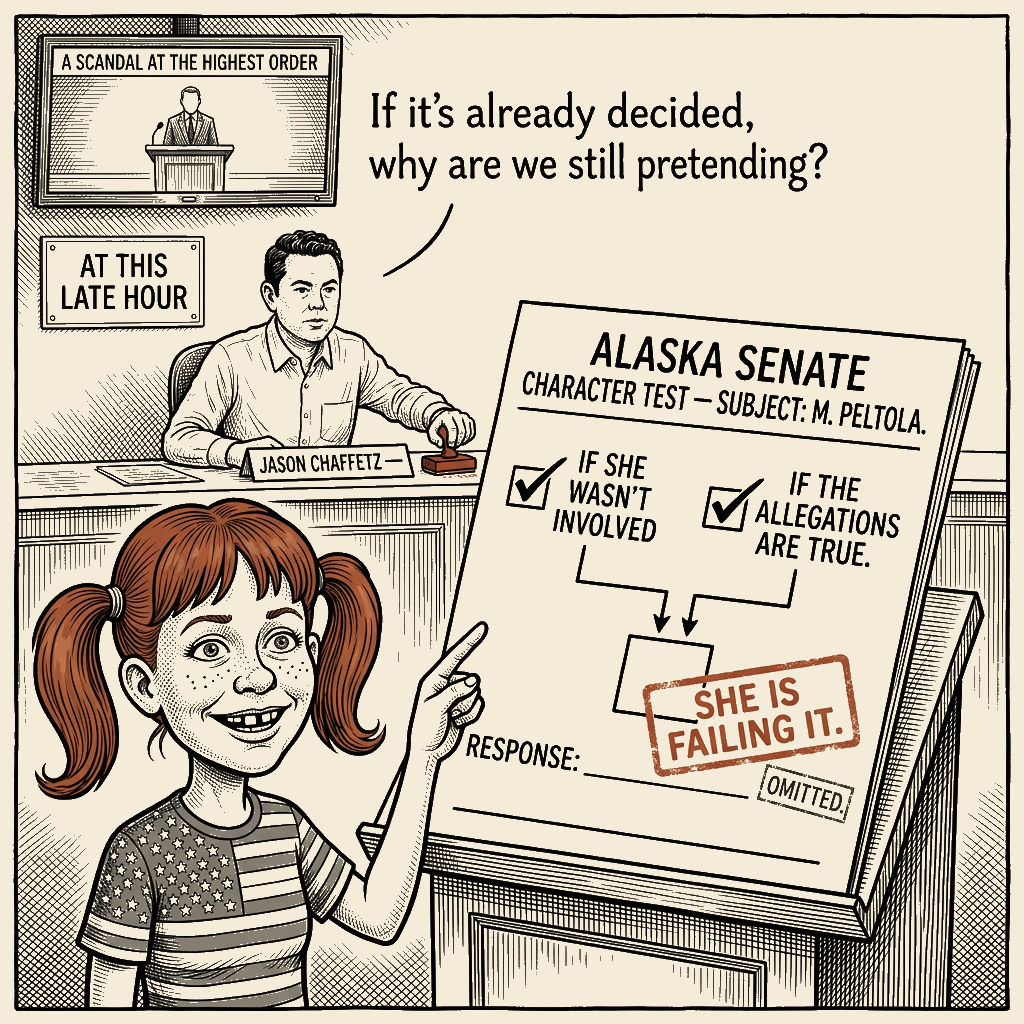
If it’s already decided, why are we still pretending?
What the Editorial Argues
Jason Chaffetz’s column argues that Mary Peltola’s campaign and the Democratic Senatorial Campaign Committee ran a deliberate scheme to put a namesake Republican — Daniel J. Sullivan — on the Alaska Senate ballot to bleed votes from incumbent Sen. Dan Sullivan under ranked-choice voting; that the New York Times reported, on a former campaign manager’s say-so, that Peltola was “definitely aware” of the effort; and that her refusal to denounce it is dispositive. It presents itself as a straightforward public-service disclosure: voters are owed “the truth,” and a candidate who will not supply it has told them everything they need to know.
That is the stated case. The operative case is narrower and harder to defend, because it never has to be defended: the column converts an evidentiary question into a character test, then hands the reader a verdict no possible answer can escape. Peltola must “come clean.” If she wasn’t involved, she must “have the political guts to call this out.” If she was, “imagine what she might be willing to do once voters give her power.” And her campaign’s existing denials? “The denials make it even worse.”
Every door in the room opens onto the same hallway. The accusation is the verdict, the denial is the confession, the silence is the character test — and the character test is failed by design. That is not an argument. That is a conviction with the paperwork filed afterward.
Receipts
The column converts a newspaper report into a conviction by making every possible answer to that report incriminating, and by adding nothing to it.
What the framing wants you to believe
- That the reader is being shown a discovery, not an assertion: “Not the denials Mary Peltola’s campaign keeps repeating, but the truth The New York Times documented this week.” In sentence two the reader is told which institution decides what truth is and that the opposing party’s statements are noise.
- That the conclusion is already settled socially, so no check is required: “Nobody really believed Daniel J. Sullivan’s name ended up on the ballot organically.”
- That the verdict has been earned: “These were disgusting, sleazy dirty tricks intended to cajole, manipulate and snooker voters instead of winning on the merits.”
What’s really going on
- The column’s entire evidentiary payload is the Times’s reporting — texts, documents and interviews; the recruiting of candidates including Daniel J. Sullivan; Peltola “definitely aware,” attributed to a former campaign manager; an Elias Law Group attorney representing both the campaign and the DSCC looped into related discussions. Watch what the column adds to that payload: nothing. No documents, no interviews, no times, no places, no corroboration the Times did not already supply. “But now the Times has provided compelling evidence” — of what? Of the Times’s own reporting. The paper is cited five times and questioned zero: each one cited, none cross-examined. That is the source-citation asymmetry the WSJ Editorial Technique Catalogue tracks at §3.6 — allied sources cited by credential, contrary sources never put to the test.
- The load-bearing omission: the denial the column calls worse than the offense is never quoted, and Mary Peltola’s own words appear nowhere in the piece — not a quote, not a paraphrase of a position, not a campaign statement. A reader is asked to judge a woman whose speech the column has made sure they never hear.
Now the finds, in the order they hit you:
-
The lede installs the arbiter before the first fact appears. “Not the denials Mary Peltola’s campaign keeps repeating, but the truth The New York Times documented this week.” Nothing that follows cross-examines the Times. The paper supplies the receipts when the conviction needs them, and is never asked a question.
-
The conditional pair convicts on both branches. “If she wasn’t involved, then she needs to have the political guts to call this out.” / “if the allegations are true, imagine what she might be willing to do once voters give her power.” Innocence is reframed as cowardice; guilt is reframed as a preview of tyranny. The Bad-Faith Techniques Catalog files this as
false_dichotomy: the option space is closed inside the conditional itself, so the reader never learns there is a third option printed nowhere on the page — the path the column itself gestures at when it invokes the federal litigation: treat the ballot as a legal defect, correct it through the court the column cites, and warn voters about the ranked-choice trap. No confession required. No tyranny previewed. The third door exists; the column never builds it. -
The denial is charged as aggravation. “The denials make it even worse.” Six words, and the target’s only rebuttal is entered as evidence against her. Immediately after, the column performs the hedge-drop — “If those allegations hold, the whole team lied about it” — where the conditional clause does all the legal work in the subordinate position and the flat accusation is what lands. Allegation, hedge, assertion, three sentences apart. That spacing is the trick. The Bad-Faith Techniques Catalog files it as
begging_the_question: the guilt is presupposed in the premise, because “come clean” only makes sense if she is already holding the truth hostage. -
The denial is never quoted. The campaign and the DSCC are said to have “denied involvement” and to have taken “that position in public and in the context of the federal litigation.” Not one sentence of the actual denial appears. A reader cannot evaluate wording they were never shown, and the column makes sure they aren’t.
-
Silence is billed as confession. “But notably, none of the parties condemned it” — the same structure applied twice, once to the denial and once to the silence. The burden never moves. Failure to denounce an accusation becomes the accusation’s proof.
-
The reader is told what everyone already knows. “Nobody really believed Daniel J. Sullivan’s name ended up on the ballot organically.” Announce the consensus and disagreement costs the reader standing rather than evidence — the Bad-Faith Techniques Catalog’s appeal-to-popularity entry, the argument from what everyone supposedly already sees. It also collides with the rest of the column: the piece charges a scheme “intended to cajole, manipulate and snooker voters,” then announces that nobody was fooled. Both claims cannot be load-bearing. If the trick was transparent, the snookering didn’t happen; if it worked, “nobody really believed” is the fantasy.
-
The verdict appears twice, word for word. “These were disgusting, sleazy dirty tricks intended to cajole, manipulate and snooker voters instead of winning on the merits” is printed in full, then printed in full again a paragraph later:
These were disgusting, sleazy dirty tricks intended to cajole, manipulate and snooker voters instead of winning on the merits.
Same words, second appearance, verbatim. The triple stack — cajole, manipulate, snooker — is one act wearing three verbs, and the identical repetition is what a column does when the second half of its case doesn’t exist. Disgust is asserted, not argued, and it is asserted twice because once was never an argument. That is not emphasis. That is an assertion doing push-ups to look stronger.
-
The opinion wears news clothing. Three all-caps interstitials run the piece’s own thesis in news-slug form: “MARY PELTOLA’S CAMPAIGN, DEMS BACKED COVERT SCHEME TO FIELD SPOILER CANDIDATES IN ALASKA SENATE RACE: REPORT.” That is the column’s argument, formatted as a headline, with ”: REPORT” bolted on as a credential. The others — Sen. Sullivan branding it “A SCANDAL AT THE HIGHEST ORDER,” the court keeping “DECOY DAN” on the ballot — do the same work: verdict stated first, sourced later, at link-reading speed. The WSJ Editorial Technique Catalogue tracks the sibling of this move at §3.2, the dek-as-thesis, where the scanning reader receives the claim before any evidence is allowed to intervene; the NR Editorial Technique Catalogue files the same furniture under its headline-and-exhibit idiom. The furniture is identical, only the masthead changes.
-
The bookend closes the case by refusing to move. The lede: they “owe voters the truth.” The last line: “Peltola owes Alaskans the truth. She has not given it.” Between them, “the character test” is named twice — once as an opening frame, once as a closing verdict. Nothing was added in between. The piece opens by announcing what it will conclude, and “the truth” is invoked four times, the final two stacked at the close so the demand lands twice before the sign-off — in a piece that contributes exactly zero facts to its own case. Truth is for preaching, not for checking.
The Operation
Read it as an operator, not a reader, and the machinery is visible.
Cui bono. Institutional authorship and placement chain. The byline is disclosed plainly enough: Chaffetz, former Republican member of Congress, former chairman of the House Oversight Committee, Fox News contributor since 2017, host of the Jason In The House podcast, filing in an Opinion slot. The evidentiary register comes from the Times; the emotional register comes from the author’s own house — network headlines and the incumbent’s on-air denunciation, played beneath the column as video so that the evidentiary section opens with the verdict already shouted by an interested party: the allegations reach “the highest levels of the government.” And the video does what print cannot: it delivers that verdict unmediated — image, voice, and outrage arriving before the text offers a single fact — so the reader’s first exposure to the piece is the beneficiary’s denunciation, not the Times’s reporting. An unnamed expert and a federal ruling supply institutional weight. Each source is used for its conclusion; none is cross-examined. That is not synthesis. It is a chain of borrowed certainties — and the operator spends the rival paper’s coin and keeps the change.
Distributional impact. The structural beneficiary is on the page as star witness: the alleged victim’s self-branded “scandal at the highest order” is treated as corroborating testimony, which means the man who benefits most from the story is also its lead witness, and the column never notices the conflict. The incumbent’s name is on the ballot; the accused’s name is in the all-caps slug. The cost-bearers are named and specific: Peltola, who receives a conviction with no appeal available in the forum, and the Alaska reader, who is charged in the column’s own currency — “At this late hour” — for reaching a verdict without ever seeing the denial. No dollars are at stake on this page; the currency is a Senate seat and a deadline manufactured on the premises. Placement: the piece is packaged as public-spirited — voters are “owed the truth” — while its structural placement runs to an incumbent. I state that as structure, not as a claim of coordination; nobody needs a memo to explain why a former Oversight chairman filing at a cable-affiliated opinion desk writes the piece that helps the incumbent in the network’s own race. The finding is the pathway, and the pathway is visible in the text.
Alternative design. If the column were optimized for its stated rationale — informing Alaskans how ballot access actually worked in this race — it would engage the federal litigation and the expert’s warning about ranked-choice voter “traps” on the merits, print the denial it calls worse than the offense, and print Peltola’s words. It cites both filings for texture and engages neither. That gap between stated rationale and actual design is the whole finding.
FGL, applied across three constituencies. The author: laziness and appetite, and I mean the professional kind — the Times did the reporting, the column supplies the sentence, and nobody has to leave the chair. The apex beneficiary, the incumbent: fear, which is why the column opens beneath his video and repeats his adjectives rather than his evidence; his interest is that the story be bigger than its proof. The reader: fear of the subjunctive image — a future corrupt Senator Peltola, which cannot be refuted or subpoenaed — plus the ordinary fatigue of a voter two weeks out who would like the verdict already assembled. That fatigue is real and human. It is the reader’s, and it was built for.
Placement of the ask. Selflessness on the surface: a citizen owes his neighbors the truth. Selfishness in the structure: the truth being demanded is a confession from one named candidate, issued in an incumbent’s interest, with the incumbent’s own conduct nowhere in the frame. The gap between those two is the operation.
The techniques.
- The reframe: procedure into character. Ranked-choice ballot access is a procedural and legal question. The column moves the whole dispute upstairs to “the character test,” named twice, where documents don’t adjudicate and the target can only lose. Substituting character for evidence is the ad hominem in its circumstantial form, as the Bad-Faith Techniques Catalog defines it — bf_catalog:
ad_hominem: the question is no longer what happened but what kind of person she is — and that question has no exhibits. - Denial as proof. “The denials make it even worse.” The escape hatch is conditional; the moral verdict is unconditional. Hypothesis in the fine print, conviction in the headline — and in the very same paragraph the column concedes it does not know whether the allegations hold. This is Bandura’s
attribution_of_blamerunning as a load-bearing mechanism: the target is reframed as the author of her own predicament, so the act of defending herself becomes the thing being punished. - The hypothetical crime. “On the other hand, if the allegations are true, imagine what she might be willing to do once voters give her power.” The Bad-Faith Techniques Catalog files this as
slippery_slope, and the WSJ Editorial Technique Catalogue files the sibling at §4.13, the threat-inflation closer: stakes escalated from a ballot filing to a character of governance, in the subjunctive, where nothing can be checked. A horror story told in the conditional is a picture the reader will keep long after they forget the “if.” - Silence as confession. “None of the parties condemned it.” Absence charged at market rate, applied to the denial and then to the silence, so that every non-response is filed as a response — Bandura’s
distortion_of_consequencesin reverse: the harm the column actually does to a person’s standing is minimized, and the harm the column alleges is magnified by the very non-response it manufactures. - The manufactured consensus. “Nobody really believed…” announced so that disagreement costs the reader socially instead of evidentially — Bernays’s engineered consent at the paragraph level: the outcome is declared already achieved, and the reader’s job is to fall in line with a public that may not exist.
- The telescoping verdict. “It says everything you need to know about today’s Democratic Party.” One unproven accusation, telephoto-lensed outward until an entire party is convicted with it — the Bad-Faith Techniques Catalog’s
hasty_generalization, and, on the lineage side, Schmitt’s friend-enemy recoding: a candidate-specific allegation rewritten as a tribal fact about half the country. That is where the piece stops being about Alaska. - The manufactured clock. “At this late hour, she still won’t call it out for what it is. That silence is the character test, and she is failing it.” There is no hour in the column; there is an election calendar being used to close the evidentiary window before the reader thinks to open it — and the failing grade is issued inside the same breath as the deadline, before any answer exists to be graded. It is also the last instrument the reader holds before the sign-off: the manufactured hour ticks against the closing demand for “the truth,” so the piece exits on urgency rather than evidence — the clock and the bookend are the same device wearing two hats.
- The flattery load. “Democrats clearly think voters are too dumb to figure it out.” The reader is simultaneously told the mark was targeted and congratulated for being too sharp to fall for it. Insult the voter, compliment the audience, and the partisan in between never has to weigh the evidence. And notice this is the same contradiction as the “nobody really believed” collision, one scale down: the column’s macro model says the public was snookered, its micro model says you are far too sharp to be snookered. Two audience theories, both flattered into place, neither permitted to meet the other on the page.
Audience-management function. This is not primarily persuasion. It is a permission structure: the reader gets to hold a conviction without opening the source, and grievance ratification dressed as inquiry — “come clean,” “call this out,” “give Alaskans the truth” — issued by the side that has never once applied the demand to itself. The demand is always issued by the accuser who is also the beneficiary. That is not a detail. That is the definition.
Disclosure, short and unornamented: I wrote conditional-pair paragraphs like this on deadline for twenty years, and I sat in the debriefs where the “if she denies it, that’s worse” branch was the branch that tested best. I know what this page is because I built pages like it.
The Record
What is on the paper: the Times reported, drawing on texts, documents and interviews, that Peltola campaign aides and DSCC staffers worked to recruit candidates including Daniel J. Sullivan; that Peltola was “definitely aware” of the name-matching effort, attributed to a former campaign manager; that an Elias Law Group attorney representing both the campaign and the DSCC was looped into related discussions. The campaign and the DSCC denied involvement. A court kept the candidate on the ballot while an expert warned ranked-choice systems create voter “traps.” Sen. Sullivan called it “a scandal at the highest order” on Hannity, and is quoted in the column’s video furniture declaring the allegations reach “the highest levels of the government.”
Per-citation verdicts. The New York Times: accurately relayed as far as the column’s fragments go, but used exclusively for its conclusions — cited five times, never cross-examined, never asked what its own reporting did or did not establish. Sen. Sullivan and the network headlines: the interested party quoted as corroborating testimony, with the interest undisclosed in the text — this is advocacy in exhibit’s clothing, not evidence. The unnamed expert and the federal ruling: cited for texture, never engaged; the substance of the litigation the column invokes is never described. The column’s own additions to the record: “the whole team lied,” offered conditionally; “nobody really believed” the filing was organic, offered with no source the column names; and a demand for confession in place of a document.
Load-bearing omissions. The denial’s actual wording — the column characterizes it and never prints it, which is how a denial gets replaced by a summary the writer controls. Peltola’s own words in any form. The substance of the federal case. What the Times itself said about the limits of its evidence. And the one omission that runs the length of the piece: there is no version of the record on this page in which the accused is not already guilty, which means the page was never processing the record.
Missing-information declaration. I have no internal document from this column and do not claim one: no leaked memo, no production notes, no distribution list. My operator’s-eye reconstruction above is trade knowledge of how this genre is built, flagged as such — it is not a documentary claim about how this specific piece was made. All technique identifications here are behavior-pattern claims from the text, quoted and locatable, which is exactly the standard the Bad-Faith Techniques Catalog sets for itself: report the documented pattern, attribute the categorization to its scholarly source, do not assert anyone’s mental state. No receipt I could not obtain was invented to fill a gap; where the column’s source is a claim rather than a fact, the prose says so.
How to Recognize This
You are watching the character-test machine when:
- The headline states the verdict; the body then “discusses” it. All-caps slug first, evidence bolted on behind it, ”: REPORT” as the credential. You are not being persuaded. You are being narrated.
- Both branches of the conditional convict. Count the outcomes. If there is no version of events in which the target is innocent, you are reading a sentence designed to close, not to find out.
- The denial is characterized, never quoted. When a column says an opponent “denied” something and doesn’t print the words, the denial has been replaced by a summary the writer controls.
- Denial becomes aggravation. “The denials make it even worse” ends the inquiry permanently. Nothing the target says can improve her position, which means nothing the target says was ever going to be heard.
- Silence is entered as admission. “None of the parties condemned it” is not evidence; it is an absence charged at market rate.
- “Nobody really believed…” The consensus is announced so disagreement costs you socially instead of evidentially. Then check whether the same column also claims the trick worked.
- The verdict sentence appears twice, word for word. Repetition at full length is the tell that the case ran out of material.
- The alleged victim is the star witness and the host network’s headlines are the exhibits. Credibility comes from the rival outlet, emotional payload from the operator’s own house.
- The demand is not for evidence but for a louder version of the accusation. “Come clean,” “call this out,” “give Alaskans the truth” — issued to a person already convicted. People who are merely asking a question do not prepare the rope.
- A deadline that exists only in the text. “At this late hour” is pressure manufactured on the premises, and the grade is issued in the same breath as the deadline.
Why it works. Each of these moves removes a step from the reader’s task. Checking the source, weighing the denial, holding a possibility open — those cost time and attention, and a column with a clock running and a verdict pre-assembled sells the reader the one thing a voter under deadline actually wants: to be finished. The technique does not out-argue you. It retires the argument on your behalf and presents the retirement as diligence.
What to do when you see it. Open the source the column leans on and ask what it added to it — if the answer is nothing, the reporting was a costume. Find the denial and see whether it was quoted or only characterized. Ask who benefits and whether the person the story is about is also the story’s lead witness. Restate the column’s claim as a bare proposition with the moral adjectives stripped off, and watch how much survives — then check that stripped claim against the Bad-Faith Techniques Catalog and the WSJ and NR Editorial Technique Catalogues, which file these patterns by name so you don’t have to invent the vocabulary each time. Look for the same vocabulary — “character test,” “come clean,” “owes the truth” — across the other outlets running the same story this week; identical phrasing across a syndication network is message discipline, not coincidence. And where the frame lands on you, name it: the pull you feel to be finished is the frame’s activation, and it loosens the moment you notice it working.
A column that tells you what everyone already believes, prints its verdict twice, charges the denial as proof, and never lets the accused speak in her own words is not making a case. It is running a close. I know a close when I read one; I spent two decades writing them, and I have no standing to be shocked by this one — only standing to name it, which is the part I do now. Read the piece that way and it loses the only power it had: the appearance that anyone in it is still arguing. Presumption never runs out. Recognition has to be carried forward, one column at a time, by whoever reads it next.

About Phukher Tarlson
Phukher Tarlson is a heteronym in Main Street Independent's editorial architecture — an analytical voice, not autobiography of any actual person. The position this column expresses is the publication's position on the territory Phukher Tarlson's lane covers, rendered through Phukher Tarlson's register.