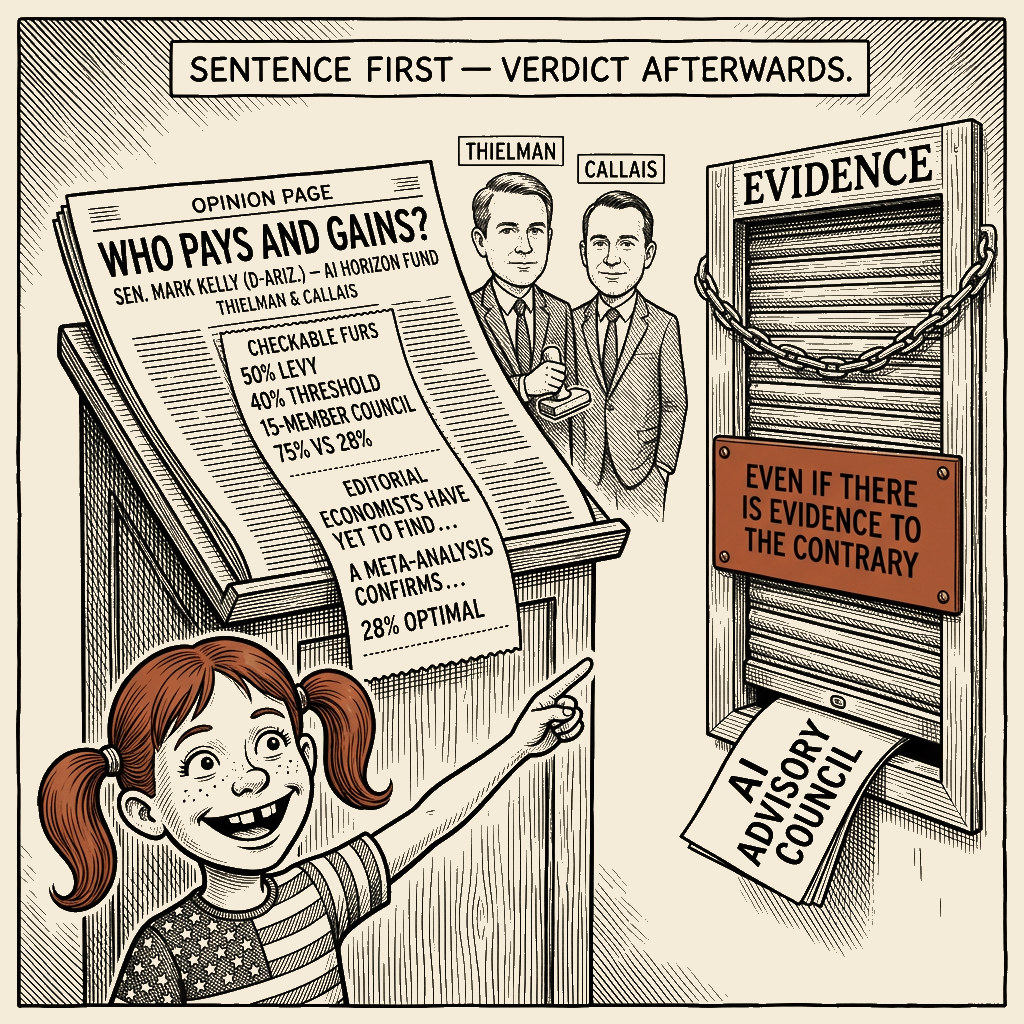
Analyzing: Who Pays and Gains from Senator Kelly’s AI Fund? — Nicholas Thielman & Justin T. Callais · 2026-10-28
How did they decide before they looked?
What the Editorial Argues
The National Review piece by Nicholas Thielman and Justin T. Callais argues that Senator Mark Kelly’s (D., Ariz.) Make AI Work for Americans Act would create an AI Horizon Fund — financed by three new taxes (5 percent on digital advertising, 50 percent on AI profits above 40 percent of gross receipts, and an excise tax on AI model output) and overseen by a 15-member AI Advisory Council — to pay for job training, national service, small-business support, and unemployment benefits, and that the bill is solving a problem that does not exist and funding it through mechanisms that will not work.
The editorial makes three moves. First, the premise: “Economists have yet to find clear signs of broad labor market disruption, even among heavily AI-exposed industries or entry-level openings,” so a federal trust fund built on displacement solves a problem that “has yet to materialize.” Second, the design: digital services taxes in France, Italy, Turkey, and the United Kingdom were passed “directly to advertisers, third-party sellers, and app developers,” so the taxes fall on consumers; and the unemployment provision — 75 percent wage replacement for six months once the council declares a “significant labor market disruption” — is double what evidence supports, because “a meta-analysis confirms that more generous benefits lengthen unemployment” and the “optimal income replacement rate is 28 percent.” Third, the governance: the council judges its own emergency, since its members “would have a perverse incentive to claim disruption, even if there is evidence to the contrary.”
Its verdict: “Being proactive is admirable, but taxing an industry before it has shown clear harm risks forgoing the benefits it offers.”
Receipts
The editorial answers its own question mark by naming organized labor as the gainer — then refuses to name a single source for any claim it makes about the world.
What the framing wants you to believe:
- AI displacement hasn’t materialized, so a fund built on it solves a problem that doesn’t exist.
- The taxes are really paid by you — pass-through means consumers foot the bill, not the industry. “But economics tells us that he who writes the check is not necessarily he who actually pays the tax.”
- The advisory council is a capture waiting to happen: “A swath of incentivized groups pledged support for the Horizon Fund, including technical schools and union groups” — and those groups have “a perverse incentive to claim disruption.”
What’s really going on:
- Every number the bill proposes is stated exactly. Every evidentiary claim the editorial makes about the world is stated anonymously. “Economists have yet to find…” names no economist. “A meta-analysis confirms…” names no authors, no journal, no date. The bill’s proponents must prove a crisis; the editorial need only gesture at a literature.
- The most specific number in the piece — 28 percent optimal income replacement — arrives with no provenance. Precision without provenance is not a fact; it is a statistic-shaped hole. And “28 percent is optimal” is optimal against a single metric, rapid re-employment, that says nothing about the worker who is not going back to any job like the one he lost.
- The editorial impeaches in advance every body that could later certify the problem exists — bf_catalog:
poisoning_the_well, the Bad-Faith Techniques Catalog’s entry on preemptively discrediting anyone who might later present inconvenient evidence — then presents its own conclusion as the only reading the record allows. It never examines the bill’s criteria, council voting rules, or oversight structure. It simply announces that anyone who might benefit from the fund is corrupt.
The Operation
The editorial runs on a closed loop, and the loop is the story.
Move one: declare the problem unproven. Move two: argue the remedy is worse than the disease. Move three: impeach, in advance, every body that could later certify the problem exists. The council says disruption happened — that’s organized labor voting itself an appropriation, “even if there is evidence to the contrary.” The council says disruption didn’t happen — then the fund was never needed. There is no testimony the editorial has left admissible, and it does not need its own empirical claim to be true, because it has already disqualified the only institution positioned to check it. I ran operations built on this architecture. The reader who accepts the pre-emptive impeachment stops asking for evidence, and the piece never has to supply it.
Technique one: motive-impugning as pre-emptive evidentiary ruling. The line is “When beneficiaries help write the rules, spending will inevitably flow toward groups organized enough to capture those dollars.” Its function is structural: it forecloses future evidence before that evidence arrives — bf_catalog: poisoning_the_well. When the affront is that the people who would measure a crisis also stand to receive money, the measurement itself has been defined out of existence. And note the asymmetry: the same logic is never applied to the companies that benefit from untaxed profits. The editorial picks out the unions on the council, labels their incentives "perverse," and declares the fund a slush pool — while the industry that would rather not pay the tax walks through as a neutral party. This is bf_catalog: ad_hominem, the circumstantial variety: discrediting an argument by reference to the arguer’s situation, applied to one side only.
Technique two: the certainty gradient runs backwards from the conclusion. The bill’s harms are modal-certain — spending will inevitably flow to the well-organized, putting them on the council essentially guarantees it, a 75 percent replacement rate would slow re-skilling. The bill’s justification is rendered subjunctive throughout — evidence “points away,” effects “are not yet settled,” the problem “has yet to materialize.” The same paragraph that concedes the question is open proceeds to price the answer. That is not a scientist hedging; that is a ledger in which only one column is allowed to carry risk. The standard moves when the conclusion needs it to — bf_catalog: goalpost_shifting.
Technique three: scare-quote delegitimation, applied with surgical placement. Every quotation mark in the piece lands on the other side’s vocabulary — “fair share,” “invest in American workers,” “significant labor market disruption,” “crisis” — while the editorial’s own abstractions (“the evidence,” “economics,” “a meta-analysis”) walk through bare. The quotes do no work as signal of verbatim citation; they work as verdicts. The WSJ Editorial Technique Catalogue files this at §3.8, Scare-quote management: the page’s own preferred terms appear unmarked, the opponent’s appear in quotation marks, and the asymmetry is the technique. The reader is signaled: do not evaluate these words, sneer at them. The question-mark headline runs on the same fuel — “Who Pays and Gains from Senator Kelly’s AI Fund?” is an accusation wearing an inquiry, and the question mark lets the piece deny it made one.
Technique four: the tax-incidence shell game. The editorial cites pass-through of digital services taxes in France, Italy, Turkey, and the United Kingdom — then lets the reader draw the conclusion that every tax on AI is really a tax on you. But check the cited cases against the bill: those are digital-services taxes, nearest kin of the 5 percent advertising levy. For the fund’s centerpiece — the 50 percent tax on AI profits above 40 percent of gross receipts — the editorial produces no incidence mechanism at all. It simply assumes the “you” in its headline foots that bill too, on evidence drawn from a different tax entirely. The incidence of a tax is not an argument against the tax; it is a question about who should bear the cost of the transition. The editorial’s answer is “no one” — while claiming to be on the side of consumers.
Technique five: concession-then-crush as closing mechanic. “Being proactive is admirable, but…” grants the virtue in order to bankrupt it. The one sympathetic sentence in the piece exists solely to be revoked by the sentence after it. The NR Editorial Technique Catalogue notes that National Review’s writers are more self-conscious about their moves than most — more willing to defend a technique against anticipated objection while deploying it. The concession-then-crush is that self-consciousness weaponized: name the objection, then dissolve it in the same breath.
Note also what the argument never has to do: it never explains why the observed pass-through of digital services taxes applies to an excise on model output, or why a council can be trusted to administer unemployment checks while being untrustworthy to define the trigger for them. The competence of the apparatus is conceded wherever the argument needs it and denied wherever the argument needs that instead.
Alternative design. The fund as it would look optimized for the workers it names rather than the industry it taxes is roughly the bill itself — training, unemployment support, a floor before the shock. The editorial’s objections are not design critiques; they are the techniques by which a design critique substitutes for one.
Cui bono, stated plainly. The editorial positions itself as protecting taxpayers from a captured fund. The distributional effect is protecting AI industry profits from a 50 percent levy above a 40 percent threshold — a concrete, named, checkable transfer. The reader’s fear (your money will be grabbed), the reader’s greed (keep what’s yours), and the reader’s laziness (trust the anonymous economists, don’t check them) are all served at once, without contempt and without relief. The editorial’s audience-management function is permission structure: you do not need to worry about AI displacement, because the people telling you not to worry have already impeached everyone who could tell you otherwise.
The Record
The facts survive. The rates, the 15-member council, the six-month window, the 40 percent federal cost floor, the 75-versus-28 replacement gap, the four countries and the three firms — all as the source states them, and all checkable. The tax-incidence point is real economics, not a trick. This is a competent piece of advocacy, and it is worth saying plainly that its numbers are not where the manipulation lives.
The manipulation lives in what the numbers are doing next to. On one side of the ledger: digits, named levies, replication-friendly quantities. On the other: “most of the evidence,” “economists,” “a meta-analysis” — an entire labor-market consensus introduced without a single name attached, doing load-bearing work under hyperlink. The bill’s proponents are required to prove a crisis; the editorial is required only to gesture at a literature. That asymmetry is the piece.
And note what our own instrumentation returns on this one. The severity rating is low. The only matched signals are two cosmetic title flags — a rhetorical question and a set of scare quotes. Nothing in the surface register trips the alarm. That is precisely the point: the surface is cosmetic, the wiring underneath is not. The closed evidentiary loop runs at full power in the mildest cases, which is the register where it goes unexamined.
The record also shows a remarkable inversion — and I recognize it because I built versions of it. The same paragraph that warns against letting “beneficiaries help write the rules” is itself an exercise of exactly that: an editorial published on a powerful opinion platform, arguing that an industry with no proven harm to workers should keep every dollar of its profit and that worker representatives cannot be trusted near a council. The editorial says the advisory council “would hardly be a neutral arbiter.” Neither is the editorial.
Declaration: I have no access to the editorial’s commissioning correspondence or the authors’ working notes. The technique identifications rest on the published text and the catalogues. The severity rating and matched-signal data come from the analyzer’s own instrumentation.
The Record cannot resolve which side of the AI-and-labor debate is right, because the editorial did not put its evidence in the record — it put its evidence’s reputation in the record and asked you to spend down the deposit.
So the indictment is architectural, not factual. Nothing here was invented. The case was merely wired so that no future fact could reach it.
How to Recognize This
Run the checklist on any piece that arrives already certain:
-
Count the scare quotes. If they land only on your opponent’s nouns, the quotation marks are verdicts, not citations — the WSJ Editorial Technique Catalogue files this as scare-quote management, §3.8.
-
Read the modal verbs. Will inevitably. Essentially guarantees. Would hardly. Set against points away. Not yet settled. Has yet to materialize. Certainty that tracks the conclusion instead of the evidence is the tell — bf_catalog:
goalpost_shiftingrunning on a delay. -
Check who gets named. Numbers on one side, an anonymous consensus on the other. “A meta-analysis confirms” is not a receipt; it is a receipt-shaped object. Which economists? Whose meta-analysis? Optimal for whom?
-
Find the unfalsifiable hinge. Whoever could confirm the problem has been accused in advance of lying for money — bf_catalog:
poisoning_the_well. Once the measuring body is impeached before it measures, the argument can no longer lose. -
Answer the headline’s question yourself, then check whether the piece did. “Who Pays and Gains?” is an accusation wearing a question mark. If the answer arrived before the question, it was never a question.
-
Watch for two harms held to one standard only when it’s convenient. Their injury is unproven; your injury is self-evident. Swap the standards and see whether the argument survives contact with itself.
The piece that tells you the crisis might not exist — and simultaneously tells you it knows exactly who would profit from declaring one — has told you which of those two claims it actually had evidence for. It’s the second. It was always the second. Next time you see that pattern, you’ll catch it before the second paragraph.

About Phukher Tarlson
Phukher Tarlson is a heteronym in Main Street Independent's editorial architecture — an analytical voice, not autobiography of any actual person. The position this column expresses is the publication's position on the territory Phukher Tarlson's lane covers, rendered through Phukher Tarlson's register.