Responding to: JONATHAN TURLEY: Supreme Court must take Herridge case and protect reporters' sources — Jonathan Turley · 2026-10-28
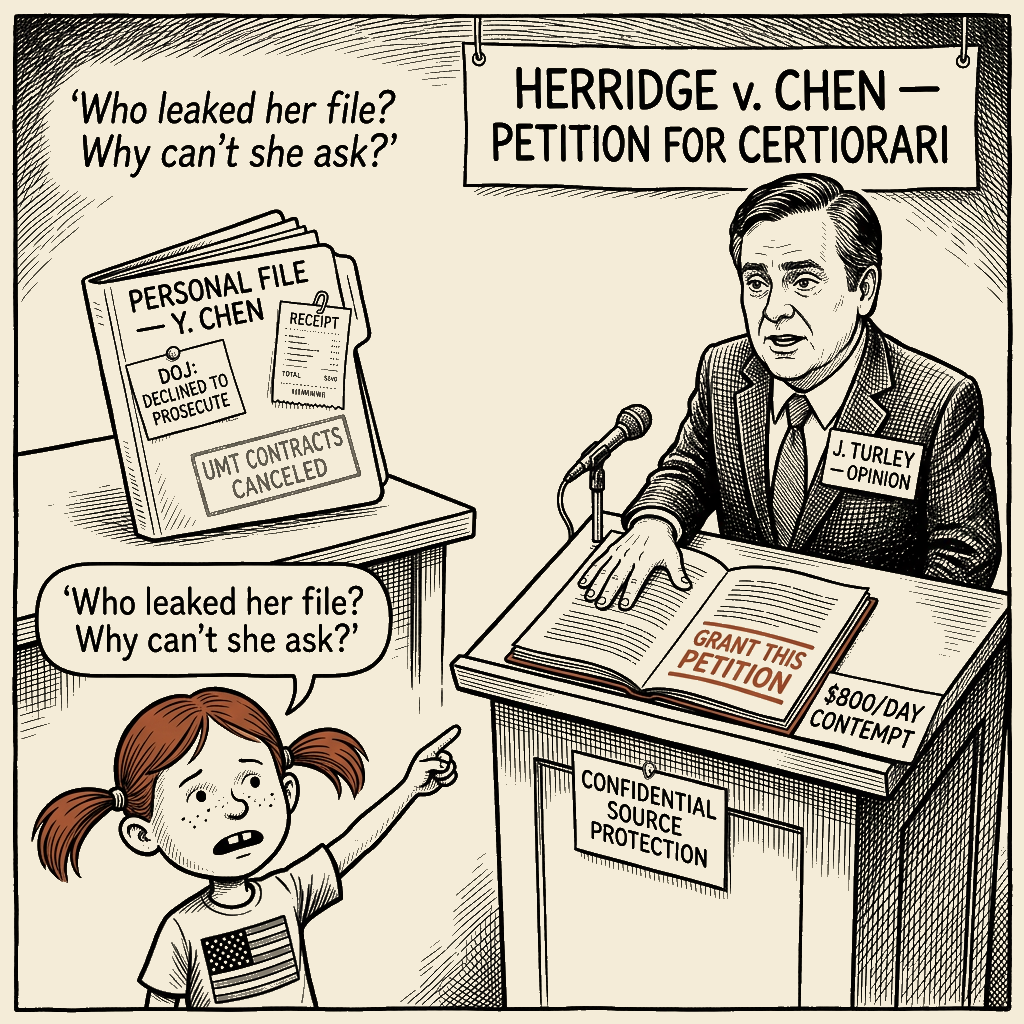
Who leaked her file? Why can’t she ask?
What the Piece Argues
The piece argues that the Supreme Court should grant certiorari in Herridge v. Chen to settle the “morass” left by the 1972 precedent Branzburg v. Hayes, because the D.C. Circuit’s permissive standard has allowed a federal judge to order former Fox News reporter Catherine Herridge to identify confidential sources or pay $800-a-day contempt fines. It portrays Yanping Chen’s Privacy Act lawsuit — which alleges government officials leaked her personal information to Herridge — as a meritless end-run around press protections, and warns that allowing such claims to force source disclosure would endanger national-security reporting. It also raises procedural objections, including the D.C. Circuit’s weak balancing test and the assigned judge’s wife’s professional ties to subjects of Herridge’s reporting.
Receipts
The piece’s single ask — “They should grant this petition and address the morass left by the ill-considered 1972 precedent in Branzburg v. Hayes” — sounds like a defense of press freedom, but what it actually protects is the anonymity of the government officials who fed a private citizen’s file to a newsroom.
- Frame: Chen is the aggressor — an “alleged former PLA colonel” exploiting “a law that does not exist in China” to destroy press freedom. Reality: Chen is a private individual in Virginia using a U.S. statute Congress wrote precisely so citizens can challenge the government’s handling of their personal records — and “alleged” is doing heroic work, because the government that called her a threat also declined to charge her with anything.
- Frame: The $800-a-day fine is persecution — a reporter being “bled dry” on money from “the college funds of her two children.” Reality: Contempt fines are the routine coercive tool for defying a lawful court order, and Herridge chose defiance; the college-fund drama aims at your tear ducts, not your reasoning. The genuinely irreparable harm belongs to the woman whose reputation was nationalized without a single charge.
- Frame: Chen “latched onto a clever tactic” to “circumvent press protections.” Reality: Her tactic was filing a lawsuit under the Privacy Act — the law that lets citizens sue over government disclosure of their records. Her only straight road to an answer — a criminal case — had dead-ended when the Justice Department declined to prosecute Chen; the Privacy Act’s private right of action was the statutory route Congress left her. A private right of action isn’t a loophole; it’s the statute’s point.
- Frame: Her complaint is “anemic and dubious” because the information was already “in the public domain.” Reality: That cuts the other way. If the sources’ identities add nothing to the public record, the subpoena is straightforward harassment of a journalist; if they add everything, someone inside the government leaked non-public records — exactly what the Privacy Act polices. The argument can’t have it both ways.
- Frame: Under the D.C. standard, “Nixon officials could have forced” Woodward and Bernstein to reveal Deep Throat. Reality: The scarecrow is self-defeating. A standard weak enough to have exposed Deep Throat is a standard that exposes official leakers — which is all Chen is asking for, and exactly the outcome the D.C. Circuit produced for her. And whatever Watergate was, this is not it; the piece’s own fine print supplies the difference: “The Department of Justice declined to prosecute Chen.”
- Frame: Even the judge is suspect — his wife is a lawyer “referenced in past Herridge stories.” Reality: That’s a recusal rumor laundered through “her supporters,” deployed to discredit a ruling without engaging it. By that standard, any judge whose spouse practices law in Washington would have to recuse from every consequential case.
- Who benefits: Fox News and the institutional press, which run on anonymous government sources; the leakers themselves, who get anonymity without accountability; a national-security establishment that can ruin a person’s standing through headlines instead of indictments. Who pays: Yanping Chen, whose school lost its government contracts, whose name now reads as a spy story, and who will never learn which officials handed her life to a reporter.
- Anchor citation: “The Department of Justice declined to prosecute Chen” — the piece’s own buried admission, and the sentence that dismantles the national-security framing above it.
The Response Ladder
Polite Reframe
When to use: with court-watchers and First-Amendment absolutists who think the inquiry ends at “protect the press” — meet them in good faith.
There is a legitimate version of this case: confidential sources matter, and Branzburg v. Hayes left a genuine mess the Court ought to clean up. But let’s be honest about what this particular petition asks. The government investigated Yanping Chen and declined to prosecute her. Nobody has accused Herridge of publishing anything false. What Chen is doing — through the Privacy Act, a statute Congress wrote for exactly this situation — is asking which government employees leaked her personal information to a reporter. That is not a clever end-run around press freedom; it is how a citizen identifies the officials who handed her file to a newsroom. A press privilege worth having protects sources who expose wrongdoing. It should not protect the leakers of unprosecuted allegations about a private person, and it should not be bankrolled out of a journalist’s children’s college fund while the person whose life was leaked receives nothing. If the Court takes the case, the right standard is not a blanket privilege but a genuine look at whether the underlying claim has merit before a reporter is dragged into discovery. Chen’s claim survives that look: the government declined to prosecute the very thing the coverage accused her of. That standard still protects Woodward and Bernstein. It would also let Chen get an answer to the simplest question a citizen can ask: who in my government gave my private life to a reporter?
Mockery and Ridicule
When to use: with the cable-news crowd already rehearsing the “war on journalism” bit — make the melodrama look ridiculous.
Let’s stage the scene exactly as written: a brave reporter walks — oldest son in tow — to the mailbox, mails a check from her children’s college funds, and does it all over again the next day, because a woman the government never charged wants to know who leaked her file. If this were a screenplay, a studio note would say “too on the nose.” The crusading journalist. The “alleged” spy colonel, with “alleged” doing all the legal heavy lifting. The judge whose wife was once referenced in the reporter’s stories. All that’s missing is a cat to stroke. And here’s the genuinely funny part: the “victim” in this saga is not the woman with the $800-a-day fine. It’s the woman whose private history was fed to a TV network by officials inside her own government, who then watched her reputation get executed in public while the person who read her file on air gets an opinion-page monument. Chen’s reward for being the subject of this journalism: her school’s contracts canceled, her name plastered next to “national security threat,” and — when she asked the most basic question a citizen can ask, “who leaked my file?” — a Supreme Court petition casting her as the villain. And the masterpiece of the whole production is the “law that does not exist in China” line, as if being from China means you forfeit American statutes. The First Amendment doesn’t exist in China either, but I don’t see anyone volunteering to give it up. The “assault on press freedom” here is one private citizen using a federal law. The assault on Chen is everyone else.
Nuclear Satire
When to use: once the “heroic mailbox walk” goes viral and the sanctimony is unbearable — strip the production bare.
ANNOUNCEMENT — The Society for the Permanent Protection of Anonymous Government Sources is proud to present its newest honor, the Shield of Convenient Courage, to Catherine Herridge, for perfecting the Herridge Method:
- Broadcast the private history of a person the Justice Department declined to prosecute;
- Let the government cancel the school’s contracts and call her a threat — no charges required;
- When she sues under an actual law Congress passed, declare it a “clever tactic” to abolish journalism;
- Orbit the word “alleged” until it does all the proving;
- Stand before the Supreme Court with a trembling voice and a child’s college fund, and announce that the only true victim in this story is the reporter.
In a related tribute, the Society is commissioning a statue of the Heroic Mailbox Walk. Onlookers will notice the statue’s subject weeping — not for the woman whose life she read aloud on television, but because the fine might go back up to $800 a day. A small plaque will read: “She tangled with the wrong reporter.” A larger plaque, placed at a respectful distance, will read: “The subject of her reporting was never charged with anything.” The sculptor assures us both plaques are equally permanent. So are UMT’s canceled contracts, the reputation she cannot sue back into existence, and the names of the leakers she will never, ever get to learn.
Profane Scorched-Earth
When to use: after the fifth person calls an uncharged woman a “Chinese spy” and no one in the room has a problem with it — unleash.
Let me get one goddamn thing straight: the government didn’t charge Yanping Chen. Not for lack of looking — it looked, and walked the fuck away. Nobody accused Herridge of writing a false word. So all of you weeping for the “courageous journalist” and her children’s college fund are crying for a woman who looked a lawful court order in the eye, told it to go fuck itself, and then turned her own defiance into a Supreme Court campaign. And the “national security threat” you’re clutching your pearls about is an allegation the feds declined to prosecute — laundered through an opinion page and dressed up in the victim’s own goddamn Privacy Act. This isn’t Watergate, you absolute donkeys. This is a private citizen asking, under a law Congress wrote, which government employee handed her private file to a newsroom — and the answer is “how dare she; in China they don’t even have this law.” She’s not in China, dickheads. She’s in Virginia, getting her name dragged through the mud by people who will never sign their names to a goddamn thing. That’s what this petition really protects: the leakers. The anonymous officials who can destroy a person’s life with a “suspected,” a “believed to be,” an “alleged” — and then just keep walking. Chen will never know who did this to her, because the courts and the columnists are too busy protecting the “courage” of the person who profited from it. Her fines got rescinded. You know what doesn’t get rescinded? A reputation. A life. A goddamn name. She doesn’t get a Supreme Court petition or a profile in bravery. She gets to be the villain of your national-security fairy tale without ever being charged with a single goddamn thing. So spare me the First Amendment sermon. The First Amendment protects the press. It was never intended to let the press turn unprosecuted people into burned sacrifices so anonymous leakers can keep their jobs and their anonymity. If that’s the “free press” you’re defending, you can shove it — right next to the college fund.

About Malcolm Little King
Malcolm Little King is a heteronym in Main Street Independent's editorial architecture — an analytical voice, not autobiography of any actual person. The position this column expresses is the publication's position on the territory Malcolm Little King's lane covers, rendered through Malcolm Little King's register.