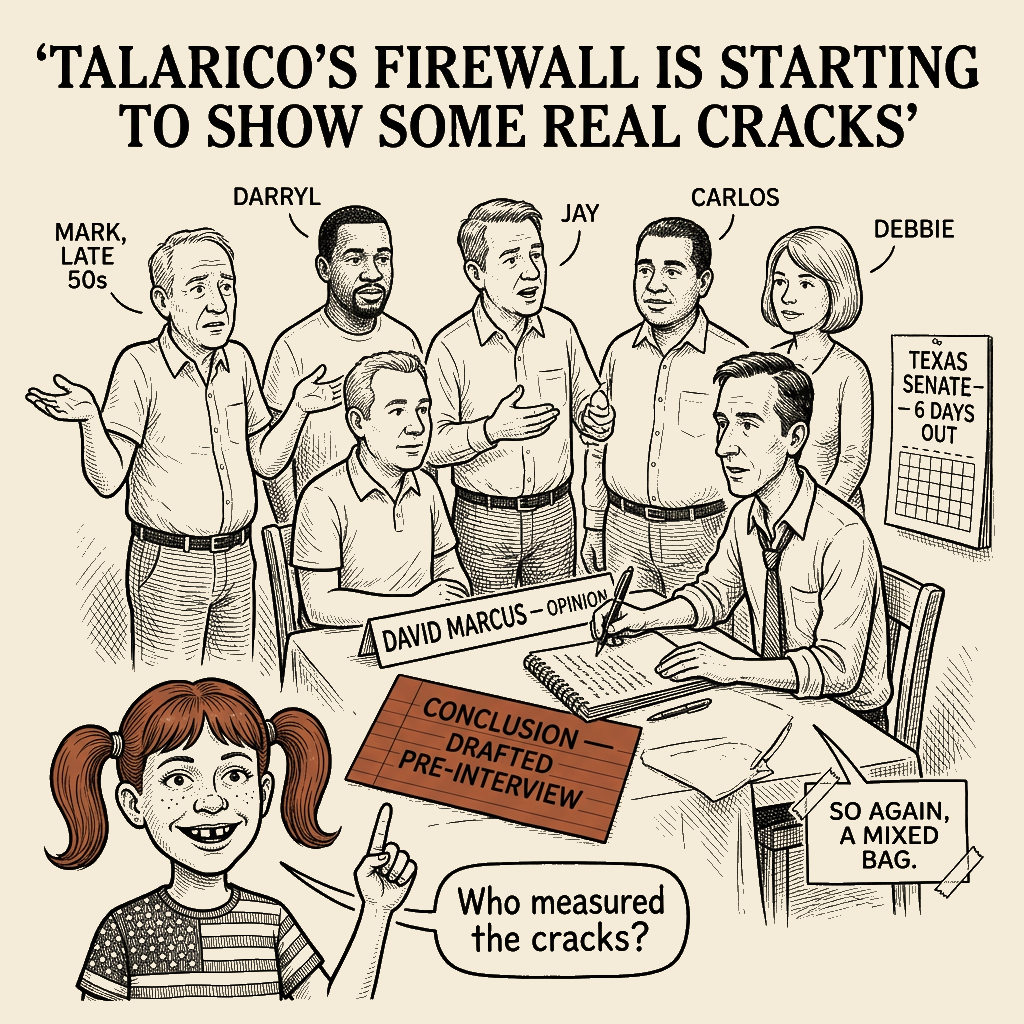
Analyzing: DAVID MARCUS: In Dallas, Talarico’s firewall is starting to show some real cracks — David Marcus · 2026-10-28
Who measured the cracks?
What the Editorial Argues
On its face, the column argues for mood: that the Texas Senate race is “tight” and that the Democratic candidate’s Dallas “firewall” — the piece’s own headline word, never once earned anywhere in the text — is “starting to show some real cracks.” On its face it even argues both ways: “a mixed bag,” a GOP consultant’s early-vote worry, a Black voter predicting a Talarico blowout. The reader gets the warm bath of fairness.
Beneath the face it argues exactly one thing, and announces it in the final sentence: that Talarico’s failure to “shore up” Dallas “very well could leave Ken Paxton with enough votes in red counties to close the deal with Texas voters and help keep the Senate in Republican hands.” Every element of the piece is inventory for that conclusion. The disappointed lifer supplies the enthusiasm gap. The two Black men at breakfast supply the coalition crack — with “insiders” on standby for sourcing. The hotel worker supplies the war-and-gasoline transfer. The suburban moderate supplies the “too much for Texas” meme. The French riots supply the fear. Not one observation in the column is one the conclusion does not need. The thesis is not “here is what I heard”; it is “here is what I heard, and here is the statewide electoral verdict I am drawing from six conversations at an upscale restaurant, a breakfast table, and a cigar.” That is the hallmark: a column that looks like canvassing and reads like a committee-built brief.
Receipts
The column manufactures the appearance of street-level reporting — strangers, first names, a notebook — in order to deliver a verdict that was written before the first stranger was ever met.
What the framing wants you to believe
- That a reporter walked Dallas six days out and let ordinary people speak, and that what he found was honest ambiguity: “So again, a mixed bag.” Fairness in real time.
- That Talarico’s firewall is cracking in the one place he cannot afford it, because the voters themselves said so — six voices, quoted at length, unfiltered by any campaign.
- That the piece is genuinely open-handed: a lifelong Democrat who “declined to tell me who he was voting for, or even whether he would vote”; a GOP consultant quoted against his own side — “I do not like what I see in the early voting for Paxton” — living proof that the columnist plays it straight.
What’s really going on
- Six conversations with no surnames, no method, no sample, and no denominator are escalated into a statewide claim about “lagging support in the Black community, long the bedrock of Texas Democratic politics.” bf_catalog:
hasty_generalization— the pattern logicians call generalizing from a sample too small or unrepresentative to support the conclusion. The column does not poll Black Texas. It eats breakfast near the AT&T Discovery District and files the receipt as a census. - The only hard number in the piece — Minchillo’s estimate that the GOP was “about 100,000 votes behind” in early voting — points the wrong way for the headline. It is banked as a fairness deposit and then spent anyway: the source is discounted with his own self-deprecation (“as a consultant, he never tries to paint a rosy picture”), and the columnist caps it with “So again, a mixed bag.” This is the Wall Street Journal Editorial Technique Catalogue’s §3.6 source-citation asymmetry run in miniature — allied sourcing cited and credited, contrary sourcing quoted and defused. A consultant saying he never paints rosy pictures is not a discount on his numbers. It is a discount the column applies on his behalf.
- The most damaging claim about the most important Democratic constituency in the piece is attributed to no one: Talarico faces a Black-voter-enthusiasm problem “according to insiders,” sealed inside a photo caption, where cross-examination cannot reach it.
[bf_catalog:Expert](/propaganda/docs/bad-faith-techniques-catalogue#Expert)-consensus / expert-deference framingsnames the tell: the authority is invoked, and the named specialist is absent. - The conclusion is unfalsifiable as packaged: “Make no mistake, the Texas Senate race is tight, but if James Talarico cannot shore up the many votes he needs in Big D…” If Paxton wins, the columnist called it from a restaurant. If Talarico runs up Dallas numbers, the piece was only ever about “cracks” — and cracks, once printed, are always there. bf_catalog:
begging_the_question: the verdict is presupposed in the premises, and the concession exists only so the conclusion can stand on it.
The Operation
Cui bono, first and plainly. Six days before the vote, under a promo chorus announcing a “deadlocked” race — “FOX NEWS POLL: IT’S A LONE STAR SENATE SHOWDOWN,” “TRUMP WON THIS RELIABLY RED STATE BY DOUBLE DIGITS. NOW A DEADLOCKED RACE IS BRINGING HIM BACK” — a columnist files the conditional prophecy that closes the Senate deal for Republicans. The institutional authorship is a named opinion columnist, David Marcus, “a columnist living in West Virginia and the author of ‘Charade: The COVID Lies That Crushed A Nation’” — his book title already an argument wearing a tourniquet — writing into a house whose wallpaper is doing the same work as the lede. The thesis is printed on the wallpaper before the prose starts.
Distributional impact. Named beneficiaries: the Republican Senate narrative, which gets a street-level “cracks” story it did not have to buy from a poll; the columnist, who gets a callable prediction with an exit ramp in its grammar (“very well could”); the outlet, which gets a segmentable dispatch — six vignettes cut to six chyrons. Named cost-bearers: the reader, who is asked to convert six unverifiable conversations into a statewide belief and to carry it into the voting booth or the group chat as if it were data; and the voters quoted, whose first names and job descriptions are now public property attached to political positions they were told was a breakfast conversation. Magnitude where documented: none. That is the point — the piece asserts statewide consequence and supplies zero statewide measurement.
Alternative design. If the piece were optimized for its stated rationale — telling the reader what Dallas actually thinks, six days out — it would carry named sources or a stated method; at least one poll result interpreted rather than linked as wallpaper; one conversation outside a Dallas zip code; and the consultant’s 100,000-vote figure engaged instead of stepped around. The column never leaves the restaurant, the breakfast table, and the cigar.
FGL, applied across three constituencies. The author’s frame: greed for the callable prediction, laziness supplied to himself by a method that cannot be checked — and fear of filing a neutral mood piece into an appetite built for verdicts. The apex beneficiary’s frame: the partisan narrative gains a permission structure — “the voters themselves say the firewall is cracking” — without spending a poll. The rank-and-file reader’s frame, without contempt: the reader is tired, working, and holding a real suspicion that politicians are full of it; “Talarico just says so much crazy stuff, it’s too much for Texas” and “my gas is super expensive from the people who said there was not going to be a war” are genuine grievances, and the reader’s willingness to accept six vivid strangers as a census is exhaustion, not stupidity. The operation exploits that exhaustion; the reader did not build it.
Placement. The piece presents itself as selfless — the humble reporter listening, letting both sides talk — while the position it advances is purely factional: an early closing argument for a Republican Senate hold. Selfless surface, selfish placement. That inversion is the operation.
The techniques, with cues.
- The cast, not the sample. Cue: “I met Mark, in his late 50s, at an upscale restaurant in downtown Dallas” — no last name, no transcript, no method, no follow-up; Mark “declined to tell me who he was voting for, or even whether he would vote.” bf_catalog:
hasty_generalization. Operationally: the anonymous ordinary person functions as evidence because he looks like listening. He is listening with a casting sheet. I drafted vox-pop furniture like this; the credibility comes from the reader’s assumption that a first name plus a job title is a methodology. Lineage: Bernays’s engineering of consent — manufactured consensus presented as common sense, with the street supplying the raw material the sponsors then finish. - The liquidated optimist. Cue: Jay’s “I don’t think it’s going to be close, he’s going to kill it” is let into the room for one sentence, adjacent to Darryl’s “silent majority” pessimism, and then both men “agreed that Talarico’s failure to mend fences with his primary opponent, Rep. Jasmine Crockett, D-Texas, is a problem.” bf_catalog:
red_herringin its minor key — quote the optimist so you can claim you heard him, then convert him to the pessimist’s agreement inside the same paragraph. The dissent is not evidence; it is a prop that makes the gloom look chosen instead of selected. - The insider plant. Cue: “according to insiders,” plural, anonymous, in a caption. Named nobody, load-bearing wall. If a rival campaign had planted so pointed a claim inside an opponent’s outlet, the trade would call it a leak. Inside the outlet, it is called a caption.
- The imported menace. Cue: “One wild-card issue that continues to come up in my conversations on the ground is the riots in France,” and one voter’s “What if that was New York City, or D.C.? That doesn’t really seem impossible.” No polling, no measurement, no base rate — then the GOP’s preferred remedy arrives in the same breath, Vice President JD Vance’s rallies on “the France issue and what it says about unchecked immigration,” sourced to nothing at all, followed by the columnist’s own forecast: “I would expect that to continue.” bf_catalog:
slippery_slope: an unbroken causal chain asserted linkless, with a vivid terminal image. The street was asked to supply a sentence, and the sentence arrived already branded. Lineage: Lippmann’s stereotypes in the original sense — the picture in the head doing the arguing before any fact is checked. - The good news that is measured in Trump’s gravity. Cue: “This is good news for Talarico, in part because Carlos is a Joe Rogan fan who, though not a President Donald Trump voter, was open to the possibility that Trump could sway him, something that has not happened.” “Good news for Talarico” is defined as: a Trump-curious voter has not flipped yet. The inference from fandom to vote-intent is stated, never shown. A screenplay, not a dispatch.
- The self-aware disclaimer used as a weapon. Cue: “Had these conversations taken place across the Lone Star State, it might be good news for Talarico, but all of these people are in the Dallas area.” The columnist names the sampling flaw himself, then uses it as the argument. Confessing the flaw is not correcting the flaw — it pre-loads your objection so the conclusion can survive it.
- The closer. Cue: “Make no mistake, the Texas Senate race is tight, but if James Talarico cannot shore up…” with the modal hedge “very well could” — the full grammar of prophecy with an exit ramp — landing on “help keep the Senate in Republican hands.” Per the Wall Street Journal Editorial Technique Catalogue §3.5, the closing line is engineered for retransmission; per §4.13, the threat-inflation closer, the stakes leap from one Dallas breakfast to control of the Senate in a single sentence. A weather report does not hope; a wish does not forecast. This does both.
Audience-management function: permission structure and grievance ratification at once. The reader gets permission to believe the race is over without looking at a single number, and gets his gas-price and crime-adjacent grievances ratified by strangers who said them first. Frame lineage runs through Lakoff: “cracks” and “firewall” are not observations, they are the cognitive frame — activated in the headline, never once supported in the body, and negation-proof, because you cannot argue with a crack that has already been named.
The Record
Anchor receipts (as quoted in the piece itself). Minchillo: “I do not like what I see in the early voting for Paxton”; the GOP “about 100,000 votes behind”; Black early vote “looks like it is down.” Mark: “This isn’t like when Beto ran.” Jay: “he’s going to kill it, because he can get people to flip over.” Darryl: “I think they are the silent majority.” Carlos: “my gas is super expensive from the people who said there was not going to be a war.” Debbie: “Talarico just says so much crazy stuff, it’s too much for Texas.” The pivot: “Had these conversations taken place across the Lone Star State… but all of these people are in the Dallas area.” The closer: “Make no mistake, the Texas Senate race is tight, but if James Talarico cannot shore up… help keep the Senate in Republican hands.”
Per-citation verdicts. The Minchillo quotation is accurately rendered and materially defanged: his number is the hardest fact in the piece and points opposite the headline, and the column discounts it with his professional self-deprecation before moving on — cited selectively, used against its own thrust. The Jay/Darryl material is quoted accurately and filed dishonestly: two men who disagree with each other are placed in adjacent paragraphs and cast, respectively, as a Talarico data point and a Talarico problem. The France material is accurately quoted as one voter’s hypothetical and then over-scoped into a “wild-card issue that continues to come up,” with the Vance-rally assertion carrying no source at all — tag: [unconfirmed: convergence threshold not met]. The Black-enthusiasm claim is tag: [unconfirmed: convergence threshold not met] — “according to insiders” is not a receipt; it is a pronoun wearing a trench coat. The word “cracks” appears in the headline and nowhere in the evidence.
Load-bearing omissions. Not one turnout number. Not one poll result interpreted — the FOX NEWS POLL headline is wallpaper, not analysis. No Black-voter data beyond one consultant saying it “looks like it is down.” No comment from either campaign. No voter outside a Dallas zip code. No engagement with the 100,000-vote gap the piece’s own source supplies. No denominator for “continue to come up,” which rests on one anonymous specimen. The omissions are not incidental; each one removed would have required the conclusion to be earned.
Missing-information declaration. No receipts exist for the “insiders,” for the Vance-rally sourcing, or for the frequency claim about France — these are tagged, not filled. No leaked memo, internal directive, or coordination document is claimed here; the placement chain above is structural-incentive language, drawn from the piece’s own text and the outlet’s own promo furniture, not from a claim of coordinated authorship. Where this analysis reconstructs what a method-checked version of the piece would contain, that reconstruction is derived from the disadvantaged constituency’s evident interest — a reader who wants to know what Dallas thinks — not from my policy preference.
How to Recognize This
You will see this again, so pack accordingly.
Count the sample. First names, ages, and job descriptions mean you are reading casting, not canvassing. If a statewide claim rests on a number of sources you can count on one hand, and every one of them was found by the writer rather than selected by a method, you have met the Bad-Faith Techniques Catalog hasty_generalization entry wearing a raincoat. Real voters have last names and complications; stock types have functions.
Watch where the hedges land. Hedges attached only to the facts that cut against the thesis — “in part because,” “So again, a mixed bag,” “he never tries to paint a rosy picture” — mean the ledger is rigged even when the entries look balanced. The concession and the discount are the tell: if the one opposition quote exists to prove fairness and the conclusion lands untouched on the operator’s side, the concession was scenery.
Find the unsourced claim and the pre-loaded flaw. One damaging sentence, “according to insiders,” no name, no title: that is a plant — treat it as seed, not fact. And when a writer confesses his own sampling flaw out loud — “Had these conversations taken place across the Lone Star State…” — check whether the flaw is corrected or recruited. Confessing the defect is not fixing the defect; it is inoculating the verdict against your objection.
Flag the imported menace and check the weather. A foreign riot, a border story, a crime wave, presented with a “what if it happened here” hypothetical and zero data — that is fear rented at retail, bf_catalog: slippery_slope with the links left out. And “mixed bag” is the operator’s favorite pavement for potholes: when a column calls the evidence mixed and the headline picks a winner, the column already knows its answer and is house-training the facts.
Why it works. Because you are tired. Because six vivid strangers feel more true than a table you cannot see, and because the frame — “cracks,” “firewall” — activates before the evidence arrives and keeps running after it fails to. The technique does not need you to believe it. It needs you to repeat it.
What to do when you see it. Read the last sentence first — “help keep the Senate in Republican hands” is the whole piece; the rest is the alibi. Count the surnames. Ask for the denominator behind “keeps coming up.” Trace whether the one hard number was engaged or stepped around. Look for the same vocabulary — “cracks,” “firewall,” “deadlocked” — across every headline on the page, because identical wallpaper is placement, not coincidence. And reduce the frame’s automatic activation by saying the headline’s claim out loud as a question: who measured the cracks?
Six voters walked into a column. They were not found; they were chosen, picked from a city of millions to say the headline’s lines. The Dallas firewall is not cracking — not because of anything in this dispatch, which measured nothing. But here is what this dispatch proves: when the fire is political and the alarm is for sale, somebody will always be standing on the sidewalk with a notebook, a deadline, and a headline that was finished before the first voter was ever met. The recognition is the discipline, and the discipline is the only thing I have to give back — carry it to the next one.

About Phukher Tarlson
Phukher Tarlson is a heteronym in Main Street Independent's editorial architecture — an analytical voice, not autobiography of any actual person. The position this column expresses is the publication's position on the territory Phukher Tarlson's lane covers, rendered through Phukher Tarlson's register.