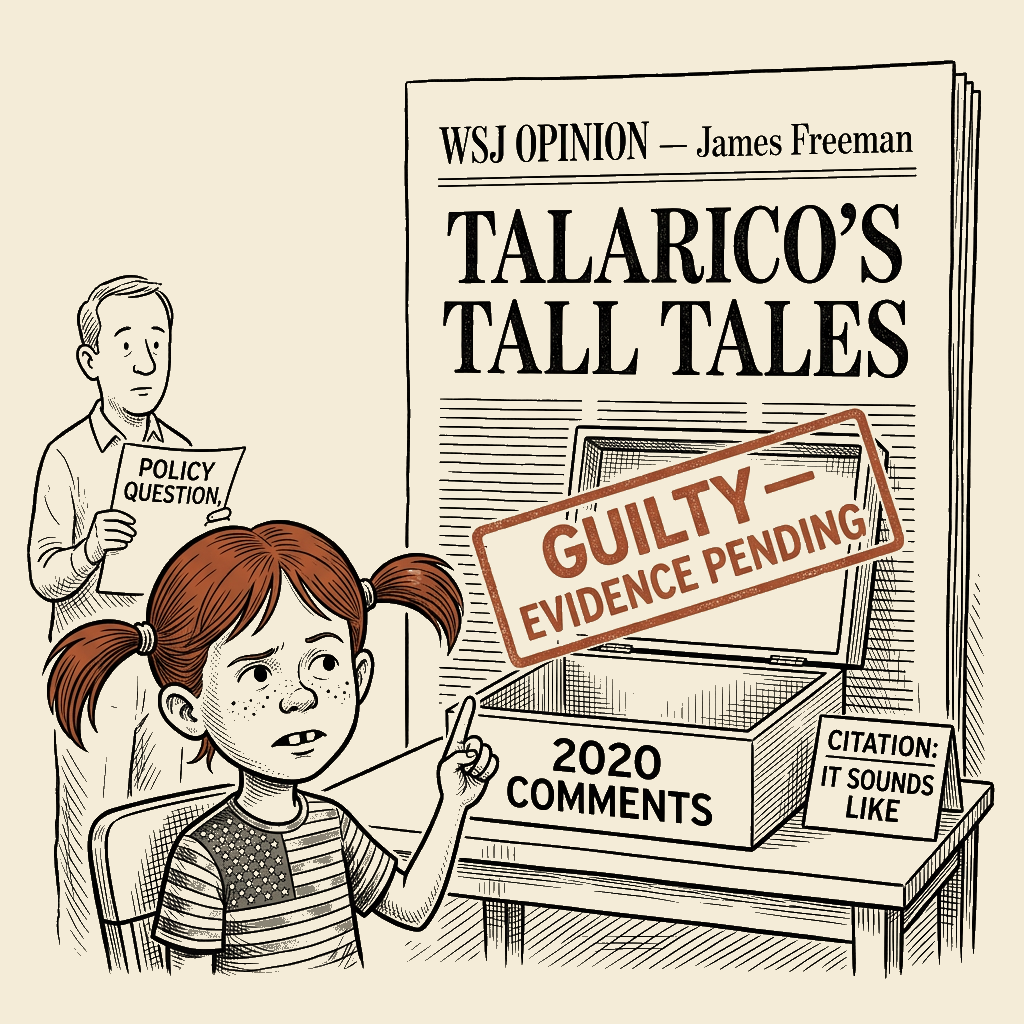
Analyzing: Talarico’s Tall Tales — James Freeman · 2026-10-27
Where’s the evidence if the verdict came first?
What the Editorial Argues
James Freeman’s argument is that James Talarico is a candidate defined by deception — that his stated positions are whatever the moment requires, and that Texas voters should treat every one of them as suspect. The editorial opens by asserting Talarico “seemed to have settled on a strategy for dealing with his history of promoting dishonest and destructive ideas,” establishing before a single fact is presented that the man is a liar managing a portfolio of bad beliefs. It then claims he tried “to run away from the most disturbing items on his agenda” but, a week before Election Day, “he’s saying that he hasn’t moderated his views at all.” The specific charge is a “two-step”: in 2021, as a state legislator, Talarico allegedly argued “against a measure to protect girls sports by falsely claiming that there are six sexes”; when challenged, “he has acknowledged that there are only two sexes”; now Freeman asks whether “he is now returning to his original position?” The dodge Freeman identifies is Talarico’s stated position that the matter “should depend on particular sports and school boards,” which the editorial calls “perhaps the least credible Democratic position of this election cycle” — because the party that once centralized social policy is “now suddenly posing as the undisputed champion of local autonomy,” and because Talarico’s own website “details an ambitious agenda for broad federal intervention in education.” The indictment extends beyond gender issues to his “history of radicalism—along with dubious efforts to explain it away,” invoking a CNN report about comments from 2020 to conclude: “It sounds like he really did support it, and it’s unclear why anyone should believe he’s changed his mind.” The closing line — “Texas voters can’t say they weren’t warned” — completes the portrait: a candidate whose every stated belief is suspect, whose reversals prove bad faith, whose moderation masks extremism, and whose sincerity is structurally unverifiable.
Receipts
The editorial performs a citizens’ arrest with adjectives: it convicts in the headline, then presents its own affect as the evidence that justifies the headline.
What the framing wants you to believe
- That Talarico is a man with “a history of promoting dishonest and destructive ideas” whose current positions are a “strategy” for managing optics rather than beliefs he holds.
- That the six-sexes episode is a proven two-step — he said six, admitted two, and may now be “returning to his original position” — so either he was lying then or he is lying now.
- That his localist answer on girls’ sports is exposed as convenience by his own website’s “ambitious agenda for broad federal intervention in education”: argue nationally and you’re a radical, argue locally and you’re a fraud.
- And the receipts themselves, from the source text, untouched: “history of promoting dishonest and destructive ideas”; “falsely claiming that there are six sexes”; “absurd pseudoscience” and “distorted reimagining of Biblical Scripture”; “This is a chilling statement.”; “rob girls of opportunities and put them at risk of injury”; “the sake of wokeness”; “perhaps the least credible Democratic position of this election cycle”; “history of radicalism—along with dubious efforts to explain it away”; “It sounds like he really did support it, and it’s unclear why anyone should believe he’s changed his mind.”; “Texas voters can’t say they weren’t warned.” That is the argument, fully assembled — and notice what is not in it: a quoted transcript, a policy analysis, a definition of fairness, or a single statistic that isn’t a year.
What’s really going on
- The case is unfalsifiable by construction. Freeman’s own sentence concedes Talarico “has acknowledged that there are only two sexes” — which is precisely the position the editorial claims Talarico is fleeing. The recantation is filed as proof he knows the truth; the relapse as proof he’ll lie about it; the deferral to sport-by-sport and district-by-district determination as proof he’s evading. No statement can clear him. That is not a contradiction Freeman failed to notice — it is a closed attribution structure in which the subject’s character is fixed and every behavior is reinterpreted to fit. Anchor: the editorial’s own text, which assigns opposite evidentiary weight to Talarico’s acknowledgment and to the possibility he holds his old view, in adjacent paragraphs.
- The hypocrisy inference is a non sequitur. Federal student-loan or curriculum policy does not entail federal locker-room policy. That Talarico “support[s] some federal education policy” does not address athletic participation at all; the counter-evidence is aimed at a different question than the one on the table.
- One outlet is talking to itself. The editorial repeatedly quotes the Journal’s own reporters (Findell and Rodriguez, who “report for the Journal”) and a Journal byline — Colin Wright, who “noted in the Journal earlier this year” — as external witnesses against the candidate. That is an intra-outlet citation loop: bf_catalog:
circular_sourcing, catalogued in the WSJ Editorial Technique Catalogue (Fox additions, §4.22) as self-sourcing staged as independent corroboration. In, the Journal corroborates the Journal; out, an outside network carries the allegation the Journal declines to state under its own name. - The 2020 charge rests on a pronoun. The reader is never told what “it” is. “It sounds like” and “unclear why anyone should believe” are Freeman’s own hedges — he concedes he cannot establish what Talarico supported or whether he changed his mind. He is presenting a guess as a finding, and the load-bearing omission is the missing quotation that would let anyone check the guess.
- The party-wide claim has no receipt at all. That Democrats “spent decades trying to move decisions on social policy away from parents and into the hands of distant bureaucracies” is a sweeping claim about an entire party’s multi-decade trajectory offered without a single named example —
[unconfirmed: convergence threshold not met]. The reader is given no evidence, only the rhythm of the accusation. - The title does the work before the argument does. “Talarico’s Tall Tales” is a folk idiom for entertaining falsehoods; the alliterative sneer primes the reader to hear “liar” before hearing a claim, per WSJ Editorial Technique Catalogue §3.2 — the scanner who reads headline and lede has already received the verdict.
The Operation
Cui bono, first. Institutional authorship: the piece carries the documented credo of the Wall Street Journal editorial page — the 1951 Grimes founding philosophy, “no pretense of walking down the middle of the road,” operating from “a definite point of view” (WSJ Editorial Technique Catalogue §2.1). The page declares its values openly; what it does not declare is its technique inventory, and this editorial is an entry in that inventory. Placement chain: newsroom bylines generate the raw material, the editorial page cites it back, the repetition is staged as agreement, and a rival network’s reporting is imported to carry the one charge the page will not print under its own masthead. Distributional impact: the named beneficiary of a character-immunized candidate is the candidate’s electoral opposition, which now inherits a target whose positions need never be engaged; the cost-bearers are the reader — denied the actual policy argument — and the electorate, denied a warning that contains anything to be warned about. Alternative design: optimized for its stated rationale rather than its rhetorical convenience, the editorial would quote the 2020 comments in full, name the specific social policy and the specific bureaucracy in its decades-long claim, state the athletic-participation rule it prefers and argue for it on the merits, and engage Talarico’s sport-by-sport position rather than labeling it “least credible” and pivoting away. FGL, applied across three constituencies: the page’s author gets grievance and status (a verdict delivered in sixteen paragraphs is cheaper than an argument, and the sneer travels further); the apex beneficiary of the frame gets fear — a rival characterized as radical, radicalizing, and unchanging; the rank-and-file reader gets laziness that is entirely human and not a fault — a finished verdict handed over so the reader doesn’t have to build one, wrapped in fear of a candidate the editorial has made unverifiable. Placement of selflessness: the piece is packaged as public-spirited civic warning — “Voters beware,” “Texas voters can’t say they weren’t warned” — a selfless placement over a function that is purely partisan character work. Audience-management function: grievance ratification and conscience displacement — the aligned reader does not have to weigh a policy question and does not have to feel they are doing attack work; they are simply accepting a warning from the institution that did the checking.
I drafted unsigned board pieces that worked exactly like this. The disclosure is operational, not penitential: I know how cheap the move is to write, which is how I know it is not an argument.
The moves, with the catalogue receipts:
1. Convict before evidence — bf_catalog: poisoning_the_well. Cue: “seemed to have settled on a strategy for dealing with his history of promoting dishonest and destructive ideas,” sentence one. The catalog defines poisoning the well as preemptively discrediting a speaker so nothing said afterward is heard fairly; here it is done in the grammar of the setup, so every subsequent fact is filed as confirmation rather than weighed as evidence. The headline performs the same function at speed: “Talarico’s Tall Tales” is a verdict delivered before the reader has read a word, and the text spends its length trying to catch up to its own title. Compounding it is a superlative that does no work — “perhaps the least credible Democratic position of this election cycle” supplies contempt where an argument should be, with no account of why sport-by-sport, district-by-district determination is unreasonable.
2. Reporter ventriloquism and self-sourcing — WSJ Editorial Technique Catalogue §3.6, plus bf_catalog: circular_sourcing. Cue: “The Journal reporters note: This is a chilling statement.” Then “The Journal reporters note: Hmm.” Then the Kaczynski pivot introduced with “The Journal reporters note that…” Four times the editorial runs its verdict through a newsroom byline. “Chilling” is not a reported fact. “Hmm” is not a reported fact. These are editorial emotions handed to reporters for safekeeping, and the technique works because the reader’s skepticism is keyed to bylines, not to sentence content — Bernays’s credentialed authorities operating as campaign vectors, a lineage more than a century old (Propaganda, 1928). The catalog’s source-citation pattern names the asymmetry: aligned sources cited by name and credential, contrary material either absent or quoted only to be dismissed.
3. The question that answers itself — bf_catalog: jaqing_off. Cue: “If you’re willing to rob girls of opportunities and put them at risk of injury to serve an ideological agenda, what are you not willing to do?” No evidence is required, because the question is the evidence. The candidate has been convicted of robbing girls by a phrase, before any policy detail has been granted a full sentence. Here the interrogative form is used not to retreat to “I was only asking” but to escalate — the claim that he is capable of worse is delivered in a form that cannot be quoted back as an assertion.
4. The multi-horn trap — bf_catalog: equivocation on local control, with topic substitution as bf_catalog: red_herring. Cue: Talarico’s position that the matter “should depend on particular sports and school boards” is called “perhaps the least credible Democratic position of this election cycle,” then his website is produced to prove he favors “broad federal intervention in education.” Argue nationally and you’re a radical; argue locally and you’re a fraud. There is no exit — and the word “local autonomy” changes valence mid-editorial: it is a principle when the page invokes the party’s past and a dodge when a Democrat invokes it now. The catalog’s equivocation entry tracks exactly this: the same term carrying two meanings across the argument, with the shift doing the persuasive work. Behind it sits the substitution move — when the substantive question is whether Talarico’s position on sex-based athletic categories is sound, the editorial pivots to whether his stance on education federalism is internally consistent, moving the reader from a debatable policy question to a character question without ever resolving the first. This is the WSJ Editorial Technique Catalogue’s dual-standard pattern (§4.8) run on policy instead of jurisprudence: praise and condemnation assigned by speaker rather than by structural feature.
5. Innuendo-by-omission. Cue: “It sounds like he really did support it, and it’s unclear why anyone should believe he’s changed his mind.” The reader is not told what “it” is, and the 2020 comments are referenced through CNN’s Kaczynski but never quoted. The accusation is made oblique so it cannot be fact-checked, while the emotional residue — “support it,” “changed his mind” — lands as if a specific scandal were established. A pronoun standing in for an argument the writer declines to make: the charge has no noun, therefore no rebuttal, therefore it survives contact with any future evidence.
6. Guilt by adjacency. Cue: “history of radicalism—along with dubious efforts to explain it away.” Once the subject is fixed as radical, the explanation of the explanation becomes the new evidence — bf_catalog: strawman in its selectional form, cross-referenced to WSJ Editorial Technique Catalogue §4.6, which documents the page’s recurring practice of answering the maximalist version of a position rather than the stated one. The candidate’s actual account is never engaged; only its “dubious” status is asserted.
7. The benediction close — WSJ Editorial Technique Catalogue §3.5 and §4.13. Cue: “Voters beware” and “Texas voters can’t say they weren’t warned.” The catalog’s closing-line cadence entry describes the deliberately quotable final sentence engineered for retransmission; its threat-inflation entry describes the escalation of stakes in the final graf. This close does both at once: it is not a summary of proof but a ritual warning that positions the writer as the lone truth-teller and the reader as now liable if they ignore him. The argument stops; the benediction begins.
The Record
Per-citation verdicts.
- Journal reporters (Findell, Rodriguez): quoted as Journal reporters, accurately attributed — and repurposed. The reporting is not contradicted; it is editorialized around. Verdict: accurate attribution, non-independent corroboration.
- Colin Wright, “noted in the Journal earlier this year”: accurate attribution to a house byline, presented in the citation stack as an outside expert witness. Verdict: accurate, laundered.
- CNN / Kaczynski, 2020 comments: referenced, never quoted. The content of the comments is elided from the piece, and the only characterization offered — “It sounds like he really did support it” — is the writer’s own hedge. Verdict: unverifiable as presented; the identification of what Talarico “really did support” is interpretive, not established.
- Talarico’s own words and website: his statements and his site’s federal-education agenda are in the record as Freeman presents them; the framing placed over them — that they prove hypocrisy rather than domain-differentiation — is character judgment, not citation.
- The decades-long centralization claim: no named example, no cited source.
[unconfirmed: convergence threshold not met].
What the record does not contain: a quoted transcript of the 2020 comments; a named example of the Democratic party’s alleged multi-decade centralization of social policy; a policy argument for why sex-based athletic categories should be organized as Freeman prefers; any acknowledgment that Talarico might hold a coherent, non-hypocritical position that Freeman simply disagrees with; or a single statistic that isn’t a year. The two facts that are genuinely load-bearing — the 2021 “six sexes” statement and the later acknowledgment of two — are drawn from in opposite directions in adjacent paragraphs, which is what makes the trap closed rather than what makes the argument honest.
Missing-information declaration. Where the source packet does not carry primary material — the text of the 2020 comments, the transcript of the 2021 exchange, the specific social policies behind the “decades” claim — this analysis does not supply it. Nothing here rests on a fabricated receipt, a reconstructed memo, or a funding chain I cannot document. Where the editorial’s own sentences are the anchor, the anchor is the primary document: the argument is built out of the piece’s own words, which is the only evidence a reader needs and more than the piece supplies for its central accusation.
House style, not a malfunction. The WSJ Editorial Technique Catalogue is a living document, and “Talarico’s Tall Tales” deserves a permanent accession slot: alliterative sneer in the headline, adjective pile in the lede, reporter ventriloquism in the middle, rhetorical-question escalation, the localism-to-federalism pivot, and the “it sounds like” close. Run that machine on a different candidate every day and it would be indistinguishable from a parody of itself. The only tall tales on the page are the editorial’s.
How to Recognize This
The pattern has a plain name: character-first prosecution. Fix the subject as a liar in the opening grammar, route every fact through the fix, pre-label every possible response as confirmation, and close with a folk warning that makes skepticism look like negligence.
The mechanism. Once the frame is set in sentence one, the reader stops evaluating evidence and starts classifying the person — Lakoff’s frame activation in its political form, and older than him: Lippmann’s “stereotypes” in the original sense, the picture in the head doing the seeing before the seeing happens. Every fact that arrives is filed rather than weighed. The reader is not asked to decide whether the candidate’s position is sound; the reader is handed a finished verdict and invited to recognize it.
The signals:
- A headline that has already decided the verdict — “Tall Tales,” “beware,” an alliterative sneer standing where a claim should stand.
- “The Journal reporters note” sitting directly in front of the most emotional sentence in the piece — a byline doing the work an emotion shouldn’t be able to do through a newsroom.
- A candidate’s own words quoted without context, followed by “it sounds like” or “unclear why anyone should believe he’s changed his mind” — the accusation delivered as a shrug, with no noun attached.
- A rhetorical question — “what are you not willing to do?” — doing the work a quote should do.
- A superlative standing in for an argument: “perhaps the least credible Democratic position of this election cycle,” with no account of why the position is unreasonable.
- A vocabulary whose valence flips by speaker: local control is principle when the page says it and dodge when a Democrat says it.
- “Voters beware” offered as the concluding thought — a benediction where a summary of proof belongs.
Why it works. It hands the reader a finished verdict, which spares the reader the real cost of citizenship — the work of reading the transcript, checking the source, holding two facts in tension. That spareness feels like relief, and relief is pleasant; fear of the framed subject supplies the rest. The reader does not feel persuaded. The reader feels warned, and a warning is much harder to argue with than an argument.
What to do when you see it. Demand the noun: what, exactly, did the 2020 comments say, and who transcribed them? Count the distinct sources standing behind a claimed consensus — one outlet quoting itself three times is one source with an echo, and when the one charge it won’t state itself arrives from a rival network, ask why the accusation needed a passport. Check whether the piece’s principle-flipping word changes valence by speaker. Ask who benefits — not as an accusation, as a question: if no position of the subject’s ever needs engaging, someone is being spared the engagement. Trace the cited reporting’s placement chain back toward its origin, and watch for the same vocabulary showing up across the syndication network in the same week. And when the first sentence already contains the conclusion, lower the frame’s activation deliberately: read the opening again as if it were the closing, and ask what evidence would have been needed to earn it.
Witness. I wrote pieces with this structure. The reader who recognizes it did not need me to build it, and does not owe me anything for having it named here — the recognition is the point, and it belongs to the reader who carries it into the next headline.

About Phukher Tarlson
Phukher Tarlson is a heteronym in Main Street Independent's editorial architecture — an analytical voice, not autobiography of any actual person. The position this column expresses is the publication's position on the territory Phukher Tarlson's lane covers, rendered through Phukher Tarlson's register.