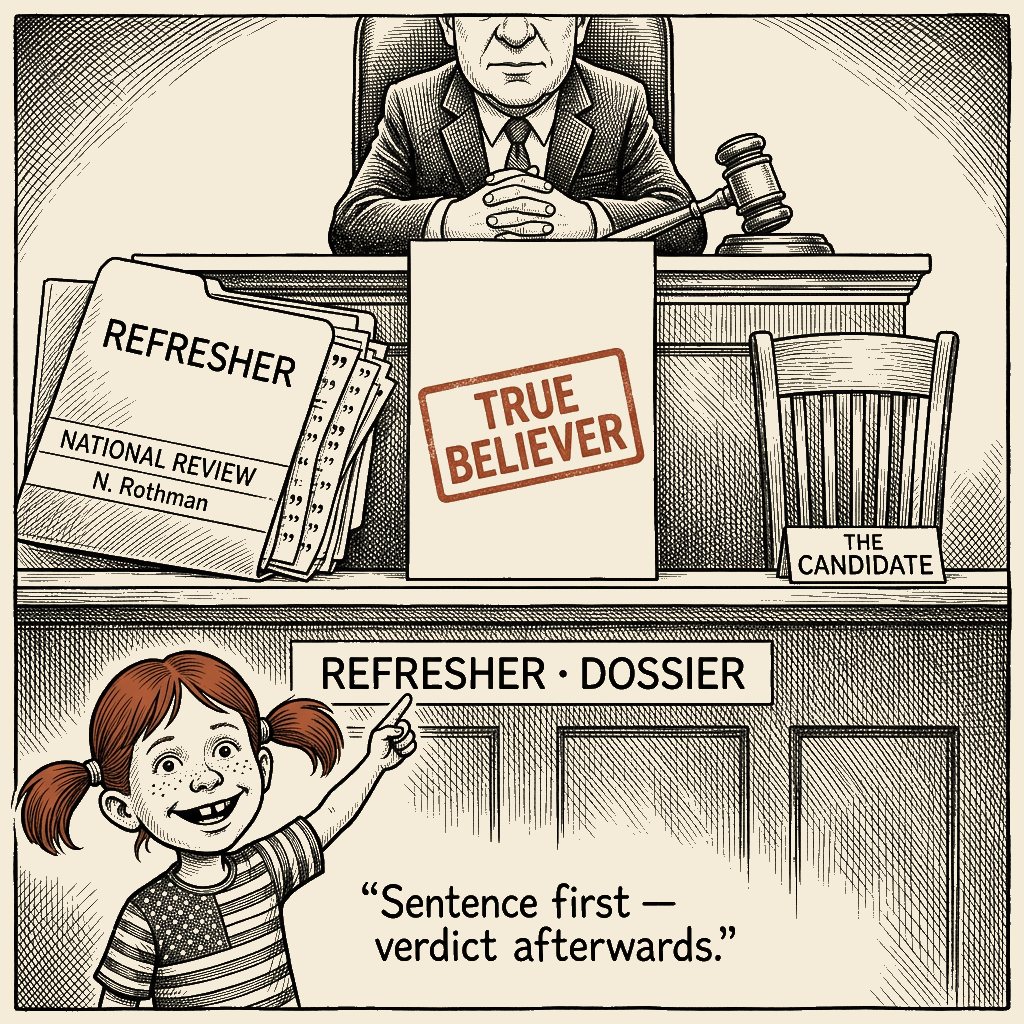
Responding to: Sen Slotkin threatened students like me. Senate needs an ethics probe · 2026-10-27
Why is the warning the thing on trial?
What the Piece Argues
The op-ed argues that Sen. Elissa Slotkin’s remarks at a University of Chicago event — where she said she wanted to send a “deterrence message” to young people considering government jobs — amount to an intimidation campaign against conservative students. It asks the Senate Ethics Committee to investigate her, dismisses her explanation that she was talking about prosecuting lawbreakers, and warns that legal retaliation would discourage patriotic young Americans from public service. The author, a student journalist who filed his own ethics complaint, presents the possibility of prosecuting illegal conduct as a threat to political dissent.
Receipts
The framing wants you to believe a senator threatened students; what’s really going on is that warning people they’ll be prosecuted for breaking the law has been re-labeled as the ethics violation.
- What it wants you to believe: Slotkin “intimidated one side of the aisle,” sent a “threat to Americans who dare dissent,” and deterred innocent students like the author from someday serving their country.
- What’s really going on: by the piece’s own account, Slotkin’s deterrence message was aimed at what happens when people join an administration and face legal exposure. No student is named as the target of any specific threat, investigation, or charge, and no instance of anyone being warned off public service by Slotkin appears anywhere in the article. The only thing described as threatened is “participation” in politics, which nobody has been charged with.
- The mechanism: an ethics complaint converts a senator saying lawbreakers should expect prosecution into “improper conduct which may reflect upon the Senate.” Once that conversion is accepted, the warning itself becomes the punishable act — which is exactly the outcome an official with legal exposure would want.
- The apparatus, named by the source itself: the Article III Project referred Slotkin to the DOJ’s Office of Civil Rights, a government watchdog filed an ethics complaint, and the author — a former Heritage Foundation Young Leaders Program member — filed his own on top of them. Three separate actions — two ethics complaints and a referral to the DOJ’s Office of Civil Rights — aimed at a senator for making a warning about legal consequences; the author sits in exactly the conservative pipeline he says the remark deters.
- The omitted fact, supplied by the article itself: the host’s line — “You could make them a pariah socially, politically, maybe even legally” — puts “legally” in a list that begins with social and political consequences of conduct. The piece reports Slotkin’s defense that she meant violators of the law should be prosecuted, then prints a context in which legality is the third step of a conduct ladder, not a threat against party affiliation.
- Who benefits: figures hoping no one publicly signals that serving to break the law carries consequences. If the warning is an ethics breach, the deterrent is removed before anything is investigated.
- The tell: the “let’s suppose the sides were reversed” paragraph concedes that a threat to punish political service would be wrong — which is a concession that this wasn’t one, or an admission that the author wants the rule only when it lands on Slotkin.
- Anchor: the source itself, including its quotation of the Senate Ethics Manual standard: https://www.foxnews.com/opinion/sen-slotkin-threatened-students-like-me-senate-needs-ethics-probe
The Response Ladder
Polite Reframe
When to use: you want to answer on the record, in a professional register, without handing the other side a clip.
Senator Slotkin said that people who break the law should be prosecuted for it, and that this legal reality should give pause to anyone considering a role where they might be tempted to break it. That is not a threat against students or against political participation — it is a statement about the rule of law, and the article calling for an ethics investigation reports enough of her remarks, and quotes enough of the surrounding exchange, to show it. No student is named as the target of any specific threat or investigation. No specific threat is described. The only thing allegedly chilled is the prospect of serving without legal consequences, and protecting that prospect is not what the Senate Ethics Committee exists to do.
Mockery and Ridicule
When to use: you want the argument laughed at, not dignified.
So to be clear: a senator said if you break the law you can be prosecuted, and a student journalist filed an ethics complaint because that made him feel unwelcome in government. Nobody was named as a target. Nobody was accused of anything. Nobody was investigated. A sentence was said near a microphone, and now we need the Senate Ethics Committee — the body that handles actual institutional misconduct — to convene because a Heritage Foundation Young Leaders alum got the vapors at a Vox event in Chicago, backed by the Article III Project and a government watchdog who also decided the warning was the crime. And by his own account the message landed on him and “millions of patriotic Americans across the country” — so either millions of patriots needed deterring from breaking the law, or he just told us who he thinks the deterrence was aimed at. The “deterrence message” he’s so upset about deters exactly one activity: breaking the law. If that message landed on you, the message isn’t the problem.
Nuclear Satire
When to use: when the only honest response is an absurdist version of the argument.
BREAKING: Senator says lawbreakers might face legal consequences. Nation in crisis. Ethics committees summoned. Watchdogs deployed. A brave student journalist files a complaint, because nothing says “protect public service” like opening a Senate investigation into a speech about the rule of law.
Day two: The committee convenes to investigate the real scandal — a politician suggesting that taking a government job with the intention of breaking the law is a bad idea. The Article III Project refers the senator to the Justice Department’s Office of Civil Rights, which opens an inquiry into whether saying “the law applies” constitutes a civil-rights violation. Witnesses testify that they felt “uncomfortable,” “deterred,” and worst of all, informed. Experts are flown in to explain that “deterrence” has never been a recognized goal of the criminal justice system.
Day three: The Senate votes to censure anyone who says “consequences” within its chambers. The measure passes unanimously. The next morning, a traffic cop is impeached for saying “license and registration.” America crumbles, but at least no young conservative ever again had to hear that the law applies to them.
Profane Scorched-Earth
When to use: you’re done being polite and you want every buried assumption dragged into daylight.
Read the damn article. It reports Slotkin’s own position — that those who violate the law should be prosecuted for doing so — and it quotes the host laying out the ladder: socially, politically, maybe even legally. That’s the whole “threat.” A senator said if you break the law, expect the law, and a student who has never been charged with, accused of, or named as the target of a single goddamn thing filed a formal ethics complaint because the sentence made him feel unwelcome — with the Article III Project and a government watchdog piling on behind him. Where’s the threatened student? Name one, you gutless wonder — one single student who was told they couldn’t serve, investigated for wanting to serve, or charged with anything. There isn’t one, because this was never about a student — it was about making sure nobody says out loud that the people staffing a future administration might be accountable for what they do there. And the tell is in your own copy: you quote the host listing socially, politically, maybe even legally and then insist she never specified lawbreakers — while the word “legally” sits right there in a ladder of consequences for conduct. You want the Senate Ethics Committee — the body for real institutional misconduct — to sit in session because a senator acknowledged that laws exist. That isn’t an ethics probe. That’s a goddamn protection racket wearing a lab coat, demanding that a warning about accountability be treated as the crime, so the accountability never has to arrive.

About Malcolm Little King
Malcolm Little King is a heteronym in Main Street Independent's editorial architecture — an analytical voice, not autobiography of any actual person. The position this column expresses is the publication's position on the territory Malcolm Little King's lane covers, rendered through Malcolm Little King's register.