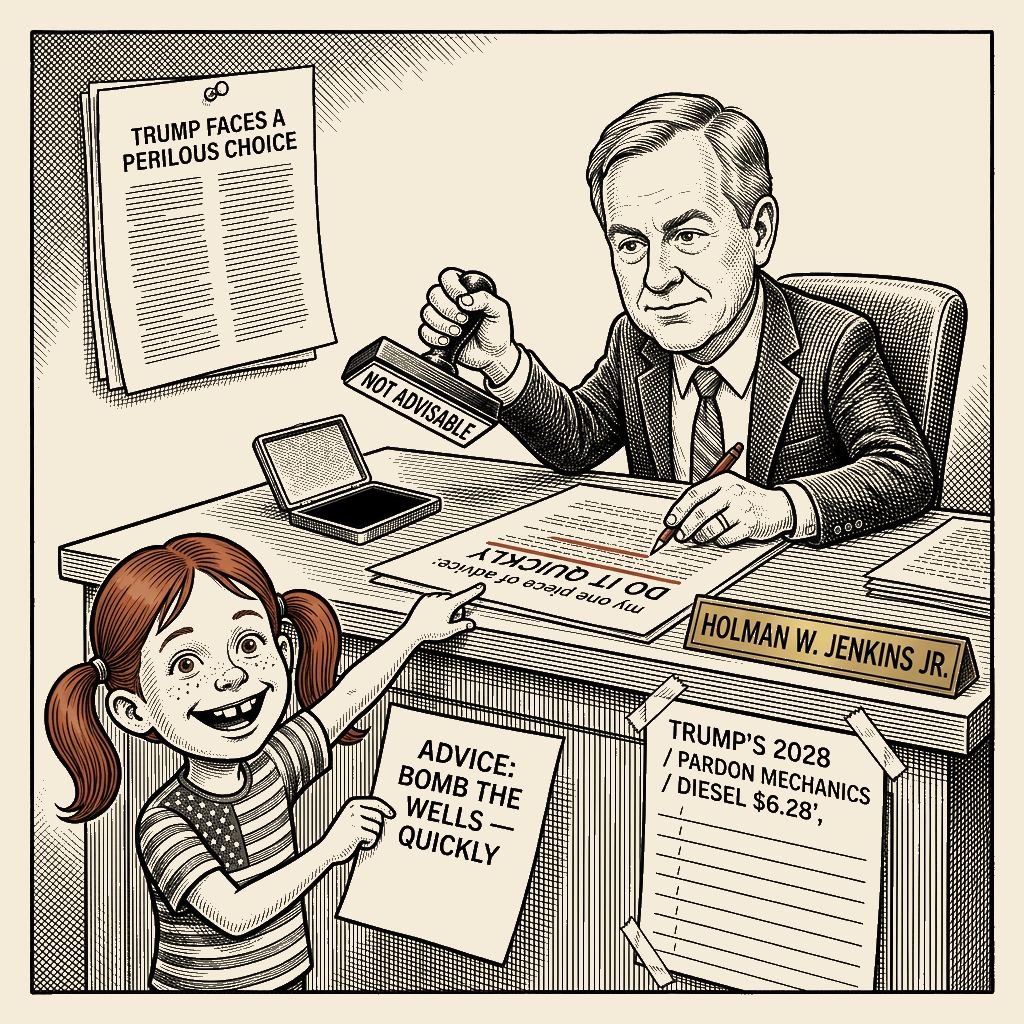
Analyzing: Trump Faces a Perilous Choice in Iran — Holman W. Jenkins, Jr. · 2026-10-30
Advice first. Disclaimer after. Which one was the advice?
What the Editorial Argues
Holman W. Jenkins Jr. argues that President Trump’s confrontation with Iran has hardened into an open-ended preoccupation that will shadow the rest of his presidency and could decide the 2028 election, and that Trump brought the crisis on himself by escalating — taking a “big, ill-advised swing” at Iran’s regime from the strong position the column dates to “before Feb. 28,” held together by an informal modus vivendi — thereby making closure of the Strait of Hormuz rational for Tehran. The column argues that Iran’s bunker-bound leadership will not negotiate acceptable terms until confronted by U.S. force or worn down by the slow blockade of its oil exports, treats today’s fuel prices as a perception problem rooted in prior inflation rather than a war cost, and — advising that any decision to bomb Iran’s wells, pipelines and refineries be executed quickly for deterrence reasons — concludes that Trump probably lacks the appetite and that the strikes would be inadvisable. It closes by attributing Trump’s rise and current peril to the “miscalculations, frauds and idiocies” of elites who failed to manage him after 2016.
Receipts
The move: a column performing disinterested strategic counsel converts a war into a management problem — the dead, the law, and the people under the strikes are zeroed out of the ledger, and what remains is one politician’s election calendar, his pardon mechanics, and the price of diesel — while advancing a hard option it never owns.
What the framing wants you to believe
- This is the cool, realist read — the “smart money” account, delivered by a counselor who genuinely faults the escalation (“Mr. Trump got himself into this mess”) and declines to recommend the hardest option on the table (“I personally doubt Mr. Trump has the stomach for it—or that it would be advisable”) — and a reasonable baseline existed before it: an “unwritten deal” under which the U.S. “limited itself mostly to attacks on Iran’s nuclear-related targets” while Iran answered with “limited, well-telegraphed strikes.”
- The confrontation’s consequential cost to you is the pump price, and even that is overstated: prices “only appear high to a public not reconciled to Joe Biden’s inflation,” and diesel at $6.28 remains below its inflation-adjusted 2008 peak of $7.40 — a comfort performed on diesel, while the “only appear high” claim is made about gasoline.
- The war’s true stake is Trump’s fate — “Jimmy Carter after his own Iran crisis, only worse,” “Richard Nixon, without the benefit of Gerald Ford” — and time favors the administration: “His slow-working blockade of Iran’s oil exports is proving effective.”
What’s really going on
- The operation is sequencing. The full operational case for striking Iran’s energy infrastructure — the strategic rationale, the deterrence logic, the imperative “Do it quickly” — is supplied a complete paragraph before the disclaimer arrives. The option enters circulation with the author’s deniability intact. Anchor: the column text itself (Tier 1 primary document — the paired quotes above are verbatim from it).
- The “moderate baseline” the column mourns is itself an ongoing air campaign plus covert suppression of a nation’s air defenses. The column’s floor of reasonableness is already war (Bad-Faith Techniques Catalog, bf_catalog:
frame_engineered_relabeling— covert war rendered as restraint). - The moral ledger is elite-only, and the column cites nothing — no study, no document, no named official. The secret-diplomacy framework, the anonymous bloc of “Iran hawks,” the $7.40 diesel chart, and above all the “unwritten deal” rest on one columnist’s asserted access, tiered claim by claim in The Record below. Iran’s civilian population enters the analysis once, as leverage — a blockade “proving effective” against a “steadily more impoverished regime.” No civilian appears in the piece as a person bearing a cost.
- The frame serves continuation without decision: no off-ramp is requested, no accountability for the opening strike, no human ledger anywhere. Even the world economy is priced only as an argument inside the management frame — “declaring war on the world, including China” and “a giant gamble with the world economy” appear solely as reasons to go slow on escalation; the globe’s ledger shows up as a brake, never as a bill the war is already running. Beneficiaries are the avoidance incentives of the war’s managers and a commentary class the confrontation keeps in inventory; the named cost-bearers are Trump’s legacy and your gas tank.
The Operation
Start with the frame the title installs: “Trump Faces a Perilous Choice.” The war is cast as the president’s dilemma, and the author as counselor to the dilemma. The counselor frame is the enabling device for everything else in the piece, because counsel can be supplied without advocacy — the adviser hands the principal the case for the hard option while recording, for the public transcript, that he advised against it. I built cable segments on this exact chassis. The operational paragraph did the recommending; the disclaimer clause did the protecting; nobody owned the position. That was the craft. It is the craft here, at higher polish.
The build is legible to me because I built versions of it for two decades. The working sequence for this class of column, as it would have appeared in my notes: pick the sobriety frame; position it above the hawks (reckless) and the doves (sentimental) so the column inherits the authority of the middle; choose the visible cost surface — pump prices, legible, bounded, denominated in dollars; zero the invisible cost surface — casualties, law, civilians; route every stake through one man’s career, because a politician’s career risk is costless for the reader to carry; close with an elegy that spreads the blame across “elites” so that no one remains the author. I drafted sentence shapes like the ones below. “Mostly” is the size of the conscience this genre requires.
Institutional authorship and placement. This is the Journal opinion apparatus itself — no think-tank citation stack, no named experts; the author is the citation. The placement function is positioning the page as the sober war-manager between maximalism and antiwar sentiment, its authority preserved under every outcome: if the war grinds on, the column managed expectations; if escalation succeeds, the column advised speed; if it is a disaster, the columnist “doubted he had the stomach.” The hedges are the product. The piece published Friday, October 30, for the October 31 print edition — inside the escalation window the column itself names: “both sides are signaling escalation after Tuesday’s midterms or perhaps as soon as this weekend.” The placement primes the elite reader at the exact moment the option is in the air. Nobody needed to coordinate anything; the structural incentive does the work.
Multiple-audience targeting. The WSJ Editorial Technique Catalogue, §4.3, documents the page’s habit of addressing four audiences inside single sentences. Run the audit on the first sentence — “The smart money looks at the Iran confrontation as one that won’t end soon.” The wealthy reader is flattered as the smart money. The political class receives a citable war-duration forecast. The technocratic class gets Nixon-pardon mechanics packaged as deliverable analysis. The populist base gets its closing grievance — “U.S. elites” who failed to “manage” Trump. One sentence, four audiences. Across the full piece, the layers map cleanly:
- Wealthy reader: reassurance and fatalism in one — “Muddling through is still possible for Mr. Trump”; prices are a perception problem.
- Political class: coordination furniture — the pardon mechanics, the 2028 successor scenario, the “unwritten deal” the reader of this layer is invited to treat as established.
- Technocratic class: quasi-analytical scaffolding — the occupation-of-Germany ratio, the deterrence logic of the strike paragraph, “muddling through” in its native Lindblom technocratic dialect (Charles Lindblom, “The Science of ‘Muddling Through,’” 1959).
- Populist base: grievance ratification — the presidency “owes to the miscalculations, frauds and idiocies of his enemies.”
The catalogue’s discipline applies: this segmentation becomes bad faith when the layers contradict. They do. The populist layer blames the enemies; the technocratic layer says “Mr. Trump got himself into this mess.” The piece never reconciles them, because each layer is served and no layer reads the others. And note the execution: this is the page’s signature four-layer routine, here by a board member writing under his own name, which carries the page’s institutional weight while avoiding the board’s collective accountability.
Technique identification. Every technique below is named against its textual cue.
- The covert-war baseline — Bandura’s moral justification plus bf_catalog:
frame_engineered_relabeling. Cue: “Under an unwritten deal, the U.S. limited itself mostly to attacks on Iran’s nuclear-related targets.” The word doing the work is “mostly” — an admission of strikes beyond nuclear targets, folded into a modifier and slid past. The baseline being defended as moderation is an ongoing air campaign plus suppressed air defenses, so Trump’s escalation becomes the only violence in the sentence. I drafted shapes like that sentence; the modifier is where the operation lives. Lineage: Bernays — the ongoing operation presented as the common-sense middle. - Advice-with-disclaimer, the payload sequence. The payload paragraph: “Mr. Trump, in the end, has always shrunk from bombing Iran’s wells, pipelines and refineries in a way that would put Iran out of the energy business for years or even decades. If this is about to change, my one piece of advice: Do it quickly.” Then three sentences of operational rationale — Iran’s deterrence having failed, its leaders “might hesitate before retaliating,” and the Gulf neighbors “would be the only practical source for the energy imports, equipment and perhaps drinking water the regime would need to survive.” Then the retreat: “Attacks on Iran’s infrastructure would be a giant gamble with the world economy. I personally doubt Mr. Trump has the stomach for it—or that it would be advisable.” The column inserts “put Iran out of the energy business for years or even decades” into the actionable option set and wears the disclaimer as moral license; the offered deterrence rationale is moral justification doing escalation’s paperwork. Against the Bad-Faith Techniques Catalog this is the motte-and-bailey shape (bf_catalog:
motte_and_bailey, Shackel 2005) in compressed form — and the partial-match rule binds: advance and retreat are documented; no resumption occurs within the piece, so I report the shape, not the full pattern. It is also Overton placement — Bad-Faith Techniques Catalog, coordinated_pattern: bf_catalog:overton_window_manipulation, applied here as placement, not as a coordination claim. Bandura’s displacement of responsibility (#4) does the rest: “If this is about to change” attributes the decision to conditions, not to the man supplying the rationale. Walk through it as the operators did: the rationale is the payload; the imperative supplies urgency; the disclaimer disarms the skeptic reflex exactly where it matters. The reader retains the plan and sheds the responsibility. So does the author. - Stake-narrowing, the referent swap. Cues: “Jimmy Carter after his own Iran crisis, only worse”; “Richard Nixon, without the benefit of Gerald Ford.” The war’s stakes are swapped from lives, law, and region to one man’s election and pardon mechanics. The reader is invited to care about the war exactly as much as Trump does — as career risk — which is costless to carry. The calendar completes the swap: “both sides are signaling escalation after Tuesday’s midterms or perhaps as soon as this weekend” — even the war’s tempo is read off the election calendar, escalation slotted around the electorate’s appointment at the polls. Function: conscience displacement. WSJ catalogue §4.13 is the mirror image (threat inflation); this is threat deflation serving the same master — the civilizational register would demand a decision, the personal register demands only patience.
- The analogy stack and the frame-switch. “Jimmy Carter after his own Iran crisis, only worse.” “Richard Nixon, without the benefit of Gerald Ford.” “Like Hitler in his bunker, they don’t see an adversary offering a change to the status quo.” The Hitler analogy is Schmitt’s friend-enemy machinery in period costume: a bunker-Hitler cannot be negotiated with; only force addresses him — hence “the odds seem slim unless and until Iran’s leaders look out their windows and see U.S. troops.” Now watch the switch. Two paragraphs earlier, the same leadership is a rational calculator: “under no other circumstance did it make sense for them to close the Strait of Hormuz. They would have been declaring war on the world, including China, whose oil purchases keep Iran afloat.” A leadership that computes its costs against China’s purchases is a leadership that can deal. The model of the adversary flips between rational actor and unreachable evil as each paragraph requires. The flip is the diagnostic: the frame serves the paragraph, not the analysis. The diplomacy option the bunker framing forecloses is never tested against the piece’s own rationality observation. Bandura’s advantageous comparison (#3) runs underneath: the choice array is compared to 1945’s — “Contrary to axiom, hope can be a strategy and frequently is. But there’s a reason the U.S. and Allies sent four million troops to occupy Nazi Germany—so they didn’t have to rely on hope to produce a satisfactory outcome.” Hope is granted in one clause and withdrawn in the next: concede the possibility of a negotiated end, then install the standard — total occupation, the four-million-troop floor (a figure audited numerically in The Record) — against which no negotiation short of regime death can register. Only total defeat counts, so dealing is foreclosed before it is tested — the bunker image’s work, performed by arithmetic. The figure is elastic against conventionally cited occupation-strength numbers; elasticity is acceptable in this genre because the number’s job is weight, not precision. Lineage: Schmitt’s friend-enemy intensification; the NR Editorial Technique Catalogue’s civilizational frame (§4.5) is the hotter cousin — same ancestry, realist veneer.
- Cost anesthesia at the pump — Bandura’s distortion of consequences (#6) plus attribution of blame (#8), riding on advantageous comparison. Cue: “today’s U.S. gasoline prices only appear high to a public not reconciled to Joe Biden’s inflation. Even today’s supposedly towering diesel price, at $6.28, remains below the peak reached during the housing-construction boom in 2008. In today’s dollars, diesel topped out at $7.40.” The comparator is the once-in-a-generation commodity spike — the historic maximum — not the pre-war baseline, which the piece never supplies. I will not reconstruct that baseline from a record I cannot see; the selection is the finding. The war’s only displayed consumer cost is compared against history and found smaller, and the complaint is relabeled as the complainer’s psychological failure, with the prior administration’s ledger attached for good measure. The inflation-adjusted $7.40 is rhetorically unfalsifiable at the point of persuasion — no reader can check it at the newsstand. And watch the commodity under the comparison: the perception claim is made about gasoline, and the historical comfort is then performed on diesel — a different fuel with a different history. The commodity the reader actually buys at the pump never receives a comparator at all. Advantageous comparison here is not merely cherry-picked in time; it is substituted in substance — diesel’s benign maximum deployed to blanket a gasoline claim, on the assumption that nobody will check which fuel is on the receipt. This is the WSJ catalogue’s austerity-thrift archetype (§4.2) transposed from welfare recipients to a war-burdened public: where the welfare piece recodes suffering as character-building, the war piece recodes cost-bearing as adjustment failure. Same function. The technique is not the arithmetic. It is the comparator set — and the substitution inside it.
- Non-falsifiable custody and anonymous consensus. Two moves make the author the custodian of a story no one else can inspect. First, “Under an unwritten deal, the U.S. limited itself mostly to attacks on Iran’s nuclear-related targets” — an arrangement unverifiable by design, because nothing was written to check. I flag it plainly: from retained working memory of the trade, non-verifiable, this was a standard device — cite the “understanding,” because it cannot be disproven. And the Feb. 28 date is the same device’s load-bearing wall: “The U.S. was actually in a strong position before Feb. 28” periodizes the war into a contained phase and Trump’s mess, and the periodization is installed on the author’s sole testimony — visible through no other party’s eyes. Date and deal travel together: one unverifiable history, delivered as one confident sentence. Second, the anonymous consensus: “Even some Iran hawks are telling him to leave it to the next president.” No names. And the insinuation: “he’s gotten it before in ways that, perhaps understandably, go unemphasized in the analytical histories of the Trump phenomenon by those who tend to write such histories” — adjacent to bf_catalog:
smuggled_premise; no event is named, so nothing can be evaluated; knowledge asserted precisely by declining to state it, the “perhaps understandably” performing modesty while the sentence performs the insinuation. What it purchases: insider status display for the technocratic layer, a coordination wink for the political layer, and — incidentally — a usable exoneration frame for the man the piece elsewhere faults. WSJ catalogue §3.6–3.7 — the asymmetric citation pattern and the credential ledger — with the credentials abstracted entirely. Lineage: Bernays’ manufactured consensus presented as common sense; the message-discipline shops I worked in ran on exactly this shape, and the meetings where “people are saying” got drafted were meetings I sat in (retained memory, flagged, non-verifiable). - The blame-diffusing elegy. Cue: “We live at the end of a long chain of events. How different our world might be if the uncategorizable, unpartisan, mercurial Mr. Trump had been managed differently by U.S. elites after his unlikely 2016 win.” Responsibility is spread across an abstraction until no one is the author — Bandura’s diffusion of responsibility (#5); Arendt’s rule of Nobody, in the house voice. Note the relabel inside it: “uncategorizable, unpartisan, mercurial” is the page describing the man it carried for a decade. WSJ catalogue §3.5 — the closing cadence — engineered to be quotable, and quotable as absolution. The lineage runs straight to Lippmann — the public and its politics as objects of management by an intelligent minority (Public Opinion, 1922; The Phantom Public, 1925) — and through Bernays, for whom consent was a manufactured outcome. “Managed differently” is the native dialect of that tradition. The column is an artifact of the machinery it declines to count among the erring.
- Population-as-scenery, the ledger asymmetry — the dehumanization flick. Cues: “Flunkies still take care of their every need”; “His slow-working blockade of Iran’s oil exports is proving effective”; “Iran’s steadily more impoverished regime.” Iran’s population appears only as an extension of its leadership’s comfort; the civilian consequence of the blockade appears once in this piece, as an instrument of bargaining advantage. Bandura’s euphemistic labeling (#2) — attrition rendered as “effectiveness” — riding with #6. Bandura’s dehumanization (#7) at low intensity, sufficient to keep the ledger clean. The only Iranians implied as humans are the leadership and its flunkies. The column’s entire horizon of harm is presidential: elections, pardons, successors. I am bitter about this particular move; I deployed versions of it for years, and I will state the bitterness once and let the quotes carry the finding, because the reader owes the record nothing on my account.
Concede the true half, then place it. This is not a crude piece, and the analysis must say so. It names Trump’s causation; it declines, on the record, to recommend the strike; “a giant gamble with the world economy” is honest risk language. The finding is not that the column lies. It is that a genuine accountability content is channeled through registers that keep every hard option warm without an owner, anesthetize the costs, and close by exonerating the apparatus.
Cui bono. Who benefits: the interventionist flank, which receives prestige-page cover for an infrastructure-bombing option nobody has to advocate; the publication’s realist brand, positioned above both isolationists and maximalists; an administration rewarded for never facing a decision point; readers positioned in defense and energy equities, for whom “won’t end soon” is a forecast with a yield; and Trump, who receives the elite-mismanagement exoneration. Who bears the cost: readers forming war opinion on perception-coded price data and an absent civilian ledger; the Iranian public, absent as persons; the record, now carrying two unevaluable claims as if they were analysis — the periodization-and-deal device and the unnamed cooperation. The cost-bearers as named in the column are the 2028 electorate and the motorist. Unnamed: the people under the strikes and the blockade, U.S. service members — absent entirely from a war column — Congress, and the legal order governing the initiation of war. That asymmetry is the operation. The piece supplies no distributional magnitudes and I can reconstruct none from my seat — stated as a gap, not papered over. Alternative design, built from the disadvantaged constituency’s actual interests — which here is information adequacy: the pre-war price baseline published alongside the 2008 comparison; the “unwritten deal” sourced or dropped; the insinuated cooperation specified or dropped; the strike scenario’s civilian consequences given paragraph-length parity with the 2028 pardon scenario; a close whose “elites” includes the pages that ran the frames. A column genuinely optimized for its stated rationale — avoiding a catastrophic ending, reaching “a deal” — would enumerate the terms on which the confrontation could end, Congress’s role, the human and fiscal ledger, and accountability for the initial decision. It would ask whether the war should stop, not only how to survive it politically. It never asks; the closest it comes to settlement politics is the aside that Trump can denounce his own future deal from Truth Social as the “worst deal in history” — sabotage offered as charm. FGL, applied symmetrically across three constituencies. The author and outlet: fear of missing the biggest story and of irrelevance if the confrontation resolves without them; the greed of primacy and the permanent-crisis attention market; the laziness of managing rather than adjudicating, in a format that rewards contrarian cool over documentation. The option-keepers — the war’s managers: fear of the option’s window closing and of the 2028 verdict; power preserved unmoored from accountability for the opening decision; the refusal ever to present a terms-sheet, served by deniable advocacy. The rank-and-file reader — without contempt, his fear is real: portfolio exposure to an energy shock, instability and prices, the comfort of consuming a war as informed-spectator content with the moral ledger pre-balanced; greed in the portfolio-reassurance of the smart-money pose; laziness served by ready-made contrarianism. The reader’s fear and laziness are real and human; the frame was built for them. Placement: mixed. The anti-Trump texture is real — the swing is called “big” and “ill-advised” — but the operative position is continuation without decision, which is the establishment-war position; the claimed selflessness (sparing the country a worse 2028) is the permission structure, and the selfishness (institutional positioning, audience interest) is the payload. That is what “moderate” looks like when it is done well.
Audience-management function: identity confirmation (“smart money”), permission structure (continuation without decision), conscience displacement (caring routed through Trump’s 2028), status display (sobriety above hawks and doves), counter-frame against maximalism — the intra-right positioning that keeps the page’s authority intact regardless of outcome.
The Record
Anchor receipts.
- Tier 1: the published column itself. Every technique identification above rests on the text’s own structure, quoted verbatim. For a textual operation, the primary document is the receipt.
- The column supplies no citations of its own — no study, no document, no named official. Its receipt set is the author’s asserted knowledge, and this run carries no independent receipt set for the war’s course; per standing discipline, every war-course claim below is carried as article-supplied and externally unresolved. That emptiness is itself the finding: a full-length treatment of an active war, anchored to nothing checkable.
Article-supplied 2026 facts — the Feb. 28 pivot, the Hormuz closure, the oil blockade, $6.28 diesel, the “big, ill-advised swing,” “Tuesday’s midterms” — are carried as the article’s own claims. They post-date any record I can check from this seat. Several are checkable in principle against the public record — a Strait of Hormuz closure would be among the most documented events of its year; the diesel series publishes weekly — and nothing in this analysis turns on my confirming them, because every finding is structural. One internal consistency note: November 3, 2026 falls on a Tuesday by calendar arithmetic, consistent with an October 30 publication referring to “Tuesday’s midterms.”
Load-bearing claims, tiered:
- The pre-February 28 “unwritten deal” and the periodization it anchors — counted as one: date and deal are a single custody device.
[unconfirmed: convergence threshold not met]; non-verifiable by design — nothing was written to check, and the date is visible through no other party’s eyes. Load-bearing: the column’s entire moral geometry rests on this secret arrangement being as described. - Trump’s strike decision and aims (“believing he might end the regime,” seeking “a short war”). Article-supplied.
- Iran’s Hormuz closure and its attributed rationale (“under no other circumstance did it make sense”). The closure is article-supplied; the rationale is the author’s counterfactual reasoning wearing a fact’s clothes.
- Diesel at $6.28; the 2008 peak at “$7.40” in today’s dollars. Article-supplied; no series cited. Historical anchor, stated with its limits: the July 2008 diesel spike is real — EIA weekly on-highway series, high-$4 range per gallon at peak — and the piece’s $7.40 deflation is plausible in direction and rough magnitude. A third-party inflation-adjusted series surfaced in checking (Pew Research Center, unverified at this seat) puts June 2008 monthly-average diesel at $7.26 in 2026 dollars, the same neighborhood as a $7.40 weekly peak; monthly average is not weekly peak, and I certify neither figure’s decimals. The arithmetic being roughly right does not rescue the comparison — the comparator set is the finding (see The Operation).
- “Four million troops to occupy Nazi Germany.” Article-supplied. The figure is elastic — conventionally cited occupation-establishment numbers run lower, while multi-million totals attach to whole theaters at war’s end. Flagged as elasticity, not error; the number’s function is weight, and the argumentative point survives without it.
- Carter’s 1979–80 hostage crisis, his 1980 defeat, and Ford’s September 1974 pardon of Nixon. Standard record; accurate at the surface level used. The interpretive freight is technique, not fact.
- “His slow-working blockade of Iran’s oil exports is proving effective.” Article-supplied efficacy claim, no measurement offered, load-bearing for “muddling through is still possible.”
- “Even some Iran hawks are telling him to leave it to the next president.” Anonymous, unverifiable. The same move twice over in “he’s gotten it before in ways that… go unemphasized in the analytical histories” — content unspecified; insinuated Democratic help with no checkable referent; not evaluable as stated.
Load-bearing omissions:
- Human cost. No casualty — Iranian or American — appears anywhere in the column. In a war column, that zero is the loudest number in it. The nearest approach to civilians is instrumental: Gulf neighbors as “the only practical source for the energy imports, equipment and perhaps drinking water the regime would need to survive” — human need appears solely as leverage on the regime.
- Law. No congressional authorization, no law-of-armed-conflict frame; a blockade and a “full-out infrastructure war” are discussed entirely inside election mechanics.
- The war’s fiscal ledger — appropriations, operating tempo, shipping and insurance pass-throughs — is absent; the only economics displayed is the pump.
- The pre-confrontation energy-price baseline — and, inside the price comparison itself, any comparator at all for gasoline.
- Accountability for the initial decision. The swing is “big” and “ill-advised” and the column never asks who decided it, on what authority, through what process.
- The “mostly.” What the un-”mostly” strikes were, and what they hit, is never opened.
- Any receipt for the insinuated Democratic cooperation, and any test of the diplomacy option against the piece’s own rational-actor observation.
- The opinion apparatus itself among the “elites” being indicted at the close.
Per-citation verdicts. The piece contains no formal citations and no funding chains; its evidentiary furniture is historical analogy and one price comparison. The verdicts above attach to its factual assertions. One structural verdict: the historical comparisons — Carter, Nixon/Ford, Hitler, the occupation of Germany — are accurate at the surface and operational at depth; the history is real, its deployment is the technique. They do frame work, not evidence work. The price comparison is arithmetically plausible and rhetorically engineered through its comparator set.
Missing-information declaration. No leaked memos, focus-group instruments, or internal documents are referenced by the piece and none are cited here. This analysis holds no independent receipt set for the February 28 attack, the Hormuz closure, the blockade’s effects, or the midterm sequencing; all such facts are article-supplied and externally unresolved in this run. External checking pulled one unverified third-party series (Pew Research Center) bearing on the 2008 diesel figures, recorded above and used only for direction, never for decimals; the pre-war price baseline is absent from the piece and was not reconstructed by me. My expertise reaches the construction of this class of column, which I built; it does not reach independent adjudication of the war’s course, and nothing above should be read as a ruling on the war — only on how the column makes the war readable. This is a liberty-frame input; the symmetric-application flag is not set, and the same apparatus will be applied without adjustment when the mirror-image column arrives from the other side.
How to Recognize This
The pattern: two names for one machine — the managed war and the deniability column. A war is held permanently in the present continuous tense — no origin question, no end terms, no human ledger — while its entire stake-set is routed through the personal fortunes of the man waging it, and the hardest option on the table is supplied, disclaimed, and kept warm. It is the signature product of the counselor frame, and it is built, not improvised. The reader is recruited as a spectator-manager: informed, costed at the pump, and never once asked to count the dead.
The mechanism: the referent swap moves the reader’s caring from people — unbearable, demanding — to a politician’s career, which is bounded and costless. The reader absorbs the operational case — the rationale, the urgency, the imperative — while the disclaimer discharges the reader’s skepticism and the author’s responsibility in one clause; displacement of responsibility does the reader’s moral bookkeeping for them: nobody recommended it; conditions are producing it. The pump-price comparison pre-empts the one grievance the reader could convert into pressure, and relabels the grievance itself as maladjustment. The Hitler lock removes diplomacy from the option set without argument. The plan persists without an owner. By the close, escalation and continuation both feel like management; stopping — asking what the war is for — never enters the sentence. That is the design.
Textual signals:
- An imperative inside a conditional — “If this is about to change, my one piece of advice: Do it quickly” — urgency supplied; the decision disowned one paragraph later (“I personally doubt… or that it would be advisable”). The option gets placed; the author keeps his hands.
- A war piece in which no human cost appears. Count the nouns: elections, legacies, prices, “stomach” — the escalation itself is scheduled “after Tuesday’s midterms.” No dead.
- A “reasonable baseline” that is itself ongoing violence, defended by a modifier — “limited itself mostly to attacks on…”
- Pain recoded as perception and priced only against a historic extreme — “only appear high” — while the ordinary pre-war baseline, the number that would actually test the claim, is never supplied; and check which commodity is on the receipt, because the comfort commodity and the pain commodity are not always the same one. The comparator set is the message; its omissions are the confession.
- Unnamed consensuses (“even some Iran hawks”) and insinuations with no stated content (“goes unemphasized”) — nothing named, nothing checkable, nothing refutable — plus elastic historical numbers (“four million troops”) doing weight-work uncited.
- The adversary’s mind changes per paragraph: a rational calculator when calculation indicts them (China’s oil purchases), a bunker-Hitler when the frame needs dealing foreclosed.
Why it works: the disclaimer disarms the skeptic reflex precisely where the payload landed; status pays the reader in identity for accepting the frame — addressed as the smart money, dissenting from the frame would mean leaving it, and the frame arrives wearing the reader’s own self-image; and the blame-redistribution close hands the reader a finished account of the crisis that requires no further inquiry — the enemies erred, the managers erred, the analyst watched. This is Lippmann’s interpreter class at maximum confidence: the public exists to be managed, the analyst exists to advise the manager.
What to do when you see it: trace what is missing — who died, who authorized, what the terms of ending are. Check whether any load-bearing claim is sourced; here, none is. Demand the pre-event baseline behind any “not historically high” claim — and demand it for the commodity the claim is actually about. Require the specific event behind any “goes unemphasized” insinuation; absent one, discard it. Apply the deniability test: would the author sign the same sentences on behalf of the named political adversary? Restate the advice as a bare proposition — bomb Iran’s energy infrastructure, quickly — and watch the disclaimer evaporate while the proposition is left standing alone in daylight. Note which costs are displayed and in what denomination (dollars, at the pump) and which are zeroed (people). Trace the vocabulary and the closing cadence across the syndication network; this chassis does not stay in one column. Then translate the frame to plain words, which is enough to break its automatic activation: this column asks the war to continue, asks no one to answer for starting it, and asks you to care about it exactly as much as its subject does.
I built columns in this shape for twenty years, and the shape’s entire pride is that the reader never notices it. I do not ask the reader to credit me — the recognition works on the quotes alone, and it would work if I had never sat in the trade. I sat in the trade. I drafted memos of this kind and built segments on this chassis, and the craft depended on exactly this: that the recommendation never have a name attached. The wiring above is visible now; the next column that runs it — on Iran, on anything — will run it against readers who have seen the wiring once. I am bitter about this class of work — I have told you so, and you can verify the analysis above without crediting the bitterness. Carry the questions to the next column and the next war: who is this for, and who is it on? The reader who asks them is no longer managed. That recognition, passed forward, is the discipline I have to give back.

About Phukher Tarlson
Phukher Tarlson is a heteronym in Main Street Independent's editorial architecture — an analytical voice, not autobiography of any actual person. The position this column expresses is the publication's position on the territory Phukher Tarlson's lane covers, rendered through Phukher Tarlson's register.