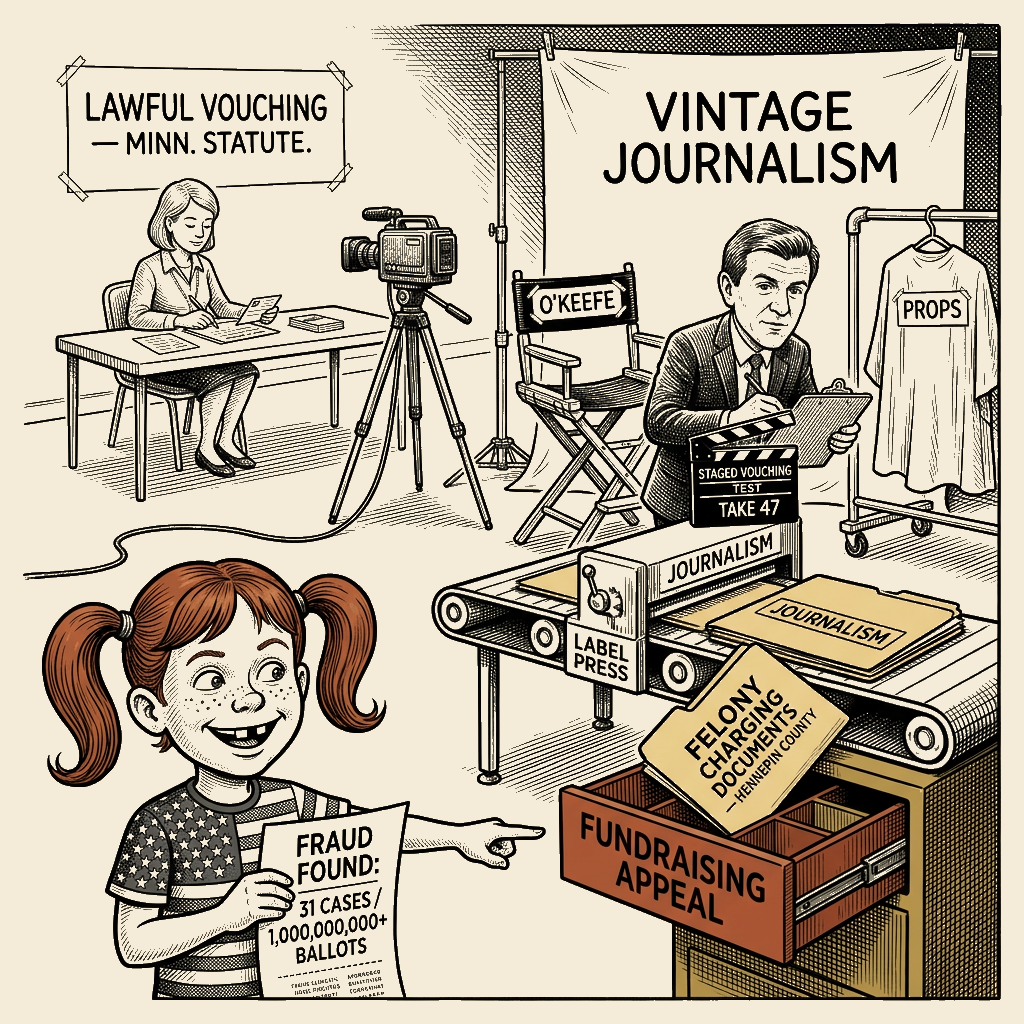
Responding to: MIKE DAVIS: Democrats' lawfare targets journalists in Minnesota — Mike Davis · 2026-10-30
If it’s journalism, why do they charge admission?
What the Piece Argues
Mike Davis, founder of the Article III Project, argues in Fox News’ opinion vertical that Hennepin County Attorney Mary Moriarty committed lawfare by bringing felony charges against conservative activists Cam Higby and James O’Keefe for an undercover “test” of Minnesota’s Election Day vouching procedure — Higby wore a burqa, posed as a registered voter, vouched for a companion who showed no ID, and neither man cast a ballot. The piece’s central sentence is: “In other words, Moriarty illegally charged two reporters for doing their jobs.” It calls on the Trump Justice Department to open a federal civil-rights criminal case against Moriarty under 18 U.S.C. §§ 241 and 242 — “if the evidence is there, which it seems obvious” — cites Tina Peters’ commutation in Colorado as precedent, and points to her misdemeanor handling of an alleged assault on a Turning Point USA activist as proof of selective prosecution. For its intended reader it presses two claims with real force — that prosecutorial discretion can be uneven, and that undercover reporting has historically exposed genuine wrongdoing — while arguing that the state’s elections are insecure and that a tightening Senate race between Michele Tafoya and Peggy Flanagan is at stake.
Receipts
The piece performs one substitution and builds everything on top of it: it relabels an election-law stunt as “journalism,” so that any legal consequence for the stunt reads as persecution of the press.
The framing wants you to believe
- That filming a staged vouching maneuver is “vintage investigative journalism” in the lineage of the Fourth Estate, and that the First Amendment exists to protect precisely this.
- That “neither cast a ballot” settles it — no ballot, no crime — so the felonies are “illegal” and “bogus” by definition and the prosecutor is the criminal.
- That the honest remedy is for the Justice Department to prosecute the prosecutor under §§ 241 and 242, because the people who spent years denouncing “lawfare” are now its most earnest practitioners.
What’s really going on
- The “flaw” being “exposed” is Minnesota’s statutory same-day vouching rule — a deliberate policy choice — and the documented fraud it produces is vanishingly small: a systematic review of a decade of American elections found 31 credible allegations of impersonation fraud among more than a billion ballots cast (Levitt, Washington Post, Oct. 2014), and Minnesota’s own court-supervised hand recount of 2.9 million ballots in the 2008 Senate race affirmed the result with no fraud finding against the count.
- The performers carry a documented record of exactly this: O’Keefe pled guilty in federal court in 2010 to entering Senator Mary Landrieu’s office under false pretenses, and the ACORN tapes that built his brand were found by multiple state investigations to be deceptively edited. False attestations to election officials are offenses whether or not a ballot results — the lie is the crime scene.
- The beneficiaries are named and concentrated: O’Keefe Media Group, whose product is the indictment-as-content; the Article III Project, which wants a precedent making local prosecutors federally indictable whenever their discretion lands on movement figures; and a fraud narrative doing work ahead of the tight Senate race the piece invokes. The cost-bearers are election judges, a county attorney’s office, and the “no one is above the law” standard — wielded here like a pickaxe, pointed at everyone but the author’s clients.
The Response Ladder
Polite Reframe
When to use: for persuadable moderates and good-faith family who have seen the clip and want the honest version — the dinner-table register, not the rally.
Consider the election judge working that Hennepin County precinct — call her Miss Ruthie, twenty-two years behind the table, a retired school aide who takes the state’s training refresher every cycle. When the man in the burqa arrived with a companion and asked to register, she followed the rule the Minnesota legislature wrote: a same-day registrant may prove residence by the oath of a registered voter of the same precinct. That is not a loophole she invented. It is a policy choice, written in statute, that Minnesotans are free to debate and amend. The video everyone is sharing documents a public employee lawfully doing her job.
That is the entire “exposé.” And the documented record around that policy choice is not hiding: a systematic review of a decade of American elections found 31 credible allegations of in-person impersonation fraud among more than a billion ballots cast (Levitt, Washington Post, 2014). When Minnesota hand-counted 2.9 million ballots in the 2008 Senate recount — the most scrutinized audit in modern memory — the courts affirmed the result and found no fraud. If Minnesotans want photo ID attached to same-day registration, that argument can be made honestly in St. Paul. It does not require actors, costumes, or a camera crew manufacturing false attestations on tape.
On “vintage investigative journalism”: the tradition has real costs and real limits, and the courts have drawn them. When ABC’s undercover reporters deceived their way into Food Lion’s kitchens, the Fourth Circuit held in 1999 that the First Amendment protects publication — not the lie you feed the personnel office. Deception in newsgathering carries liability like anyone else’s deception. No court has ever held that a false statement to an election official becomes privileged because the false statement is filmable.
And here is the quiet part, worth saying politely: the people who spent years explaining that every prosecution of their own was “lawfare” now demand the Justice Department prosecute a county attorney over her charging decisions. They told us no one is above the law. We agreed. A standard has to survive contact with the people we like, or it was never a standard — it was a costume.
We are the people who work elections: we staff the polls, we audit the machines, we hand-count when the margin demands it. If ballot security is what you care about, sign up as an election judge, read your county’s post-election audit procedures, and take the ID argument to your legislator. That path strengthens elections. The other path — actors, costumes, indictments, fundraisers — strengthens only the fundraising.
Mockery and Ridicule
When to use: for the bystander who needs to watch the grift operate in real time — the true believer is not the audience here.
James O’Keefe’s latest production: a man puts on a burqa, walks into a Minnesota polling place, recites a sentence any registered voter could lawfully recite, and — hold for the drumroll — “discovers” a procedure the Secretary of State’s website has been explaining to high-school civics classes since before he owned the costume. This is the journalism of breaking the news that water is wet and then selling the audience flood insurance.
But sure: “vintage investigative journalism.” Vintage, at least, is doing honest work in that sentence — the vintage in question is 2010, when the same James O’Keefe pleaded guilty to a misdemeanor for the false-pretenses entry attempt on Senator Mary Landrieu’s office. A man with a conviction for sneaking into a federal office is lecturing a county attorney about the sanctity of the law.
And take the detour to the Savannah Hernandez case head-on, because it’s the strongest card in the deck: yes, federal prosecutors upgraded those charges — after an alleged assault captured on camera. Here the cameras rolled too, and they filmed two men obeying the published rules of a procedure they then sold as a hole. That’s the difference the piece waves past — and the detour itself is the deflective pattern The Economist helped popularize as whataboutism in 2008: point at another grievance, never answer the question.
Here’s who you are in this picture, friend: not the audience — the inventory. The martyrdom video is the product. Your anger is the raw material. The fundraising appeal is the fulfillment step, and it goes out before the charging documents are dry. When the piece demands the Justice Department charge a prosecutor “if the evidence is there, which it seems obvious,” it is showing you its editorial process: verdict first, evidence later. These men are not journalists. Journalists find out what powerful people are hiding. These men manufacture what ordinary people are told to be angry about — performance art with a charge card and a persecution product line.
Nuclear Satire
When to use: when the frame itself needs to be burned down in front of the whole room, on the record.
Consider the fire-inspection school of journalism: the inspector pours the accelerant, strikes the match, films the alarm failing to stop the fire he personally set, and submits the footage for a Pulitzer along with a bulk order of the extinguishers he’d like you to fund. That is the Higby-O’Keefe “test” of Minnesota election security — voter-fraud cosplay wearing the First Amendment as a costume, complete with a burqa chosen less for concealment than for production design, engineered to make the reader’s skin crawl at the sight of a stranger near a ballot.
The relabeling is the whole trick — call a sting “journalism” and the prosecutor becomes a censor, the term substitution Frank Luntz’s memos turned into an industry. What the Court actually held, in Branzburg v. Hayes (1972), is that there is no journalist’s exemption from generally applicable law; what Levitt’s survey actually found is roughly thirty-one credible impersonation cases in more than a billion ballots; what Minnesota actually publishes is the vouching statute, criminal penalties included, which the burqa stunt then filmed like a safari through a petting zoo.
And the martyr canon: Tina Peters, whom the piece offers as precedent, was convicted by a Colorado jury on multiple felony counts for facilitating the copying of protected voting-system images that promptly surfaced online. A governor’s commutation is mercy. It is not an acquittal, and it does not rebrand a verdict as martyrdom — though it is very useful for fundraising, which is the point.
Meanwhile the piece’s own signature line — “if the evidence is there, which it seems obvious” — is the school of jurisprudence where the verdict is filed before discovery begins, a ransom note stapled to the First Amendment. The statutes it waves, 18 U.S.C. §§ 241 and 242, were written in Reconstruction to prosecute the Klan for terrorizing Black voters; now they are demanded as a weapon against a county attorney for enforcing election law. This is the big-lie pattern Hannah Arendt described: a demonstrable falsehood, repeated at magnitude until it structures a Senate campaign. The Article III Project is a donor-fueled indictment factory that has never met a prosecutor it wouldn’t prosecute, and O’Keefe’s operation is an ambulance-chasing firm that stages the accidents.
Profane Scorched-Earth
When to use: for the reader who has earned the right to hear it said without the costume.
Fuck the euphemism. The entire product here is the euphemism, so let’s do this one straight.
James O’Keefe is not a fucking journalist. He is a man who pleaded guilty in 2010 to a misdemeanor for the false-pretenses entry attempt on Senator Mary Landrieu’s office — a conviction for sneaking into a federal office — and he has spent sixteen years since selling stings as scripture to an audience he treats as a goddamn ATM. The burqa wasn’t concealment; it was production design, a costume selected to make you flinch at the sight of a stranger near a ballot, because flinching at the stranger is the entire fucking business model.
The threat his “test” dramatizes does not exist. Thirty-one credible cases of in-person impersonation fraud in more than a billion ballots, you shameless grifters — that’s the scholarly record, Levitt’s survey, the most careful count anyone has ever done. And the Supreme Court said the word you need to hear in Branzburg v. Hayes (1972): no journalist’s exemption from generally applicable law. Not one fucking syllable of it. Real reporters file stories. You file fundraisers.
And Mike Davis — a man who built an entire organization around demanding that judges and prosecutors answer to his movement — writes “if the evidence is there, which it seems obvious” about charging a county attorney. Obvious? You wrote the verdict before the indictment, you authoritarian little lawfare merchants; that sentence is the whole confession, and it’s sitting in your own goddamn column. You wave 18 U.S.C. §§ 241 and 242 — statutes written in Reconstruction to prosecute the Klan for terrorizing Black voters — as a weapon against a prosecutor enforcing election law, and you have the unmitigated gall to say the word “lawfare” with your own mouth.
Scripture, since you wear it the way you wore the burqa: Matthew 25 — “I was a stranger and you did not invite me in.” Your whole apparatus runs on not inviting the stranger in. And Amos didn’t say let the grift roll down like a fundraising email at two in the morning; he said let justice roll down like waters. You wrote “no one is above the law,” and you meant everyone except the men with the conviction, the con, and the charge card.
To the uncle who keeps forwarding this shit: you are not my enemy. You’ve been sold a martyr and a monster, and both were manufactured in the same shop, by the same men, for the same invoice. We keep the receipts — every plea, every verdict, every billion-ballot number, every statute, every goddamn quote you wrote yourself. We will name what this is, in public, by every analytical and political means we have, until it can’t hide behind the word “journalism” ever fucking again.
About Malcolm Little King
Malcolm Little King is a heteronym in Main Street Independent's editorial architecture — an analytical voice, not autobiography of any actual person. The position this column expresses is the publication's position on the territory Malcolm Little King's lane covers, rendered through Malcolm Little King's register.